

What Makes an SEO Support Article Worth Publishing Instead of Just Updating the Landing Page?
For a Summerlin business with a limited monthly SEO budget, the question is rarely “Should we create more content?” The better question is: Will the next hour of content work improve the page that drives leads, or answer a search question the site does not currently cover?
Sometimes the highest-value task is a service page SEO refresh. Other times, the right move is a focused supporting FAQ article that addresses a specific concern, links naturally to the core service page, and expands your topical coverage without trying to replace the page that converts.
Publishing more URLs is not automatically better for SEO. A new page needs a distinct purpose, useful information, and a clear relationship to the rest of the site. This guide gives Summerlin, Las Vegas, and Clark County business owners a practical way to choose between updating a service page or creating FAQ SEO content as part of ongoing SEO content maintenance.
The Short Answer: Refresh the Page or Publish a Supporting FAQ?
Refresh the service page when it already has meaningful visibility, has an important conversion role, and is not fully answering the main service search intent. Publish a supporting FAQ when people are searching for narrower questions that deserve more than a short paragraph on the main page.
For example, imagine a Summerlin home service company has a plumbing repair page that receives impressions for searches related to emergency repair, repair costs, same-day availability, and whether a particular problem requires replacement. If the core page is visible but not earning enough clicks or inquiries, it may need stronger headings, clearer service details, more useful local information, better calls to action, and answers to the most important questions. That is a service page SEO refresh.
However, if Search Console shows queries such as “what causes recurring drain clogs,” “can a sewer line be repaired without replacement,” or “what to do before an emergency plumber arrives,” a separate support article may be justified. Those searches have a more educational intent. Trying to force every answer into the primary repair page can make the page unfocused and less effective at converting a person who is ready to call.
The practical rule is simple:
- Improve the landing page when the opportunity is tied directly to the service you sell and the page is underperforming for its core purpose.
- Create a support article when the opportunity is a distinct question, comparison, concern, or decision stage that the service page cannot cover well without becoming overly broad.
- Do both over time when the service page has conversion value and the business has a real set of unanswered search questions worth covering.
That last option is often the most sustainable. The service page remains the commercial destination. The supporting FAQ content helps searchers earlier in their decision process, builds relevance around the subject, and gives the site a natural internal linking path toward the core service.
Before choosing either route, review page-level performance in Google Search Console and compare it with actual inquiry, call, form, or appointment data where available. Google’s Search Console Performance report documentation explains how to review clicks, impressions, queries, and pages. Those signals do not replace business judgment, but they are more useful than selecting topics based only on a hunch or a keyword list.
What Each Option Is Designed to Accomplish in Search
A service page and a support article can cover the same subject area, but they should not do the same job. Understanding that difference reduces wasted writing, keyword cannibalization risk, and confusion for potential customers.
The purpose of a service page
A service page should help someone decide whether to contact your business for a specific service. Its main job is commercial and conversion-focused. It should explain what you do, who you serve, what a customer can expect, relevant service boundaries, and the appropriate next step.
For a local business in Summerlin, the core page may include:
- A clear description of the service.
- The service area when it is relevant and accurate.
- Major problems or use cases the service addresses.
- What is included or how the process works.
- Relevant trust information that can be verified.
- A direct path to request an estimate, schedule, call, or ask a question.
In SEO terms, the page usually targets the primary service intent: searches from people looking to hire, compare providers, or take a direct action. A page about “Summerlin commercial landscaping,” for instance, should make it easy to understand the company’s commercial landscaping offering. It should not turn into a 3,000-word encyclopedia on every type of drought-tolerant plant or irrigation question.
The purpose of supporting FAQ content
A supporting FAQ article has a narrower, informational purpose. It gives a useful answer to a real question that may arise before a customer is ready to choose a provider. Done well, it can attract qualified visitors, clarify concerns, and guide readers toward the appropriate service page.
Good supporting FAQ content often addresses:
- How a service works.
- What affects scope, timing, or cost without inventing price estimates.
- How customers can identify common issues.
- The difference between two services or approaches.
- What to prepare before contacting a provider.
- When a problem may require professional help.
For Red Zone SEO clients, an example could be a support article answering, “Should a Summerlin business update an old service page or publish a new FAQ?” That article can support a primary SEO service page because it addresses the decision process without competing for the exact role of the service page.
Google’s guidance on helpful, reliable, people-first content is a useful standard here: content should exist because it helps a real audience, not simply because a business wants one more indexed page. If a question can be answered clearly in two sentences on the existing service page, it usually does not need its own article.
Intent, scope, and conversion importance
Use these three questions to separate the two assets:
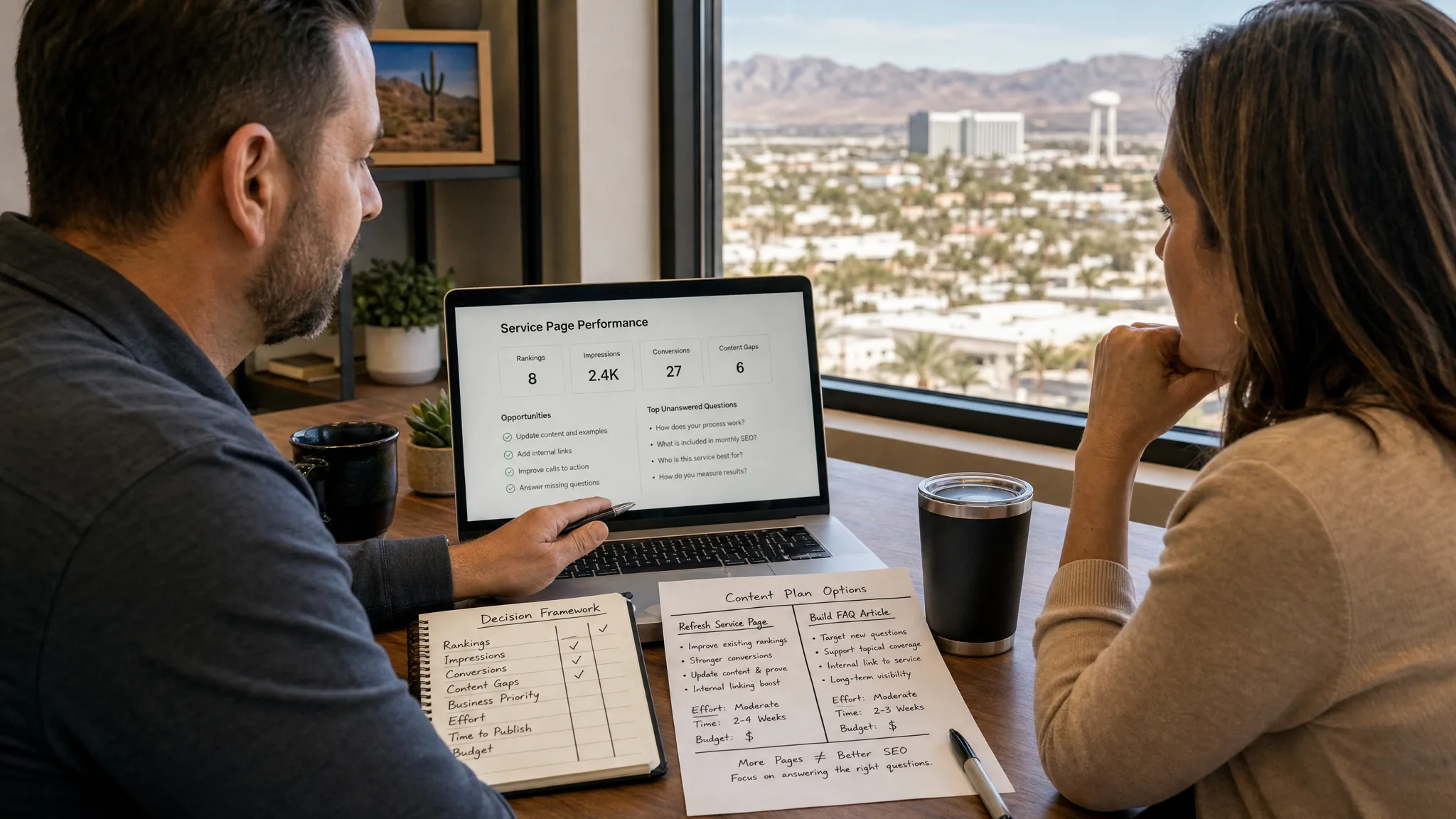
- What does the searcher want to do? A person searching for a provider needs a service page. A person researching a specific concern may need a support article.
- Can the question be answered briefly without distracting from the page’s main job? If yes, put it on-page. If no, consider a separate article.
- Where should the visitor go after reading? If the answer should naturally lead to a service request, the support article should link to the relevant landing page with descriptive anchor text.
Choose a Service Page Refresh When the Core Page Has Untapped Potential
A service page refresh is often the better investment because it improves an asset already close to the bottom of the funnel. This is especially true for a Summerlin business that has one important service page attracting impressions but not producing enough clicks, engagement, or leads.
Signals that a refresh should come first
Prioritize updating the core page when one or more of these conditions apply:
- The page already receives impressions for relevant service searches. Search visibility suggests Google has some understanding of the page’s relevance, even if the page is not yet performing as well as it could.
- The page ranks within reach of more useful visibility. A page that appears around the first several pages of results for the right terms may deserve refinement before you invest in a completely new topic.
- The page has a weak or outdated explanation of the service. Thin copy, generic headings, missing process details, and unclear service areas make it harder for users and search engines to understand the page.
- The page earns traffic but has limited conversion support. The visitor may not see a clear next step, an explanation of what happens after they reach out, or enough information to make a decision.
- The same questions keep coming up in sales calls. If customers repeatedly ask a question that is essential to hiring you, it probably belongs on the service page.
- The page has changed operationally. New service details, changed service areas, revised processes, or obsolete copy should be corrected before adding more content elsewhere.
A refresh does not mean adding words simply to make the page longer. Longer pages are not automatically better. The goal is to remove uncertainty and improve usefulness. Review the page purpose, title tag, main heading, section headings, internal links, location references, call-to-action placement, and whether the content answers the questions a ready-to-act customer has.
Questions that normally belong on the service page
On-page FAQs are useful when they directly help someone decide whether the service fits their need. Examples include:
- “What is included in this service?”
- “Do you serve Summerlin and nearby Clark County communities?”
- “What type of business or property is this service designed for?”
- “What information should I have ready before requesting service?”
- “When is this service the right option versus another service you offer?”
For an SEO agency, a core page about monthly SEO work might include concise answers about what ongoing work can involve, why priorities change from month to month, and how reporting informs future tasks. These questions reinforce the service decision. They do not require a separate article unless the answer becomes a substantial comparison or educational guide.
How to refresh a page without losing its focus
Start with the existing page rather than discarding it. Check what it ranks for, what queries create impressions, and whether those queries match the service you actually want to sell. Then make deliberate changes:
- Clarify the primary intent. State the service plainly near the top of the page.
- Fill important information gaps. Add useful details that a prospective customer needs to understand fit and next steps.
- Improve page organization. Use clear headings that separate service details, process, audience fit, and questions.
- Address meaningful local relevance. Mention Summerlin, Las Vegas, or Clark County only where the location genuinely helps explain service coverage, market conditions, or customer needs.
- Strengthen conversion paths. Give visitors a logical way to call, request a consultation, or move to a related service page.
- Add selective internal links. Link to useful supporting content, not every article that happens to mention the same keyword.
Google’s SEO Starter Guide supports clear content organization, helpful headings, and logical linking. These are basic practices, but they matter when a landing page has to serve both searchers and potential customers.
Choose a Supporting FAQ When Searchers Need More Specific Answers
A separate FAQ article is justified when the question has a clearly different intent from the core service page and requires a complete answer. It should not be a thin page created for every minor keyword variation. Instead, it should solve one meaningful problem or compare choices a real customer is likely to consider.
Signals that a new supporting article is worth publishing
Consider a focused FAQ article when:
- Search Console shows recurring question-based queries that the service page does not answer well.
- The topic needs context, examples, warnings, or a step-by-step explanation.
- The answer is useful before a visitor is ready to hire a provider.
- The topic naturally leads back to a specific service page or next-step action.
- A customer question comes up repeatedly in calls, emails, or consultations.
- The business can provide a useful answer without repeating the entire service page.
For example, a local accounting firm’s tax preparation page might briefly answer, “What documents should I bring?” But a standalone article titled “What Summerlin Small Businesses Should Gather Before a Tax Preparation Appointment” may be worthwhile if the topic requires a practical checklist and explanation. The article can help a prospective client prepare, while the main tax service page remains focused on the service itself.
Questions that are better suited to a standalone FAQ article
These types of questions generally have enough scope for separate supporting FAQ content:
- “What is the difference between an SEO audit and monthly SEO work?”
- “Why does a service page receive impressions but few clicks?”
- “How should a multi-location business organize service pages for Summerlin and Las Vegas?”
- “What should a business do before replacing an underperforming website page?”
- “How do customers compare two service options that solve similar problems?”
In contrast, variations such as “Summerlin SEO FAQ,” “SEO FAQ Summerlin,” and “Summerlin frequently asked SEO questions” are not separate article ideas. They are largely the same topic expressed in different words. Creating one page for each variation can dilute the site and create unnecessary cannibalization risk.
Use internal links to connect the two assets
Internal linking is what turns a service page and support article into a useful content system rather than two isolated URLs.
The supporting article should link to the service page at the point where a reader may need professional help or want to explore the service. The anchor text should describe the destination naturally. For example, an article about deciding between SEO tasks can link to a page about monthly SEO services using language such as “ongoing monthly SEO support” rather than an awkward repetition of a target keyword.
The service page can link back to the FAQ article when a visitor needs a deeper answer before contacting the business. For example, a monthly SEO service page might include a “Not sure where your budget should go first?” section that links to an article explaining the refresh-versus-new-content decision.
This two-way relationship helps users navigate by need. It also gives search engines clearer context about how the pages relate, provided each page remains distinct in purpose and wording.
Comparison: Cost, Timing, Ranking Potential, and Conversion Impact
Neither option is universally cheaper or faster. The better choice depends on what already exists, how much research is needed, and whether the business needs to improve a revenue-focused page or expand coverage around a proven content gap.
| Decision Factor | Service Page SEO Refresh | Supporting FAQ Article |
|---|---|---|
| Primary intent | Commercial or service-seeking intent. | Informational, comparison, preparation, or problem-solving intent. |
| Best use case | An important page already has visibility, traffic, or conversion responsibility. | A distinct customer question is not being answered adequately anywhere on the site. |
| Scope of work | Review existing copy, search queries, structure, conversion elements, and internal links. | Research one focused question, create a complete answer, and connect it to a relevant service page. |
| Budget tradeoff | Often efficient when the page has a solid foundation and clear gaps to fix. | Useful when the topic is genuinely separate, but it also requires planning, writing, optimization, and promotion through internal links. |
| Ranking potential | Can improve relevance and click appeal for queries already associated with the page. | Can reach question-based and long-tail searches that the service page should not try to own alone. |
| Conversion impact | Usually more direct because it improves a page where visitors can contact or request service. | Often more indirect at first; it educates and routes qualified visitors toward the main service page. |
| Cannibalization risk | Low when the page remains focused on its core service. | Higher if the article repeats the service page’s title, intent, headings, and target query without offering a distinct answer. |
| Measurement | Track page impressions, clicks, query mix, engagement, and leads or calls. | Track indexing, impressions, query relevance, internal-link traffic, assisted conversions, and whether readers move to service pages. |
Realistic budget choices for Summerlin small businesses
If your monthly SEO budget covers only one content task, prioritize the task closest to a documented opportunity. Do not choose based on a generic content calendar.
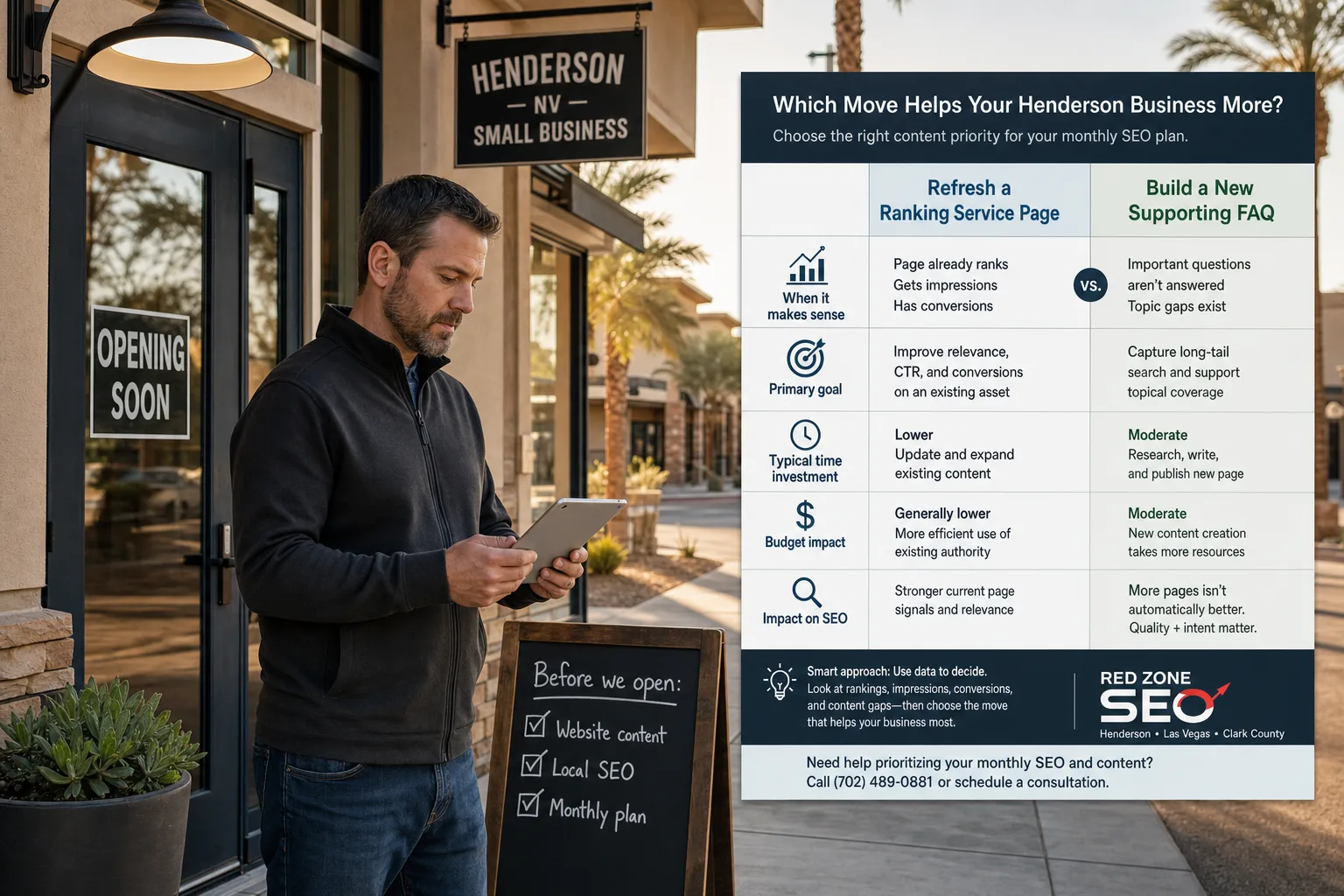
A practical priority order often looks like this:
- Correct critical technical, accuracy, or conversion problems on key pages.
- Refresh the core service page when it already has relevant impressions or is central to lead generation.
- Create a support article when the data or customer conversations reveal a meaningful unanswered question.
- Build additional supporting content only after the first piece is indexed, internally linked, and measured.
For many businesses, this means a service page refresh wins before a new article. But not always. If the core page is already clear and focused, while Search Console reveals repeated question queries with no suitable page, a supporting article may be the more sensible monthly SEO work item.
It is also important to separate a one-time improvement from a sustainable plan. A page refresh can solve obvious problems, but SEO content maintenance includes monitoring search behavior, improving internal links, updating stale material, and identifying new gaps over time. Read more about one-time SEO fixes versus an ongoing monthly SEO retainer to understand why the ongoing work can differ from a single-page project.
Timing: what to expect after publishing or updating
Content changes need time to be crawled, indexed, and evaluated. A page may be discovered quickly, but that does not mean its search performance will immediately settle into a predictable pattern. Search demand, competitors, page quality, site authority, local relevance, and user behavior can all affect the result.
After a meaningful refresh or new article, establish a measurement window rather than making an immediate second change. Check that the page is indexable, review whether relevant queries and impressions begin appearing, and watch for user activity. Compare data to a reasonable pre-change period while accounting for seasonality or shifts in business demand.
If the page receives impressions but weak clicks, review whether the title and search snippet accurately set expectations. If it receives visits but no inquiry activity, review the page’s conversion path and whether the traffic matches the service offered. If the article has no impressions after enough time for indexing and review, verify that it fills a real gap instead of duplicating an existing page.
Common Mistakes That Create Duplicate or Weak SEO Content
The most common content problem is not a lack of pages. It is a lack of page purpose. When every article attempts to target the same service phrase, the website gives both users and search engines little reason to prefer one page over another.
Creating an FAQ for every keyword variation
Do not publish separate pages for tiny variations of the same phrase. A “Summerlin local SEO FAQ,” “local SEO questions Summerlin,” and “Summerlin SEO answers” article may all serve the same intent. Combining them into one useful resource is usually more sensible than creating thin pages that repeat the same points.
Build a separate article only when the user’s underlying question is meaningfully different. A comparison between local SEO and traditional SEO, for example, has a different purpose from a page explaining monthly SEO priorities.
Turning the service page into a blog post
A core service page should not try to answer every broad educational question in the industry. When it does, its commercial purpose can disappear under too much background explanation. Keep essential decision-making information on-page. Move deeper educational material into support content that links back to the service.
Publishing an article without a content gap
Before writing, search your own site. Look for pages that already answer the question, even if they use different wording. Then examine Search Console, customer inquiries, sales notes, and the real questions people ask your team. If you cannot identify a gap, do not force a new URL into the plan.
Using nearly identical titles, headings, and calls to action
The service page and FAQ should not look like copies with a few words changed. Give each page a distinct title, introduction, structure, and destination. The service page may lead with what the business provides. The FAQ article may lead with the customer’s problem, comparison, or decision question.
Ignoring conversion data
Rankings and impressions matter, but a page that helps drive calls or form submissions deserves special attention. A support article may bring useful traffic, yet the main service page is often where a local business earns the opportunity to speak with the customer. Review both search visibility and conversion performance before moving budget away from an important landing page.
Publishing and never following up
SEO content maintenance does not end when a page goes live. Confirm that the content is indexed, internally linked, accurate, and still aligned with the business. Measure whether the intended queries are appearing and whether users are reaching related service pages. A new article that gets no follow-up can become another disconnected item in the blog archive.
A Practical Monthly SEO Content Plan for Summerlin Businesses
Small businesses do not need an endless publishing schedule to make progress. They need a process that puts limited resources behind the most sensible next task. That might be a ranking service page improvement one month and a focused supporting article the next.
Red Zone SEO’s approach to content marketing for small businesses should be practical: prioritize pages with business value, investigate what searchers are actually looking for, make purposeful updates, and measure before assuming the next move.
Step 1: Start with the pages that matter most
List your main service pages, location pages, and pages that generate leads or support sales conversations. For a multi-location company, separate true location-specific needs from duplicated city wording. A Summerlin page should offer meaningful value for Summerlin customers, not merely swap the city name from a Las Vegas page.
Then review which pages have active search impressions, visits, or engagement. A page with existing demand and clear commercial importance may deserve a refresh before a brand-new article receives budget.

Step 2: Review Search Console and conversion evidence
For each priority page, look at:
- Queries producing impressions and clicks.
- Whether the query intent matches the page’s purpose.
- Changes in clicks and impressions over time.
- Pages that draw visitors toward your service and contact paths.
- Form submissions, calls, booked appointments, or other available conversion signals.
A page with many relevant impressions but limited clicks may need a clearer search presentation and stronger alignment to the query. A page with solid traffic but low inquiries may need better service explanation or conversion structure. A set of recurring questions with no relevant destination may point to supporting FAQ content.
Step 3: Choose one primary task, not five partial tasks
When the budget is tight, avoid spreading a small amount of work across many pages. Choose one meaningful project: a focused refresh, a single high-value FAQ article, or a tightly related pair of updates if the scope allows.
Examples of sensible monthly priorities include:
- Refresh a Summerlin service page that already has relevant impressions but unclear content and a weak call to action.
- Publish one article answering a recurring customer question that has a distinct search intent.
- Add internal links between a recently published guide and the core service page it supports.
- Update an older article so its guidance, links, and service references remain accurate.
- Review whether similar pages should be consolidated rather than adding another near-duplicate page.
For more context on planning work in stages, see how monthly SEO work is typically prioritized for affordable campaigns.
Step 4: Build the service-page-and-support-content path
Once a useful support article exists, link it to the relevant service page. On the service page, add a link back only where additional education helps a visitor make a decision. This is content marketing with a job to do: the article answers the question, and the service page provides the appropriate path for someone who needs help.
For example, an SEO service page can point visitors to an article about prioritizing updates versus new FAQ content. That article can then point back to the monthly SEO service discussion when the reader needs help applying the framework to their own website.
Businesses that need a broader approach can explore Red Zone SEO’s guidance on content marketing for small businesses. The objective is not content volume for its own sake. It is a useful collection of pages that supports customer questions and business goals.
Step 5: Measure, learn, and choose the next task
After the update or publication, record what changed and monitor the page. Look for relevant impressions, clicks, user movement to service pages, and conversions where tracking is available. Do not treat a temporary movement as a final verdict, and do not make constant unmeasured edits that obscure what helped.
The next month’s decision should build on what you learned. If the refreshed service page is gaining relevant visibility but still has conversion weakness, continue improving the customer experience. If a support article attracts question-based searches and sends readers to the service page, consider the next related gap. If neither route shows a clear opportunity, investigate technical issues, search intent mismatch, or whether the topic is too broad before simply publishing more.
Frequently Asked Questions
How do I know whether my existing service page needs an update or a separate FAQ article?
Start by checking whether the question is central to hiring your business. If it is, add or improve the answer on the service page. If it is a narrower educational question that requires a detailed explanation, examples, or comparison, a separate FAQ article may be better. Review Search Console queries, the page’s existing performance, and common customer questions before deciding.
Can a supporting FAQ article help a service page rank better in local search?
It can support the overall topic and help users discover the service page through relevant internal links, but it is not a guaranteed ranking tactic. The article must provide a distinct, useful answer and connect naturally to the main page. Local search performance also depends on many other factors, including the relevance and quality of the service page itself.
What should a Summerlin small business prioritize if the monthly SEO budget only covers one content task?
Prioritize the option with the clearest evidence of business value. In many cases, that means improving an important service page that already has relevant impressions or contributes to lead generation. Choose a new FAQ article when you have identified a meaningful unanswered question and the service page is already doing its primary job well.
Will a new FAQ compete with my main service page for the same keyword?
It can if both pages target the same intent, use nearly identical titles and headings, and offer the same answer. Reduce this risk by giving the service page a commercial purpose and the FAQ article a specific informational purpose. Use internal links to show their relationship, and avoid creating pages for minor keyword variations.
How long should I wait before deciding whether a refreshed service page is working?
Allow time for crawling, indexing, and enough search activity to evaluate the change. The right review period depends on the page’s existing traffic level, search demand, and competition. First confirm that the page is indexed and that relevant queries are appearing. Then compare impressions, clicks, engagement, and conversion activity against an appropriate pre-update period before deciding whether additional work is needed.
Choose the Content Task That Solves the Actual Problem
A service page refresh is the right first move when a core page has visibility, conversion importance, and correctable gaps. A supporting FAQ is the right move when searchers need a distinct answer that the main page cannot cover well without losing focus. The strongest long-term SEO content plan usually uses both, but in the right order and for clearly different purposes.
If you are deciding where your next Summerlin SEO budget should go, Red Zone SEO can review your existing page, search visibility, and content gaps, then recommend the most sensible next step for your Summerlin growth goals, timeline, and budget. Request a practical SEO review for your Summerlin business or call (702) 489-0881 to talk through which option fits your situation best.


