

When Does Search Console Show SEO Progress? A Practical Guide for Summerlin Businesses
It is common to launch an SEO campaign, publish or improve important pages, and then wonder why the rankings you care about have not moved yet. For Summerlin and Clark County businesses, Google Search Console can often show early SEO progress before a page reaches stronger positions or generates a noticeable increase in leads.
The key is knowing what each metric actually means. More impressions can be encouraging, but they are not a final result. Flat clicks can be normal in an early stage, but a long period with no indexing, visibility, or page-level improvement may call for a closer technical or strategy review.
Short Answer: Search Console Can Show Progress Before Rankings Move
Search Console may show progress before a primary keyword appears to move because Google can begin testing your page in more searches before it consistently ranks well enough to earn clicks. A page can become indexed, gain impressions for related terms, and appear in a wider range of search results while its average position and traffic remain relatively unchanged.
There is no credible SEO provider that can guarantee a fixed ranking date. Google has to crawl changes, process the updated page, evaluate its relevance against other results, and decide where it belongs for many different searches. Competition, search demand, the condition of your website, and the usefulness of the page all affect that process.
For example, a Summerlin plumbing company may update a service page to better explain emergency repair, service areas, common issues, and how to request help. Search Console may first show that page receiving impressions for a broader set of Summerlin-related repair searches. That does not mean the page has already earned top visibility. It means Google is beginning to display it more often, which is a signal worth tracking alongside quality, relevance, and conversion readiness.
For a practical reference, Google explains the definitions and reporting filters in its Search Console Performance report documentation. The useful takeaway for business owners is simple: look for a pattern across multiple metrics and time periods, not one exciting or disappointing number.
Which Early Search Console Signals Usually Appear First
SEO progress does not always arrive in the same sequence, but these are common early signals in Search Console.
1. Indexing Comes Before Search Performance
Indexing means Google has discovered and added a page to its searchable index. A page that is not indexed cannot build normal organic search visibility. In Search Console, use the URL Inspection tool to see whether a priority page is indexed and whether Google identifies crawl, canonical, or coverage issues that need attention.
Indexing is necessary, but it is not the same thing as ranking, traffic, or leads. A newly indexed page may still take time to appear meaningfully for the searches that matter to your business. Google’s SEO Starter Guide also notes that changes may take time to be reflected in Search results.
2. Impressions May Increase First
An impression occurs when your site appears in a Google search result that meets Google’s reporting rules. Early SEO progress in Search Console often begins with more impressions because Google is showing a page for additional searches, including longer, more specific queries.
Suppose a Summerlin accountant improves a page about business tax preparation. The page may initially gain impressions for searches such as “small business tax help Summerlin,” “bookkeeping and tax preparation near Summerlin,” or specific tax-related questions. Those impressions may arrive before the page earns enough visibility to create a meaningful lift in clicks.
Impressions can be meaningful because they show potential search visibility is expanding. They should not be treated as success by themselves. The next question is whether those impressions are relevant to the services, locations, and customers the business wants to reach.
3. Query Coverage Can Broaden
Instead of watching one headline keyword, look for an expanding group of relevant queries. A useful service page may begin appearing for variations involving service type, urgency, neighborhood, customer need, and location.

For local SEO, this may include Summerlin, Las Vegas, Green Valley, Clark County, or “near me” searches, depending on how and where customers search. A broader query footprint is often more useful than a single ranking report because real customers do not all use the exact same wording.
4. Average Position Can Improve Gradually
Average position is the average ranking position of your highest result for reported impressions. It is a directional metric, not a promise of a fixed rank. A page can rank differently by query, location, device, and search-result layout. Local packs, ads, maps, AI features, and other result elements can also change what a searcher sees.
Because Search Console averages across many searches, a small movement in average position can be useful when it aligns with more relevant impressions and eventually more clicks. It is less useful when viewed in isolation.
5. Clicks and Leads Usually Require More Context
A click means someone selected your organic result in Google Search. Clicks are closer to business value than impressions, but they still are not the same as leads. A lead may be a call, form request, appointment request, quote request, or another action your business tracks after the visitor arrives.
The normal chain is:
- Indexing: Google can include the page in its search database.
- Impressions: The page is displayed for relevant searches.
- Position: The page’s visibility changes across those searches.
- Clicks: Searchers choose the result.
- Leads: Qualified visitors take a meaningful business action.
Each step can reveal a different problem. A page may have no impressions because of indexing or relevance issues. It may have impressions but few clicks because it is too low in results, the title does not match the query well, or the searches are not commercially useful. It may earn clicks but few leads because the page does not make the next step clear.
Why Impressions Can Rise Before Clicks and Average Position
Search Console impressions before ranking improvements are common. Google may be testing whether your page is a reasonable answer for more searches, including searches where the page currently appears far down the results. Those appearances count as impressions, but they may not create many clicks.
Click-through rate, usually shortened to CTR, is clicks divided by impressions. If impressions rise faster than clicks, CTR can decline even while visibility is expanding. That is not automatically bad. It can mean the page is now appearing for more searches, but it has not yet reached a prominent enough position or a strong enough search-result message to earn the click.
Consider a multi-location home service business serving Summerlin and Las Vegas. An improved Summerlin location page may appear for a wider range of local searches after it is updated. If many of those new impressions occur on later result pages, impressions can rise while clicks remain flat. The right response is not necessarily to rewrite everything. First, verify that the additional queries match the location and service, then assess the page’s position range, search intent, title tag, headings, and internal links.
It is also important to remember that Search Console average position does not represent one fixed ranking for one phrase. If a page gains impressions for new queries where it ranks lower, the average may look flat or even worse while its total relevant reach is growing. Review individual query themes and page-level data before concluding that an update failed.
A Practical SEO Timeline for Summerlin Businesses
Rather than expecting an exact SEO results timeline for small businesses, use stages. The length of each stage varies, and some campaigns will move through them unevenly.
Early Stage: Validate Access, Indexing, and Priorities
At the start of an SEO campaign, the most important questions are whether Google can crawl and index priority pages, whether tracking is configured correctly, and whether the work is focused on pages that match real customer demand. Technical repairs, content improvements, local business information, site structure, and internal linking may all be relevant.
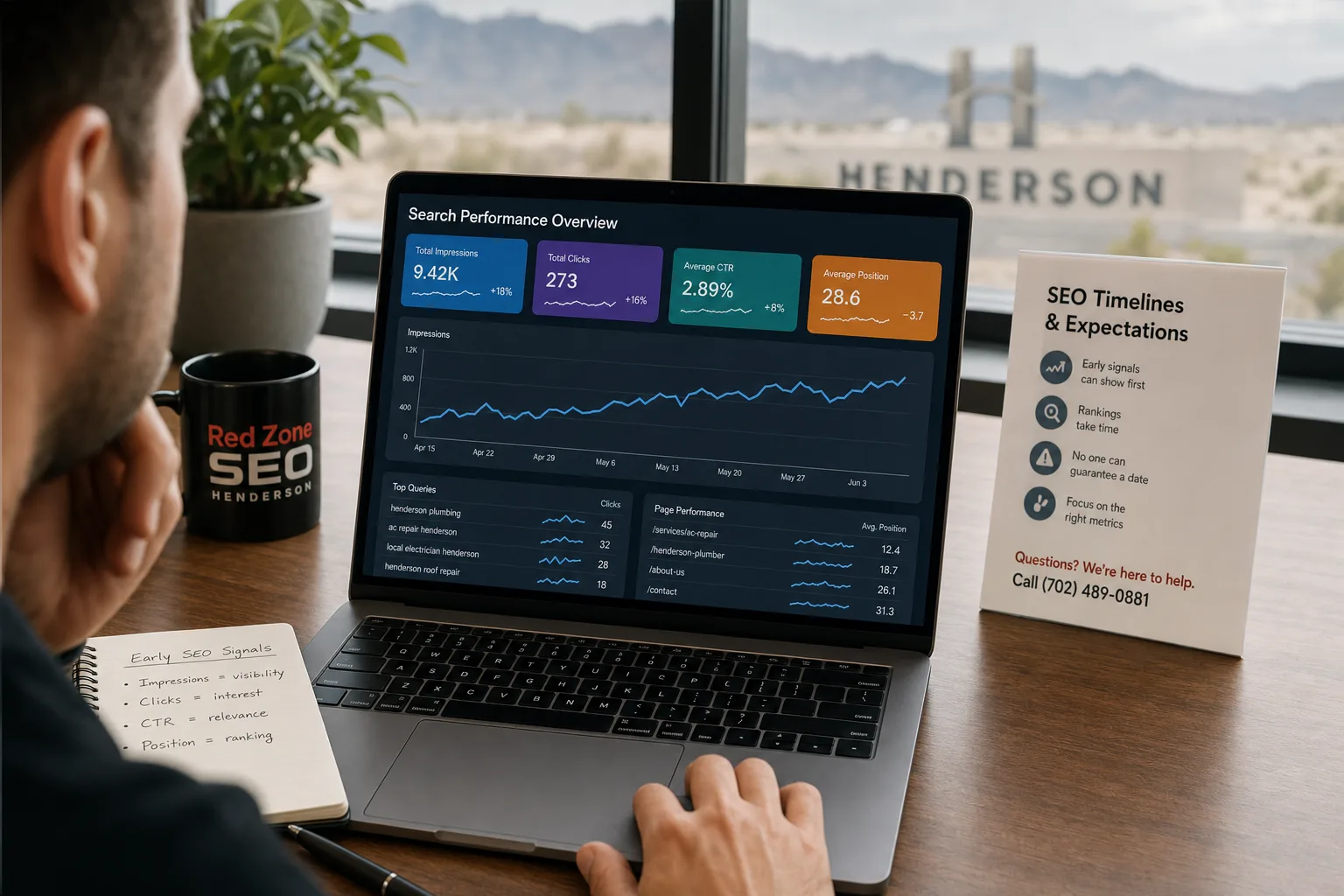
A lack of immediate ranking movement at this stage is not unusual. The more practical evidence is that priority pages are indexable, improvements have been published, and there is a clear plan for what is being addressed and why.
Developing Stage: Watch for Relevant Visibility Expansion
Once Google processes updates, Search Console may begin to show more impressions, additional query themes, or better visibility for pages that previously had little exposure. Compare the period after an update with a comparable earlier period. Use a long enough date range to avoid making a decision from a few scattered searches.
For instance, compare a meaningful post-update period with the equivalent period beforehand, then filter the report to the updated URL. Review whether impressions, clicks, CTR, and average position changed for the specific service or location query theme the page was intended to support.
Evaluation Stage: Measure Business Relevance, Not Just Visibility
As visibility develops, evaluate whether searchers are reaching the right pages and whether those pages support calls, inquiries, or appointments. This is where a campaign needs to connect SEO reporting to business priorities. A page that gains impressions for unrelated informational searches may not be as valuable as a page that earns fewer but more qualified service-related clicks.
Businesses evaluating SEO campaigns and ongoing optimization should ask how reporting will connect the work completed to pages, query themes, local markets, and next priorities. A monthly report with only a few ranking screenshots is not enough context to evaluate a campaign thoughtfully.
What Can Delay Meaningful Search Console Progress
A slower pattern does not always mean an SEO campaign is ineffective, but it should be explained. Common reasons include the following:
- New or weak pages: A recently published page may need time, stronger internal connections, and clearer information before Google has confidence in its relevance.
- Technical barriers: Noindex directives, incorrect canonicals, crawl errors, redirect problems, duplicate pages, or weak site architecture can limit visibility.
- Search-intent mismatch: A page about a general service may not answer the specific need behind a local, urgent, pricing, comparison, or informational search.
- Local competition: Summerlin businesses can compete with established local providers, Las Vegas companies that serve the area, directories, maps results, and national sites.
- Limited page depth: Thin location pages or nearly identical city pages often give Google and visitors little reason to prefer them.
- Seasonality and demand shifts: Search behavior changes throughout the year. A weekly comparison during a holiday, event period, weather change, or slower buying window can be misleading.
- Small data sets: A business with only a handful of impressions or clicks can see large percentage swings that do not represent a durable trend.
Budget-conscious owners should also confirm that the campaign scope matches the problem. A one-time repair can be appropriate for clear technical issues, while content, local relevance, monitoring, and competitive improvement often require ongoing prioritization. This guide to one-time SEO fixes versus a monthly SEO retainer can help clarify the difference.
How to Review Search Console Without Overreacting to Small Changes
Do not check Search Console every day and react to each fluctuation. Search data is delayed, local results vary, and a small business may not have enough daily volume to make day-to-day changes meaningful. A calmer, repeatable review process is more useful.
Use a Page-First Review
Start with the page that was changed or is meant to generate business. Then review the queries sending impressions and clicks to that page. This prevents a general site-level trend from hiding a problem or improvement on a key Summerlin service page.
Group Queries by Theme
Do not judge an entire campaign by one exact keyword. Group queries into themes such as “Summerlin service,” “Las Vegas service,” “emergency service,” “service cost,” or “brand and non-brand.” This makes it easier to tell whether growth is coming from the audience you actually want.
Filter by Location and Device When It Helps
For a business that serves Summerlin and Las Vegas, location filters can reveal whether visibility is changing differently across markets. Device filters can also matter because local customers often search from mobile devices. Use filters to investigate a question, not to create a complicated report with no decision behind it.
Compare Meaningful Date Ranges
When reviewing a page update, compare a post-update period with a comparable preceding period. Avoid treating a short weekly change as proof when the site has low volume or demand is seasonal. Look for repeated direction: more relevant impressions, improving positions for targeted query themes, stronger clicks, or improved lead quality.

For a multi-location business, keep location pages separate in the review. A gain for Las Vegas does not automatically mean the Summerlin page is performing well. Each page should have a distinct purpose, useful local detail, and a way to measure its own visibility.
When Early Data Suggests Your SEO Campaign Needs Attention
Early SEO data deserves attention when it reveals a clear obstacle, not merely because a favorite keyword has not reached a desired position yet. Ask for a focused review if you see any of these patterns:
- Priority pages remain unindexed or show persistent technical issues.
- Important pages have little or no relevant impression growth after updates have had reasonable time to be crawled and processed.
- Impressions are increasing, but the queries are unrelated to your actual services, locations, or customers.
- A page receives impressions and ranks within a plausible range but earns few clicks because its title, description, or content does not meet the apparent search intent.
- Multiple city pages use nearly the same content and one market consistently stalls.
- SEO work is being reported without a clear explanation of which pages were improved, what problem was addressed, and what comes next.
- Organic clicks are arriving, but visitors are not finding a useful next step to call, request service, or submit an inquiry.
A technical review may be appropriate when indexing or crawl issues are present. An intent review is more useful when Google is displaying the page but the wrong searchers are seeing it, or the right searchers are not clicking. A prioritization review is often needed when the work is scattered across too many low-impact tasks while core service and location pages need attention.
Before hiring or reassessing a provider, make sure the scope explains how decisions will be made. Review what an SEO proposal should include before you sign and understand why SEO quotes vary for small businesses in Las Vegas and Summerlin. The lowest quote is not automatically the best value if it does not identify the pages, technical issues, content needs, local-market priorities, and reporting process involved.
Frequently Asked Questions
How soon should a new SEO campaign show impressions in Google Search Console?
There is no fixed date. If Google can crawl and index the page, impressions may begin appearing after Google processes the page, but the timing and volume vary. New pages, competitive local services, technical constraints, and low search demand can all affect what you see. First confirm indexing, then review whether impressions are relevant and whether they develop over a meaningful date range.
Can Search Console impressions increase even if my keyword rankings have not improved?
Yes. Google may show your page for more searches before it ranks prominently enough to improve clicks or a specific target keyword’s visible position. This is why SEO rankings can lag behind impressions. Check the actual queries, page, average position, and CTR before deciding whether the trend is useful.
Why are clicks flat when Search Console is showing more impressions?
The new impressions may be in lower positions, may involve less relevant searches, or may not have an appealing enough title and page message for searchers to click. Search-result competition and low demand can also limit clicks. Review query relevance and positions before changing titles or content.
How long should a Summerlin small business wait before reassessing an SEO campaign?
Reassess whenever there is a clear issue: pages are not indexed, work is not being explained, content does not match customer intent, or the campaign lacks priorities. For normal performance evaluation, use meaningful comparison periods rather than expecting a daily or weekly verdict. The goal is not to wait passively; it is to verify that work is published, measurable, locally relevant, and adjusted when the evidence calls for it.
What Search Console metrics matter most for local SEO progress?
Start with indexing status, impressions, clicks, CTR, and average position, then view them by landing page, query theme, location, device, and date range where helpful. Finally, compare organic visits with the leads or inquiries those visits support. No single metric tells the complete story.
Get a Direct Answer About Your Early SEO Data
Early impressions, flat clicks, and uneven ranking movement can be normal parts of an SEO campaign, especially for a Summerlin business competing across local markets. They can also reveal a technical issue, an intent mismatch, or a plan that needs stronger priorities.
If you want help separating normal early-stage fluctuations from a campaign that needs a clearer plan or prioritization change, request a practical SEO review from Red Zone SEO or call (702) 489-0881. What is your Search Console data actually telling you about the next best step for your Summerlin-area business?


