

SEO Maintenance and Monthly Work for Summerlin Businesses: Expanding From “SEO Summerlin” to Service-Focused Search Demand
For a Summerlin service business, showing up for a broad phrase such as “SEO Summerlin” may be useful, but it is rarely enough to create a reliable flow of qualified inquiries. A broad query can help people discover your agency or business category. The more valuable opportunity is often found in the searches that describe a specific problem, service, location, or buying need.
That is where monthly SEO retainers can be practical. Instead of treating SEO as a one-time batch of edits or a monthly ranking report, ongoing work can identify the next service-page opportunity, improve pages that already have potential, maintain technical health, and measure which topics deserve more attention. For Summerlin and Las Vegas small businesses with limited budgets, the goal is not broad traffic for its own sake. It is stronger coverage for searches connected to the services you actually want to sell.
Why “SEO Summerlin” Is Usually Not Enough for a Service Business
“SEO Summerlin” is a broad category search. A person using it may be looking for an SEO agency, comparing providers, researching costs, seeking a consultant, or simply learning what SEO means. It is relevant to Red Zone SEO, but it does not represent every way a potential customer searches for SEO help.
For many local businesses, the same problem applies to their own target keywords. A plumber may want visibility for “plumber Summerlin,” but a customer ready to solve a specific issue may search for water heater repair, leak detection, drain cleaning, or emergency plumbing service. A broad keyword can matter, but it cannot replace pages that clearly address the individual services that produce the right type of call.
Monthly SEO work turns broad visibility into more focused service coverage over time. That work may involve:
- Reviewing the queries, pages, and impressions that are already appearing in search.
- Finding services that are important to the business but weakly represented on the website.
- Improving an existing page when it already matches the search intent.
- Building a new service page or supporting resource when the existing page is too broad.
- Adding internal links so search engines and users can move from broad topic pages to specific services.
- Monitoring whether technical or WordPress changes affect page visibility, indexing, titles, links, or conversions.
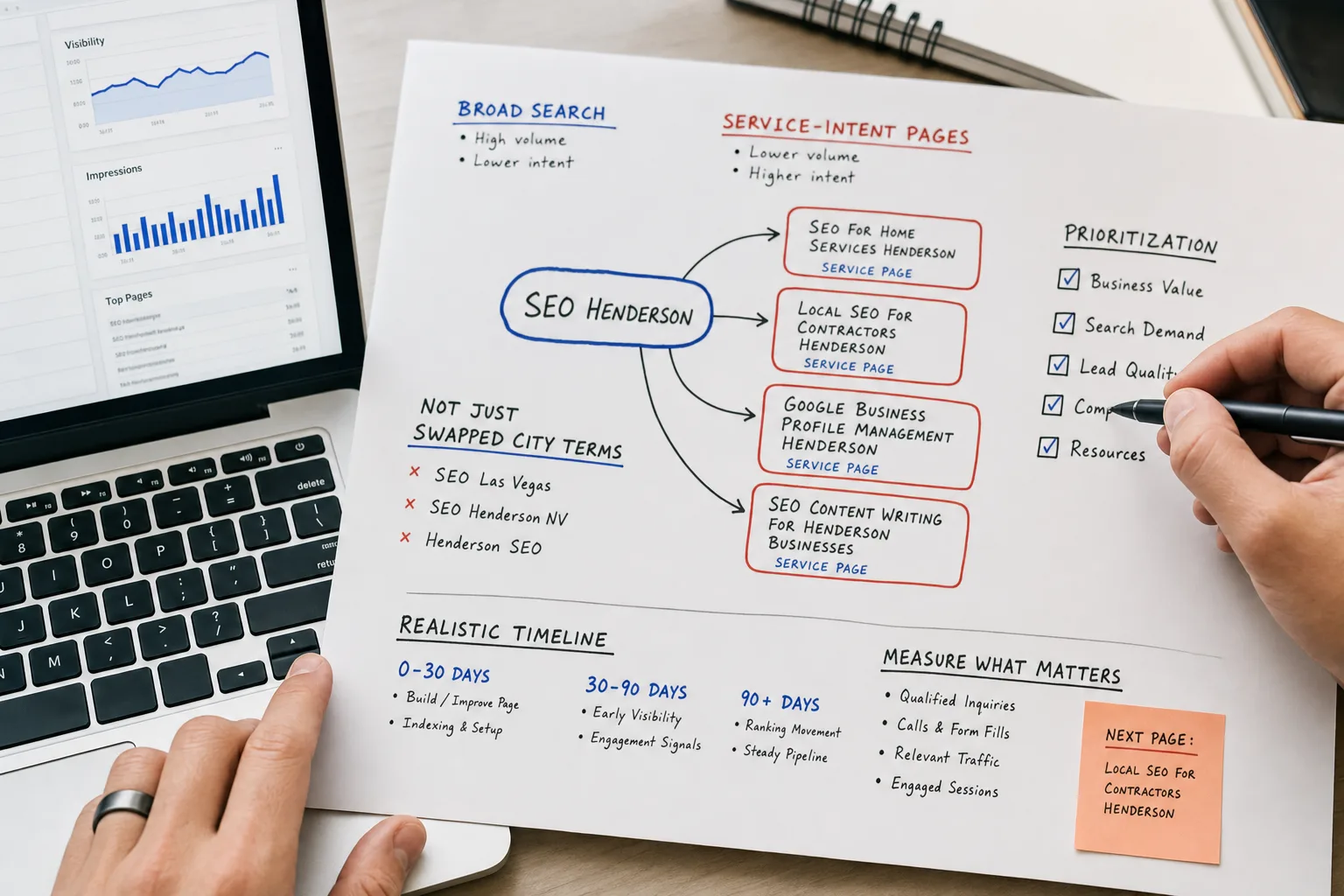
A monthly plan should not create a new page simply because a keyword contains “Summerlin.” Swapping city terms onto nearly identical pages is not a useful long-term strategy. Keyword variants need distinct customer intent, distinct service information, or a meaningful location-specific purpose.
For example, an “SEO company Summerlin” page and an “SEO services Summerlin” page may deserve separate attention if one is primarily a provider-selection page and the other needs to explain the actual services, process, and ongoing work included in a campaign. This distinction matters because a company page can be strong for one kind of search while missing people who are specifically looking for services. Red Zone SEO explains that issue further in why a Summerlin SEO company page can miss service-focused search demand.
The same principle applies to your own site. A single “Services” page may be useful for navigation, but it is not always the best destination for a person who needs one specialized service now.
What Higher-Intent Summerlin Search Variants Look Like
Higher-intent does not always mean a longer keyword. It means the wording gives a clearer indication of what the person needs and what type of page would help them make a decision.
For an agency offering Summerlin SEO services, search intent may expand from a broad phrase into related terms such as:
- SEO Summerlin
- SEO company Summerlin
- Summerlin SEO services
- local SEO for Summerlin businesses
- Summerlin SEO expert
- monthly SEO retainers Summerlin
- SEO service-page optimization
- SEO content strategy for local service businesses
- WordPress SEO maintenance after updates
These are not automatically separate pages. A monthly SEO plan must first determine whether the customer intent is truly different. “SEO company” and “SEO expert,” for example, may be close enough to address together on a well-developed provider page. “WordPress SEO maintenance after updates” is more specific and may need its own supporting page because the visitor is evaluating a particular technical need.
Intent should guide the page, not word swapping
A practical test is to ask: would a visitor expect different information, examples, next steps, or proof before contacting the business?
If the answer is yes, a dedicated page may be justified. If the answer is no, the better choice is often to strengthen one existing page with clearer headings, better service details, internal links, and useful frequently asked questions.
Consider a Summerlin home-service company that offers HVAC repair, maintenance, and replacement. A general HVAC page may introduce the company, but a person searching for air conditioner repair in Summerlin has a different need from someone evaluating a maintenance plan or considering replacement. Those services have distinct problems, decision factors, and calls to action. Combining everything into one thin page can leave the website less useful to customers and less clear to search engines.
In SEO, the equivalent may be a main Summerlin SEO services page supported by pages or sections covering local SEO, technical SEO, service-page creation, existing-page refreshes, content strategy, and maintenance after WordPress changes. The page structure should follow the business’s real service model, not an arbitrary list of keywords.

Do not confuse traffic potential with lead quality
A broad topic can generate impressions without producing the inquiries a small business needs. Higher-intent SEO keywords are often more valuable because they align with a defined service and a person further along in the decision process.
That does not mean every narrow phrase deserves a standalone page. A service page takes planning, writing, review, technical setup, linking, and monitoring. With a limited budget, the best opportunity is usually the one that combines:
- A service your business actively wants to sell.
- A reasonable margin or long-term customer value.
- Clear local demand or evidence of relevant search activity.
- A page gap or a page that can be improved meaningfully.
- A realistic ability to answer the customer’s question better than a generic page can.
How Monthly SEO Finds the Next Service Page Opportunity
Good monthly SEO does not begin with a predetermined number of blog posts or a promise to target every possible term. It begins with the current website, the business’s service priorities, and evidence from search performance.
For an established Summerlin website, a monthly review can examine Google Search Console data for impressions, clicks, queries, and landing pages. A page that receives impressions for a service but has limited clicks may need a clearer title, better page description, stronger alignment with the query, or more useful on-page content. A page that receives no relevant impressions may have an indexing, technical, content, or internal-linking problem.
Search Console is useful because it shows what Google is already testing. It does not replace business judgment. If your team does not want more calls for a low-margin service, that topic should not automatically move to the front of the SEO queue merely because it has impressions.
A practical monthly opportunity-review process
- Confirm sales priorities. Review which services are profitable, available, operationally important, and appropriate for Summerlin or the broader Las Vegas service area.
- Review current page coverage. Identify whether the site has a useful page for each priority service or whether important services are buried on a general page.
- Check search signals. Look at queries and landing pages to see where Google is already showing the site, where demand seems service-specific, and where users may be landing on the wrong page.
- Choose the right action. Decide whether the priority is a page refresh, a new service page, a supporting FAQ or guide, an internal-linking improvement, or a technical correction.
- Publish carefully. Use accurate service details, clear headings, meaningful calls to action, sensible title tags, and links to related pages.
- Measure and refine. Monitor crawl and indexing status, early impressions, changes in query relevance, user engagement, and the quality of inquiries reported by the business.
This approach is especially useful for local SEO for Summerlin businesses because the site may need to serve nearby communities without becoming a collection of duplicate city pages. A business that legitimately serves Summerlin and Las Vegas can explain its service areas where appropriate, but each page still needs a clear reason to exist. A page should help a customer understand the service, not just repeat a location name.
Recurring work that moves pages forward
Once the initial priorities are set, monthly SEO work can continue with specific improvements rather than passive observation. Depending on the site’s needs, that can include title testing, on-page refinement, internal linking, support content, Search Console review, technical checks, and outreach for relevant link-building opportunities.
For example, title testing may mean refining a page title when it is appearing for relevant searches but not earning many clicks. Internal linking may mean connecting a general local SEO page to a page about service-page optimization, technical maintenance, or a relevant FAQ. Supporting content can answer a narrow question that would distract from the primary sales page but still helps a buyer evaluate the service.
Monthly SEO is not just rank tracking. Rankings can be useful context, but they do not tell the full story. A page can improve in average position while attracting irrelevant queries, or it can gain valuable impressions before a ranking tool shows a meaningful change. The real work is deciding what to improve next and making changes that better connect your pages with high-intent searches.
Refresh an Existing Page or Build a New Supporting Page?
This is one of the most important choices in Summerlin service page SEO. Publishing a new page when an existing page only needs improvement can spread attention too thin. Updating an existing page when the business needs a clearly separate service destination can make the page confusing and less useful.
Refresh an existing page when the core intent is already a fit
A refresh is usually the right move when the page already addresses the service, has some relevant visibility, and needs clearer or more current information. Common refresh work includes:
- Updating services, process details, staff information, offers, or service areas that are no longer accurate.
- Adding missing explanations that customers need before contacting the business.
- Improving headings so the page better reflects the service and local search intent.
- Refining title tags and meta descriptions for relevance and click-through potential.
- Adding internal links to related service pages, supporting resources, and contact options.
- Correcting duplicate, thin, outdated, or conflicting content.
A refresh can be efficient because the page may already be indexed and have a history with search engines. However, it still requires careful review. If a page is already producing qualified inquiries, changes should protect the useful elements rather than replace them blindly.
Build a new page when the customer need is genuinely distinct
A new service page or supporting resource can make more sense when the searcher has a different problem, expects different information, or needs a different next step. For example, a main SEO services page may not be the ideal place to explain post-update WordPress SEO maintenance. That subject involves specific risks, checks, and ongoing monitoring that deserve focused treatment.
Likewise, a supporting FAQ may be a better fit than expanding a sales page when the question is narrow but important. The choice is not simply “new content versus old content.” It is about placing useful information in the format that best matches the visitor’s purpose.
For a closer look at this decision, review whether to refresh a ranking service page or publish a new supporting FAQ. You can also compare updating existing Summerlin pages versus publishing new ones when planning work on a limited monthly budget.
What a Practical Monthly SEO Retainer Should Include
Monthly SEO retainers should be built around a documented priority plan, not a vague list of activities. The exact work will differ between a Summerlin startup with a small site and an established Las Vegas business with dozens of older pages. Still, a useful retainer should make it clear what is being reviewed, what work is being completed, why each priority matters, and what results can realistically be monitored.
For service-page growth and maintenance, the plan should address four connected areas.
1. Service-page planning and optimization
This includes identifying gaps between the services you sell and the pages you have, mapping high-intent SEO keywords to appropriate pages, and improving page structure. The objective is not to force every phrase into a heading. It is to make each page a clear, useful destination for a customer evaluating a specific service.
2. Existing-page refreshes and support content
Older pages can lose usefulness when business details change, services evolve, or competitors publish clearer resources. Monthly work can keep important pages accurate and strengthen them with supporting FAQs, related articles, comparison content, or internal links. This is also where an SEO content strategy becomes practical: every new piece should support a service priority or help customers make a real decision.
3. Technical SEO maintenance
Technical maintenance helps make sure useful pages remain accessible and understandable to search engines. It can include checking indexing, redirects, canonical tags, broken links, page templates, crawl issues, mobile usability concerns, and important metadata.
WordPress updates, plugins, theme changes, and new forms can affect SEO in ways that are not always obvious. A plugin update may alter page settings, introduce redirects, change how titles are generated, or interfere with internal links and tracking. That is why maintenance is part of an ongoing SEO plan rather than an afterthought.
4. Reporting and campaign planning
Reporting should explain more than a position change. A helpful report connects the work completed to search visibility, important queries, relevant landing pages, technical findings, and next priorities. It should also allow the business owner to provide context: Are calls coming from the right services? Has the business changed its service area? Is there a higher-margin job type that now deserves attention?
A monthly SEO retainer is most useful when reporting leads to an informed next action. If it only repeats rankings without explaining what will change next month, it is not giving a small business enough decision-making value.
How to Prioritize Service Pages When Your Budget Is Limited
Most small businesses cannot improve every page, publish multiple new resources, fix every technical issue, and run ongoing outreach all at once. That is normal. The solution is not to choose random tasks based on whichever keyword has the highest apparent volume. It is to prioritize based on business value and the current state of the website.
Use a service-value framework
Start by listing the services you want more of. Then score each one against practical questions:
- Does this service produce healthy margins or valuable repeat business?
- Can your team take on more of this work right now?
- Does the service attract qualified local leads rather than low-value inquiries?
- Does the website already have a page that serves this intent?
- Is there evidence that searchers are looking for this specific service in Summerlin or Las Vegas?
- Would a page refresh solve the problem, or is a dedicated page needed?
- Are there technical barriers preventing existing pages from being indexed or understood correctly?
A high-margin, high-priority service with weak page coverage often deserves attention before a broad topic that produces general awareness. For example, if a business has a detailed service page for one core offering but only mentions another profitable service in a short paragraph, building out the missing service coverage may be more valuable than writing another general blog post.
Protect pages that already have momentum
Limited budgets should also account for pages that already earn relevant impressions or inquiries. A page with some visibility may be a faster and more sensible improvement opportunity than a brand-new topic. That could mean updating information, improving clarity, building internal links, adding a frequently asked question section, or publishing a supporting page that helps the core service page answer related concerns.
At the same time, do not assume that every ranking page should be left untouched. Outdated content can undermine trust, especially when it references services, staff, prices, offers, or business practices that no longer apply. The page should be accurate before it is aggressively promoted.
Sequence the work instead of trying to do everything
A practical Summerlin SEO plan may start with a technical and content baseline, then move through the highest-value pages in order. After a priority service page is refreshed or published, the next month can support it through internal linking, targeted supporting content, title refinement, and review of early search signals.
This sequencing creates a connected site rather than isolated pages. A general “SEO Summerlin” page can introduce the agency, while more focused pages help visitors evaluate local SEO, technical support, service-page optimization, content strategy, or ongoing maintenance. That structure also helps search engines understand the relationship between your broad category pages and specific services.

What Summerlin Businesses Can Expect in the First Few Months
SEO progress is rarely a straight line, particularly when a site needs new service pages or significant revisions. A realistic plan separates the work that can be completed promptly from the time search engines need to crawl, process, test, and evaluate pages.
Early stage: audit, priorities, and foundational corrections
Early work often includes reviewing the website, service priorities, existing content, technical conditions, and search performance. The first recommendations may be less visible than a new article because they can involve fixing page structure, improving indexing signals, cleaning up internal links, or deciding which existing page should be the main destination for a service.
This stage should produce clarity. You should know which services are being prioritized, why they matter, what pages will be refreshed or created, and what technical concerns need attention.
Middle stage: publishing, refinement, and early search signals
After pages are improved or published, search engines need time to crawl and index them. Early progress may show up as relevant impressions, new query variations, or a better match between the queries people use and the page Google selects. Those are useful signs, but they are not a guarantee of immediate rankings, calls, or lead volume.
New pages generally need more time and supporting signals than a well-established page receiving a thoughtful refresh. The condition of the domain, the competition for the service, page quality, local relevance, internal linking, and technical health can all affect the pace of movement. For a more detailed discussion, see how long local SEO takes when new Summerlin service pages are needed.
Ongoing stage: measure qualified relevance, not vanity metrics
As the campaign continues, the important questions become more specific:
- Are priority pages appearing for more relevant service queries?
- Is Google selecting the intended service page rather than a generic homepage?
- Are title and page improvements helping attract appropriate clicks?
- Are new supporting pages strengthening the main service pages?
- Are technical changes or WordPress updates creating new issues to address?
- Are inquiries becoming more aligned with the services the business wants to provide?
A responsible SEO provider will not promise a specific ranking or lead count. What they should provide is a clear explanation of the work, an evidence-based priority sequence, and reporting that shows what is being learned and improved over time.
Frequently Asked Questions About Monthly SEO Retainers in Summerlin
How do I know whether my Summerlin business needs a new service page or an update to an existing page?
Start with intent. If the existing page already addresses the same service and customer need, a refresh may be the best use of budget. If the target service has different questions, qualifications, outcomes, or buying considerations, a dedicated page may be more useful. Search data can help show whether Google is already testing the existing page for the topic, but the final decision should also reflect how your customers actually evaluate the service.
How many service pages can a monthly SEO retainer realistically improve or create?
There is no responsible universal number. It depends on the condition of the site, the depth required for each page, the amount of technical work needed, approval timing, available business information, and whether a priority page needs supporting content and internal links. A strong plan should explain the scope of the next priority rather than treating pages as interchangeable production units.
When should a business target a specific service keyword instead of a broad term like “SEO Summerlin”?
Target a specific service keyword when it reflects a service you actively sell and a distinct customer need. A broader phrase can support general visibility, but a specific term often leads to a page that can answer more useful questions and move a qualified visitor closer to contacting you. The page must offer real service information; it should not exist only to repeat a keyword variation.
How long does it take for new or refreshed Summerlin service pages to show early SEO progress?
Pages may first show progress through indexing, impressions, or emerging query data before meaningful ranking movement is visible. An existing page with relevant history may respond differently from a completely new page. Competition, website health, content quality, internal linking, and the clarity of the service intent all influence timing. Monthly review is valuable because it provides evidence for the next adjustment instead of assuming every page will follow the same schedule.
What should I ask before hiring a Summerlin SEO agency on a monthly retainer?
Ask how the agency chooses priorities, how it distinguishes a page refresh from new page creation, what technical maintenance is included, how reporting connects to business goals, and how it handles changes after WordPress updates. Ask what information they need from your business to create accurate service pages. You should also ask how they evaluate qualified search demand rather than focusing only on broad rankings or traffic.
Build a Focused Monthly SEO Plan for Your Summerlin Business
For a Summerlin business with a limited SEO budget, the best next step is usually not trying to rank for every possible variation at once. It is identifying the services that matter most, reviewing the pages you already have, and choosing the next improvement that can create more useful search coverage.
Red Zone SEO can review your current site, identify whether existing service pages should be refreshed or new variants should be built, and recommend a realistic monthly priority plan for local search visibility. To discuss monthly SEO retainers and Summerlin service-page SEO, request an SEO consultation or call (702) 489-0881.


