

SEO Service Pages Never Updated While Blog Posts Are Published: A Henderson Business Problem
Publishing helpful blog posts can be a sound part of content marketing for small businesses in Henderson. Educational articles can answer early research questions, introduce your expertise, and create more entry points from search. But there is a common problem: the blog keeps growing while the pages that explain and sell your core services stay untouched for years.
When that happens, a business may see more website traffic without seeing enough qualified calls, form submissions, or consultation requests. The issue is not necessarily that blogging is ineffective. More often, the revenue-driving service pages are outdated, thin, poorly connected to the blog, or no longer aligned with what local customers need when they are ready to choose a provider.
For Henderson and Las Vegas businesses, a practical SEO maintenance plan should include both new content and scheduled service-page review. The goal is not to make pages look newly written for search engines. It is to keep the pages accurate, useful, locally relevant, easy to navigate, and prepared to help a high-intent visitor take the next step.
The Problem: Your Blog Is Growing but Your Service Pages Are Standing Still
Many business owners have a familiar publishing routine. A new blog post goes live every month, every other week, or whenever a topic comes to mind. The topics may be useful: common questions, seasonal guidance, buying considerations, maintenance advice, or local concerns. Over time, the site gains dozens of posts.
Meanwhile, the main service page may still contain a few generic paragraphs written when the website launched. It may describe services the business no longer emphasizes, omit the actual process customers ask about on sales calls, and use an old contact option. It may never explain who the service is for, what the customer can expect, which areas are served, or what makes the service relevant to a Henderson customer rather than a visitor from anywhere else.
This creates a gap between informational visibility and lead generation. Someone searching for a broad question may find a blog post, read it, and leave. Someone searching for a specific service in Henderson, however, is more likely to need a clear service page with direct answers and a logical path to call or request an estimate.
Consider a local business that publishes articles about routine maintenance, service costs, and warning signs that a customer needs help. Those posts may attract readers at the research stage. But if each article points only to the homepage—or nowhere at all—the visitor may never reach the page that explains the relevant paid service. If the core service page is vague or outdated when they do reach it, the business has lost much of the value created by the blog.
Traffic growth and qualified lead growth are not the same measurement. Traffic can rise because a post answers a broad question, ranks for an informational search, or receives attention from people outside the local service area. Qualified lead growth requires the right person to land on, trust, and act from a page that fits their immediate need.
Why Service Pages Matter More for High-Intent Local Searches
Blog posts and service pages have different jobs. A blog post usually helps a person learn, compare options, or understand a problem. A service page should help a person decide whether your company is a fit and show them what to do next.
For local SEO service pages, that distinction matters. Searchers using service-focused phrases often have stronger commercial intent. They may be looking for a provider, evaluating whether a service is available in their area, or deciding whom to call. These searchers need more than a short paragraph with a service name and a button.
What a useful service page should answer
A well-maintained service page does not need to be overloaded with keywords. It should make the decision easier by addressing real questions, including:
- What specific service is offered?
- What customer problems or situations does it address?
- Who is the service appropriate for?
- What does the customer need to know before contacting the business?
- How does the service process generally work?
- What information should a prospect provide when requesting help?
- Which Henderson, Las Vegas, or Clark County areas are relevant to the business?
- What is the clearest next step: call, request information, book an appointment, or schedule a consultation?
These are not cosmetic additions. They reduce uncertainty for visitors who may already be comparing several local options. They also give search engines clearer context about the purpose of the page and its relationship to the rest of the site.
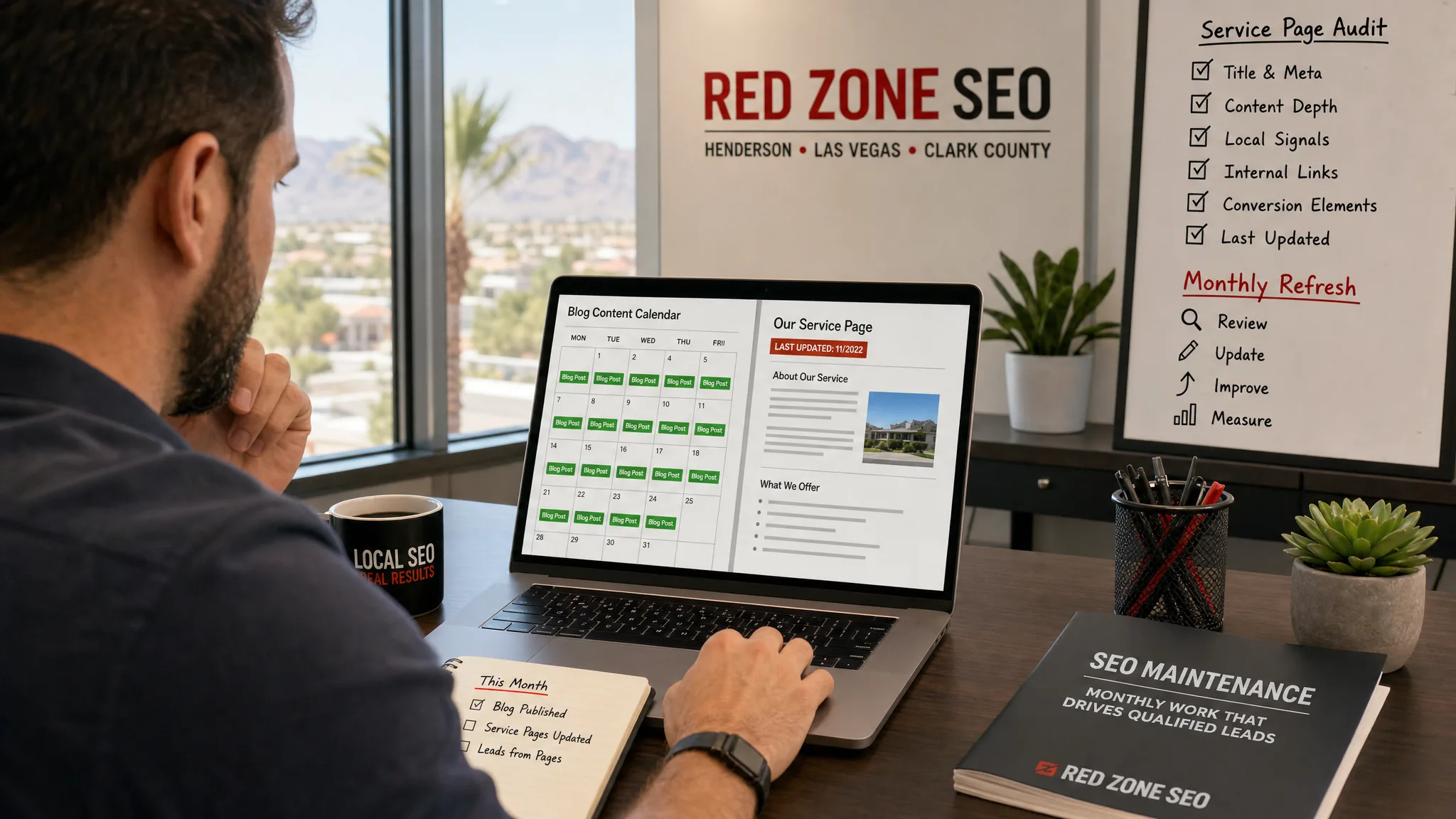
A Henderson company that publishes a blog post about a problem can use that article to earn attention. The matching service page should then carry the conversion work: explaining the solution, clarifying scope, confirming local relevance, and offering a usable next action.
For more guidance on site structure, review Red Zone SEO’s article on how to structure service pages before adding local SEO blog content.
Signs a Henderson Business Service Page Needs an Update
An older page does not automatically need to be rewritten. Age by itself is not the issue, and frequent edits do not automatically improve rankings. A page needs attention when its information, search intent, usability, local relevance, or conversion path no longer supports the customer’s decision.
Warning signs to check now
- The page describes an old version of the service. Your process, priorities, staff workflow, service territory, or qualification requirements have changed, but the page still reflects the past.
- The copy is thin or generic. The page says you provide excellent service but gives little practical information about what that means for a prospective customer.
- The page no longer matches search intent. A person looking for a specific service finds a page that reads like a broad company overview instead of a direct answer about that service.
- The local details are unclear. A Henderson-focused business page does not explain the relevant city, nearby communities, service-area limits, or local considerations where appropriate.
- Important proof or context is missing. The page lacks current process details, customer preparation guidance, practical FAQs, or other accurate information that helps a visitor evaluate the service.
- The calls to action are weak or buried. A visitor must scroll through unrelated copy or return to the header to understand how to reach the business.
- The page has no meaningful internal links. It is disconnected from helpful blog posts, related services, location pages, or supporting resources.
- Blog posts cover the subject better than the service page. The informational content is more complete than the page intended to generate inquiries.
- Analytics show interest without action. A page receives visits but produces few calls, forms, or other conversion signals relative to its purpose.
For example, a Henderson home-service business may have several blog posts about symptoms homeowners notice, but the main repair page may never explain the repair process, service availability, or what information to provide when calling. A professional service firm may publish articles about common client questions while its primary service page still uses vague language from several years ago. In both situations, visitors can learn from the blog but may not get the confidence or direction needed to become leads.
A self-audit checklist for outdated service pages SEO issues
Before assigning another blog topic, review your most important service pages with this checklist:
- Is the service description accurate as of today?
- Does the title and main heading clearly identify the service and its intended customer?
- Does the opening explain the customer problem the page addresses?
- Are the page’s claims specific, supportable, and free of vague filler?
- Does the content address the questions qualified prospects raise before contacting you?
- Are local references useful and accurate rather than added solely for repetition?
- Are the phone number, form, hours, service-area details, and other contact information current?
- Is there a clear call to action near the point where a visitor is ready to act?
- Do relevant blog posts link to this service page using natural, descriptive anchor text?
- Does the page link to a small number of genuinely helpful supporting resources?
- Does the page work well on a phone, including buttons, forms, and navigation?
- Is the page distinct from other service pages, rather than a near-duplicate with the location name changed?
If several answers are “no,” the page is a stronger candidate for a service page content refresh than another standalone article.
What to Refresh Before Publishing Another Blog Post
When a page needs maintenance, prioritize substantive improvements over surface changes. Do not replace wording merely to make the page appear fresh. Do not copy an entire blog post onto the service page. Instead, improve the page for the visitor who is close to making a decision.
1. Confirm the page’s primary purpose
Each core page should have a clear job. Is it meant to generate calls for one service? Explain a service category? Help visitors select between related options? Support a city-specific audience? A service page with too many competing purposes can become difficult for both users and search engines to understand.
Review the searches and questions that lead people to the page, then compare them to the page’s actual content. If people want a specific solution and the page mostly discusses general education, move the educational material to supporting content and make the service page more direct.
2. Update the information that affects a buying decision
Refresh the details that visitors rely on. This can include current service scope, how inquiries are handled, what customers should prepare, eligibility or availability considerations, common concerns, and the appropriate next step. Keep language accurate and avoid promises that the business cannot verify.
If services or local coverage have changed, update website pages alongside the corresponding business information managed elsewhere. Consistency matters because customers may compare details across your site, your Google Business Profile, and other local listings before they make contact.
3. Add focused FAQs where they remove friction
Frequently asked questions can help a service page when they answer questions a qualified buyer actually has. Useful examples include whether a consultation is needed, what happens after the first call, what information helps the business evaluate the request, or whether a service is appropriate for a particular situation.
FAQs are not a reason to pile every keyword variation onto the page. Keep them concise, accurate, and tied to the service decision.
4. Repair internal links and conversion paths
Every relevant blog post should give the reader a logical path toward the service that solves the problem discussed. A blog article about a recurring issue can link to the matching service page. A guide comparing options can link to the relevant service category. The service page can link back to a related article for visitors who are still researching.
Also review calls to action. A visitor should not need to guess whether to call, submit an inquiry, request an assessment, or book time with the business. On a mobile device, that clarity is especially important.
5. Check technical and on-page basics
Content alone cannot solve every page problem. Confirm that the page is indexable, uses a descriptive title and heading, loads reliably, has no broken links, and can be reached through normal site navigation. Review duplicate pages and conflicting service or city pages that may confuse the site’s structure.
How Blogs and Service Pages Should Support Each Other
The best approach is not blog posts versus service pages. It is a connected content system in which each page type handles the stage of the customer journey it is best suited for.
A blog post can address an early question. A service page can explain the available solution. A location or service-area page can add relevant context when it genuinely helps a local searcher. Together, they guide a prospect from research to action without forcing the same message onto every page.
A simple internal-linking model
- Start with the customer question. Publish a blog post only when it answers a useful question related to a core service.
- Identify the destination page. Before the blog goes live, choose the appropriate service page it should support.
- Link naturally in context. Explain why the reader may want the service, then link to the relevant page using descriptive language.
- Link back selectively. On the service page, point to one or two articles that help hesitant prospects understand a related concern.
- Review performance as a path, not isolated URLs. Look at whether readers move from support content to service content and whether those service-page visits generate useful inquiries.
For example, a Henderson business could publish an article explaining how to recognize a service problem. Near the point where the article discusses solutions, it can direct readers to the corresponding service page. That service page should not repeat the article word for word. It should explain the company’s service, local fit, process, and contact path.
This is a more purposeful form of content marketing for small businesses than publishing unrelated topics simply to increase the total number of posts.
A Practical Monthly SEO Maintenance Routine
Small businesses do not need to rewrite every service page each month. A manageable routine is to monitor a few core pages monthly and complete deeper reviews on a quarterly calendar. The right workload depends on the size of the site and how frequently the business changes, but consistency is more useful than letting years pass without a review.
Monthly: check priorities and friction points
- Review the pages tied to your highest-priority services.
- Check for broken forms, outdated phone numbers, incorrect details, and poor mobile calls to action.
- Review new blog posts and add relevant links to the correct service pages.
- Check whether newly published content accidentally competes with a core service page for the same intent.
- Note recurring customer questions from calls, emails, and sales conversations that may justify a page clarification or FAQ.
Quarterly: conduct a structured service-page review
Set aside time each quarter for a deeper review of a small group of revenue-driving pages. A simple calendar can prevent neglect:
- Quarter one: Review your top service page, its primary call to action, and all supporting blog links.
- Quarter two: Review the next priority service page and its relevant Henderson or Clark County context.
- Quarter three: Review related service pages for overlap, missing internal links, and outdated FAQs.
- Quarter four: Review the full conversion path, including mobile usability, contact options, business details, and the blog-to-service-page journey.
Keep a basic record of what changed and why. This helps your team avoid random edits and makes it easier to connect updates to genuine customer needs. If a page is already accurate and effective, leave it alone rather than changing it for the sake of activity.
What can be handled in-house
Business owners and internal marketing teams are usually best positioned to update factual information. They know when service scope changes, which questions prospects ask, which areas are served, and what the real customer process looks like. They can also flag confusing forms, missing contact information, and outdated descriptions.
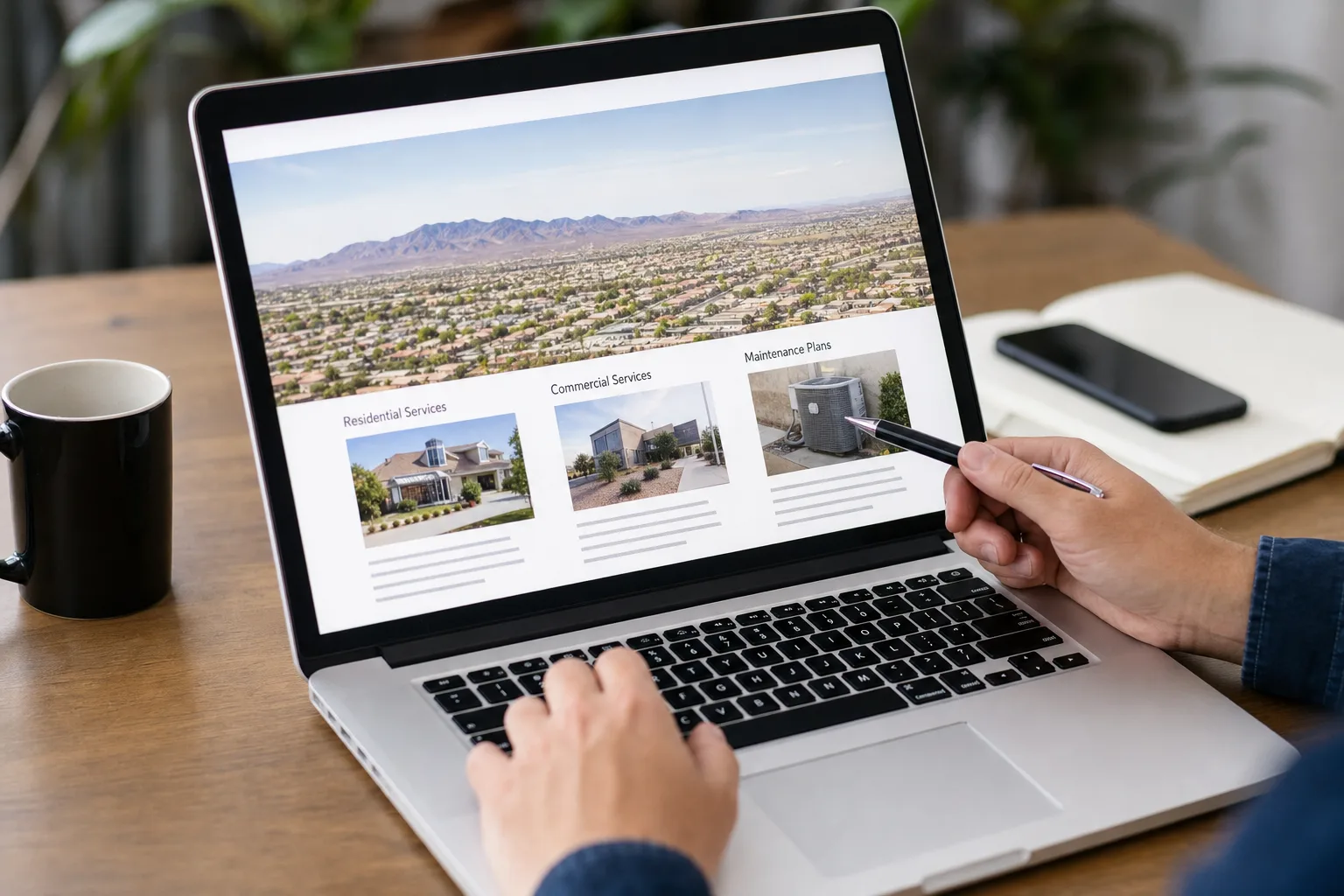
An in-house team can often handle routine link additions, FAQ updates, minor copy clarification, and quarterly checks using the audit list above. The key is to give the work a schedule rather than treating it as an afterthought.
When an Outside SEO Review Makes Sense
Professional review is useful when you know pages are underperforming but cannot tell whether the issue is content, local relevance, search intent, internal linking, technical setup, conversion design, or a combination of factors.
An outside perspective can also help when multiple services overlap, different city pages seem too similar, blog content has grown without a clear structure, or the business has limited internal time to review the site carefully. A useful review should not begin with generic promises. It should identify the priority pages, examine how they support the actual business goals, and explain what should be repaired first.
For businesses seeking ongoing support, Red Zone SEO provides SEO services for Henderson businesses with attention to local relevance, service-page structure, content marketing, and practical maintenance priorities.
Frequently Asked Questions
Should a small business update service pages or publish more blog posts first?
If your primary service pages are thin, outdated, poorly linked, or unclear about how a prospect should contact you, address those pages first. Blog posts can still be valuable, but they should support a conversion-ready destination. Publishing more articles before fixing that destination can add traffic without improving qualified lead opportunities.
How often should service pages be reviewed for SEO?
Review priority service pages at least quarterly, with lighter monthly checks for broken links, business detail changes, new customer questions, and new blog content that should link to them. Pages may need earlier attention when the service, service area, customer process, or conversion path changes.
What should be updated on an old local service page besides the copy?
Review contact details, calls to action, forms, page titles, headings, mobile usability, internal links, related service links, service-area references, FAQs, and technical accessibility. The page should also remain consistent with the business’s current local presence and service information.
Can outdated service pages hurt leads even when blog traffic is increasing?
Yes. Blog traffic may come from people researching broad questions, while leads often depend on high-intent visitors reaching a service page that is clear, current, and easy to act on. If that page is vague or disconnected from the blog, visitors may leave without contacting the business.
What does an SEO service-page review typically include?
A practical review generally examines search intent, page purpose, service information accuracy, local relevance, headings, internal links, supporting content, calls to action, mobile experience, duplicate-content risks, and technical basics. The result should be a prioritized repair plan, not a list of unnecessary changes.
Diagnose the Service-Page Gap Before Adding More Blog Content
If your Henderson business has an active blog but core service pages are not producing enough qualified leads, do not assume the answer is simply to publish faster. First, determine whether your priority pages are being neglected: their intent alignment, current details, internal links, local relevance, and conversion paths may all need attention.
Red Zone SEO can review your service pages and content path to help identify what should be repaired before more blog production is added. Call (702) 489-0881 to discuss whether your most important pages are doing the work your content marketing is supposed to support.


