

FAQ: How Often Should a Las Vegas Business Refresh SEO Service Pages That Already Rank?
A service page that ranks in Google or brings in calls can still be costing your business leads if the information on it is no longer accurate. An old promotional price, a former team member, a discontinued service, or an outdated service area can create doubt at the exact moment a potential customer is deciding whether to call.
For small businesses in Las Vegas, Summerlin, and throughout Clark County, outdated service page SEO is not a reason to rewrite every page from scratch. It is a reason to review the pages that matter most, correct what is inaccurate, and protect the search visibility those pages have already earned.
The practical answer: review high-value service pages at least quarterly, review time-sensitive details immediately when they change, and conduct a broader content review at least once per year. Pages with active promotions, prices, staff references, limited availability, or multiple locations may need more frequent checks.
Why Old Service-Page Details Create a Real Business Problem
Ranking is only part of the job. A service page also has to help a real person make a decision. If a Las Vegas homeowner, patient, client, or buyer reaches a page that contains old information, the page may still receive traffic while converting fewer visitors into calls or form submissions.
That is why outdated website content is both a conversion issue and an SEO maintenance issue. Search visibility gets a prospect to the page. Accurate information gives that prospect a reason to trust the business once they arrive.
Consider a few common situations:
- A Summerlin service company ranks for a valuable repair service but still advertises a seasonal offer that ended months ago.
- A Las Vegas professional practice has a service page featuring a provider who no longer works there.
- A multi-location business has separate service pages that list the wrong office, outdated hours, or an old service area.
- A business changed its service packages but kept older wording that promises an option it no longer provides.
- A page’s call to action sends visitors toward a phone number, form, or booking process that is no longer the preferred path.
Each problem can lead to avoidable friction. A visitor may call expecting an expired deal, ask for a service that is no longer available, or leave when the page does not match what they see elsewhere online. In local markets, that loss of confidence can be enough for a customer to continue searching and choose another nearby business.
For businesses using content marketing for small businesses, service-page accuracy should be part of the ongoing work. Helpful content is not limited to publishing blog posts. It also includes keeping the pages closest to a call, appointment request, quote request, or purchase decision useful and current.
Google’s guidance emphasizes creating helpful, reliable, people-first content. In practical terms, that means a service page should accurately explain what a business offers now, not what it offered two years ago. Updating pages solely to chase rankings is not a sound strategy. Updating them because customers need correct, clear information is a necessary part of local business website maintenance.
The Types of Outdated Information That Need Attention First
Not all aging content creates the same level of risk. A dated sentence about a past event is different from a current service page showing an incorrect price or offering a service your business stopped providing. When time and budget are limited, start with the details that could directly change a customer’s decision.
1. Pricing, Discounts, and Expired Offers
Old pricing on a website is one of the highest-priority issues to review. This includes introductory rates, package prices, financing language, coupons, percentage-off offers, waived-fee promotions, and “limited-time” messaging that no longer applies.
If an offer has expired, remove it or replace it as soon as the business confirms it is no longer valid. Do not leave it online until the next monthly marketing meeting. A customer who sees a price or offer on your site has a reasonable expectation that it is current.
If pricing varies by scope, location, condition, or customer needs, the page should explain that clearly rather than presenting an overly broad statement that may be misunderstood. Businesses should verify all pricing language internally before changing it. Do not casually edit historical claims, rate language, or promotional terms without confirming the correct current information with the business owner or responsible team member.
2. Discontinued, Changed, or Limited Services
A ranking page may target a service that is no longer offered, offered only in certain areas, or delivered differently than before. This is common when a company narrows its focus, adds new packages, changes vendors, updates equipment, or stops serving a specific customer type.
Do not automatically delete a successful page because the business has changed. First, determine which of these situations applies:
- Update: The service still exists, but details, scope, qualifications, process, or availability have changed.
- Redirect: The old service is no longer available, but there is a clearly relevant replacement service page that would help the visitor.
- Retire: The service is permanently gone, there is no appropriate replacement, and keeping the page live would mislead visitors.
A redirect should lead users to the closest relevant current page, not simply to the homepage. If there is no meaningful alternative, an SEO review can help determine the best way to retire the page while minimizing confusion for search engines and users.
3. Former Employee Names, Photos, and Credentials
Former employee names and photos generally should not remain on an active service page when they imply that person is still available to serve customers. The same applies to provider bios, team references, and “ask for” language attached to someone who has left.

There are exceptions. A business may retain verified historical references in an archive, press mention, or past-event content when the context makes it clear that the information is historical. The key is not to alter historical claims without verification and not to make a current service page appear current when it is not.
For active pages, either replace the outdated staff reference with confirmed current information or revise the section to explain the service without centering it on a former employee.
4. Incorrect Locations, Service Areas, Hours, and Availability
Clark County businesses often serve a mix of Las Vegas, Summerlin, North Las Vegas, Summerlin, Paradise, and surrounding areas. Location accuracy matters especially for multi-location businesses. A page that lists the wrong office address, service area, service radius, hours, or availability can create poor leads and unnecessary calls.
Review each location-specific service page independently. A service available in Las Vegas may not be available at a Summerlin office. A special offer may apply in one location but not another. Copying one page across multiple markets without verifying the local details can create both customer confusion and weak local relevance.
5. Testimonials, Reviews, and Calls to Action
Testimonials should be reviewed for accuracy, context, and permission. Do not edit a customer’s statement in a way that changes its meaning. If a testimonial refers to a discontinued service, former provider, old location, or past promotion, consider whether it still supports the current page.
Also verify every call to action. Check phone numbers, contact forms, quote-request links, booking links, email addresses, and instructions such as “visit our office” or “call for same-day availability.” A ranking page with a broken or misleading next step wastes the attention it earned.
How Stale Prices, Offers, and Staff Details Affect Trust and Leads
Customers do not separate marketing information from operational information. If a service page says one thing and the business says another when the customer calls, the customer sees a mismatch. Even if the explanation is reasonable, the business has to work harder to rebuild trust.
For example, a prospective customer may find a Las Vegas service page through search, see an advertised package or discount, and call expecting that exact offer. If the offer expired long ago, the call may turn into a pricing disagreement instead of a qualified lead. The same problem can happen when a page names a specialist who left the company or describes a discontinued service.
These problems can affect more than a single inquiry:
- Visitors may leave quickly if the page appears neglected.
- Front-office staff may spend time explaining inaccurate website information.
- Sales teams may receive leads that are poorly matched to the current service lineup.
- Customers may hesitate to submit a form if they are uncertain about pricing, availability, or location.
- Multi-location businesses may route prospects to the wrong branch or market.
Advertising claims, offers, and pricing should be reviewed carefully. The Federal Trade Commission provides guidance on truthful advertising and pricing practices, which reinforces a basic operational principle: promotional and service information should not be misleading. Businesses should have a clear internal owner for approving changes to pricing, eligibility, service scope, and promotional wording before the website is updated.
This does not mean every service page needs lengthy pricing tables. Some services require custom quotes. But the language should match reality. If a quoted price depends on an inspection, project size, service location, materials, urgency, or other factors, say so plainly. Clear expectations can qualify leads without making promises the business cannot keep.
Does Updating a Ranking Page Hurt SEO?
Usually, necessary accuracy updates do not require sacrificing a page that already ranks. In fact, keeping useful service information current is generally a more sensible choice than preserving inaccurate content simply because the page has search visibility.
The risk comes from changing too much without a plan. A full rewrite can unintentionally remove useful topical detail, weaken headings, change search intent, delete internal links, or eliminate the information that made the page relevant in the first place. That is why a necessary accuracy update is different from an unnecessary full rewrite.
A Necessary Accuracy Update
A focused update corrects details that customers rely on while preserving the page’s central subject and purpose. Examples include:
- Removing an expired promotion and replacing it with current, verified wording.
- Correcting a service area or location reference.
- Updating a former staff member’s name, photo, or role.
- Clarifying which services are currently available.
- Repairing a phone number, form link, or appointment instruction.
- Updating a paragraph that no longer reflects the business process.
An Unnecessary Full Rewrite
A full rewrite is often unnecessary when the page still accurately addresses the same service, matches the searcher’s intent, receives meaningful impressions or visits, and contains useful information. Replacing every section merely because the page is old can create avoidable SEO risk and consume budget better used elsewhere.
Before making larger changes, record the page URL, title tag, main headings, target service, internal links, calls to action, and current performance indicators. Then update the necessary facts first. If the page needs a broader overhaul, make changes in a deliberate way rather than removing successful content blindly.
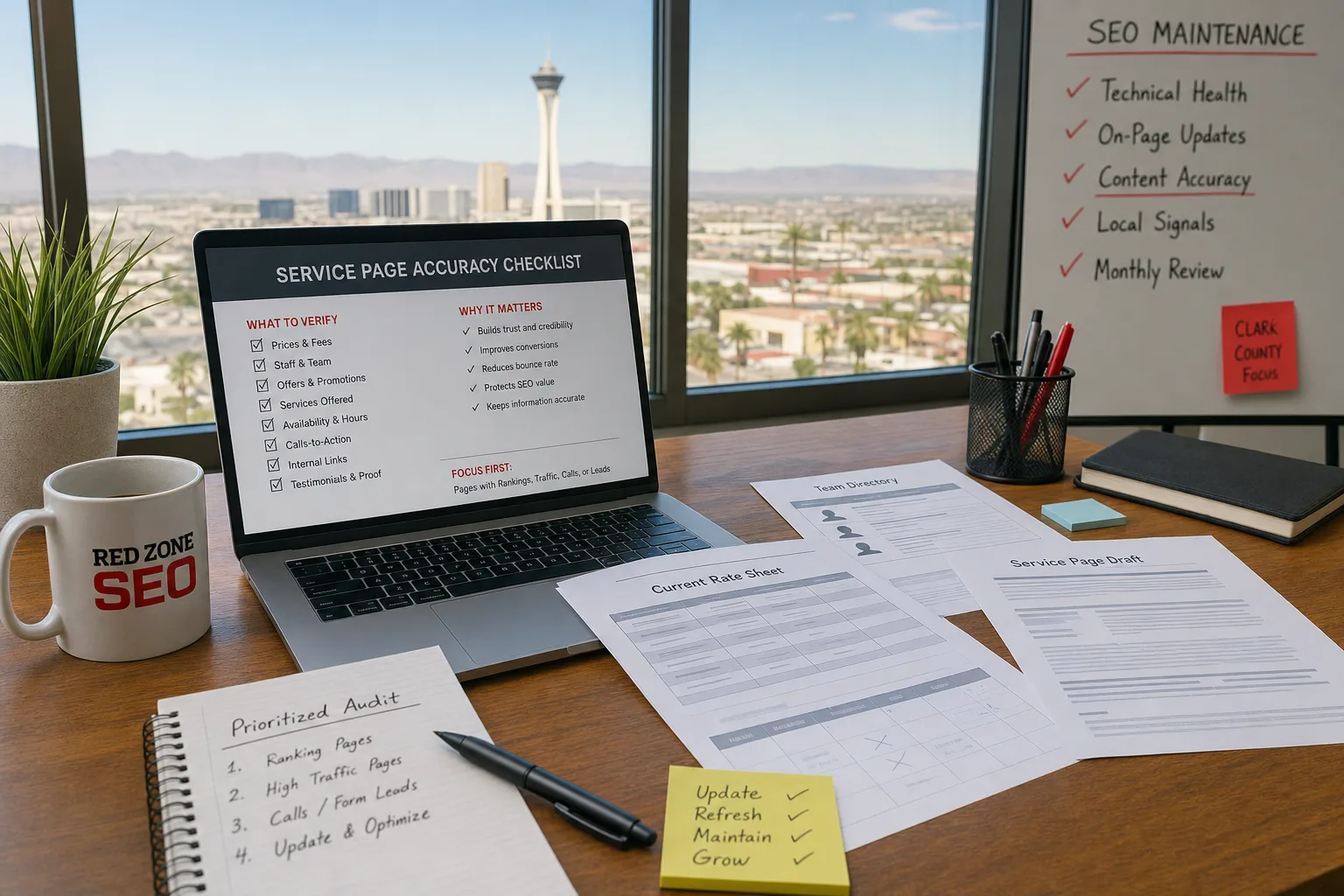
Content updates can protect trust, improve clarity, and maintain relevance. They do not guarantee immediate ranking gains. Search results can change for many reasons, including competition, search demand, technical site issues, location, and how well the page meets the searcher’s needs. The goal is to protect a valuable business asset while making the page more reliable for visitors.
For context on balancing local relevance with broader search visibility, read local SEO versus traditional SEO for Las Vegas businesses. A strong page should be useful to the searcher first while still clearly communicating where and how the business serves customers.
A Practical Service-Page Refresh Checklist for Clark County Businesses
A service page content audit does not need to begin with every URL on the site. Start with the pages that already have the greatest business value: pages that rank, receive search impressions, draw visits, generate calls, produce form submissions, support quote requests, or explain a high-value service.
Use this checklist for each priority page.
Step 1: Identify the Pages Worth Reviewing First
- List primary service pages and location-specific service pages.
- Prioritize pages that receive organic traffic or rank for service-related searches.
- Include pages mentioned by callers, sales staff, front-desk staff, or location managers.
- Review pages that send visitors toward a pricing page, contact form, appointment process, or quote request.
- Flag pages for services with recent operational changes.
A simple priority system is useful:
- Priority 1: Pages with traffic, rankings, calls, leads, current offers, visible prices, or time-sensitive availability.
- Priority 2: Important core services with limited activity but a clear role in the sales process.
- Priority 3: Older supporting pages with no current business value, no traffic, or uncertain accuracy.
Step 2: Verify Customer-Facing Facts
Check the following items against current business information, not against assumptions or old marketing files:
- Pricing: Rates, starting prices, fees, discounts, coupons, financing references, package descriptions, and price qualifiers.
- Availability: Current appointment availability statements, turnaround claims, seasonal capacity messages, emergency-service wording, and eligibility requirements.
- Locations: Office addresses, service areas, branch names, location-specific services, hours, and directions.
- Testimonials: Whether each testimonial remains relevant, accurately represented, and appropriate for the current service page.
- Calls to action: Phone numbers, form links, booking instructions, quote requests, and what customers should expect after contacting the business.
- Staff and ownership references: Names, photos, titles, bios, credentials, and team-related language.
- Services: Current offerings, exclusions, package names, service process, and the types of customers served.
Step 3: Preserve What Is Still Working
Keep the parts of the page that remain accurate and useful. That may include the main topic, well-structured headings, service explanations, local context, FAQs, internal links, images managed elsewhere on the site, and clear conversion paths.
When an old offer is removed, do not automatically replace it with vague sales language. Replace it with useful current information. For example, a business could explain what the service includes, when a quote is necessary, what service area applies, or what the next step looks like.
Step 4: Match Changes Across Relevant Business Channels
When a material detail changes, review the other places where customers may see it. That can include location pages, pricing pages, Google Business Profile information, social profiles, paid advertising, email templates, appointment tools, downloadable brochures, and printed materials.
For multi-location businesses, create a simple approval process. A location manager or operations contact confirms local details; the marketing team updates the relevant pages; and someone verifies the completed changes. This reduces the chance that Las Vegas, Summerlin, and Clark County pages drift out of sync.
Step 5: Record the Change and Recheck the Page
Maintain a basic change log with the page URL, change date, what was changed, who verified it, and whether related locations or pages were checked. This is especially helpful when several team members manage content or when a business has many service lines.
After publishing, check the live page on desktop and mobile. Confirm that the updated wording appears correctly, buttons work, forms submit, and the page still directs visitors toward the right next step.
How Often to Review Pages That Already Rank
There is no one calendar that fits every business, but the following schedule is practical for most local businesses in Clark County.
Update Immediately When a Material Detail Changes
Do not wait for a quarterly review if any of these change:
- A promotion or discount expires.
- A posted price, package, or fee changes.
- A service is discontinued or replaced.
- A staff member featured on the page leaves or changes roles.
- A location opens, closes, moves, changes hours, or changes its service area.
- A phone number, contact process, booking link, or call to action changes.
- Availability language is no longer accurate.
Expired offers should be removed as quickly as possible once they are no longer valid. If the offer has a defined end date, schedule the update before that date arrives. This is less expensive and less disruptive than correcting customer confusion afterward.
Review High-Value Service Pages Quarterly
Quarterly is a useful rhythm for pages that produce impressions, traffic, calls, form leads, or quote requests. It is frequent enough to catch drift in operational details without forcing a monthly rewrite cycle.

During a quarterly check, focus first on accuracy, conversion paths, location details, current offers, and service descriptions. You do not need to change copy just to show that work was done. Make a revision only when there is a real improvement or correction to make.
Conduct a Broader Annual Content Review
At least once per year, review the larger service-page system: duplicated location copy, obsolete service pages, thin pages, outdated internal links, pages with overlapping intent, and content that no longer aligns with the business’s current priorities.
This is also the right time to decide whether certain pages should be consolidated, redirected, expanded, or retired. Small businesses can often handle this work in phases. Multi-location organizations may need a more structured audit so the same issue does not repeat across dozens of pages.
Regular reviews are part of the larger decision between isolated repairs and ongoing maintenance. Our guide to one-time SEO fixes versus monthly SEO retainers explains why some issues can be handled as a focused project while other sites benefit from a prioritized monthly process.
When a Content Refresh Needs an SEO Review Instead of a Quick Edit
A quick edit is appropriate when the change is contained and verified: replacing an old phone number, removing an expired offer, correcting business hours, or updating a former employee reference.
An SEO review is more appropriate when the change could affect how a page is understood by search engines or how it fits into the rest of the site. Consider a review when:
- The page ranks or receives substantial impressions for important service searches.
- You plan to change the primary service topic, title tag, main heading, URL, or page purpose.
- A discontinued service needs to be redirected or removed.
- Several service pages target nearly identical terms or use nearly identical copy.
- A Las Vegas page and a Summerlin page contain conflicting location or service information.
- You are changing pricing language across multiple pages.
- The page has traffic but few calls, quote requests, or form leads.
- You need to preserve useful ranking content while updating the business model or service lineup.
An effective review should not begin with a generic promise to “optimize everything.” It should identify the pages with the highest risk, verify the factual changes with the business, preserve content that is still working, and prioritize fixes based on lead impact.
If you are evaluating outside help, ask how the provider distinguishes factual updates from a full SEO rewrite, how they document redirects and retired pages, how they verify location-level content, and how they prioritize pages that already receive attention from searchers. Those are useful questions to include when considering what should be included in an SEO proposal.
Frequently Asked Questions About Outdated Service Page SEO
Will changing prices or service descriptions on a ranking page hurt its SEO?
Changing accurate business details is usually better than leaving misleading information in place. A focused update to pricing, scope, availability, or service descriptions does not require discarding the page’s successful structure. The greater risk is making broad, unplanned changes that remove useful content, shift the page away from its original purpose, or create a poor redirect path. Preserve what is accurate and valuable, then update only what needs to change.
How quickly should a business remove an expired offer from its website?
Remove or update an expired offer immediately after it is no longer valid. If the offer has a known end date, prepare the replacement content in advance. Check service pages, location pages, pricing pages, ads, forms, and any other customer-facing channel where the offer appears.
Should former employee names and photos stay on a service page?
Not if the page makes visitors believe that person is still part of the current service team. Replace the information with verified current details or revise the page so it accurately describes the service without the outdated staff reference. Historical content can sometimes remain in an appropriate archive or past-event context, but it should be clearly historical and verified.
What should a Clark County business review first when it has many service pages?
Start with the pages that drive the most business value: pages with rankings, impressions, organic visits, calls, form leads, quote requests, visible prices, promotions, or location-specific details. Then review pages tied to recently changed services, staff, locations, or availability. This approach protects the pages most likely to affect revenue before spending time on low-priority content.
Can Red Zone SEO update old service pages without starting the SEO strategy over?
Yes. A practical content review can focus on the pages that already matter, identify inaccurate details, and prioritize updates without assuming the entire SEO strategy needs to be rebuilt. Some pages only need verified corrections. Others may need a more detailed review of page structure, targeting, internal links, local relevance, redirects, and conversion paths.
Protect the Search Visibility You Have Already Earned
A ranking service page should not be left untouched simply because it is performing in search. If it contains an old price, expired offer, former employee, incorrect location, discontinued service, stale testimonial context, or broken call to action, it can undermine the trust that search visibility worked to create.
Red Zone SEO can review the service pages that drive impressions, calls, and quote requests for your Las Vegas, Summerlin, or Clark County business. The goal is to identify the highest-risk inaccuracies, separate quick repairs from pages needing a deeper SEO review, and prioritize practical fixes without rewriting successful pages blindly.
To have the issue diagnosed before outdated information costs more leads, call Red Zone SEO at (702) 489-0881 or request a consultation through the Red Zone SEO contact page.


