Ecommerce store SEO is the process of optimizing your online store to rank higher in search engines like Google, driving more qualified traffic and sales without paying for ads. Here's what you need to know:
Key Components of Ecommerce Store SEO:
If you're a small business owner struggling to compete with larger retailers, SEO levels the playing field. While big companies spend millions on ads, you can capture their customers through strategic organic search optimization.
The numbers tell a compelling story. 43% of all ecommerce traffic comes from Google's organic search results, and with global ecommerce sales projected to reach $8 trillion by 2027, the opportunity is massive. Even better, 75% of users never scroll past the first page of search results, meaning top rankings deliver consistent, high-quality traffic.
Unlike paid ads that stop working the moment you stop paying, SEO builds long-term value. According to research on page speed and conversions, websites improving their loading time by just one second experienced an 8.4% boost in conversions.
The beauty of ecommerce SEO lies in its ability to capture customers at the exact moment they're ready to buy. When someone searches for "best running shoes for flat feet," they're not just browsing - they're shopping. Your job is to be there when they search.

Ecommerce store SEO is your digital storefront's secret weapon. While traditional website SEO focuses on getting visitors through the door, ecommerce SEO is all about turning those visitors into paying customers.
Ecommerce store SEO is the art and science of making your online store visible when people search for products you sell. You're not just competing for any traffic - you're fighting for the attention of people who are ready to buy.
When someone searches for "waterproof hiking boots size 10," they've already decided they need boots, they want them waterproof, and they know their size. Your job is to be there at that exact moment.
The numbers are staggering. We're looking at a global ecommerce market heading toward $8 trillion by 2027. Google controls nearly 90% of all web traffic, making search visibility critical for survival.
What sets ecommerce SEO apart is its laser focus on commercial intent. Regular SEO might target someone looking for "how to tie shoes," but ecommerce SEO targets "buy Nike Air Force 1 size 9." One query might lead to a blog read; the other leads to a sale.
While Google Shopping ads might give you a decent 4.6x return on ad spend, SEO delivers something even better: 500-1000% ROI that keeps paying dividends long after you've done the work.
Picture this: You spend $1,000 on Google Ads and get $4,600 in sales. Great! But next month, if you don't spend another $1,000, your traffic disappears. SEO spending that same $1,000 gets $5,000 in sales this month, then $5,000 next month, and the month after that - all without additional ad spend.
75% of users never scroll past the first page of search results, and the top organic result captures nearly 28% of all clicks. When your product appears at the top organically, customers see it as more trustworthy than paid ads.
B2B ecommerce operates differently. Your customers aren't making impulse purchases; they're conducting board meetings about your product. The sales cycle stretches from days to months. A B2B buyer might search for "industrial equipment specifications" months before they search for "buy industrial equipment."
B2C ecommerce is where emotions drive decisions. Your customers might see a product and buy it within minutes. They search for "cute summer dresses" or "trendy phone cases" - terms loaded with emotional intent.
The KPI differences are striking. B2B focuses on lead generation metrics, while B2C measures immediate conversions, average order value, and repeat purchase rates.
Building a successful ecommerce store SEO strategy is like constructing a house - you need a solid foundation before you can add the finishing touches. The most successful online stores follow a systematic approach that starts with understanding their customers and builds outward from there.
Before diving into tactics, consider conducting a comprehensive SEO audit to understand your current position.
Real keyword research for ecommerce requires detective work. Start with Amazon's search bar, which acts like a crystal ball into customer behavior. Amazon processes over 2 billion searches monthly, making its autocomplete suggestions incredibly valuable.
Tools like Helium10 and Semrush take this research to the next level. Helium10 specializes in ecommerce keyword research and can generate hundreds of variations from a single seed term. Semrush reveals the search volume and competition levels that help you prioritize your efforts.
Create a keyword matrix that organizes your findings by commercial intent. Focus heavily on long-tail terms with clear transactional intent. While "shoes" might have massive search volume, "waterproof hiking boots size 10 wide" tells you exactly what the customer wants.
Don't overlook seasonal patterns. Google Trends reveals that searches for "organic dog food" spike 300% in January and drop significantly during summer months.
Your site architecture is the invisible foundation that makes or breaks your ecommerce store SEO efforts. The 3-click rule should govern your architecture decisions. Every product should be accessible within three clicks from your homepage.
Implement a flat hierarchy that flows logically: Homepage leads to main categories, which lead to subcategories (if needed), which lead to individual products.
Clean URLs serve as street addresses for your products. Instead of "yourstore.com/p/x7b9k2m," use "yourstore.com/womens-running-shoes/nike-air-zoom-pegasus."
Breadcrumb trails help users understand where they are on your site and create additional internal linking opportunities.
Internal linking guides both search engines and customers through your store. Use anchor relevance - your link text should accurately describe the destination page while incorporating target keywords naturally.
The reasonable-surfer model tells us that links placed prominently within main content areas carry more authority than those buried in footers or sidebars.
Cross-selling through internal links serves dual purposes - it boosts SEO while increasing average order value. Implement "customers also bought" sections and "frequently bought together" recommendations.
Your ecommerce store SEO success hinges on creating pages that both search engines and customers absolutely love. You're not just optimizing for algorithms - you're crafting experiences that guide shoppers from curiosity to checkout.
Your title tags are your first impression in search results. Keep them under 60 characters and front-load the good stuff. Instead of "Nike Air Max 270 Running Shoes for Men Available Now," try "Nike Air Max 270 - Men's Running Shoes | Free Shipping."
Your meta descriptions are like movie trailers - they need to tell the whole story in under 160 characters while making people desperate to click. "Shop Nike Air Max 270 running shoes with superior cushioning and breathable design. Free shipping on orders over $75. 4.8-star rating from 1,200+ reviews."
Your H1 should match your title tag's intent while reading naturally on the page. Use H2 tags for major benefits and features, then H3 tags for specifications.
Product descriptions deserve 300-500 words minimum of unique, benefit-focused copy. Stop listing features like you're reading a spec sheet. Instead of "waterproof material," explain how it "keeps your feet completely dry during those unexpected downpours."
Ditch generic filenames like "IMG_001.jpg" and use descriptive names like "nike-air-max-270-black-running-shoe-side-view.jpg." Write alt text that describes what's in the image while naturally including your target keywords.
Schema markup tells search engines exactly what they're looking at, which can earn you rich snippets showing prices, ratings, and availability right in search results.
Category pages capture those broader, high-volume keywords that drive serious traffic. Start every category page with at least 300 words of genuinely helpful content.
FAQ sections are pure gold for category pages. They naturally target those long-tail questions people actually search for. Questions like "What's the difference between trail running shoes and road running shoes?"
Weave internal links throughout your category descriptions. When you mention a specific benefit or feature, link to products that showcase it perfectly.
Content marketing transforms your ecommerce site from a simple catalog into a trusted resource. Buying guides are content marketing gold for ecommerce. They target informational keywords while naturally funneling readers toward your products. For more insights on creating compelling content, check out our guide on content marketing for small businesses.
Gift guides tap into seasonal search trends and social sharing opportunities. Create guides for different recipients, budgets, and occasions.
Video content is becoming increasingly important. Research shows that 76% of consumers have purchased a product after watching a video.
Focus on E-E-A-T (Experience, Expertise, Authoritativeness, Trustworthiness) in everything you create. Google's recent updates prioritize content with genuine first-hand experience.
The technical foundation of your ecommerce store SEO can make or break your entire optimization effort. Most store owners focus on keywords and content while ignoring the technical elements that actually determine whether search engines can find, crawl, and index their pages effectively.
53% of mobile users abandon sites that take longer than three seconds to load. Page speed affects your bottom line in two ways: Google uses Core Web Vitals as a ranking factor, and conversion rates drop by 7% for every additional second of load time.
Start with Google's PageSpeed Insights tool. This free resource identifies specific issues slowing down your site and provides actionable recommendations.
Image optimization delivers the biggest impact. Compress all images without sacrificing visual quality, implement lazy loading for images below the fold, and consider using WebP formats.
A Content Delivery Network (CDN) serves your images from servers closer to your customers, cutting load times in half for international visitors.
Mobile optimization extends beyond making your site look good on phones. Google uses mobile-first indexing, meaning they primarily evaluate the mobile version of your site for ranking purposes.
Test your mobile experience using Google's Mobile-Friendly Test tool. Pay attention to Core Web Vitals metrics: Largest Contentful Paint, First Input Delay, and Cumulative Layout Shift.
Ecommerce sites naturally create duplicate content through product variations, category assignments, and filtering options. Canonical tags serve as your primary weapon against duplicate content.
Product variations present a common challenge. When possible, use single product pages with selectable options rather than creating separate URLs for each variation.
Faceted navigation creates complex duplicate content scenarios. Use noindex directives for filter combinations with no search demand, or implement canonical tags pointing to the main category page.
Product schema markup should include essential details like name, description, price, availability, and review ratings. This enables rich snippets that make your products stand out in search results with star ratings and pricing information.
XML sitemaps guide search engines through your site efficiently. Create separate sitemaps for different content types: products, categories, blog posts, and images. Configure your sitemaps to update automatically as you add new products.
Building authority and creating exceptional user experiences work together when it comes to ecommerce store SEO. Search engines want to recommend sites that people actually enjoy using and trust.
Link building for ecommerce requires building trust for transactions. People need to feel confident enough to enter their credit card information, which means the links pointing to your site should come from credible, relevant sources.
The Moving Man Method works beautifully for ecommerce stores. Find broken links on supplier websites, industry resource pages, or competitor sites that have gone out of business. Then reach out with a helpful replacement - your relevant product page.
HARO (Help a Reporter Out) connects you directly with journalists who need expert sources. When a reporter asks about "best practices for choosing hiking boots," and you sell outdoor gear, share genuine expertise without being salesy.
Your supplier and distributor relationships represent untapped link opportunities. Many suppliers maintain partner directories or dealer locator pages where they'll link to authorized retailers.
User-generated content campaigns create natural linking opportunities while building community around your brand. When customers share photos of your products in action, they often link back to your site.
Google's algorithm prioritizes sites that people actually want to use. Core Web Vitals, mobile-friendliness, and overall user satisfaction now directly influence your search rankings.
Site navigation should feel intuitive. Implement a prominent search function with autocomplete suggestions. Create clear category hierarchies that make logical sense, and use filtering options that help rather than overwhelm.
Your internal search functionality deserves special attention because many users prefer searching to browsing. Make sure your search returns relevant results, handles common typos gracefully, and provides helpful suggestions when searches return zero results.
Trust signals throughout your site build the confidence needed for online purchases. Display security badges prominently, showcase genuine customer reviews, provide clear return policies, and make contact information easily accessible.
International expansion opens massive opportunities for ecommerce store SEO, but requires careful technical implementation. Hreflang tags tell search engines which version of your site should appear for users in different countries or languages.
Create genuinely localized content rather than simply running existing pages through Google Translate. Consider local preferences, cultural differences, seasonal variations, and market-specific product needs.
Niche market domination often proves more profitable than trying to compete with Amazon on broad terms. Instead of fighting for "running shoes," consider targeting "barefoot running shoes for wide feet."
Voice search optimization becomes increasingly crucial as smart speakers change how people search. Optimize for conversational queries and question-based searches that sound natural when spoken aloud.
WordPress users looking to expand their ecommerce presence should consider professional WordPress SEO Services to ensure their platform can handle international expansion effectively.
Success in ecommerce store SEO isn't just about implementing strategies - it's about measuring what works, scaling your efforts, and continuously improving based on real data.
Google Analytics 4 has revolutionized how we track ecommerce performance, offering improved ecommerce tracking that follows customers through their entire journey. Setting this up properly gives you X-ray vision into your business.
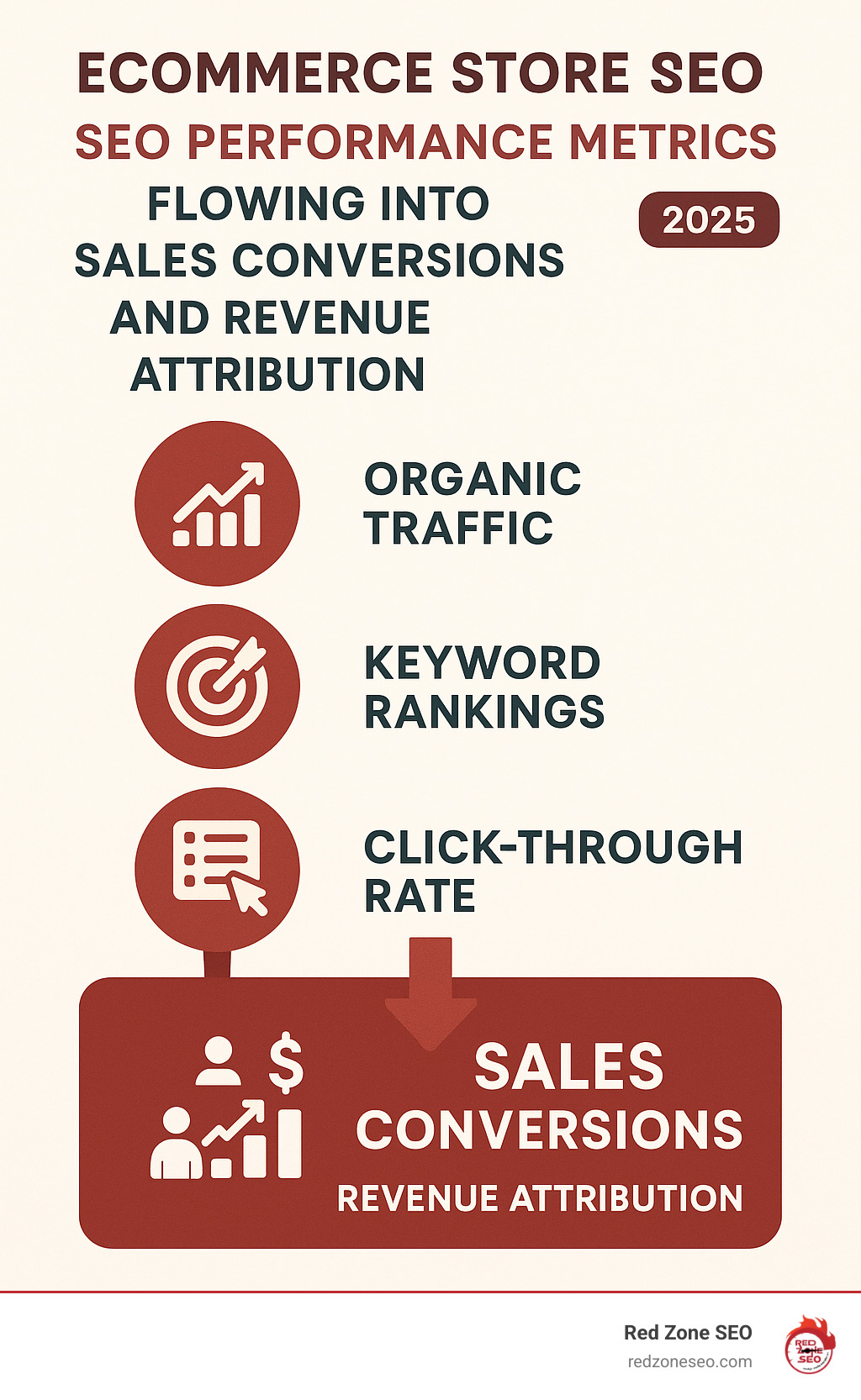
The metrics that matter most tell a complete story. Organic sessions and users show your overall reach, while keyword rankings reveal your competitive position. Click-through rates from Google Search Console tell you how compelling your search listings are.
Conversion rates separate the wheat from the chaff. A keyword that drives 1,000 visitors but zero sales isn't helping your business. Focus on average order value from organic traffic and revenue attribution that ties everything together.
Google Search Console deserves special attention because it's like having a direct line to Google's thoughts about your site. The Performance report reveals trending keywords, declining rankings, and new opportunities.
The smartest ecommerce businesses treat SEO and PPC as dance partners rather than competitors. Your PPC keyword performance data becomes a crystal ball for SEO strategy. Keywords that convert well in paid search often make excellent targets for organic optimization.
Retargeting campaigns that capture visitors from organic search extend the value of every SEO visitor. Someone who found you through Google but didn't buy immediately might need that gentle reminder ad to complete their purchase.
Budget allocation requires thinking about lifecycle coverage. PPC provides immediate results but requires ongoing investment. SEO builds long-term value that continues generating returns months or years after the initial investment.
Index bloat affects many large ecommerce sites. Combat this by regularly auditing your indexed pages and using noindex tags for low-value content like filtered views with no search demand.
Thin content challenges arise when you have many similar products. Instead of fifty nearly identical product pages, create detailed, benefit-focused descriptions that highlight what makes each product special.
Resource limitations affect many small businesses. The solution isn't to do everything - it's to do the right things exceptionally well. Focus on long-tail keywords where you can realistically compete.
Most ecommerce businesses see initial improvements within 4-6 months, with significant results typically appearing after 6-12 months of consistent effort. Technical fixes and on-page optimizations can show results relatively quickly, sometimes within weeks. However, building authority through content creation and link building requires more patience.
Ecommerce SEO focuses on driving sales rather than just traffic, requiring optimization for commercial intent keywords and conversion-focused user experiences. Ecommerce sites face unique technical challenges like duplicate content from product variations and complex site architectures with thousands of pages.
Absolutely. Small businesses have advantages that larger retailers cannot match: agility, specialized expertise, and the ability to create personalized experiences. Focus on long-tail keywords where your specialized knowledge shines. Instead of competing for "running shoes" against Amazon, target "trail running shoes for wide feet."
The journey to mastering ecommerce store SEO doesn't end with reading this guide—it begins here. You now have a comprehensive roadmap that can transform your online store from invisible to irresistible in Google's search results.
Think of SEO as planting seeds in a garden. The technical optimizations and keyword research you do today are like preparing the soil. Your on-page content and product descriptions are the seeds themselves. The authority building and link acquisition efforts? That's the watering and nurturing that helps everything grow.
Start with the foundations first. Don't try to tackle everything at once—that's a recipe for overwhelm and incomplete implementation. Begin with your technical SEO audit to fix any glaring issues that might be holding you back. A beautiful garden won't thrive if the soil is contaminated, and amazing content won't rank if your site has fundamental technical problems.
Once your technical foundation is solid, move into keyword research and on-page optimization. Focus on your highest-value product and category pages first. These are your money-makers, so they deserve priority attention. Perfect these pages before expanding to your entire catalog.
Content creation and authority building come next in your journey. This is where patience becomes your best friend. Building genuine authority takes time, but the compound effect is extraordinary. One well-researched buying guide can drive traffic and sales for years, paying dividends long after you've moved on to other projects.
The beauty of ecommerce store SEO lies in its sustainability. Unlike paid advertising that demands constant feeding with fresh budget, your SEO efforts build momentum over time. That product page you optimize today will keep working for you next month, next year, and beyond.
Data should drive every decision you make moving forward. Set up your tracking systems properly from day one—you can't improve what you don't measure. Google Analytics 4 and Search Console aren't just nice-to-have tools; they're your compass and map in the SEO journey.
Don't get discouraged if results don't appear overnight. We've seen businesses transform their entire trajectory through consistent SEO efforts, but it rarely happens in the first month. The most successful ecommerce stores we work with think in quarters and years, not days and weeks.
Your competitive advantage often lies not in having the biggest budget, but in being more focused and strategic than larger retailers. While big companies get bogged down in bureaucracy and generic approaches, you can pivot quickly, create personalized experiences, and dominate specific niches.
The ecommerce landscape continues evolving at breakneck speed. Voice search, AI-powered shopping experiences, and new Google algorithm updates will reshape how customers find and buy products online. The fundamentals covered in this guide provide a strong foundation, but staying curious and adaptable ensures long-term success.
SEO is both an art and a science. The technical aspects require precision and attention to detail, but understanding your customers' needs and creating genuinely helpful experiences requires empathy and creativity. The most successful ecommerce store SEO strategies blend both elements seamlessly.
Your next action step should be conducting a comprehensive audit of your current situation. Where do you stand today? What are your biggest opportunities? Which technical issues need immediate attention? This honest assessment guides your priority list and helps you allocate time and resources effectively.
At Red Zone SEO, we've guided hundreds of ecommerce businesses through this exact journey. We've seen tiny startups grow into seven-figure businesses and watched established retailers double their organic traffic within months. The strategies work, but only when implemented consistently and strategically.
Every day you delay implementation is another day your competitors gain ground in search results. The opportunity cost of inaction often exceeds the investment required for proper SEO implementation. Your potential customers are searching for your products right now—make sure they find you instead of your competition.
Whether you choose to implement these strategies internally or partner with experienced professionals, the important thing is to start. Perfect is the enemy of good in SEO. A decent optimization implemented today beats a perfect plan that never gets executed.
Ready to turn your ecommerce store into a search engine magnet? Find how our proven process works or reach out to discuss your specific situation. We love helping ambitious business owners open up the massive potential that ecommerce store SEO offers.
The search results are waiting. Your customers are searching. Your competitors are investing. The question isn't whether SEO works for ecommerce—it's whether you'll implement it before or after your competition does.
Start small, think big, and stay consistent. Your future self will thank you for the SEO seeds you plant today.