SEO for SaaS Startups: 3 Pillars to Hero
The SaaS Battlefield: Why SEO is Your Key Weapon
In the fiercely competitive world of cloud software, mastering seo for saas startups isn't just an option; it's a survival strategy. It’s a specific kind of search engine optimization designed to boost visibility, attract targeted traffic, increase leads, and build brand authority for Software-as-a-Service (SaaS) companies.
The SaaS industry is crowded, with new companies launching daily. While many startups turn to paid ads for quick results, this can be expensive, and the traffic stops when you stop paying. SEO, on the other hand, is a long-term play that builds a steady, sustainable stream of organic traffic.
With 93% of online experiences starting with a search engine, SEO helps potential customers find your solution when they need it most. This "free" traffic from Google significantly lowers your customer acquisition costs over time. As one expert notes, "We won’t sugarcoat this – startup SaaS companies need to try really hard, be patient, and be dedicated to their SEO efforts. Indeed, results won’t appear overnight." This highlights the patience required, but the payoff is a strong foundation for continuous growth.
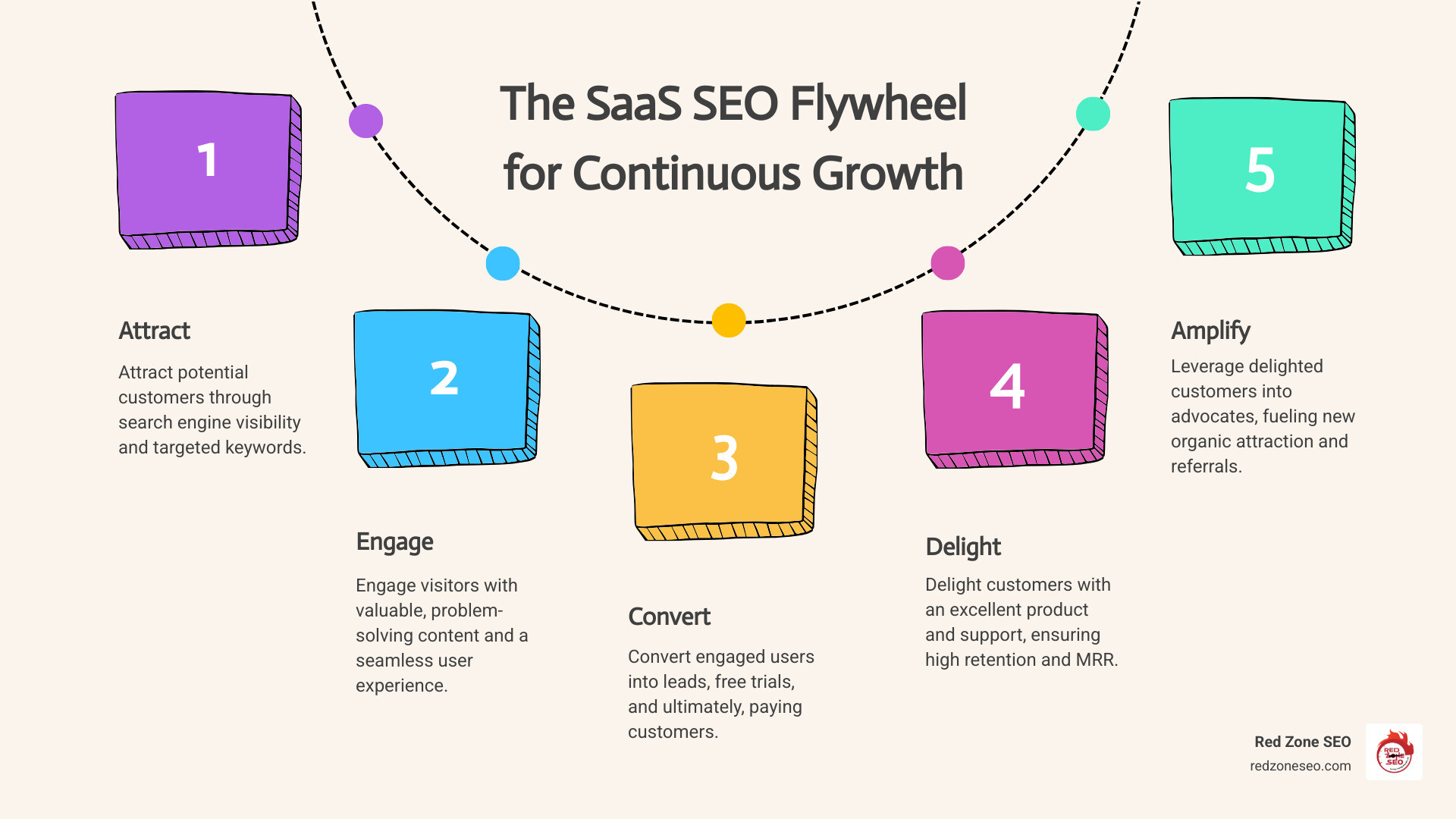
Why SaaS SEO is Your Unfair Advantage in a Crowded Market
Here at Red Zone SEO, founders often ask, "Is seo for saas startups really different from regular SEO?" The answer is a resounding yes! While core principles remain, their application in the SaaS world is unique. Unlike a one-time sale, SaaS businesses thrive on a subscription model, aiming for long-term customer relationships and steady Monthly Recurring Revenue (MRR). This often involves a longer, more considered sales journey, requiring a more patient content and nurturing strategy.
One of the biggest advantages of seo for saas startups is its power to lower your Customer Acquisition Cost (CAC). Paid ads offer quick visibility but can drain your budget, and traffic often vanishes when the campaign ends. Organic traffic, once established, is essentially "free," allowing you to scale sustainably.
SEO is also crucial for building trust. In a crowded market, ranking high on Google signals authority and aligns with Google's emphasis on E-E-A-T (Experience, Expertise, Authoritativeness, and Trustworthiness). Just look at Copy.ai, which grew its organic traffic to 1 million clicks in five months, generating an estimated $98,500 in monthly traffic value. This incredible growth wasn't a happy accident; it was the direct result of a smart, strategic SEO approach specifically designed for the SaaS landscape. You can explore other impressive SaaS content marketing case studies to see the potential.
At Red Zone SEO, we focus on data-driven SEO solutions that deliver qualified leads and grow your MRR. Learn more about how we tailor our comprehensive SEO Services for businesses like yours.
What Makes SaaS SEO Unique?
The special sauce for seo for saas startups comes from a few key ingredients:
- Technical Complexity: SaaS platforms are often intricate web apps. Technical SEO must handle dynamic content and API documentation, ensuring search engines can crawl and index your product correctly.
- Focus on Bottom-of-Funnel (BOFU) Keywords: We heavily target keywords with high purchase intent, like "[your product] alternatives" or "[feature name] software." These terms have high conversion potential, even with lower search volume. As one expert noted, "Offering a Baby Version of Our SaaS Is the #1 Thing That Helped Get Our SEO off the Ground," showing how free tiers can drive strong signals.
- Product-Led Content: Instead of generic articles, we create content that seamlessly weaves your product into the solution. A post on "how to manage agile sprints" would show how your tool simplifies the process. This is tied to user intent mapping, matching content to the user's stage in the buyer's journey (awareness, consideration, or decision).
- Integration with the Product: We often use parts of your product as "free tools" or lead magnets. These attract users, generate backlinks, and introduce them to your core offering.
Here's a quick comparison:
| Feature |
Traditional SEO |
SaaS SEO |
| Primary Goal |
Website traffic, leads, sales |
MRR, customer acquisition, retention, product adoption |
| Keyword Focus |
Broad informational, transactional |
Problem-aware, solution-aware, product-aware, BOFU |
| Content Strategy |
Blog posts, service pages, product descriptions |
Product-led content, comparison pages, feature pages, free tools, case studies |
| Sales Cycle |
Often shorter, direct purchase |
Can be longer, nurturing through trials/demos |
| Technical SEO Needs |
Standard website optimization |
Complex web applications, dynamic content, user accounts |
| Key Metric |
Organic traffic, conversions |
MRR, CAC, free trial sign-ups, feature adoption |
The Crucial Role of SEO in SaaS Growth
For seo for saas startups, the impact is fundamental. It drives high-quality leads by attracting users actively searching for your solutions, which directly increases MRR. It builds brand credibility, positioning you as an expert and helping you compete with established giants. Finally, SEO is about long-term asset building; your optimized content continues to generate leads for years, providing compounding returns. For example, Hotjar's SEO efforts boosted Sales Qualified Leads (SQLs) by 150% and helped them secure over 200 backlinks from unlinked brand mentions.
The Three Pillars of a Powerful SaaS SEO Strategy
Think of your seo for saas startups strategy as a finely tuned machine built on three interdependent pillars: the Engine (Technical SEO), the Fuel (Content), and the Oil (Off-Page SEO). Ignore or under-invest in any one of them and the whole system sputters.

Pillar 1: The Engine (Technical SEO)
The "Engine" is your website’s technical backbone—everything that helps search engines crawl, interpret, and index your pages.
- Site Speed & Core Web Vitals – A one-second delay can tank conversions. We compress images, minify code, and enable caching. Check your site speed with Google’s PageSpeed Insights.
- Mobile Responsiveness – Google now uses mobile-first indexing. A seamless mobile experience is non-negotiable.
- Crawlability & Indexability – Clean
robots.txt, logical internal linking, and no stray 404s ensure bots can reach every important page.
- XML Sitemaps – A living roadmap for search engines. Here’s Google’s official guide to sitemaps.
- Schema Markup – Structured data (pricing, reviews, FAQs) earns rich snippets that improve click-through rate. For SaaS, implementing
SoftwareApplication schema is crucial for telling Google about your product, its price, and user ratings.
- International SEO Signals – If you target multiple countries, using
hreflang tags is essential to tell Google which language and regional version of a page to show to users, preventing duplicate content issues and improving user experience.
We surface every technical gap in a comprehensive SEO Audit before we ever write a single keyword.
Pillar 2: The Fuel (Content Marketing & E-E-A-T)
Content is the "Fuel" that powers visibility, nurtures prospects, and—crucially—demonstrates E-E-A-T (Experience, Expertise, Authoritativeness, Trustworthiness).
- Awareness – Educational articles that tackle pain points without a hard sell.
- Consideration – Comparisons, feature breakdowns, and how-tos that position your product as the logical solution.
- Decision – Pricing pages, testimonials, and case studies that give prospects the final push.
Need help mapping keywords to each stage of the funnel? This in-depth guide on keyword research and the buyer’s journey from Search Engine Journal dives deeper.
To cement authority we build topic clusters: a broad, comprehensive "pillar" page that acts as a hub for a specific topic (e.g., "Agile Project Management"). This pillar page then links out to multiple in-depth "cluster" posts that cover specific subtopics (e.g., "How to Run a Sprint Retrospective," "Best Agile Tools"). This structure signals to Google that you are a definitive source on the subject and improves internal linking.

We also lean heavily on product-led content—tutorials, templates, and free tools that weave your SaaS interface directly into the narrative. It’s education and soft demo rolled into one tidy asset.
Pillar 3: The Oil (Off-Page SEO & Backlinks)
Off-page SEO is the "Oil" that keeps the whole engine humming, primarily through high-quality backlinks—digital votes of confidence.
Industry studies consistently show that sites with more links from unique, high-authority domains dominate the search results. For a deeper dive, check out Search Engine Journal’s comprehensive overview of why backlinks matter.
Our go-to link-building playbook includes:
- Digital PR – We move beyond basic outreach to create newsworthy assets. This could involve surveying your user base to create a unique 'State of [Your Industry]' report, then pitching the exclusive findings to top-tier journalists and publications.
- Guest Posting – Publishing expert content on respected industry blogs in exchange for contextual links. The focus is on quality and relevance, not quantity.
- Unlinked Brand-Mention Reclamation – Identifying mentions of your brand and politely asking for a link (a tactic that netted Hotjar 200+ links).
- Community Engagement – Providing genuine, helpful answers on platforms like Reddit, Quora, Indie Hackers, and Stack Exchange. The key is to build authority by solving problems, not just dropping links. Become a recognized expert in relevant subreddits or forums.
Built over time, a healthy backlink profile cements you as a market authority. Explore our proven Link Building Services to accelerate the process.
A Step-by-Step Blueprint for Building Your SaaS SEO Strategy
Now, let's put it all into action with a practical blueprint. At Red Zone SEO, we often use a "70/20/10 rule" for initial execution: 70% on-page optimization, 20% internal linking and technical fixes, and 10% backlink building. This phased approach ensures efficient and effective efforts.
Step 1: Master Keyword Research and Competitor Analysis
This first step is about understanding what customers search for and who you're competing against.
- Find Buyer Keywords: We hunt for gems like "[your product] alternatives" or "best [feature] software." These terms show high purchase intent and often lead to high-value customers.
- Use Long-Tail Keywords: Instead of broad, competitive "head terms" like "project management," we target specific, long-tail phrases like "best project management software for small teams." These are easier to rank for and attract highly qualified traffic, making up 91% of all Google searches.
- Analyze Search Intent with the 'Jobs to Be Done' Framework: We go beyond basic intent (informational, commercial) to understand the underlying 'job' a user is trying to accomplish. For example, someone searching for "project management software" has the job of "improving team collaboration to hit deadlines." Framing content around solving this core job leads to much higher engagement and conversion.
- Use Powerful Tools: We leverage tools like SEMrush and Ahrefs to uncover opportunities and perform a keyword gap analysis, identifying keywords your competitors rank for that you don't. Other great tools include AnswerThePublic, Google Keyword Planner, and Google Search Console.
Ready to understand your audience? Let us help you start your Keyword Research journey.
Step 2: Create and Optimize High-Value Content
With target keywords identified, we create the content "fuel." We start with a content calendar to map out topics and ensure consistent, strategic production. Every piece of content is optimized using on-page SEO best practices:
- Compelling Title Tags & Meta Descriptions: We craft keyword-rich titles (under 60 characters) and persuasive meta descriptions (under 155 characters) to entice clicks from search results.
- Logical URL Structure: Create clean, descriptive URLs (e.g.,
yourdomain.com/features/team-collaboration) that are easy for both users and search engines to understand.
- Structured Headers & Natural Keyword Placement: Logical headers (H1, H2, H3) outline your content for users and search engines, with keywords woven in naturally.
- Image Optimization: We compress images for speed and use descriptive alt tags to improve visibility.
- Internal Linking: We strategically link to other relevant pages on your site to distribute "link equity" and keep users engaged.
- Compelling Calls-to-Action (CTAs): Clear CTAs like "Sign Up for a Trial" or "Request a Demo" are essential for converting readers into leads.
- Content Promotion: Creating great content is only half the battle. We promote it through email newsletters, social media channels, and targeted outreach to kickstart its visibility and accelerate link acquisition.

Let us help you perfect your Content Optimization and make every word count.
Step 3: Measure, Analyze, and Iterate
SEO for saas startups is not "set it and forget it." It requires continuous measurement and refinement. We focus on key SaaS KPIs that tie directly to revenue:
- Organic visitors, impressions, and clicks
- Keyword rankings (especially for BOFU terms)
- Conversion rates (free trials, demos)
- Monthly Recurring Revenue (MRR) from organic channels
- Customer Lifetime Value (LTV) from organic users
- Branded vs. Non-Branded traffic growth
- Assisted Conversions: In a long sales cycle, SEO often plays a crucial early role. We track how many conversions organic traffic contributed to, even if it wasn't the final click.
We use indispensable tools like Google Analytics and Google Search Console to track these metrics. This constant monitoring allows us to see what's working (e.g., high impressions but low CTR means we should test new titles) and where adjustments are needed. We also prioritize content refreshes and updates. Keeping older articles fresh and accurate is a high-ROI tactic that can significantly boost rankings and traffic.
Ready to track your progress? Get started with Google Analytics and see your data come alive.
Adapting Your SEO Strategy for SaaS Startups Across Funding Stages
In seo for saas startups, there's no one-size-fits-all solution. Your strategy must evolve with your company's growth and funding. At Red Zone SEO, we align our efforts with your business goals at every stage.
Pre-Seed & Seed Stage: Building the Foundation
With tight resources, the focus is on proving product-market fit and attracting early customers. The strategy is about efficient wins.
- Focus: Target specific, long-tail keywords with high purchase intent ("bottom-of-funnel"). These are "quick wins" that bring in qualified visitors who are ready to solve a problem.
- Content: Create content for your primary use cases that directly addresses the core problems your SaaS solves. This means creating detailed 'vs.' pages (e.g., 'YourSaaS vs. Competitor A'), use-case specific landing pages, and tutorials that showcase your product's value. SEO data at this stage can help validate product-market fit for investors.
- Backlinks: Secure early backlinks through guest posts on niche blogs, startup directories (like Product Hunt and BetaList), and leveraging your personal and professional network. A free tool or a "baby version" of your SaaS can be a powerful link magnet.
Series A-C: Scaling for Sustainable Growth
With more funding, the goal is to accelerate growth and boost MRR. The SEO strategy scales up accordingly.
- Focus: Expand to adjacent problems and target broader, "mid-funnel" keywords to capture a wider audience. The goal is to own the conversation around the entire problem space, not just your specific solution.
- Content & PR: Invest heavily in digital PR. This moves beyond simple guest posting to creating large-scale, data-driven content campaigns. Think original research, industry surveys, or interactive tools that become go-to resources for journalists and bloggers, earning high-authority backlinks at scale.
- Optimization: Refine your website experience to drive more free trial sign-ups and demo requests, directly impacting your customer acquisition funnel. This includes A/B testing CTAs, improving onboarding flows, and optimizing pricing pages.
Series D+ & Beyond: Dominating the Market
At this mature stage, the focus shifts to maintaining market leadership and exploring new growth avenues.
- Focus: Defend your top rankings against new competitors through continuous content updates and optimization. Explore programmatic SEO to generate thousands of landing pages for long-tail keywords at scale. For example, a project management tool could programmatically generate pages for 'project management for marketing agencies,' 'project management for construction firms,' and so on, capturing thousands of niche, high-intent searches.
- Audience Expansion: Target "problem unaware" audiences with thought leadership content on broader industry trends to position your brand as an innovator. For global products, implement a robust international SEO strategy.
- Strategy: Use SEO data for market expansion insights, revealing emerging trends and untapped markets to guide overall business strategy. Advanced tactics include sophisticated A/B testing, deep user experience analysis, and creating powerful "link magnet" resources. International SEO at this stage involves a full technical setup (hreflang, ccTLDs vs. subdirectories) and, crucially, culturally adapting and translating content to resonate with local audiences, not just word-for-word translation.
Frequently Asked Questions about SEO for SaaS Startups
Getting started with seo for saas startups can feel like a big leap. Let's clear up some common questions.
How long does it take for SaaS SEO to show results?
SEO is a marathon, not a sprint. You can generally expect to see tangible results, like increased organic traffic and keyword rankings, within 6 to 12 months of consistent effort. Significant impact on MRR often takes 12 to 24 months.
The timeline depends on several factors:
- Competition: Highly competitive niches take longer.
- Budget & Resources: More investment can speed up results.
- Execution Quality: A well-planned, expert strategy yields faster results.
- Website Authority: Older, more established domains tend to rank faster.
- Technical Health: A technically sound site is crucial for ranking.
While early wins are encouraging, the real magic of SEO is its compounding, long-term growth.
What are the most important ranking signals for SaaS websites?
While Google uses hundreds of signals, some are more important for seo for saas startups:
- E-E-A-T (Experience, Expertise, Authoritativeness, Trustworthiness): Google's guiding principle for content quality. Show off your team's deep knowledge and build a brand people trust.
- High-Quality Backlinks: These are "votes of confidence" from relevant, authoritative websites that signal your content is valuable.
- User Experience Signals: This includes Core Web Vitals (site speed, stability) and dwell time (how long users stay). A good user experience is a positive ranking signal.
- Content Relevance and Depth: Create comprehensive content that fully answers a user's query and becomes the go-to resource on a topic.
- Search Intent Alignment: Your content must match what the user is actually looking for (e.g., a comparison post for a "best software" query).
You can dig into Google's Search Quality Evaluator Guidelines for more detail on what they look for.
How can I do SEO for my SaaS startup with a limited budget?
You can still make significant progress with a tight budget by being strategic:
- Focus on long-tail keywords: Target specific, low-competition keywords that have high conversion potential.
- Create exceptional "link magnet" content: Invest your resources in a few truly outstanding pieces of content (e.g., original research, an in-depth guide, a free tool) that earn links naturally.
- Leverage founder expertise: Encourage your team to share their knowledge on LinkedIn, Reddit, Quora, and industry forums to build brand awareness and drive traffic.
- Prioritize DIY on-page and technical SEO: Ensure your site is mobile-friendly, loads quickly, and has proper on-page elements (titles, headers, meta descriptions). Use Google Search Console to find and fix basic errors.
Conclusion: Your Journey to Becoming an SEO Hero
We've covered a lot on our journey through seo for saas startups. You're now armed with a powerful framework for conquering the digital world. By focusing on the three pillars—The Engine (Technical SEO), The Fuel (Content Marketing), and The Oil (Off-Page SEO)—you can build a well-oiled machine for sustainable organic growth.
SEO isn't a quick fix; it's a long-term, high-ROI investment that demands patience, consistency, and a data-driven approach. The payoff is immense: lower customer acquisition costs, a steady increase in MRR, and enduring brand authority that sets you apart in the crowded SaaS market.
At Red Zone SEO, we're passionate about helping businesses like yours thrive. Our data-driven solutions are designed to deliver real, measurable results, changing your startup from a hidden gem into an SEO hero. Whether you're building your dream in Austin, growing in Florida, or making waves in Henderson, Las Vegas, or across Nevada, our team is ready to help.
Ready to start your journey? Let's discuss how our Digital Marketing Agency can build your strategy.