Ecommerce Technical SEO Audit: 2025 Essential
Why Your Ecommerce Store's Technical Foundation Determines Success
An ecommerce technical SEO audit is a deep dive into your online store's technical framework to find and fix issues that stop search engines from crawling, indexing, and ranking your pages. It's the key to opening your store's visibility in a world where 93% of online experiences begin with a search engine.
Think of your website as a house. Content and design are the paint and furniture, but technical SEO is the foundation, plumbing, and wiring. Without a solid technical base, the rest of your efforts can crumble. This is especially true for ecommerce sites, which have unique challenges like thousands of product pages, complex filtering systems, and frequent inventory changes. A single technical mistake can cascade across your entire catalog, making profitable pages invisible to search engines.
The stakes are high. A one-second delay in page load time can cut conversions by 7%. A poor mobile experience drives away a significant portion of the 67% of users browsing on mobile devices. An ecommerce technical SEO audit finds these silent ranking killers before they cause traffic to drop and competitors to surge ahead.
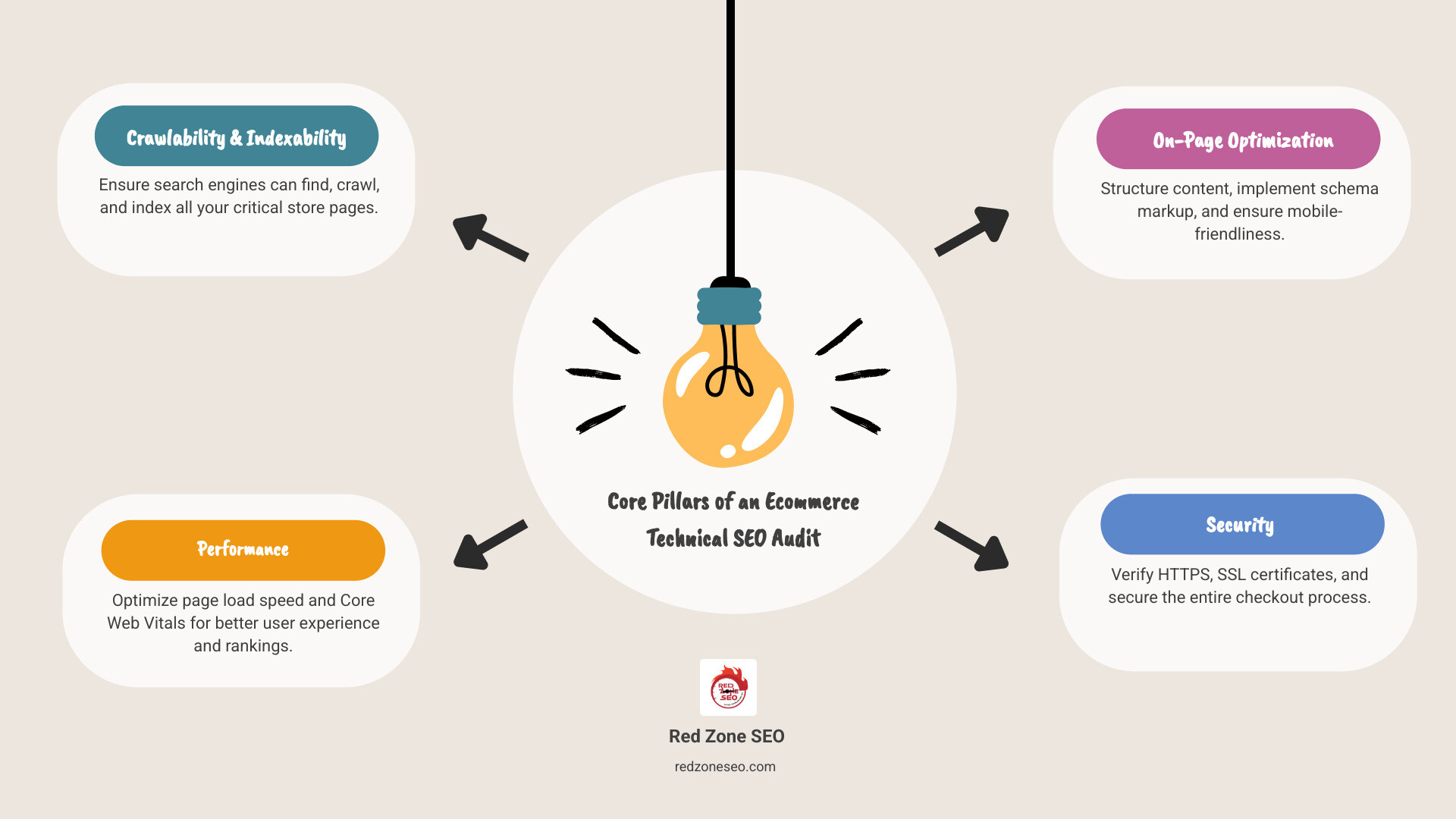
Core Areas of an Ecommerce Technical SEO Audit:
- Crawlability & Indexability: Ensuring search engines can find and access your pages.
- Site Speed & Performance: Optimizing load times and Core Web Vitals.
- Mobile-Friendliness: Guaranteeing your site works perfectly on all devices.
- URL Structure & Architecture: Creating logical, search-friendly site organization.
- Structured Data: Implementing schema markup for rich snippets.
- Security & Trust Signals: Ensuring HTTPS and secure checkout processes.
Why Your Store Needs a Technical SEO Audit
If you've perfected your products and branding but still lag behind competitors in search results, the culprit is likely hiding in your site's technical foundation. An ecommerce technical SEO audit is a diagnostic health check for your website, revealing why it might be invisible to search engines and frustrating for customers.
Your site's technical health directly impacts ranking signals, conversion rates, and ultimately, your return on investment (ROI). Fixing technical issues provides a measurable impact on your bottom line and a significant competitive advantage. Regular audits ensure your site is built for long-term growth, ready to handle more traffic and evolving search engine standards.
The Critical Difference: Standard vs. Ecommerce Audits
An ecommerce technical SEO audit is far more complex than a standard audit. A typical business site may have 50 pages; an ecommerce store can have tens of thousands, creating unique challenges:
- Scale and Complexity: Managing thousands of product, category, and filter pages requires specialized tools and expertise.
- Product Variations: A single product with multiple sizes and colors can create dozens of URLs, leading to duplicate content issues if not handled correctly.
- Faceted Navigation: The filters customers use to sort products (by size, brand, price) can generate thousands of parameter-based URLs, wasting your site's crawl budget—the number of pages Google will crawl on each visit.
- Duplicate Content: Similar product descriptions or manufacturer-provided text across many pages can dilute your site's authority.
- Structured Data: Correctly implementing schema markup for products, prices, availability, and reviews is crucial for standing out in search results but requires constant monitoring.
The Tangible Benefits of Regular Audits
Investing in regular audits delivers concrete results that show up in your analytics and revenue.
- Increased Organic Traffic: By fixing technical barriers, you make more of your products findable in search, driving qualified customers to your store.
- Improved User Engagement: Faster load times and smoother navigation mean visitors stay longer and view more products, sending positive signals to search engines.
- Higher Conversion Rates: A usability study by the Baymard Institute found 37% of shoppers abandon a site that's difficult to steer. Audits eliminate these conversion killers.
- Proactive Issue Detection: Find and fix problems before they cause traffic drops or ranking penalties, keeping you ahead of the curve.
- Algorithm Update Readiness: Regular audits ensure your site aligns with Google's latest best practices, helping you benefit from algorithm changes rather than suffer from them.
- Improved Security and Trust: A secure site with proper HTTPS implementation protects customer data, builds trust, and is a confirmed ranking factor.
The Core Components of an Ecommerce Technical SEO Audit

An ecommerce technical SEO audit is a systematic review of the pillars supporting your store's performance. Getting these components right builds a rock-solid foundation for success.
Crawlability and Indexability: The Gateway for Search Engines
If search engines can't find or access your pages, nothing else matters. This is about ensuring your store is visible and understandable to Google.
- Crawl Budget: Google allocates a finite amount of resources to crawl your site. We ensure it's spent on your most important pages, not on duplicates or broken links.
- Robots.txt: This file directs search engine bots. A single error can accidentally block your entire product catalog.
- XML Sitemaps: Your sitemap is a roadmap for search engines. It must be clean, up-to-date, and free of errors to guide bots effectively.
- Index Coverage: We analyze Google Search Console reports to see which pages are indexed and which are ignored, and why.
- JavaScript Rendering: Modern sites use JavaScript for dynamic experiences, but if Google can't render it, your content may be invisible. We test to ensure all critical content is accessible.
- 404 Errors & Redirects: Broken pages (404s) and long redirect chains frustrate users and waste crawl budget. We identify and fix these roadblocks.
Site Architecture and URL Structure

Your site's structure should be intuitive for both users and search engines. A logical layout improves user experience and helps search engines understand your content's hierarchy.
- URL Structure: URLs should be clean, descriptive, and user-friendly (e.g.,
/mens-running-shoes instead of /prod?id=123).
- Internal Linking: A strategic internal linking plan guides users and search engines to your most important pages, distributing authority throughout your site.
- Canonical Tags: These tags are essential for ecommerce, telling search engines the "master" version of a page to prevent duplicate content issues from product variants or filters.
- Breadcrumbs: These navigational aids help users understand where they are on your site and provide structural context for search engines.
Page Speed and Core Web Vitals
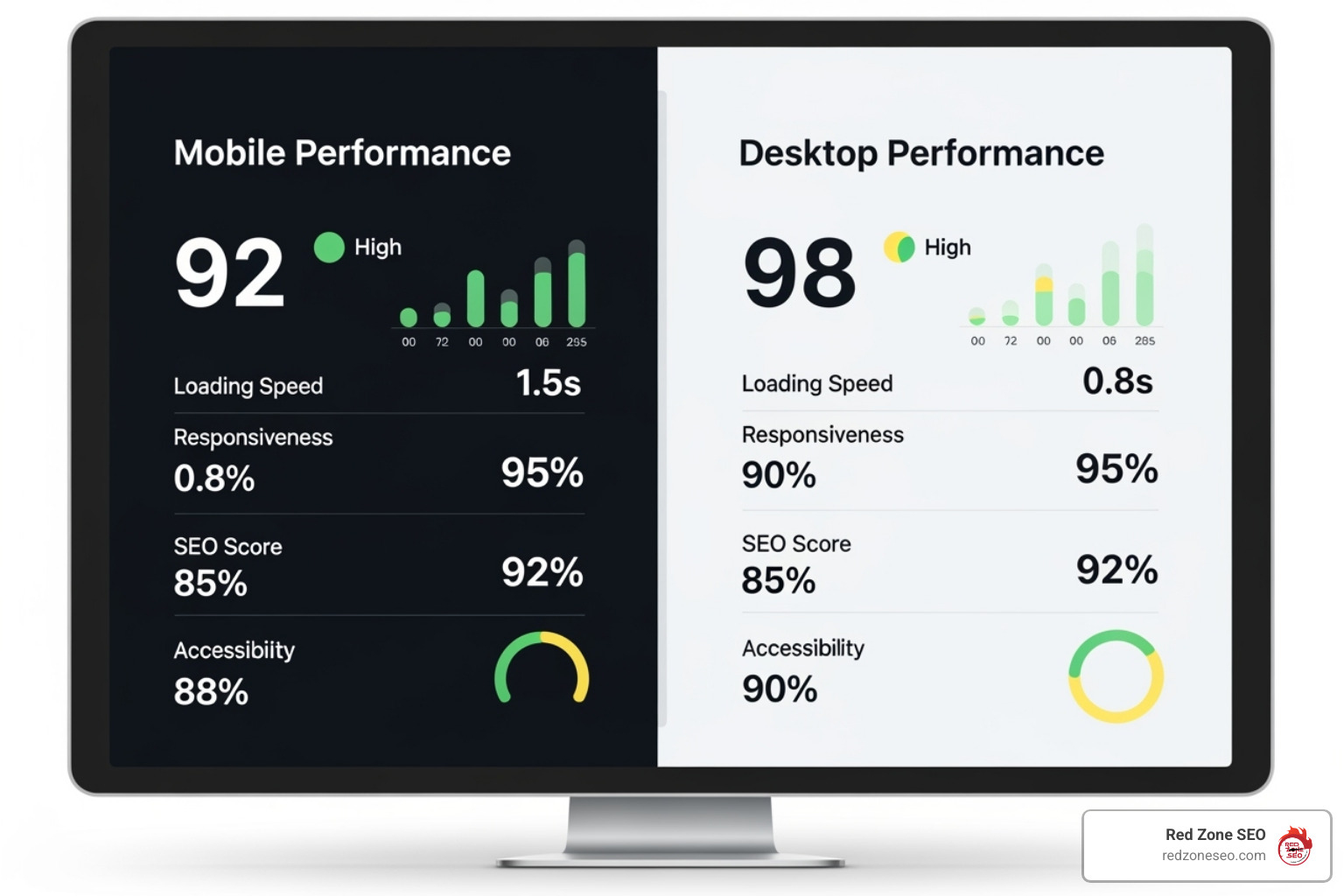
In ecommerce, speed equals revenue. Slow pages lead to abandoned carts and poor rankings. We focus on Google's Core Web Vitals, which measure real-world user experience:
- Largest Contentful Paint (LCP): Measures loading performance. An ideal LCP is under 2.5 seconds.
- First Input Delay (FID): Measures interactivity. A good FID indicates the page responds quickly to user actions.
- Cumulative Layout Shift (CLS): Measures visual stability, preventing frustrating experiences where elements shift as the page loads.
We achieve this through image compression, browser caching, and minifying CSS & JavaScript.
Mobile-Friendliness and Responsiveness

With mobile-first indexing, Google primarily uses your mobile site for ranking. Your store must offer a seamless experience on all devices, with a responsive design, readable text, and easy-to-tap buttons.
Structured Data and Rich Snippets

Structured data is code that helps search engines understand your content. Proper implementation of Product, Review, and FAQ schema can earn you rich snippets—improved search results with ratings, price, and availability that increase click-through rates.
Security and Trust Signals
Security is non-negotiable. HTTPS is a confirmed ranking signal and the foundation of customer trust. We ensure your SSL certificate is correctly installed, and there are no mixed content issues that could trigger browser warnings and scare away customers.
A systematic approach turns the overwhelming task of an ecommerce technical SEO audit into manageable, actionable steps. This framework will guide you through uncovering and fixing issues on your site.
Before you begin, gather the right tools and set clear goals. Your objectives—whether recovering lost traffic or outranking a competitor—will guide your priorities.
Essential Tools:
- Google Search Console: Your direct line to Google for data on crawl errors, index status, and mobile usability.
- Google Analytics: Provides insight into user behavior, helping you understand the real-world impact of technical issues.
- Site Crawler: A professional crawler is essential for auditing large ecommerce sites, identifying issues like broken links, redirect chains, and duplicate content at scale.
- Page Speed Insights: Measures Core Web Vitals and provides specific recommendations for improving site performance.
- Schema Markup Validator: Checks that your structured data is implemented correctly so you can earn rich snippets.
Step 2: How to Conduct Your First Ecommerce Technical SEO Audit
With your tools ready, it's time to begin the analysis. This process gives you a comprehensive view of your site's technical health.
- Run an Initial Crawl: Use your site crawler to get a complete picture of your website, collecting data on URLs, status codes, titles, meta descriptions, and more.
- Identify 404 Errors: Find and fix "page not found" errors. Decide whether to restore the page or implement a 301 redirect to a relevant alternative.
- Check Redirects: Ensure that page moves are handled with permanent 301 redirects and eliminate long redirect chains that slow down your site.
- Review Canonical Tags: Verify that canonical tags point to the correct "master" version of a page to avoid duplicate content issues, especially with product variants and filters.
- Analyze On-Page Elements: Check for unique, descriptive title tags and meta descriptions, and ensure every page has a clear H1 heading.
- Detect Duplicate Content: Look for identical content across product descriptions, category pages, or blog posts that could dilute your site's authority.
Step 3: Common Issues Uncovered in an Ecommerce Technical SEO Audit
Certain problems appear frequently on ecommerce sites. Knowing what to look for helps you spot them faster:
- Duplicate Content: Often caused by product variants (color/size) and faceted navigation (filters) creating multiple URLs for similar content.
- Incorrect Canonicalization: Missing, incorrect, or circular canonical tags that confuse search engines about which page to rank.
- Thin Content: Product and category pages with minimal unique text struggle to rank against competitors with more detailed information.
- Broken Internal Links: Dead ends from discontinued products or site restructures that frustrate users and waste crawl budget.
- Unoptimized Images: Large image files are a primary cause of slow page speeds, hurting both user experience and rankings.
- Slow Mobile Performance: Even if a site looks good on mobile, slow loading times on cellular networks can lead to high bounce rates.
Step 4: Prioritizing and Implementing Fixes
An audit is only useful if you act on its findings. Create a roadmap by prioritizing fixes based on their potential impact and the effort required to implement them.
- High-Priority: Critical issues that block search engines or severely impact user experience. Examples include incorrect robots.txt files, widespread 404 errors on key pages, or major indexation problems.
- Medium-Priority: Issues that hurt performance but aren't catastrophic. This includes page speed optimizations, mobile usability improvements, and correcting duplicate content.
- Low-Priority: Minor tweaks and optimizations that contribute to overall SEO health but won't cause dramatic shifts on their own.
Assign tasks to the appropriate teams—developers for technical fixes and content teams for on-page improvements—to ensure the plan is executed effectively.
After the Audit: Measuring Success and Maintaining Health
An ecommerce technical SEO audit is not a one-time fix; it's the beginning of an ongoing process of maintenance and improvement. After implementing fixes, you must track your progress and maintain your site's health to ensure long-term success.
Tracking the right metrics helps you understand what's working and where to focus your efforts next. Key KPIs include:
- Organic Traffic & Conversion Rate: Is your site attracting more visitors from search, and are those visitors converting into customers?
- Keyword Rankings: Are your target product and category pages climbing in search results for valuable terms?
- User Engagement: Look for a lower bounce rate and higher pages per session, which indicate an improved user experience.
- Crawl Errors: Monitor Google Search Console to ensure new crawl errors aren't appearing as you update your site.
- Indexed Pages: Check that Google is successfully finding and indexing all your important product and category pages.
The ideal frequency depends on your store's size and how often you make changes. A good schedule ensures you stay ahead of problems and your competition.
- Full Audit (Annually or Bi-Annually): A comprehensive deep dive to assess your site's overall technical health and strategy.
- Mini-Audits (Quarterly): Focused check-ups on critical areas like Core Web Vitals, site speed, and new crawl errors.
- Health Checks (Monthly): A quick review of Google Search Console for any major red flags.
It is essential to perform an audit before and after any major site changes, such as a redesign, platform migration, or URL structure update, to prevent any negative SEO impact.
Frequently Asked Questions about Ecommerce Technical SEO
Technical SEO can seem complex, so it's natural to have questions. Here are answers to some of the most common queries we receive from ecommerce store owners.
What is the most critical part of an ecommerce technical SEO audit?
If we had to choose one, it would be crawlability and indexability. You can have the best products and content in the world, but if Google's bots can't find, crawl, and understand your pages, your store is effectively invisible. This foundation includes your robots.txt file, XML sitemap, and site architecture. Errors in these areas can prevent thousands of your pages from ever appearing in search results.
You can certainly perform a basic audit yourself using free tools like Google Search Console. However, the complexity of ecommerce sites—with faceted navigation, product variants, and JavaScript rendering—often requires professional expertise. Enterprise-level tools are needed to crawl thousands of pages efficiently, and fixing issues like slow server response times or implementing structured data at scale typically requires a developer. A professional brings the experience to spot subtle issues that can have a major impact on revenue.
How long does it take to see results from a technical SEO audit?
The timeline for results varies. Quick wins, such as fixing critical crawl blockers or major indexing issues, can show positive effects within days or weeks as search engines re-crawl your site. We've seen indexed page counts jump almost immediately after fixing a misconfigured robots.txt file. Broader improvements from changes like page speed optimization or a new site structure typically take 3-6 months to fully materialize. Google needs time to process these changes and adjust rankings accordingly. Technical SEO is a long-term investment that builds a stronger, more resilient site over time.
Open up Your Store's Full Potential
An ecommerce technical SEO audit is more than just an error check; it's the cornerstone of a resilient foundation for sustainable growth. By ensuring search engines can efficiently crawl, index, and understand your site, you open the door to better rankings, increased organic traffic, and higher revenue.
Each technical improvement has a compound effect. Fixing a crawl issue can make hundreds of products visible in search. Optimizing Core Web Vitals improves user experience and boosts conversion rates. Implementing structured data helps your products stand out with rich snippets that attract more clicks.
A professional audit uncovers hidden opportunities and protects your most valuable digital asset: your online presence. It can reveal high-value categories that aren't being indexed or a poor mobile experience that's silently driving away customers.
At Red Zone SEO, we provide data-driven, proven SEO solutions custom to the unique challenges of ecommerce businesses. We don't just find problems; we create strategic roadmaps that combine technical expertise with a deep understanding of ecommerce dynamics to deliver measurable results.
Investing in your site's technical health today pays dividends for years. While competitors struggle with hidden issues, your optimized store will be capturing more traffic, converting more visitors, and building the kind of growth that transforms a business.
Ready to see what's possible when your store operates at its full potential? Contact Us today to discuss how a professional SEO audit can transform your online store. Let's build the technical foundation your business deserves.