Why is on page seo important? It’s the foundation of your entire digital marketing strategy. By optimizing elements directly on your website, you control how search engines understand your content and how users experience your brand, which directly impacts your rankings, traffic, and revenue.
Here’s why on-page SEO is critical for your business:
Consider the data: half of all website traffic comes from search engines, and the first page of results captures 91.5% of that traffic. The top result alone gets over 32% of all clicks. This means your on-page optimization directly affects your bottom line.
Unlike off-page SEO (like earning backlinks), on-page SEO puts you in complete control of your site's content, HTML, and structure. These factors work together to signal relevance to search engines while creating a better experience for your visitors, turning your website into a revenue-generating asset.
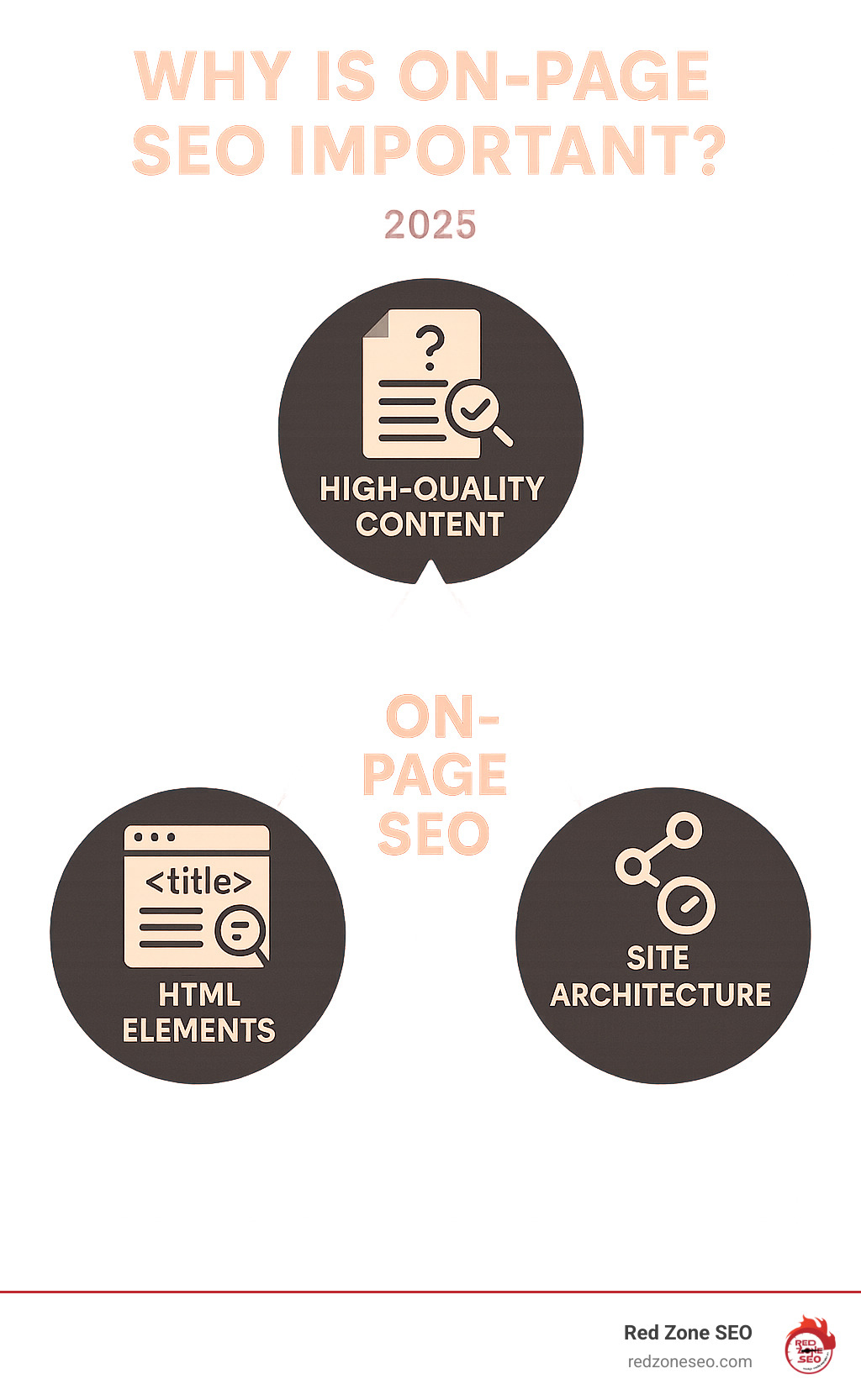
On-page SEO (or on-site SEO) is the practice of optimizing individual web pages to rank higher in search results and attract more relevant traffic. Think of it like running a great restaurant: you need a clear menu (content), delicious food (value), and a clean, welcoming environment (user experience). It’s everything you do directly on your site to make it appealing and understandable to both search engines and people.
This includes the words you write, the images you choose, and the way you organize content with headings. It also covers behind-the-scenes HTML elements that signal importance to search engines. The key benefit of on-page SEO is its controllable nature; you can make these improvements yourself and see a direct impact.
To understand why is on-page SEO important, it helps to see how it fits with other SEO strategies. SEO is a combination of what happens on your site (on-page) and what happens elsewhere on the internet (off-page).
Off-page SEO builds your site's reputation and authority through external signals, primarily high-quality backlinks from other websites. It also includes social media marketing, brand mentions, and online reviews.
Technical SEO is the foundation that supports both. It ensures your site is technically sound—fast, crawlable by search engines, and secure.
Here’s a quick comparison:
| On-Page SEO | Off-Page SEO |
|---|---|
| What you control: Content quality, keywords, title tags, meta descriptions, headings, URLs, internal links, image optimization, structured data, page speed, mobile-friendliness | External signals: Backlinks, guest posting, social media engagement, brand mentions, online reviews, local citations |
| Your control level: Complete control – you can make changes immediately | Your control level: Limited control – you need to earn these signals from others |
| Primary purpose: Helps search engines understand what your page is about and ensures great user experience | Primary purpose: Builds authority and trust signals that show your site is popular and credible |
The best results come when these strategies work in synergy. Great on-page content naturally attracts off-page backlinks, and a technically sound site ensures all your efforts are recognized by Google.
A successful SEO strategy always begins with a solid on-page foundation. It's the only part of SEO that's entirely in your hands. You can implement these changes today to immediately improve how search engines and users perceive your site.
If Google can't figure out what your page is about, even a mountain of backlinks won't help you rank. Strong on-page SEO makes your off-page efforts, such as link building, exponentially more effective. A link to a well-optimized, user-friendly page carries far more weight.
That's why a holistic approach is essential. At Red Zone SEO, we often start with a comprehensive SEO audit to ensure all elements are working together seamlessly.
On-page SEO directly translates to business growth by improving visibility, user experience, and ROI. The data is clear: with nearly 40% of online revenue coming from search and the top result getting over 32% of clicks, optimizing your pages is not optional—it's essential for capturing your share of the market. If you're not on the first page, you're effectively invisible to most potential customers.
On-page SEO is your direct path to claiming that valuable digital real estate by aligning your website with key ranking factors and user intent.
Search engine crawlers need clear signals to understand and index your content. On-page SEO provides these signals.
Google's ultimate goal is to satisfy users. This is where why is on-page SEO important becomes most meaningful. Google's guidelines emphasize E-E-A-T: Experience, Expertise, Authoritativeness, and Trustworthiness.
On-page SEO delivers one of the strongest returns on investment in digital marketing.
Now that we've established the "why," let's focus on the "how." The real power of on-page SEO comes from optimizing the specific elements you control. These are the practical tools you can use to build a website that is both functional for search engines and valuable for users.
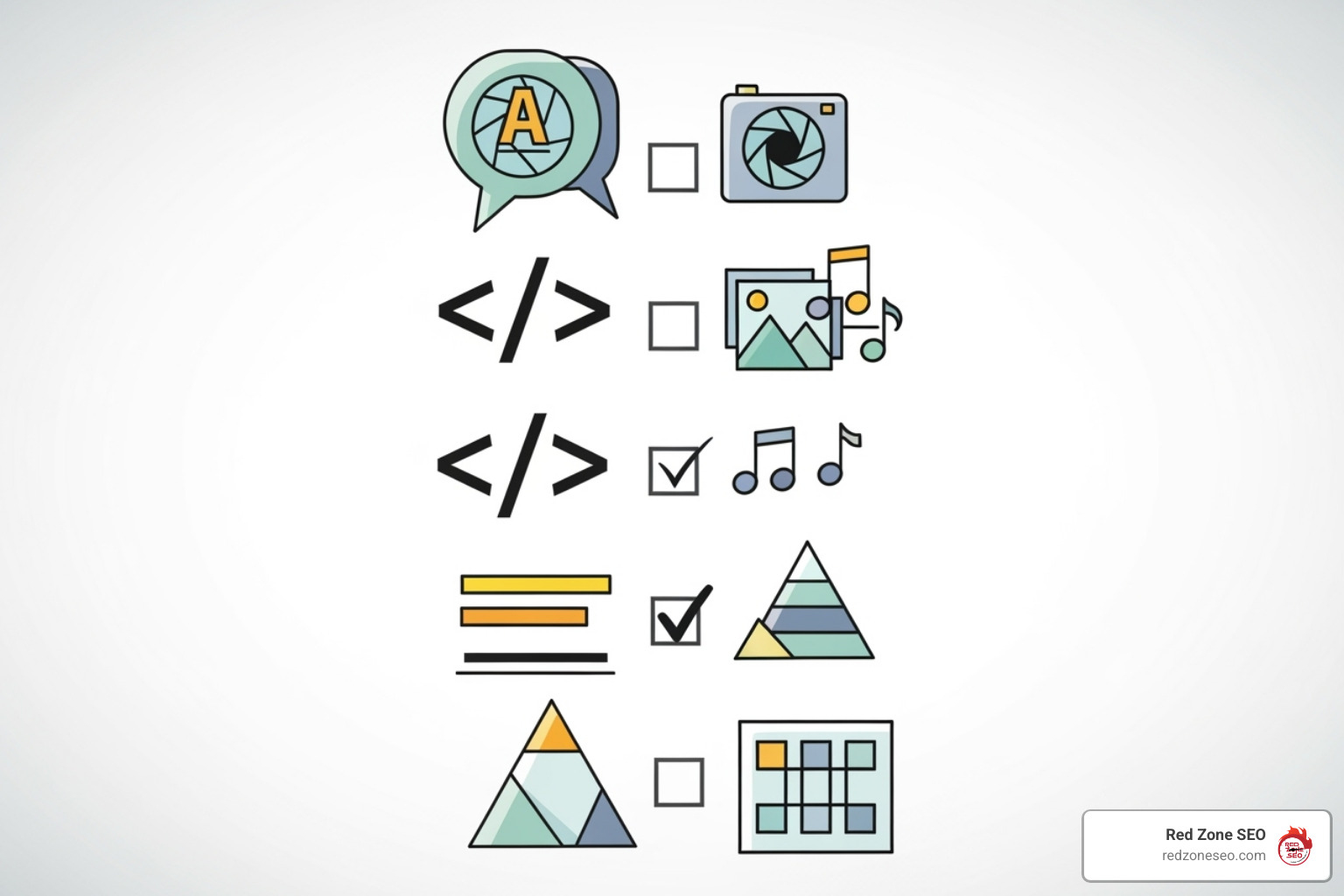
At Red Zone SEO, we focus on seven core on-page elements that fall into three main categories: content creation, HTML elements, and site architecture. Because you have direct control over these elements, you can implement changes today and start improving how search engines rank your content. Let's explore each one.
High-quality content is the cornerstone of on-page SEO. To succeed, your content must be helpful, comprehensive, and original, directly answering the questions your audience is asking. This means going beyond surface-level information to provide real solutions and unique insights.
This valuable content must be paired with strategic keyword research. A thorough keyword research process helps identify the exact phrases your potential customers are using.
Title tags and meta descriptions are your website's advertisement in search results. They are the first thing a potential visitor sees, making them critical for earning clicks.
Title tags are the clickable blue headlines in search results and are a confirmed ranking factor. A great title tag is:
Meta descriptions are the short summaries that appear under the title. While not a direct ranking factor, they heavily influence click-through rates. A compelling meta description acts as a mini-advertisement for your page, using active language and a clear call to action to convince users to click. Even though Google sometimes rewrites them, a well-crafted description provides a strong suggestion and can significantly boost clicks when used.
Header tags (H1, H2, H3) create a logical structure for your content, acting as a roadmap for both readers and search engines. This hierarchy is crucial for readability and signaling your content's relevance.
This structure makes your content highly scannable, as most users scan pages for relevant information before reading in detail. Well-organized headings help them find what they need quickly, improving engagement and sending positive signals to search engines.
An SEO-friendly URL is like a clear street address for your web page. It should be simple, descriptive, and easy for both humans and search engines to understand at a glance.
A well-structured URL provides context and reinforces your page's topic. Google's advice on simple URLs emphasizes this human-first approach.
Best practices for URLs include:
redzoneseo.com/on-page-seo-checklist is much better than redzoneseo.com/p?id=123.on-page-seo more understandable than on_page_seo or onpageseo.Clean, descriptive URLs are more shareable and can improve click-through rates from search results, especially when the keywords in the URL match a user's query.
Strategic internal linking creates a connected web of content on your site, guiding users and search engines to relevant information. This practice is essential for distributing page authority, improving navigation, and establishing your expertise on a topic.
For best results, use descriptive, keyword-rich anchor text (e.g., "learn about our SEO audit services" instead of "click here") to provide clear context for both users and search engines.
Images make your content more engaging, but unoptimized files can slow down your site and hurt your SEO. Proper image optimization ensures fast load times and helps search engines understand your visual content, making it a win for both user experience and rankings.
Key elements of image optimization include:
alt="sparrow-resistant bluebird house").bluebird-house-plans.jpg instead of IMG_1234.jpg).Optimized images can also rank in Google Image Search, driving additional traffic to your site.

Structured data (or Schema markup) is a specialized code that gives search engines explicit context about your content. It's like adding labels to your information, helping Google understand it better and display it in more engaging ways in search results.
Why is on page seo important here? Because structured data can open up rich snippets—improved listings in the search results that include extra details like star ratings, prices, cooking times, or FAQ dropdowns. While not a direct ranking factor, rich snippets make your listing stand out, which can dramatically increase your click-through rate.
The vocabulary for this code comes from Schema.org, a collaborative effort supported by all major search engines. Common types of Schema that provide high impact include:
Before implementing, always validate your code using Google's Rich Results Test to ensure it's eligible for display.
Beyond content and HTML, the technical performance of your site is a massive part of on-page SEO. Google's page experience signals measure how fast, responsive, and stable your site is for users. A poor technical experience can undermine even the best content, hurting both your rankings and conversions. Optimizing these technical pillars is a key part of any effective SEO strategy for an online business because it creates a better site for both Google and your customers.
Page speed is a confirmed ranking factor. Google measures this using Core Web Vitals, a set of metrics that capture the real-world user experience of a page.
You can analyze your site's performance and get recommendations for improvement using Google's free PageSpeed Insights tool.
With more users browsing on mobile than desktop, Google uses mobile-first indexing. This means Google primarily evaluates the mobile version of your site to determine rankings. If your mobile site is poor, your rankings will suffer on all devices.
Responsive web design is the best solution. It allows your website layout to automatically adapt to any screen size, providing a consistent experience for all users. A mobile-friendly site should also have:
You can audit your site's mobile performance with tools like Google Lighthouse. A website that isn't optimized for mobile is bad for business.
Business owners often have similar questions about on-page SEO. Here are straight answers to the most common ones we hear at Red Zone SEO.
There's no single answer, as results depend on factors like your industry's competition, your website's existing authority, and the scope of the changes made. On-page SEO can produce results faster than off-page efforts, but it's still a long-term strategy.
Typically, you might see initial crawling and indexing improvements within weeks. Minor ranking shifts can appear in one to three months. However, significant, sustained growth in traffic and revenue usually takes three to six months of consistent effort. Patience and persistence are key.
Yes, absolutely. Many fundamental on-page SEO tasks are accessible to business owners. With free tools like Google Search Console and user-friendly platforms like WordPress or Shopify, you can manage basics like writing title tags, structuring content with headers, and optimizing images.
However, advanced strategy and technical optimization often require specialized expertise. In-depth keyword research, technical audits, and large-scale content strategy can be complex and time-consuming. For many, hiring a professional is a smart investment to save time and achieve better results. Deciding when to seek help, such as by requesting a quote for an SEO audit, is a strategic choice about maximizing your impact.
This is like asking if a house needs a foundation or walls—you need both. On-page and off-page SEO have a synergistic relationship and are both essential for success.
We always recommend starting with on-page SEO because it's entirely within your control and sets the stage for all other efforts. A strong on-page strategy makes your off-page campaigns significantly more powerful. A balanced approach that integrates both is the only way to achieve sustainable, long-term growth.
On-page SEO isn't a technical chore; it's the bedrock of your online success and a powerful engine for growth. It’s the most direct way to influence how both search engines and customers see your business.
To recap, why is on-page SEO important?
SEO is not a one-time task but a continuous process of refinement to adapt to algorithm updates and changing user behavior. At Redzone SEO, we build data-driven strategies from the ground up, always starting with a solid on-page foundation to ensure the long-term success of our clients in Las Vegas, Austin, Florida, and across the country.
Ready to take control of your online visibility and build your blueprint for success? Explore our expert Las Vegas SEO Services today.