
When you search for the average cost of search engine optimization, you’ll come across a wide range of numbers. (If you’re new to the topic entirely, this concise SEO overview on Wikipedia is a helpful primer.) That variance exists because SEO isn't a one-size-fits-all product you can pull off a shelf. It's a highly customized service, custom to the unique DNA of your business. The final cost is influenced by a multitude of moving parts: the depth of work required, the ferocity of competition in your industry, your specific growth goals, and the kind of partnership you form with your provider.
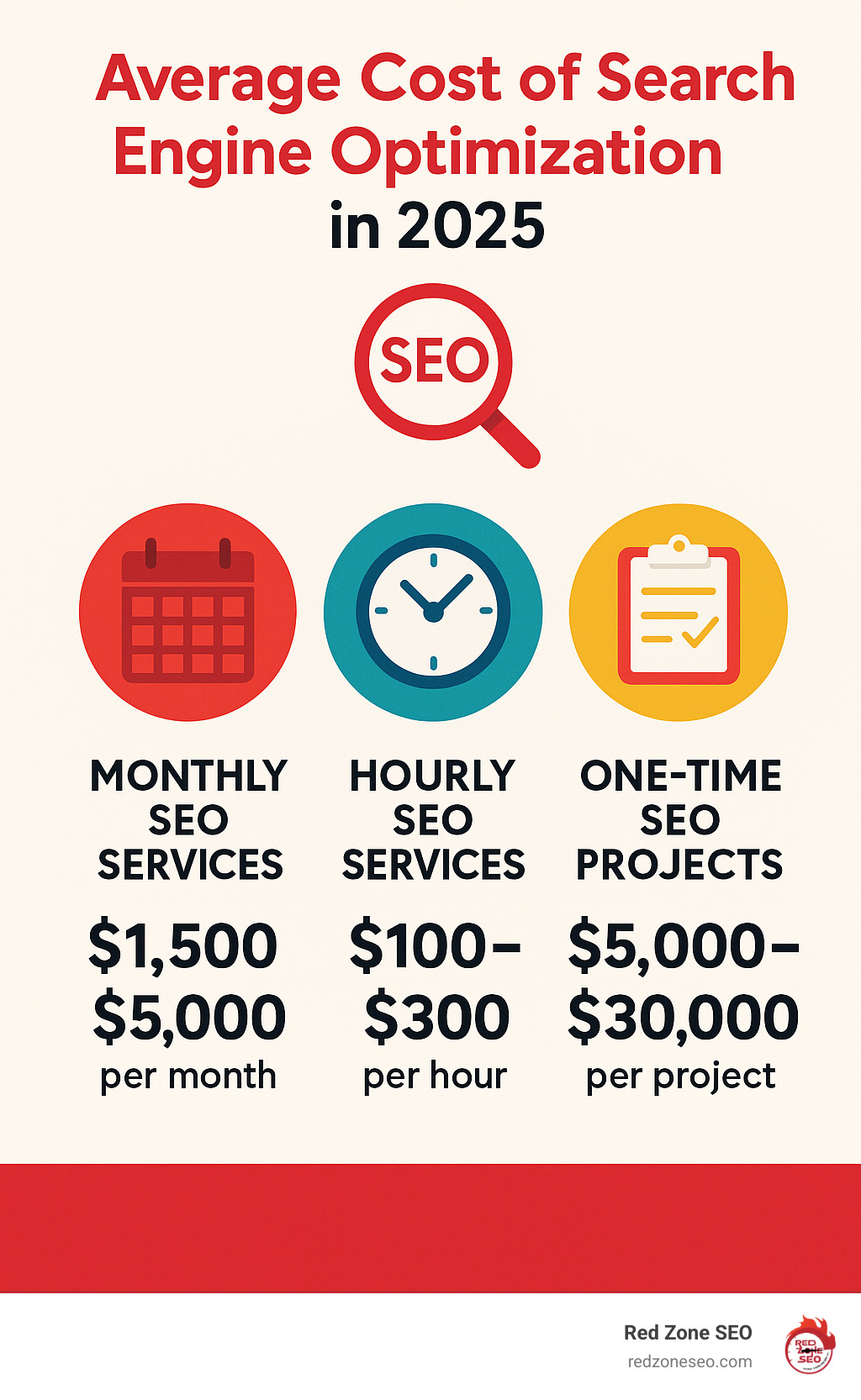
Here’s a quick snapshot of the most common SEO pricing benchmarks for 2025, which serve as a starting point for budgeting:
As a business owner, your goal is to shine online and attract customers who are actively searching for what you offer. Figuring out what SEO costs can, however, feel a bit like solving a puzzle. The truth is that there isn’t a single, universal price tag. Your ultimate investment will depend on your objectives, the competitiveness of your market, and the size (and current health) of your website.
Understanding these cost variables is critical. It helps you:
Learn more about average cost of search engine optimization:
The digital landscape is constantly evolving, and so are the strategies required to sustain meaningful rankings. Investing in SEO isn’t merely about "getting found" today; it’s about building a durable online presence that continually attracts your target audience tomorrow. That’s why experts recommend thinking of SEO as an ongoing investment rather than a one-off task. It requires consistent upkeep, algorithm-aware adjustments, and iterative optimization to protect and grow your visibility.
We understand that an “ongoing investment” can sound daunting. However, when executed well, SEO remains one of the most cost-effective marketing channels. Unlike paid ads—where costs accumulate with every click—organic traffic driven by SEO becomes effectively "free" once you’ve earned your rankings. This long-term value is why understanding the true cost of SEO is so important for strategic planning.
When you explore SEO services, you’ll usually encounter three distinct pricing models. Each comes with its own advantages and is best suited for different business scenarios. Mastering these models is the first step in clarifying the average cost of search engine optimization.
Monthly Retainer
The most popular—and often the most effective—model for sustained growth. A recurring monthly fee gives you continuous SEO support, proactive strategy, and performance monitoring. This model is ideal for businesses committed to long-term success, as SEO results build over time. Expect to invest $1,500 to $5,000 per month, with costs scaling up for complex sites or highly competitive sectors. A typical retainer involves an initial phase of auditing and strategy, followed by ongoing execution, content creation, link building, and reporting.
Hourly Consulting
Paying for expert time makes sense when you need help with a specific, well-defined task or require strategic guidance for your in-house team. This could include troubleshooting a technical issue (e.g., a structured data problem), conducting a focused keyword brainstorming session, or providing training on a particular aspect of SEO. Rates typically hover between $100 and $300 per hour, depending on the consultant's experience and specialty.
Project-Based Pricing
This model involves a fixed fee for a clearly defined scope of work with a specific start and end date. It's perfect for one-off needs like a comprehensive technical SEO audit, a website migration project, a penalty recovery effort, or a foundational content strategy development. The cost for a project typically ranges from $5,000 to $30,000, contingent on the complexity and duration of the work.
To make the numbers more tangible, let's break down what you can generally expect at different monthly investment levels. These are not rigid packages but representative scopes of work.
Budget Tier 1: Foundational SEO ($500 – $1,500/mo)
This tier is best suited for startups, small local businesses, or companies in low-competition niches that need to establish a solid baseline. The focus is on high-impact, fundamental tasks. Activities often include:
Budget Tier 2: Growth-Focused SEO ($1,500 – $5,000/mo)
This is the sweet spot for most small-to-medium-sized businesses aiming for significant growth and a competitive edge. It represents a balanced, full-service approach. This tier builds on the foundation with more proactive strategies:
Budget Tier 3: Aggressive & Enterprise SEO ($5,000+/mo)
This level is for established businesses in highly competitive markets or large enterprises that require a dominant online presence. The investment supports a resource-intensive, data-driven, and highly customized strategy.
Understanding the average cost of search engine optimization is just the beginning of your SEO journey. The actual price tag for your business's online success isn't a fixed number; it's a dynamic figure, carefully shaped by several interconnected factors. Imagine you're building a custom dream home: the final price isn't just about the square footage. It depends on the size of the plot, its location, the quality of materials, and all those special features you choose to make it uniquely yours. SEO investment works in much the same way.

From the unique complexity of your business and its online presence to the expertise of your chosen SEO partner, each element plays a crucial role in determining the ideal investment for your digital marketing budget. Let's dive deeper into these key influencing factors to help you understand what truly drives your final SEO price.
One of the most significant determinants of SEO cost is the size of your business and the sheer scale of your website. It makes sense, doesn't it? A sprawling, complex website with a vast array of products or services will naturally require a more extensive – and therefore more robust – SEO strategy than a simpler, more concise site.
For Small Business SEO, especially for startups and very small businesses, your SEO needs often center on building a strong foundation. You might have a brand new website or a limited number of offerings, and the goal is to get noticed. Our SEO for Small Business solutions are designed to establish that solid online presence right from the ground up. For startups, an initial investment, typically ranging from $750 to $1,500 per month, focuses on core keyword research, essential on-page optimization, and local SEO if you serve a specific geographic area. The challenge is often maximizing a limited budget by prioritizing the most impactful activities first. The aim here is to lay the groundwork and start attracting those crucial first organic visitors. For more detailed insights on getting started, be sure to check out our guide on SEO Strategies for Start Ups.
As businesses evolve into Medium-Sized Businesses, their SEO needs grow in complexity. These are often established companies looking for significant online expansion. Their strategies are typically growth-focused, aiming for things like expanding into new locations, gaining a larger share in specific market niches, or broadening their service offerings. This involves scaling content production, competing for more difficult national-level keywords, and earning higher-authority backlinks. This level of engagement, often requiring an investment between $1,500 and $5,000 per month, involves more in-depth content creation, more advanced technical SEO considerations, and competitive link building efforts to truly outrank those rivals in a wider market.
At the Enterprise level, SEO transforms into a highly sophisticated, large-scale operation. These companies often have colossal websites with thousands or even millions of pages, demanding intricate technical SEO solutions, vast content strategies, and aggressive outreach for link building. Challenges include managing faceted navigation, handling international targeting with hreflang, optimizing crawl budget, and sometimes implementing programmatic SEO for pages at scale. The ultimate goal here is market domination, maintaining a competitive edge, and managing brand reputation across an enormous digital footprint. The sheer volume of work involved, coupled with the necessity for highly specialized expertise and cutting-edge tools, naturally drives the investment significantly higher, often starting at $5,000 per month and going well beyond.
Your specific business objectives, the industry you operate within, and the competitive landscape are immense drivers of your SEO investment. Think of it like planning a road trip: driving across a quiet, open country road generally costs less in terms of fuel and effort than navigating a busy, congested city highway during rush hour.
If your business has aggressive growth goals, such as aiming to double organic leads within a tight timeframe or achieving a substantial traffic increase year-over-year, your SEO investment will understandably be more substantial. A goal of "increase traffic" is less intensive than "generate 50 qualified leads per month from organic search." The latter requires not just traffic, but the right traffic, plus on-site optimization to ensure those visitors convert. Achieving rapid, significant results often demands a more intensive, comprehensive strategy, meaning more content, more proactive link building, and more frequent technical optimizations. The urgency of your desired results directly correlates with the resources and effort needed to achieve them.
The industry competitiveness you face also plays a huge role. Highly competitive industries, such as legal services, healthcare, financial services, and SaaS (Software as a Service), naturally demand a higher SEO investment. Keywords in these sectors are often incredibly high-value because a single new client or customer can be worth thousands of dollars. This leads to fierce competition for those coveted top rankings. This means you'll need more sophisticated strategies, higher-quality content that demonstrates deep expertise (E-E-A-T), and more robust link-building efforts just to stand out from the crowd. For instance, legal keywords often have a significantly higher Cost Per Click (CPC) in paid search, which, as industry data shows, perfectly reflects their high value and the intense competition you'll face in organic search as well.
Finally, we always conduct a thorough analysis of your competitor landscape. If you're up against well-established brands with formidable online presences and significant existing SEO investments, outranking them will undeniably require a more substantial budget and a more strategic, often aggressive, approach. A competitive analysis looks at your rivals' backlink profiles, content quality and depth, keyword rankings, and overall site authority. This data helps benchmark the level of effort required. If your top competitor is publishing four in-depth articles a month and earning 20 high-quality backlinks, a plan that only includes one article and no link building will struggle to make progress. Understanding your competitor's current SEO performance is absolutely key to determining the amount of work required to surpass them.
The choice between partnering with an SEO agency, hiring a freelance SEO professional, or building an in-house team will also significantly influence the average cost of search engine optimization and, crucially, the breadth and depth of services you receive.
| Feature | SEO Agency | Freelancer | In-House Team |
|---|---|---|---|
| Expertise | Access to a bundled team of specialists (technical, content, link building). | Often brings highly specialized skills in a specific niche. | Deep product/company knowledge, fully dedicated. |
| Scope & Scalability | Ideal for large, complex projects; can scale services as your business grows. | Best suited for specific, project-based work with a defined scope. | Scalability depends on hiring capacity and budget. |
| Process | Proven processes and established workflows ensure consistency. | Processes can be more flexible but may vary. | Processes must be built from scratch. |
| Resources | Access to a wide range of premium tools and collective team knowledge. | May have limited access to expensive tools and resources. | All tool costs (~$500-$2k+/mo) are direct expenses. |
| Availability | Consistent availability and support from a dedicated team or account manager. | Availability can be variable, managing multiple clients and schedules. | Fully available during work hours, but subject to PTO/sick leave. |
| Cost | Monthly retainer ($1,500-$5,000+). | Hourly ($100-$300) or project-based. | Full-time salary + benefits + overhead ($70k-$150k+/year per hire). |
SEO Agencies offer a comprehensive, one-stop solution. You gain access to a diverse team of specialists without the overhead of hiring them individually. This model is excellent for businesses that need a complete, managed SEO strategy and want to scale their efforts efficiently.
Freelancers are a great option for businesses with specific needs, a limited budget, or an in-house team that needs support in a particular area (like technical audits or link building). They offer flexibility and deep niche expertise but may have limited bandwidth for large, ongoing campaigns.
Building an In-House Team provides the ultimate level of integration and brand alignment. However, it represents the highest potential cost. Beyond the competitive salary of an experienced SEO manager, you must also budget for benefits, payroll taxes, training, and the expensive suite of essential SEO tools (e.g., Ahrefs, Semrush, Screaming Frog).
While business size, competition, and provider type are the three heavy hitters behind the average cost of search engine optimization, several secondary variables can nudge your total investment up or down. Understanding them helps you avoid unwelcome surprises when you receive a proposal and allows for a more accurate comparison between potential partners.
The geographic scope of your target audience dramatically impacts the complexity and cost of an SEO campaign.
Need results “yesterday”? While SEO is inherently a long-term strategy, an accelerated timeline demands a front-loaded, more aggressive approach. This requires more resources—think extra content writers to produce assets faster, a larger outreach team to build links more quickly, or faster development cycles for technical fixes. That surge capacity translates into higher monthly retainers or premium project-based fees. For example, a business wanting to rank for "best Christmas gifts" that starts its campaign in October will require a much more intensive (and expensive) push than one that begins planning in March. Conversely, if you can adopt a slower, more methodical pace, your spend can be smoothed out over a longer horizon.
A well-built website with clean code, a logical architecture, and error-free analytics tracking is far easier (and cheaper) to optimize than one burdened with technical debt. An outdated CMS, a slow and clunky user experience, or a history of poor SEO practices can create significant problems. The deeper the technical debt—issues like a difficult HTTP to HTTPS migration, poor mobile usability, messy URL structures, internal redirect chains, keyword cannibalization, or widespread duplicate content—the larger the up-front audit and remediation phase will be. This initial cleanup is often a prerequisite for any future success and will increase the initial investment.
Your starting point in terms of content and brand recognition matters. Brands that already publish authoritative content, have in-house subject matter experts, or benefit from strong PR coverage often have a head start. They may require less foundational work to establish credibility (E-E-A-T: Experience, Expertise, Authoritativeness, and Trustworthiness). Meanwhile, newer brands with limited topical authority and brand recognition need a more aggressive content and outreach plan to build that credibility from scratch. This increases both the workload and the cost, as the agency must create a content engine and build brand signals that Google and users trust.
SEO is not a single activity but a collection of disciplines. Some agencies offer comprehensive retainers that include the full spectrum of services: technical SEO, on-page optimization, content creation, and link building. Others might allow you to select services a la carte. For example, you might only need a one-time technical audit to guide your development team, or perhaps you only require an ongoing content plan because you handle the technical aspects in-house. While a comprehensive package often provides the best long-term value and synergy between activities, an a la carte approach can be more budget-friendly if you have specific, isolated needs. It's crucial to understand exactly what is included in a proposal to ensure it aligns with your requirements and avoids paying for services you don't need.