
The average cost of SEO for small business typically falls between $500 and $5,000 per month. While this provides a general idea, your actual investment will depend on your specific industry, goals, and the competitiveness of your market. Understanding these costs is critical, as 93% of online experiences begin with a search engine, making visibility essential for growth.
Quick Answer: Small Business SEO Cost Breakdown
Generic pricing guides often fail because they don't consider your unique situation. A local plumber in Austin has different SEO needs than an e-commerce store in Las Vegas. SEO is not just a marketing expense; it's an investment in a long-term asset. Unlike paid ads, which stop when you stop paying, SEO builds compounding value over time.
Research shows that businesses spending over $500 monthly on SEO report 53% higher satisfaction rates, not because they're spending more, but because they're investing enough to achieve tangible results. This guide will break down what SEO costs, why it costs what it does, and how to budget for growth that moves the needle.
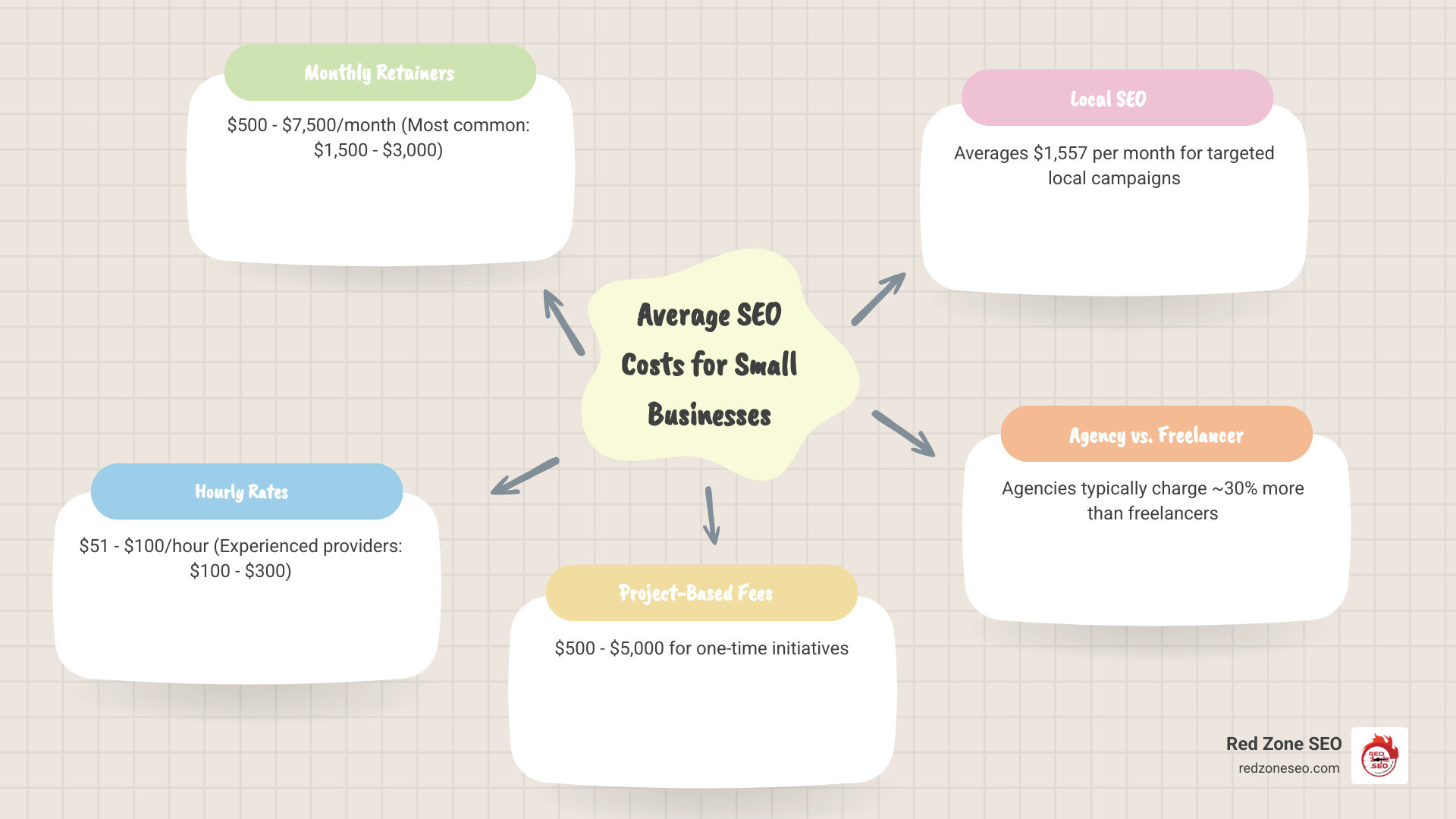
Terms related to average cost of seo for small business:
When small business owners ask about the average cost of SEO for small business, the honest answer is: it depends. Effective SEO is not a one-size-fits-all product. The cost is custom to your business's unique needs, goals, and competitive landscape. The industry primarily uses three pricing models, each suited for different situations.
1. Monthly Retainers
This is the most common model, used by nearly 78% of SEO professionals according to an Ahrefs' survey. A monthly retainer makes sense because SEO requires continuous effort. Search engine algorithms change constantly, and competitors are always working to outrank you. A retainer covers a comprehensive suite of ongoing services like keyword research, content optimization, technical fixes, and link building. It provides predictable monthly costs and allows for long-term strategic planning.
2. Hourly Rates
Hourly billing offers flexibility for specific, targeted tasks. It's ideal if you need an expert to diagnose a technical issue, conduct a competitor analysis, or provide consultation. You pay only for the time used, which offers transparency.
3. Project-Based Pricing
This model involves a fixed price for a well-defined project, such as a complete website audit, a keyword research initiative, or a local SEO setup. It's great for businesses that need specific improvements or want to test an SEO provider before committing to a retainer.
For sustained growth, a monthly retainer typically delivers the best long-term value. A common approach is to start with a project-based audit to identify key issues and then transition to a retainer for ongoing optimization. You can learn more about our approach and how we structure services to fit your needs.
Choosing between an agency and a freelancer also impacts your investment and the level of service you receive.
SEO Agencies
Agencies like Red Zone SEO typically charge more because you're not hiring one person; you're accessing a team of specialists in technical SEO, content, and link building. This team approach often leads to better results because each expert focuses on their area of strength. Agencies also invest in premium tools that can cost thousands per month, providing deeper data and analysis. You also benefit from dedicated account management, structured reporting, and continuity of service.
SEO Freelancers
Freelancers are often more affordable and can offer a more personal, one-on-one working relationship. Many freelancers specialize in a specific niche (e.g., local SEO for restaurants), which can be highly valuable. However, a single person has limitations in terms of scalability and the breadth of their expertise. If your project grows or requires diverse skills, you might need to hire multiple freelancers, which can complicate management and increase costs.
Making the Choice
Your decision should be based on your budget, the complexity of your needs, and how much management you want to handle. A freelancer may be perfect for a local business with straightforward needs. An agency is often a better fit for businesses aiming to dominate competitive markets or those requiring a comprehensive digital strategy. Don't choose based on price alone; consider the total value, including expertise, resources, and strategic support.

The average cost of SEO for small business isn't a fixed number because a quality strategy must be customized. A one-size-fits-all price is a red flag; a reputable provider will first seek to understand your unique business situation. The most effective SEO for Small Business is custom to several key factors that influence your investment.
Your industry is the single biggest factor determining your SEO investment. Some niches are far more competitive than others. For example, industries like legal services, healthcare providers, and online retail are incredibly competitive because a single new client or sale can be highly valuable. Businesses in these fields invest heavily to secure top rankings.
In contrast, a local artisan potter faces less direct competition from multi-million dollar corporations. The intensity of competition for your target keywords directly impacts the resources needed to rank. A look at the most expensive keywords on Google shows how valuable certain search terms are, indicating a fierce fight for organic visibility.
The size and complexity of your website and campaign goals are also major cost drivers.
Your geographic target creates a clear cost difference. For most small businesses with a physical location or service area, Local SEO is the most cost-effective approach.
Local SEO focuses on dominating search results in your immediate area (e.g., "plumber near me"). This involves optimizing your Google Business Profile, managing local citations (ensuring your name, address, and phone number are consistent online), and creating localized content. Competition is confined to a smaller geographic area, making it more affordable to achieve results. The average cost of local SEO is around $1,557 per month, making our Local SEO Packages an accessible and high-return investment for many businesses.
National SEO is far more complex and expensive. When you target broad keywords without a geographic modifier, you're competing against every business in your industry nationwide, including large corporations with huge budgets. This requires a much larger investment in content, link building, and overall strategy to make an impact.

When evaluating the average cost of SEO for small business, it's important to see it as an investment in a long-term asset, not just a monthly bill. Unlike paid advertising, where visibility vanishes when you stop paying, SEO builds compounding value. Understanding what services are included, the expected returns, and the timeline is key to setting realistic expectations.
A comprehensive SEO strategy integrates several key services working together:
The return on investment from SEO is often significant. Organic search drives over 40% of online revenue for most businesses, according to research from Brightedge. ROI is measured by:
SEO is a marathon, not a sprint. Patience is essential, and results build over time.
The timeline can be affected by your website's history, industry competition, and the level of investment. A more aggressive budget can often accelerate this process.

Determining your average cost of SEO for small business is about making a smart investment, not just finding the lowest price. Cheap SEO often leads to poor results and can even harm your business. Focusing on value and knowing how to spot red flags will protect your investment and drive real growth.
Instead of looking for a generic price, calculate a budget that fits your specific situation:
Be wary of providers who make unrealistic promises. Here are common warning signs:
Opting for the lowest price often costs more in the long run. The risks include Google penalties that can wipe out your visibility, poor quality work that fails to produce results, and damage to your brand's online reputation. You end up wasting time and money, only to have to hire a reputable provider to fix the damage. Data shows that businesses investing adequately in SEO report far higher satisfaction because that investment is what's required to generate real, sustainable results.
Figuring out the average cost of SEO for small business brings up many valid questions. Here are straightforward answers to the ones we hear most often.
For a new business, it's wise to start with a foundational approach. Instead of a large monthly commitment, begin with a one-time project. Understanding your SEO Audit Cost first will provide a clear roadmap of what needs to be fixed and what opportunities exist.
From there, a modest monthly retainer (often in the $750-$1,500 range) is a smart starting point. The strategy should focus on achievable early wins, like targeting local search and niche keywords where you can build momentum. As your business grows and you see a return, you can scale your investment.
While you can technically handle some basic SEO tasks yourself, it's important to consider the trade-offs. DIY SEO has a steep learning curve and requires a significant time commitment—often several hours per week—to stay current with algorithm changes and execute tasks effectively.
Furthermore, professional SEO tools like Ahrefs or Semrush, which are essential for data analysis, can cost hundreds of dollars per month. There's also a real risk of making costly mistakes that could harm your site's rankings, requiring an expert to fix them later. Consider the value of your own time; often, hiring an expert is more cost-effective than the hours you'd spend learning and implementing SEO yourself.
This varies significantly between providers, so it's a critical question to ask. Some agencies bundle a specific amount of content creation (e.g., two blog posts per month) and link building activities into their monthly retainers. Others offer these as separate, add-on services.
What's most important is quality over quantity. A few high-quality articles and authoritative links are far more valuable than a large volume of generic content and low-quality links. Before signing any contract, demand a detailed scope of work that clearly outlines all deliverables. Ask specific questions about who creates the content, the strategy for link building, and how success is measured. Transparency is the hallmark of a professional SEO provider.
Understanding the average cost of SEO for small business is less about finding a single number and more about shifting your perspective. SEO is not a monthly expense; it's a strategic investment in the long-term growth and visibility of your business. The cost is custom to your unique goals, industry, and competitive landscape.
Delaying this investment allows your competitors to gain ground, while your business remains invisible to customers actively searching for your services. The businesses that invest wisely in a data-driven strategy are the ones that become market leaders.
At Red Zone SEO, we focus on delivering proven SEO solutions for measurable results. We understand that every dollar counts, which is why we build custom strategies designed to deliver a clear return on your investment. We aim to be a partner in your growth, not just another vendor.
Effective SEO builds a digital asset that generates leads and sales 24/7, long after the initial work is done. The best time to start building that asset was yesterday. The second-best time is today.
Ready to move from wondering about costs to understanding your growth opportunities? Take the next step. Explore our transparent Pricing and let's discuss how we can help your business win in the search results.