
SEO for SaaS companies is the strategic process of optimizing a software website to rank higher in search results, attract qualified leads, and convert them into paying customers. Unlike traditional SEO, it focuses on guiding prospects through longer sales cycles and targeting technical decision-makers who research solutions extensively before buying.
Effective SaaS SEO requires a multi-faceted approach:
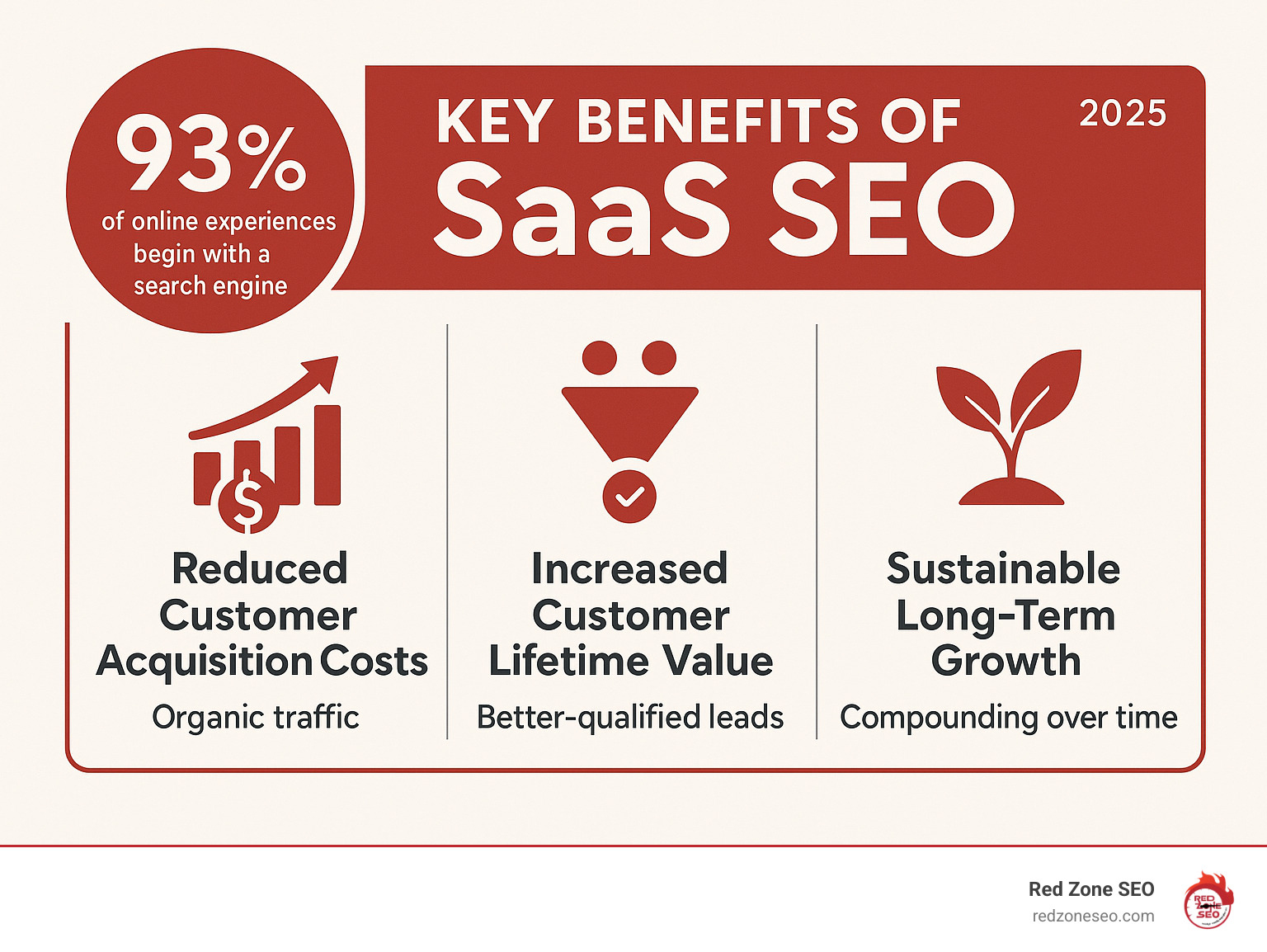
With 93% of online experiences starting with a search engine, SEO is essential for growth. It helps reduce Customer Acquisition Cost (CAC) while increasing Customer Lifetime Value (CLV). However, SaaS SEO is unique, requiring a deep understanding of complex buyer journeys and subscription-based models. Prospects aren't making a one-time purchase; they're choosing a long-term solution.
Many SaaS companies struggle with long sales cycles and high competition. Paid advertising can be costly, especially in B2B. SEO offers a sustainable alternative. While paid traffic stops when you stop paying, organic search creates a growth engine where content continues to attract qualified leads for months and even years.
Seo for saas companies glossary:
SaaS companies face a unique challenge: connecting with people who may not even know a software solution exists for their problem. This is where SEO for SaaS companies becomes a powerful tool, but it operates differently from traditional e-commerce SEO.
Your prospects aren't making a quick purchase; they're entering a relationship. They need to trust your software with their data, workflows, and business processes. This fundamental difference means SaaS SEO focuses on personas and problems. We must understand the distinct needs of each decision-maker involved in the purchase. For example:
Building trust is paramount. In SaaS, you compete on credibility. When your content consistently appears in search results, answering real questions, you become an authority. This aligns perfectly with Google's E-E-A-T (Experience, Expertise, Authority, Trustworthiness) signals, which reward websites demonstrating deep, real-world expertise. For a SaaS company, this means:
SaaS SEO is conversion-focused from day one. Every piece of content aims to drive free trial sign-ups, demo requests, or move prospects closer to a decision. Unlike paid ads, SEO creates sustainable, long-term traffic that improves over time. A blog post published today can attract qualified leads for years, creating a powerful compounding effect on your growth.
Furthermore, SEO complements your other marketing channels. A prospect might see a social media ad but then use Google to research reviews or learn more about the problem you solve. A strong SEO presence ensures you're there to guide them at every touchpoint.
Understanding the customer journey is crucial for SaaS success. We tailor content for each stage of the marketing funnel.
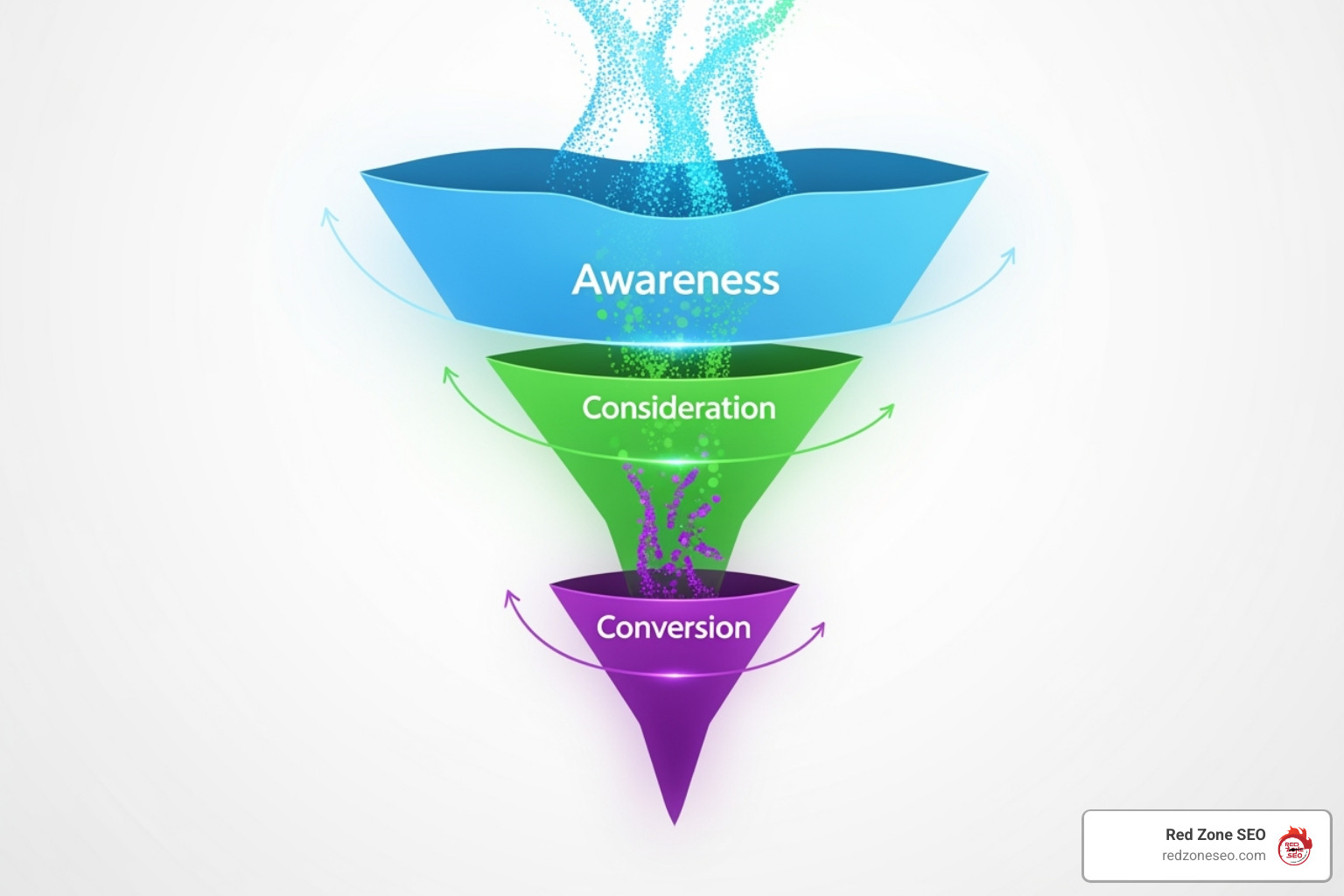
Top-of-the-Funnel (ToFu): Awareness. Prospects are searching for answers to problems, not products. They might search "how to improve remote team communication" or "what is lead scoring." We create comprehensive guides and blog posts that address these pain points to build trust and brand awareness.
Middle-of-the-Funnel (MoFu): Consideration. Prospects know they need a solution and are exploring options. They search for "best project management tools," "HubSpot alternatives," or "CRM software comparison." This is where case studies, testimonials, and detailed feature comparisons demonstrate your value and differentiate you from the competition.
Bottom-of-the-Funnel (BoFu): Decision. Prospects are ready to buy. They search for your brand name, pricing, and reviews (e.g., "Salesforce pricing" or "Asana reviews"). Optimized landing pages, clear pricing tables, and detailed FAQs are essential here to remove friction and drive conversions.
The goal is to connect content across the funnel, guiding prospects naturally from awareness to purchase.
Google's algorithms are increasingly sophisticated, rewarding sites that genuinely help users.
User Intent Alignment: Your content must fully satisfy the reason behind a search query, whether it's to compare options, see pricing, or understand features.
Content Freshness: SaaS products and industries evolve quickly. Regularly updating content to reflect current trends, new features, and pricing changes is critical for maintaining credibility and rankings.
Core Web Vitals: A fast, mobile-friendly, and responsive website is non-negotiable. A poor technical experience suggests a poor software experience.
High-Quality Backlinks: Earning links from reputable industry publications, software roundups, and partners remains a crucial signal of authority and trust.
Semantic Search: Google understands context and relationships between topics. Comprehensive content that covers a subject thoroughly is rewarded over narrowly focused, keyword-stuffed articles.
An effective SEO for SaaS companies strategy requires three components working in harmony. Think of it as a high-performance vehicle: your website's technical foundation is the Engine, your content strategy is the Fuel, and your link building efforts are the Oil that keeps everything running smoothly.
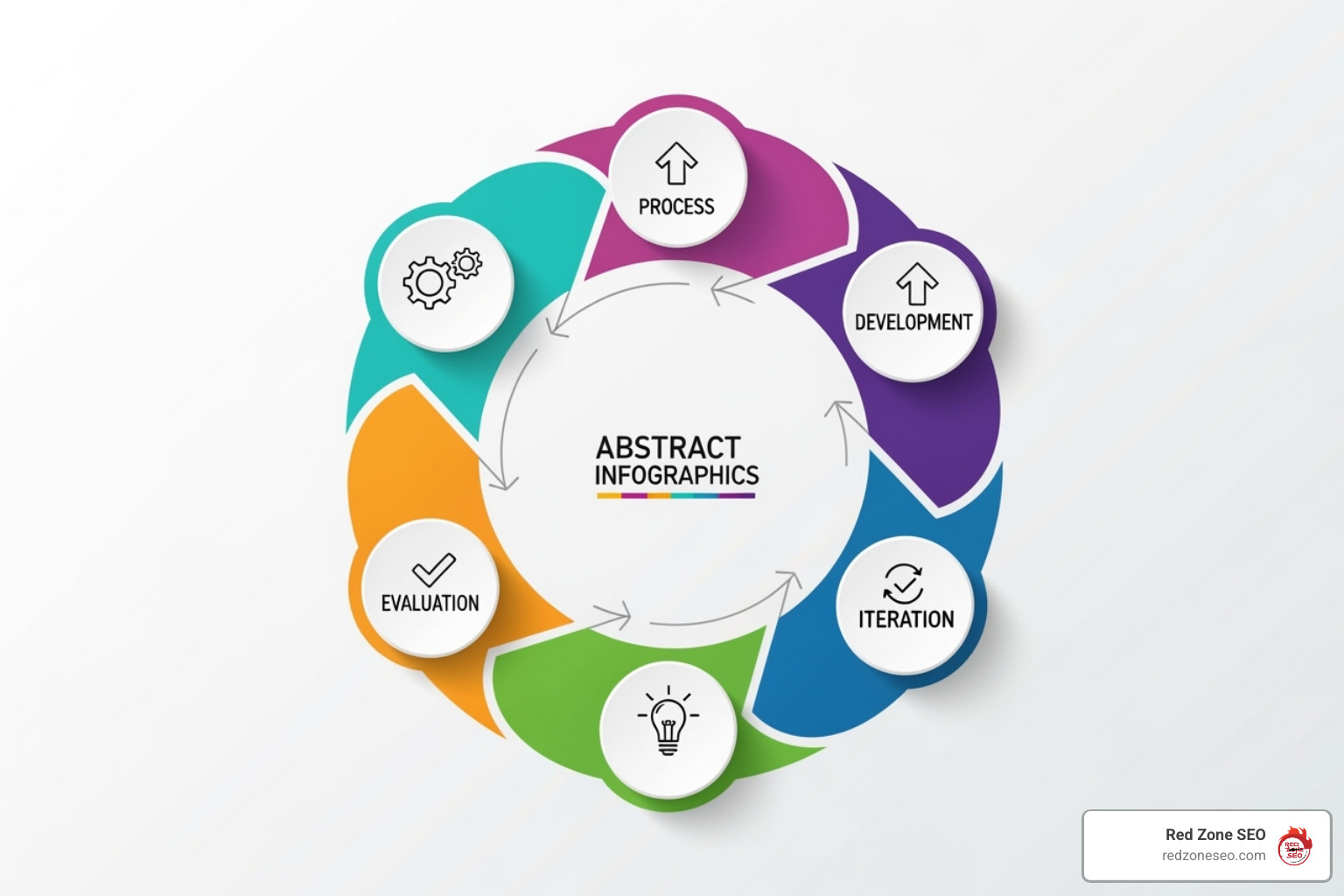
These pillars are integrated into our proven five-step process: Ideate to plan your strategy, Create compelling content, Publish while building connections, Monitor performance with data, and Refine continuously. This cycle creates sustainable growth that compounds over time.
Before any execution, we immerse ourselves in your business. This foundational step maps your path to success.
For new businesses, we focus on building a solid foundation while targeting quick wins. You can learn more in our guide on SEO Strategies for Start Ups.
Here, we create high-value content that drives results.
For more on our process, see our guide on Content Optimization.
Great content needs proper publishing and promotion to reach its potential.
SEO requires continuous analysis and adjustment. It's a dynamic process, not a one-time setup.
Your website is the engine of your marketing. Without a solid technical foundation, even the best content strategy will fail. For SEO for SaaS companies, technical excellence is non-negotiable, as it directly impacts user experience, search engine rankings, and ultimately, a prospect's perception of your product's quality.

Many SaaS companies have beautiful websites that underperform due to hidden technical issues. If Google can't properly crawl, render, and understand your pages, your prospects will never see your content. The stakes are high, as technical decision-makers expect fast, seamless digital experiences. A slow page damages credibility before a prospect even learns about your product.
Core Web Vitals and mobile-first indexing are critical ranking factors. Core Web Vitals measure a user's real-world experience on your site:
Your site must perform flawlessly on mobile devices. Technical SEO isn't just for algorithms; it's about creating the professional, high-performance experience your prospects expect.
Sitemaps: We create comprehensive XML sitemaps to act as a roadmap for Google, then submit them via Google Search Console to ensure efficient crawling and indexing of all your important pages. For specifications, see Google's guide on sitemaps.
Schema Markup: We implement structured data to help search engines understand your content's context. For SaaS, this includes Article schema for blog posts and, crucially, SaaSProduct and SoftwareApplication schema. This can enable rich results in search, such as star ratings, pricing, and key features shown directly on the results page.
Canonical Tags: These tags solve duplicate content issues by telling Google which version of a page is the master copy. This is vital for pages with URL parameters (e.g., from marketing campaigns), consolidating all SEO value to a single, preferred URL.
301 Redirects: When URLs change, we implement permanent 301 redirects to pass link equity and ensure a seamless user experience, preventing visitors and search engines from hitting 404 "Page Not Found" errors.
Robots.txt File: We configure this file to guide search engine crawlers toward your most valuable pages and away from non-essential sections (like admin logins or internal search results), optimizing your crawl budget.
HTTPS Security: A secure site (using HTTPS) is a confirmed ranking factor and is absolutely essential for building trust with prospects who are considering sharing business data with your software.
The platform your website is built on significantly impacts SEO success. We evaluate platforms on three key criteria:
For these reasons, we often recommend platforms like Webflow or well-optimized WordPress installations, which provide the granular control and performance needed for competitive SaaS SEO.
Content is the fuel for your SEO for SaaS companies engine. A strategic content plan transforms your SEO efforts into a growth machine that attracts, educates, and converts your ideal customers. This means creating purposeful content mapped directly to the buyer's journey, where every article, guide, and landing page has a specific job to do.
Our approach focuses on solving real user problems. When a prospect searches for a solution, your content should provide the best answer. This is where product-led content excels. This strategy involves naturally weaving your product into the narrative to demonstrate how it solves the user's problem, without a hard sell. For example, an email marketing SaaS could publish an article, "10 Welcome Email Templates to Boost User Onboarding." The article provides genuine value with the templates, while also using screenshots and GIFs to show exactly how to build and automate those sequences within their software. This doesn't just drive traffic; it drives the right traffic—people who are already looking for what you offer and can see its value in action.
A successful content strategy begins with understanding what your audience is searching for and the search intent behind their queries.
For more details, see our page on Keyword Research.
We organize these keywords into topic clusters. Each cluster focuses on a core "pillar" topic, supported by multiple "cluster" articles on related sub-topics. For a project management SaaS, a pillar page might be an ultimate guide to "Agile Project Management." This would be supported by cluster articles on "Scrum vs. Kanban," "How to run a sprint planning meeting," and "Best agile tools." The cluster articles all link back to the pillar page, and to each other where relevant.
Founders and marketing teams often have similar questions about SEO for SaaS companies. Here are answers to the most common ones.
SEO is a marathon, not a sprint, which is its greatest strength. While every case is different, a general timeline is:
3-6 Months: You can expect to see initial results, such as improvements in keyword rankings for less competitive terms and a gradual increase in organic traffic. This is when technical optimizations and early content pieces start to gain traction.
6-12 Months: This is when you should experience significant impact. Organic traffic growth becomes more substantial, you begin ranking for more competitive, high-value keywords, and qualified leads from search flow more consistently.
The speed of results depends on several factors, including your website's starting authority, the competitiveness of your industry, your budget and resource allocation, and the quality of the strategy's execution.
SEO is a long-term investment. Unlike paid ads, the content created today continues to attract prospects for years, creating compounding returns that lower your customer acquisition costs over time.
We track concrete metrics that tie directly to your bottom line:
This is a common and important question.
DIY SEO is possible if you are a technical founder with ample time and a strong grasp of content marketing. However, SEO is a complex, full-time discipline encompassing keyword research, technical optimization, content strategy, link building, and analytics. Mistakes can be costly, such as earning toxic backlinks that lead to a Google penalty or making a technical error that gets your site de-indexed.
Hiring a specialized agency like Red Zone SEO provides immediate access to expertise, premium tools, and proven processes custom-built for SaaS companies. We've spent years refining our approach, which allows us to accelerate results and help you avoid the costly mistakes that can set your growth back by months or even years.
The real question is about opportunity cost. A comprehensive SEO audit can help clarify your specific needs and determine the best path forward. An agency acts as an extension of your team, allowing you to focus on building a great product while we focus on driving sustainable organic growth.
We've covered the core components of SEO for SaaS companies, from the unique challenges to a comprehensive 5-step strategy. In today's competitive market, having great software isn't enough; the right people must be able to find you when they need a solution.
Our Engine, Fuel, and Oil framework provides a clear path forward. A technically sound website (Engine), powered by a high-value content strategy (Fuel), and supported by authority-building links (Oil) creates a sustainable growth engine. This engine works 24/7, attracting qualified prospects and converting them into loyal customers.
Unlike paid ads, a holistic, data-driven SEO strategy delivers compounding returns. The authority you build becomes a competitive moat, protecting and growing your market share over time.
At Red Zone SEO, we understand that every SaaS business is unique. We don't use one-size-fits-all solutions. Our expertise lies in creating custom strategies that align with your specific business objectives, target audience, and market position. We know your customers are investing in solutions, not just buying software.
Ready to open up your organic growth potential? Your competitors are already investing in SEO. The time to act is now.
Learn how our proven SEO process can drive growth for your SaaS business.