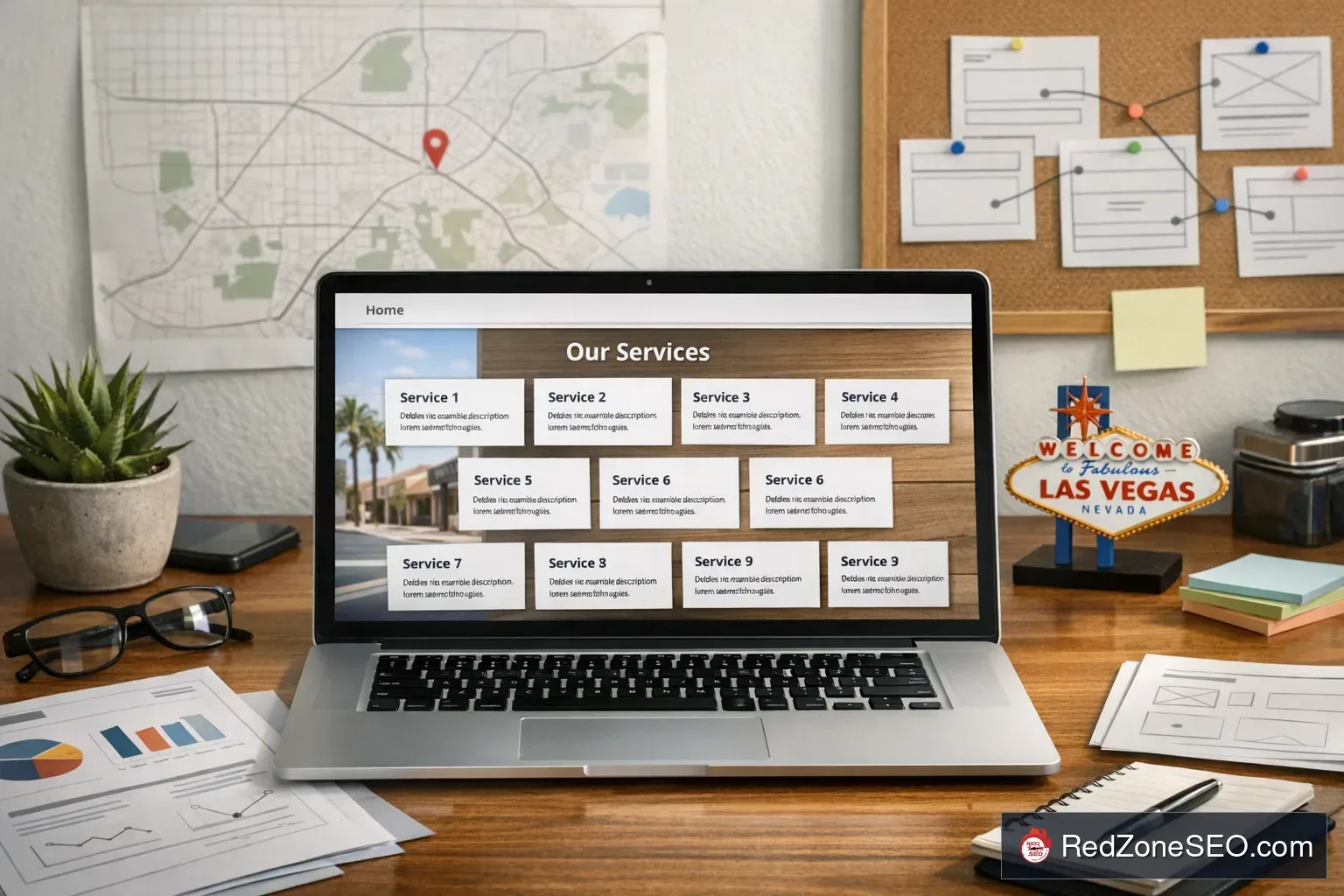
Many small business websites in Henderson look fine at first glance. They have a homepage, a few service pages, a contact page, and maybe a WordPress theme that feels modern enough. But rankings stay weak. The homepage may show up for branded searches, while the service pages barely appear at all. In some cases, Google seems to treat the whole site as thin even though the business owner knows there is real information on the website.
This is a common homepage SEO problem. The issue is not always that the site has too few pages. Often, it is that the site puts too much service meaning on the homepage and leaves the supporting pages too shallow, too similar, or too disconnected to rank well on their own. For businesses looking for search engine optimization Henderson support, this is one of the most important architecture problems to diagnose early.
If your business serves Henderson, Las Vegas, or wider Clark County, and your site mentions multiple services but still struggles to rank, the problem may be page depth, internal linking, or site structure rather than a total lack of content. Below is how to recognize it, what causes it, and what a practical fix usually looks like without wasting money on random SEO tasks.
A thin-site problem does not always mean a website is tiny. It often means the important pages do not give Google enough usable detail to understand what each page should rank for.
Here is what that looks like in the real world for Henderson small businesses:
Many business owners assume that once a page exists, Google will eventually rank it. That is not how it works. Google still has to understand the page’s purpose, how it differs from the homepage, what search intent it satisfies, and whether the site structure supports that page as a meaningful destination.
For example, a marketing agency homepage might say:
But if each linked page only repeats the same basic promise without explaining who the service is for, what problems it solves, how it works, and how it connects to local business needs in Henderson, Google may not see enough differentiation. To the business owner, the site feels complete. To search engines, it may still look shallow.
This is especially important in local markets where smaller service businesses are competing for similar phrases. Search results for local queries are not won by tossing all your value into the homepage and hoping Google sorts it out.
Google does not count pages the way a business owner might. Ten weak pages are not automatically better than three strong ones. A website can have service pages and still have a thin content SEO problem if those pages do not offer enough original, useful, page-specific value.
If your SEO page, local SEO page, and digital marketing page all say roughly the same thing, Google has little reason to rank all three separately. The pages may compete with each other or simply fail to stand out.
A strong service page SEO setup gives each page a clear job. One page should explain standard SEO work. Another should explain local SEO for map visibility and service-area relevance. Another might focus on WordPress SEO support, technical cleanup, and plugin or theme-related SEO issues. If they all blur together, the site looks less useful.
This is one of the biggest issues on small business sites. The homepage often contains:
Meanwhile, the service pages are weak by comparison. That creates a pattern where the homepage ranks a little, but the actual service pages do not. Google sees the homepage as the main relevant page and the deeper pages as secondary or underdeveloped.
Internal linking is not a minor detail. It helps Google understand page relationships and relative importance. When service pages are only linked once in the main menu and never referenced again in body content, they can stay structurally weak.
Google Search Central guidance repeatedly supports the importance of helpful site structure and internal links for discovery and context. If your homepage mentions a service but your blog posts, related pages, and supporting content never link back to that service page with clear context, that page often remains under-supported.
There is no magic word count. But there is a practical reality: some searches require more depth than 150 to 250 words can provide.
If a Henderson business wants to rank for search engine optimization henderson or related local service phrases, the page usually needs to do more than define SEO and invite a call. It should explain:
Thin pages often fail because they do not match the depth implied by the search.

A homepage might mention Henderson once in a hero section and Las Vegas once in the footer. That is not the same as building strong local relevance throughout the site.
For local SEO Henderson visibility, Google needs clearer signals about what services are offered, where, and in what local context. That does not mean stuffing city names into every paragraph. It means making sure the right service pages explain service delivery in Henderson, common local competition issues, and how the work applies to businesses in that market.
When service detail lives mostly on the homepage, the site creates confusion.
The homepage should introduce the business and guide visitors deeper. It should not be the only page that fully explains your major offerings. When it becomes the main container for every service description, every city mention, every trust point, and every problem-solution summary, the supporting pages end up thin by comparison.
Local search depends on relevance, clarity, and structure. If Google sees one strong homepage and several light service pages, it may struggle to match the right page to the right query. That affects rankings for service-based searches in Henderson.
For example:
In that situation, the homepage absorbs attention while the deeper pages remain weak.
The more services you push into one page, the less precise the relevance becomes. A homepage can say, “We offer affordable SEO, local SEO, content marketing, and digital marketing for Henderson businesses.” But that broad statement does not replace dedicated page-level relevance.
Google wants clearer signals for query matching. If someone searches a local service phrase with specific intent, the best ranking page is often a page focused on that service, not a homepage that covers everything lightly.
This is one reason some businesses see impressions for terms like henderson seo services but no clicks and poor positions. The site may be partially relevant, but not sharply relevant enough.
If your homepage currently contains the most complete explanation of your services, that is a warning sign. Businesses should usually move detailed service-specific material into pages such as:
The homepage can still summarize these services. It just should not be the only place where they are explained with depth.
That does not mean every keyword needs its own page. It means major service categories should have their own useful destinations, and those pages should be substantially more informative than a homepage teaser.
Once business owners realize the site may be thin in structure, they often rush into the wrong fix. That can waste budget, especially for companies looking for affordable henderson seo services.
One common overreaction is building a separate page for every slight keyword variation:
That usually does not help. It creates overlapping pages that target the same intent and make the site look repetitive. A better approach is to create one strong page that addresses the topic thoroughly and naturally includes related phrasing.
Some websites try to solve thin content by adding generic text that says very little. Long pages are not automatically strong pages. If the added content is vague, repetitive, or obviously written for word count, the page is still weak.
A better page adds practical detail, not filler. For example:

Businesses often rewrite pages but never improve how those pages connect. This leaves the structure weak even if the copy improves.
If you expand a local SEO page but the homepage, blog posts, related service pages, and footer resources never point to it in meaningful ways, Google may still treat it as secondary.
Many business owners worry that moving content off the homepage will hurt conversions. In practice, it usually helps when done correctly. The homepage should remain strong, but the service pages should be the real destinations for detailed information.
If visitors want specifics, they should be able to click deeper and find them quickly. That improves both user experience and SEO clarity.
Small businesses sometimes buy random monthly tasks before anyone determines whether the actual issue is page depth, structure, internal links, or indexing. That is where SEO budgets get burned.
Before buying ongoing work, it helps to understand how affordable campaigns are usually prioritized. This related article on How Henderson SEO Companies Structure Monthly Work for Affordable Campaigns explains what smart sequencing looks like when budget matters.
A real fix is not just “write more.” It usually combines content improvement, page role clarification, and internal linking support.
Each major page should have a clear purpose:
If the page roles are muddy, rankings usually stay muddy too.
A stronger service page often includes:
This is where service page SEO becomes practical. The goal is not to impress with jargon. The goal is to make it easy for Google and users to understand what that page is for.
Internal links should reflect how your services actually relate:
This helps search engines understand which pages deserve attention and how topics connect across the site.
If two pages target the same intent, they may need consolidation rather than expansion. This is especially common on older WordPress sites where pages were added over time with no clear structure.
Strong WordPress SEO support often includes reviewing old slugs, duplicate service pages, tag or category clutter, redirect issues, and pages that should be merged.
Fixing a thin-site architecture problem is important, but it is not an overnight ranking switch. Once page structure improves, Google still needs time to crawl, reprocess, and re-evaluate the site.
Some pages may improve faster than others. In local SEO, results can also depend on competition, business profile strength, link quality, and location relevance. That is why the right question is not “How fast will I rank?” It is “Are we fixing the right bottleneck first?”
If you are weighing what level of SEO support makes sense, this article on Search Engine Optimization in Henderson: Is a Basic Plan Enough to Compete Locally? gives useful context for how much work may actually be needed.

Not every weak site needs a full rebuild. Some need better pages. Some need better structure. Some need both.
In this case, improving content depth and clarity may be the first priority.
In this case, expanding copy alone will not solve the problem.
That last point matters. When search demand exists for phrases like search engine optimization henderson, henderson seo services, and seo services henderson, but the site is not converting those impressions into visibility, the problem may be structural rather than purely promotional.
If budget is tight, do not try to fix everything at once. Start with the pages closest to revenue and local intent:
This is usually more effective than publishing endless blog posts while core service pages stay thin.
For businesses trying to decide how to sequence limited SEO spending, this article on What Henderson SEO Services Should Small Businesses Prioritize First on a Limited Budget? is a useful next read.
Because the existence of pages is not enough. Google evaluates whether those pages are useful, distinct, well connected, and specific enough to match search intent. If your homepage contains most of the real service explanation and the deeper pages only skim the surface, the site can still look thin in practice.
No, not if it is done well. The homepage should still summarize your value and direct users clearly. But service pages should carry the deeper information. This often improves conversions because visitors can find the exact detail they need without forcing the homepage to do every job at once.
There is no fixed number. The page needs enough substance to satisfy the search and clearly separate itself from other pages on your site. In most cases, a local service page needs more than a short intro, a list of benefits, and a contact form. It should answer real questions, define scope, show relevance to the local market, and connect logically to the rest of the site.
Often it is a combination. Small business sites frequently have underdeveloped service pages and weak internal linking at the same time. That is why diagnosis matters. If you only rewrite content without fixing the structure, or only add links without improving page depth, results may stay limited.
Review whether the homepage is carrying all the useful service detail while the service pages remain too thin, too similar, or too weakly linked. If so, the next step is usually a focused site diagnosis that identifies whether the best move is expansion, consolidation, restructuring, or all three.
If your site has been sitting in the same weak range for months, this is not the kind of problem to ignore. A thin architecture issue can waste time in two ways:
This is especially relevant for small businesses in Henderson and Las Vegas using WordPress, older service-page templates, or basic brochure-style websites. Many of these sites are not missing effort. They are missing structure.
If you are also comparing one-time fixes versus ongoing support, this article on One-Time SEO Fixes vs Monthly SEO Retainers: Which Costs Less Long Term? can help frame the decision. In many cases, the right answer depends on whether the site first needs a structural repair before ongoing growth work makes sense.
The main point is simple: do not assume that having service pages means your site is structurally strong. If the homepage is doing all the heavy lifting, if your service pages are short or overlapping, or if internal links are too weak to reinforce page importance, rankings can stall even when the site looks complete to you.
Red Zone SEO helps Henderson-area small businesses figure out whether homepage-only service content, weak page depth, or poor internal linking is suppressing visibility. If that sounds like your site, the right next step is to contact Red Zone SEO for a site diagnosis or call (702) 489-0881 and have the structure reviewed before the issue costs more rankings, more wasted content work, and more lost local search visibility.