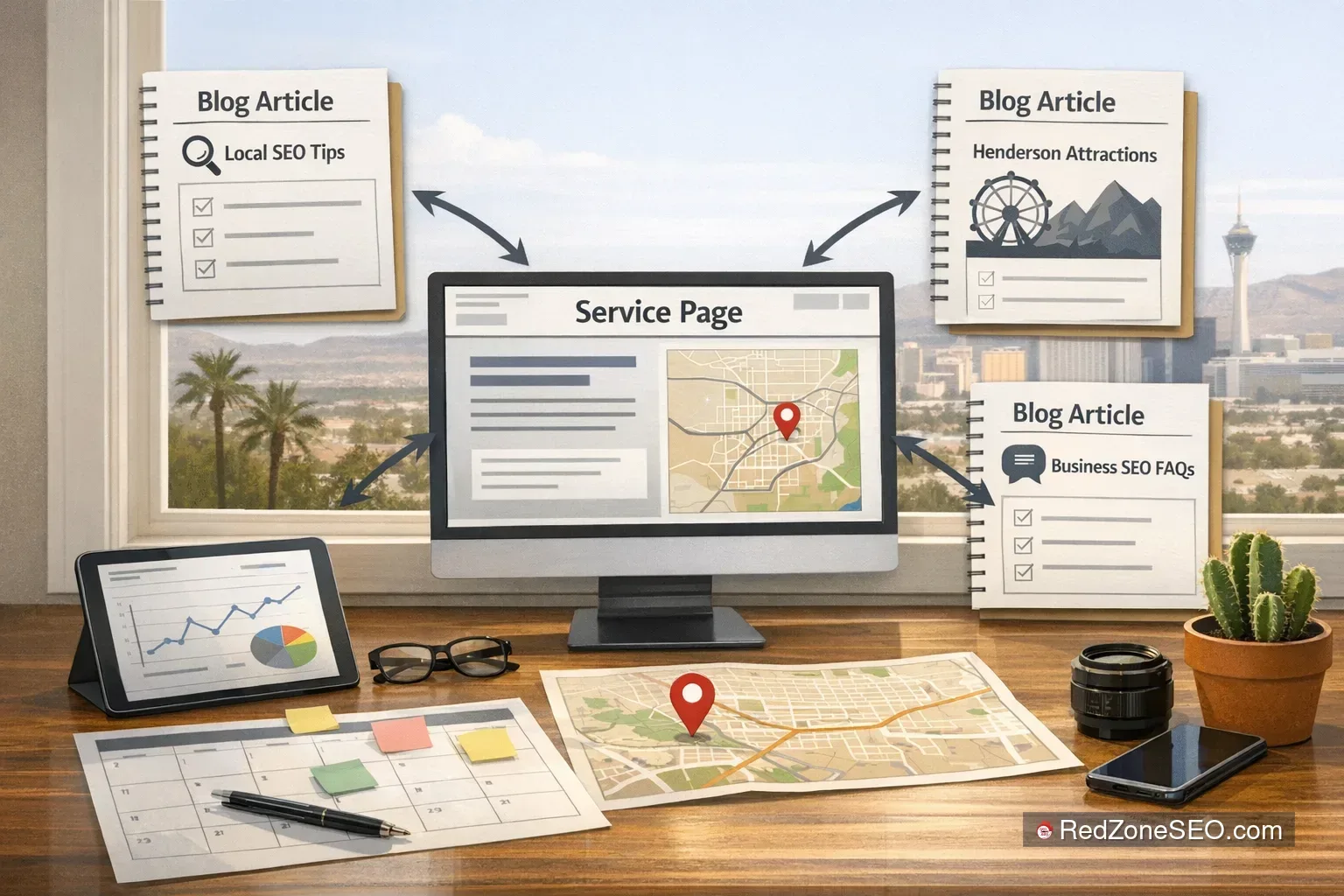
Many Henderson business owners know they need a strong service page, but they are less sure what role blog content should play around it. A common mistake is publishing multiple pages that all chase the same keyword, then wondering why none of them ranks well. A better approach is to use blog content to support the main page, answer related questions, and guide readers toward the page that should convert.
If your goal is to strengthen a Henderson SEO company page, this article explains how to build blog content for SEO service pages without creating overlap that hurts performance. The focus here is practical: how to support local SEO pages with blogs, how to avoid keyword cannibalization SEO problems, and how to make internal linking for local SEO work the way it should.
Supporting a service page with blog content does not mean rewriting the same page in five different formats. It means building nearby content that helps search engines and readers understand the topic more completely while keeping one clear page as the main conversion destination.
For example, if your main service page is about Henderson SEO services, that page should stay focused on service intent. It should explain what the service is, who it is for, how it applies to Henderson businesses, and what next step a prospect should take. It is the page that should speak to a person comparing providers or deciding whether to ask for help.
Supporting blog posts should do different work. They should answer adjacent questions such as:
That is the difference between educational content and conversion content. The blog post educates. The service page sells the fit.
This matters in Henderson because local search terms like henderson seo, henderson seo companies, and search engine optimization henderson often signal mixed intent. Some searchers want to learn. Others want to compare agencies. If every page on your site tries to rank for the same phrase, search engines may have trouble deciding which page deserves visibility.
A support page should make the main page stronger by doing one or more of these things:
If you want a simple test, ask this: is the blog post helping the reader understand the problem, or is it trying to replace the service page? If it is trying to replace it, you likely have overlap.
Most cannibalization problems are not caused by bad intent. They happen because a business keeps publishing “more SEO content” without assigning each page a specific role.
A typical example looks like this:
On paper, these seem like different keywords. In practice, they often reflect the same underlying intent. Search engines may treat them as close variations of one topic. Now your own pages are competing for the same query family.
That is what people mean by keyword cannibalization SEO. In plain language, it means your site has multiple pages signaling, “I am the one that should rank for this.” Instead of building authority into one page, you spread it across several.
Here are the most common reasons this happens:
If the post title is just another version of your service page title, you are creating confusion. A blog article called “Henderson SEO Services for Local Businesses” is probably too close to a service page about the same thing.
Before publishing, you should know whether the page is meant to educate, compare, diagnose, or convert. Without that decision, blog content for SEO service pages often drifts into sales copy.
Sometimes business owners link from the service page down to blog posts heavily, but forget to link those articles back to the service page. That weakens the hierarchy. Supporting content should usually reinforce the main page, not compete with it.

Using the exact same target phrase in the title tag, H1, intro, and anchor text across multiple pages is one of the easiest ways to create overlap. You do not need to force the exact same keyword repeatedly to build relevance.
This is especially important if you are seeing impressions for terms like henderson seo or henderson seo companies but not getting clicks. That can be a sign your page titles and page roles are not differentiated enough. In some cases, a site has the right topics but the wrong page is being surfaced.
For more on that issue, see why your Henderson SEO service page gets impressions but no clicks.
The best supporting topics are close enough to reinforce the core service, but different enough to deserve their own page.
A practical way to choose topics is to think in rings around the main service page.
These are questions prospects ask before contacting an agency, but they are not the main service term itself.
These topics support conversion because they address hesitation and expectations.
These are strong blog topics because they reflect a real obstacle the reader is facing.
Problem-based content tends to support local SEO pages with blogs more effectively than generic “tips” posts because it matches actual search behavior and real business concerns.
These help budget-conscious business owners decide where to focus first.
This is where content marketing strategy fits in. If your site needs topical depth, supporting education can explain how SEO content works without stepping on the service page.
For example, an article about content marketing for small businesses can support your Henderson service page if it explains how content builds visibility, trust, and internal linking opportunities. It should not try to become another Henderson SEO service page.
Before writing a post, ask these five questions:
If the answer to several of these is no, the topic may be too close to the main page.
In terms of timing, supporting content rarely changes service-page performance overnight. Blog support is usually cumulative. Search engines need time to crawl, understand relationships, and see how users respond. That is why realistic expectations matter. Strong supporting content can help over time, but it is not instant repair.
The easiest way to keep a service page and blog strategy clear is to define three things for every page: its intent, its role, and its link path.

If someone searches “Henderson SEO company,” they are often provider-shopping or evaluating options. That is service-page intent.
If someone searches “why my Henderson SEO page gets impressions but no clicks,” they are trying to diagnose a problem. That is blog-post intent.
If someone searches “content marketing for small businesses,” they are likely looking for guidance or planning help. That is educational intent.
Those pages can all support each other, but they should not all be optimized as if they serve the same purpose.
For local SEO, this structure is especially important. A Henderson page should not simply duplicate a Las Vegas page with the city swapped. Likewise, a blog article about Henderson content marketing SEO should not be treated like a city service page unless that is truly its job.
Internal linking for local SEO works best when it reflects page roles clearly.
Here is a practical pattern:
Good anchor examples might include:
That is usually better than using the exact same anchor phrase in every article.
Google’s own guidance consistently points toward helpful content, clear site structure, and natural linking relationships. The practical takeaway for a small business owner is simple: build pages for distinct needs, then connect them in a way that makes sense to a real person.
If you are trying to avoid keyword cannibalization SEO issues, watch for these common mistakes.
A business serving Henderson, Las Vegas, and Clark County may create several pages with almost identical copy. If the content is too similar, none of the pages stands out. Each should have a real local angle, not just a different city name.
Some posts start as educational articles but end up stuffed with service copy, repeated calls to hire the company, and headings that mirror the main service page. That creates overlap fast.
If every article starts with “Henderson SEO…” you may be clustering too tightly around one phrase. Supporting content needs topic variety.
Old, thin, or outdated posts can continue competing with stronger pages. Sometimes the fix is to update them, consolidate them, or redirect them if they no longer serve a unique purpose.
One of the best ways to avoid cannibalization is to map content to where the reader is in the decision process. Early-stage readers need explanations. Mid-stage readers need comparisons and problem diagnosis. Late-stage readers need a clear service page.

If all pages are written as late-stage pages, they will compete.
Here is a simple example content map for a Henderson SEO service page.
Each article addresses a separate question. None of them needs to target the exact same phrase as the main service page. Instead, each one builds context and sends qualified readers toward the page that should convert.
This is how blog content for SEO service pages should work in practice. The blog creates supporting relevance. The service page remains the main destination for commercial intent.
For a multi-location business, the same framework can be repeated by city, but carefully. Henderson and Las Vegas may need different supporting examples, different problem framing, and different internal links depending on what each market needs. A copy-and-paste city strategy often creates thin local relevance instead of stronger visibility.
Some content issues are easy to spot. Others are not. A professional review makes sense when:
A review does not have to mean rebuilding everything. Sometimes the biggest wins come from clarifying page roles, improving internal links, merging overlap, and tightening titles and headings.
That kind of review is especially useful if your business has been publishing content steadily but not seeing service-page growth. The issue may not be lack of content. It may be that your content is competing with itself.
A helpful blog post answers a related but different question, then naturally points readers to the service page for the next step. A competing post often has a similar title, similar headings, and similar conversion language as the service page. If both pages seem to be trying to rank for the same Henderson service term, that is a warning sign.
Usually no. It is better to target adjacent questions, problem-based searches, and educational topics that support the main page. Repeating the exact same keyword target across multiple pages increases the risk of cannibalization and muddles page roles.
The best topics are practical and nearby: cost questions, proposal questions, budget priorities, local ranking problems, click-through issues, content planning, and market-specific concerns in Henderson. These topics build topical relevance without trying to replace the service page.
It varies. Supporting content often works gradually because search engines need time to crawl, interpret, and connect the pages. The effect also depends on the quality of the service page, the internal linking setup, the site’s existing authority, and whether the content truly avoids overlap. It is better to think of this as a structure improvement, not a quick trick.
Ask for a review when you have several similar posts, weak service-page performance, impressions without clicks, or uncertainty about which page should rank. A review is also smart before adding more content if your current structure already feels messy.
A strong service page and a strong blog do not compete when each page has a clear job. The service page should target hiring intent. The blog should answer related questions, expand topical relevance, and support internal links back to the main page. That is the core of a practical service page and blog strategy.
If you are trying to grow in Henderson, especially with limited time or budget, the goal is not to publish more pages for the sake of publishing. The goal is to make sure each page helps the site as a whole. When done well, supporting content can strengthen local relevance, improve user paths, and help search engines understand which page should rank for what.
If you want a practical review of whether your current blog posts and service pages are helping or competing with each other, Red Zone SEO can give you a direct answer based on your Henderson growth goals. Call (702) 489-0881 or visit https://redzoneseo.com/contact to ask whether your existing content structure is supporting your main SEO pages or holding them back.