If your website shows up for broad searches like “SEO Henderson” or “search engine optimization Henderson” but does not rank well for the exact service pages you want customers to find, that is a real SEO problem—not just a traffic problem.
For many Henderson and Las Vegas small businesses, the issue is not that Google cannot find the site. The issue is that Google is not fully confident about which page should rank for which service. That leads to impressions without clicks, visibility without leads, and service pages that stay buried while broader pages collect weak search exposure.
This article breaks down why that happens, how to spot a keyword-to-service mismatch, and what to fix before weak rankings keep wasting traffic and leads. If you need practical help from a henderson seo expert, the goal here is simple: diagnose the page targeting problem first, then repair the pages that matter most.
A lot of business owners assume that if they rank for a broad term, they are close to ranking for everything related to that service. In reality, broad visibility often hides a page relevance problem.
For example, your site may collect impressions for terms like:
That pattern matters. It suggests Google sees your site as generally related to SEO in Henderson, but users are not seeing a result that clearly matches what they want. That can happen when:
Broad rankings can also produce the wrong type of visitor. Someone searching “SEO Henderson” may be comparing agencies, looking for a definition, researching pricing, or trying to understand local providers. Someone searching “WordPress SEO services Henderson” or “service page SEO help” is much closer to action.
That difference is search intent.
Search intent is simply the reason behind the search. Google tries to rank pages that best match that reason. If your page is too generic, it may get tested for broad terms but fail for more specific commercial searches.
Here is a practical Henderson example:
For a Henderson plumbing company, roofing contractor, med spa, attorney, or home service business, this hurts lead flow. Their service pages may be visible for general category searches but invisible for the services that actually close business.
That is why ranking for a broad keyword is not enough. If the page language does not line up with commercial service intent, the traffic will be weak, the clicks will be weak, and the leads will be weak.
Most service-page SEO problems come from page relevance, not just authority. A page can be indexed, technically live, and even partially visible while still missing the actual keyword set that matters.
Many small-business websites have pages with broad labels like:
Those labels are too vague if the business really wants to rank for individual services such as local SEO, WordPress SEO support, content marketing, or service page optimization.
Google needs clearer signals about what the page is actually about. If the page mostly uses broad industry terms, it may rank for broad searches but miss the service keywords with buying intent.
Headings are often overlooked. A service page that uses headings like “What We Do,” “Our Process,” or “Why Choose Us” without service-specific language can dilute relevance.
Compare these two heading approaches:
The second version gives Google and users a much clearer signal. It connects the page to a specific problem, service type, and local market.
A big reason pages miss rankings is search intent mismatch. The page may mention the service name once or twice, but the actual content does not satisfy what a searcher expects.

If someone searches for “henderson seo services,” they usually want details such as:
If your page stays general and never goes into service specifics, Google may test it but not reward it.
Many websites try to make one page rank for everything:
That usually creates mixed signals. Broad keywords vs service keywords need structure. One main page can support the overall category, but specific services usually need their own focused pages.
If a page tries to rank for several unrelated commercial intents, it often ranks poorly for all of them.
For Henderson SEO pages, local relevance matters. That does not mean stuffing “Henderson” into every line. It means making the page clearly useful for searchers in Henderson, Las Vegas, and Clark County.
Common missing local signals include:
Google’s Search Central guidance consistently supports the idea that helpful, relevant, well-structured pages perform better when the site makes topic and page purpose clear.
Sometimes the service page exists, but Google keeps ranking another page instead. That often means the site structure is unclear.
Examples:
When that happens, Google may choose a weaker page because your site failed to show which page is the main answer.
Small businesses usually notice this problem through weak results, not through analytics reports. But the warning signs are fairly consistent.
One of the best starting points is Google Search Console. If you see query patterns like:
but clicks stay at zero, look closer at which page is showing and whether it actually matches the service intent.
That is often the earliest sign of mismatch. Google is testing your relevance, but users are not convinced by the result snippet, page angle, or service alignment.
If your SEO page gets impressions but your individual service pages do not, that usually means Google understands your category but not your service breakdown.
For example, a Henderson digital marketing company may have pages for:
If those pages are not showing at all, they may be too thin, too similar, poorly linked, or not mapped to clear keywords.
This is extremely common. You search a service term and find that Google shows:

That tells you Google does not trust the current service page enough to rank it.
If people contact you asking for things you do not specialize in, or they seem unclear about what you offer, your pages may be attracting broad attention instead of qualified search intent.
This is where cost concerns come in. Many small businesses think they need a bigger SEO budget, but in a lot of cases they first need cleaner keyword mapping and stronger page targeting.
A list of services is not the same as a service page. If the page says “we offer SEO, local SEO, content marketing, and WordPress SEO” but does not explain each offering in a focused way, it is not likely to rank well for those services.
If your Henderson page, Las Vegas page, homepage, and SEO service page all repeat the same text with small edits, Google may struggle to tell them apart. That leads to page cannibalization and muddled rankings.
The fix is not to cram more keywords into title tags. This problem usually needs tighter page targeting, clearer structure, and better local-service alignment.
Open Search Console and review:
This is the best diagnostic starting point. If a page is getting impressions for broad local terms but not for the service keywords you actually want, that is your signal to inspect keyword mapping.
Each important service should usually have a dedicated page with a clear purpose.
For example:
This does not mean every minor variation needs a separate page. It means every distinct commercial service should have a page strong enough to deserve rankings for that service.
If you need platform-specific help, Red Zone SEO offers WordPress SEO services that align technical setup, page structure, and on-page targeting with the services you actually want to rank.
Headings should make the page unmistakable. They should answer the searcher’s practical questions, not just decorate the page.
A stronger Henderson service page might include headings like:
Those headings reinforce topic depth and commercial relevance.
If your page says “we help businesses grow online,” that is too broad. If it says “we fix service page targeting so Henderson businesses can rank for the exact services they sell,” that is clearer and stronger.
Useful service-page content often includes:
For Henderson, use locally relevant examples and context:
Google Business Profile guidance also supports the importance of keeping your service area and website messaging aligned. If your website says one thing and your local presence says another, that weakens confidence.

Supporting content can strengthen the main service pages if it is used correctly. That means publishing content that answers related questions and links back to the service page with natural relevance.
For example, if your service page targets local SEO issues for contractors, your supporting content can address related pain points like page structure, local entity signals, or service-area targeting. The point is to reinforce the main page, not compete with it.
Helpful support content may also include content marketing for small businesses, but only when that content clearly supports your service hierarchy rather than replacing it.
On the technical side, if crawl, indexation, or page rendering issues are part of the problem, review this technical SEO guide to understand how underlying issues can interfere with service-page rankings.
Many Henderson small-business sites run on WordPress, and that creates a specific set of SEO issues. Some are easy to fix. Some require a careful audit before updating pages.
Before editing anything, make sure the intended service page is the canonical version. If WordPress, plugins, templates, or duplicate paths have created multiple versions, you can end up strengthening the wrong URL.
It sounds basic, but noindex mistakes happen often on WordPress sites. Check:
Metadata matters, but this article is not just about metadata. You do need to verify that the page title, H1, and opening copy support the target service. But if the body content, internal links, and structure are weak, metadata alone will not solve the problem.
WordPress sites often have weak internal linking because menus, widgets, and page builders were designed for layout, not SEO. Look at:
If all internal links say “learn more” or “our services,” that is a missed relevance signal.
Many WordPress service pages are built with visual editors that produce nice layouts but weak content. You may have sections with icons, short blurbs, sliders, and accordions—but very little indexable text that explains the service.
Google needs content it can interpret clearly. If the page is visually polished but semantically thin, rankings can stall.
Schema is not a magic ranking button, but it can help reinforce page meaning and business context. More important is whether your site consistently communicates:
Missing entity signals can make a local service page feel less trustworthy or less complete.
One of the most common fears is: “Will updating my WordPress service pages hurt the rankings I already have?”
It can, if changes are careless. But a structured update is usually safer than leaving a mismatched page untouched. Before changes are made, document:
That way, improvements are intentional, and useful signals are not removed by accident.
Henderson business owners need realistic expectations here. Service-page SEO fixes do not usually create overnight jumps, especially if the site has weak authority, unclear structure, or multiple competing pages.
Some changes can be recognized fairly fast, especially when they fix obvious mismatch:

In some cases, indexing and query patterns can shift within a few weeks.
More competitive gains often take longer because Google needs to re-evaluate page quality, relevance, and comparative usefulness. That can mean:
For terms like henderson seo expert and henderson seo services, current impression data with zero clicks and positions in the 50s to 70s suggests there is visibility potential, but the pages likely need stronger alignment before they can compete for qualified traffic.
If you change page targeting every two weeks, you make diagnosis harder. The smartest approach is to:
That gives you evidence, not guesswork.
Not every problem needs a full campaign right away. But some situations do call for a closer page audit from a henderson seo expert.
If your site appears for terms like “henderson seo expert” or “henderson seo services” but clicks and leads are weak, the issue may be page targeting, not market demand.
This is one of the most common questions small businesses ask: how do I know if the issue is content, site structure, or keyword targeting?
The honest answer is that these issues overlap. A good audit checks:
This is very common in local SEO for small businesses. If you have pages for Henderson, Las Vegas, and Clark County plus broad service pages, overlap can get messy fast. An audit can help clarify:
Older WordPress sites often accumulate SEO problems slowly: duplicate drafts, old slugs, plugin conflicts, page-builder clutter, redirected content, and thin service pages. A page audit helps prevent random edits from making things worse.
Because Google may see your page as generally relevant to SEO in Henderson but not specifically relevant to the service intent behind the search. If your content is broad, vague, or blended across multiple services, it may collect impressions for category terms while missing the exact service phrases that bring better leads.
A main category page can rank for broader terms, but distinct commercial services usually perform better with their own pages. If local SEO, WordPress SEO, and content marketing are all real services you sell, each one usually needs focused copy, headings, internal links, and intent alignment. Otherwise, one page can become too diluted to rank well for any of them.
Start in Search Console. Look at the query, the ranking page, and whether that page is the best match for what the user searched. If the wrong page ranks, structure and internal linking may be part of the problem. If the right page ranks but gets weak response, the content or intent match may be weak. In many cases, all three need review together.
It can if you remove useful relevance signals, change URLs carelessly, or rewrite pages without preserving what is working. But if the page currently ranks for the wrong queries or attracts poor-fit traffic, a controlled update is often the right move. The key is to document current performance and make changes based on diagnosis, not assumptions.
Do not guess. Review query-to-page patterns first. If the page is visible for broad local terms but not for service-specific intent, you likely have a keyword mapping or page relevance issue. The smartest next step is a page diagnosis that checks targeting, content structure, internal links, and local signals before you keep editing pages blindly.
If your Henderson pages are showing up for broad SEO searches but not for the services you actually sell, that is usually a fixable problem. The problem is not just ranking position. It is page intent, keyword mapping, service detail, and local relevance working against each other.
For Henderson and Las Vegas small businesses, this often shows up as impressions with no clicks, broad visibility with no qualified leads, or a WordPress site where the wrong pages keep appearing in search. The longer that mismatch stays in place, the more traffic and lead opportunities get wasted.
Before you rewrite more pages, have Red Zone SEO inspect your current service-page targeting, keyword mapping, and on-page signals so the real issue is identified before it gets worse. You can contact Red Zone SEO for an SEO page diagnosis and get a practical review of what is misaligned, which pages should be repaired first, and how to tighten your Henderson service-page relevance without guessing.
If you want to compare SEO companies in Clark County, the challenge is not finding agencies. It is figuring out which one is actually a good fit for your business goals, budget, timeline, and market. In Las Vegas, Henderson, and the wider Clark County area, many agencies offer similar promises on the surface. They may all mention traffic, leads, rankings, and growth. What separates them is how they work, what they specialize in, how they report progress, and whether their approach matches the needs of your business.
This guide is designed to help small businesses and growing companies make a smarter decision. Rather than making broad claims, we will break down the real factors to evaluate when you compare SEO companies Clark County businesses commonly consider. We will cover service offerings, pricing models, contract terms, reporting, support, proven results, reputation, and warning signs to watch for before you sign an agreement.
If you are researching options for SEO in Las Vegas, Henderson, or nearby markets, this article will give you a practical framework you can use right away.
SEO is never one-size-fits-all, and that is especially true in Clark County. Businesses here often compete in fast-moving local markets where search visibility can shift based on location, seasonality, competition, and service area targeting. A company serving Summerlin, downtown Las Vegas, Henderson, and broader Clark County may need a very different SEO strategy than a company focused on one neighborhood or one niche.
Local competition matters. Search behavior in Clark County often includes city-modified searches, service-plus-location phrases, and mobile searches from users who are ready to contact a business quickly. That means the best SEO company for one business may not be the best option for another.
When comparing agencies, it helps to ask: do they understand local intent, neighborhood-level visibility, map-driven search behavior, and how to build content around real searches people make in Las Vegas and Henderson? Agencies with local experience can often structure campaigns more effectively because they understand how businesses compete in this area.
Local context is not the only factor, but it should absolutely be part of your comparison process.
The phrase “top SEO companies” can be misleading if you do not define what “top” means for your business. One agency may be strong at technical SEO for large websites. Another may excel at content marketing for local service businesses. Another may focus on WordPress SEO services for small to midsize companies that need a practical, manageable site structure. A different firm may position itself around affordable SEO services with leaner packages and more limited scope.
So before you compare agencies, define your own priorities.
Once you answer those questions, it becomes easier to compare agencies in a meaningful way instead of just reacting to whichever proposal looks the most polished.
One of the biggest factors that sets SEO companies apart is the actual mix of services they provide. Two agencies may both say they offer SEO, but one may focus mainly on audits and technical fixes while another builds full campaigns that include content, local optimization, on-page improvements, strategy, and ongoing reporting.
For businesses in Clark County, it is important to look past the general label of “SEO” and ask exactly what is included.
Some agencies are broad digital marketing firms. Others are highly specialized in search engine optimization. Neither model is automatically better. The right fit depends on what your business needs now and what it may need in the next year.

For example, if your website runs on WordPress, an agency with real WordPress SEO services experience may be better equipped to improve page templates, plugin settings, schema implementation, performance, indexation, and content organization. If your website is not the problem but your visibility is weak, a firm with strong content marketing and local SEO strategy may be more valuable.
If your business needs support beyond SEO, such as a wider internet marketing strategy, a broader agency may help align multiple channels. The key is clarity. You want to know whether the agency can solve your actual problem, not just sell a generic service package.
When reviewing agencies, ask for details on how they handle the following:
The more specific the answers, the easier it is to compare agencies honestly.
Beyond the service list, the real difference between SEO companies is how they approach strategy. Some firms build campaigns around quick surface-level tasks. Others start by understanding your business, market, website, and conversion goals before prioritizing work.
A strong SEO strategy usually includes sequencing. Not every task should happen at once. If your website has technical issues, weak service pages, poor content targeting, and unclear conversion paths, the agency should explain what to fix first and why.
If an agency cannot clearly explain its process, that is a problem. Good SEO is not just a list of tasks. It is a plan tied to outcomes.
In Clark County, many businesses need a blend of local and service-page SEO. An effective strategy may include improving city-targeted pages, refining title tags and headings, strengthening internal links, building useful content around nearby search intent, and making sure the website is easy for search engines and users to navigate. Agencies that understand this balance tend to build stronger long-term campaigns than those that focus on one narrow tactic.
Pricing is often where business owners focus first, but the monthly number alone does not tell you much. You need to understand what is included, how the work is structured, and whether the contract terms are reasonable.
SEO companies in Clark County may use several pricing models, each with different implications.
Do not compare proposals by price alone. Compare scope, priorities, communication, and execution responsibility. A lower monthly fee may cover only basic reporting and light on-page work, while a higher fee may include technical updates, content creation, local SEO enhancements, and regular strategy calls.
Here are the questions that matter:
Contract language is one of the biggest factors that can set agencies apart. A business-friendly contract should be understandable and clear about commitment, deliverables, cancellation, and ownership.
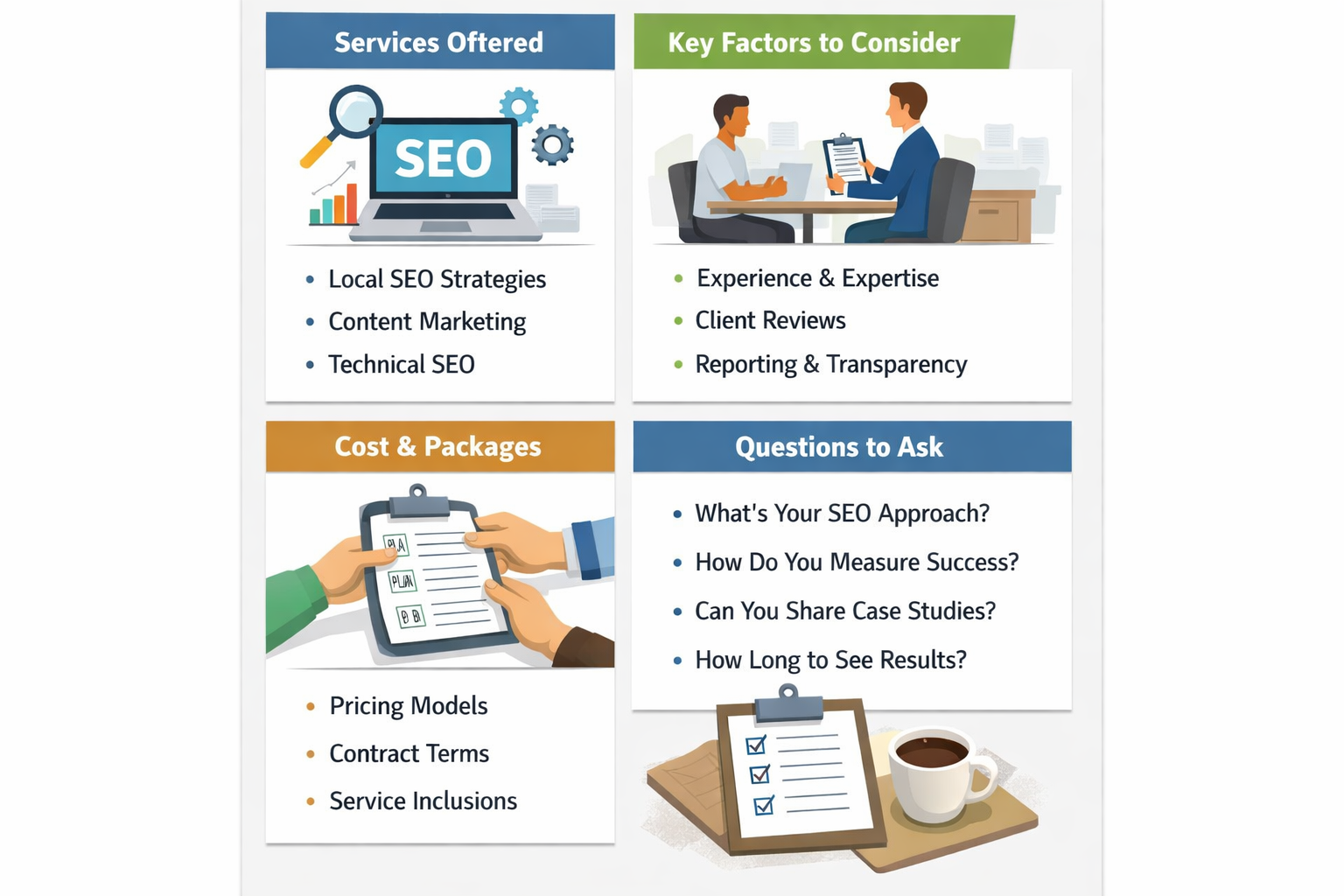
Look for details on:
Longer contracts are not always bad. SEO takes time, and agencies may reasonably prefer enough runway to execute a strategy. But the terms should still make sense. Businesses should know what they are paying for and what happens if priorities change.
Many small businesses in Las Vegas and Henderson are looking for affordable SEO services. That is a practical concern. The key is understanding the difference between affordable and incomplete. A lower-cost campaign can be a good fit if it is focused, realistic, and built around the highest-priority improvements. Problems arise when a low-cost offer sounds comprehensive but does not actually provide meaningful work or strategic attention.
Ask the agency to explain what they would prioritize first within your budget. That answer will often tell you more than the package pricing itself.
Another major point of comparison is how an agency communicates once the campaign starts. Many businesses only discover support problems after signing. The sales process may feel highly responsive, but ongoing communication may become slow, vague, or inconsistent.
That is why you should compare support structure and reporting frequency before committing.
Different agencies report in different ways. Some send monthly summaries. Others provide dashboards plus monthly calls. Some report weekly on active campaigns. Frequency matters, but quality matters more.
A useful SEO report should help you answer:
The best reports connect activity to business goals. If you are a local service business, you may care more about qualified leads, local visibility, and page-level improvement than broad national ranking charts. If an agency floods you with data but does not interpret it, the report may be impressive without being helpful.
For many Clark County small businesses, a responsive agency that provides practical communication can be more valuable than a larger firm with polished materials but limited access.
When you compare SEO companies Clark County businesses talk to, nearly all of them will mention results. The challenge is understanding which claims are useful and which are too vague to evaluate.
You do not need dramatic promises. You need evidence of competence, consistency, and professionalism.
Because every campaign is different, honest agencies tend to talk about process, constraints, timelines, and business context rather than making broad claims. That is a good sign.

Industry reputation is not just about awards or polished branding. It often shows up in smaller but more meaningful ways:
When comparing options in Las Vegas, Henderson, and Clark County, look for agencies that sound grounded and specific. Reputation is often strongest where expertise and transparency overlap.
If you are trying to narrow a list of agencies, use a structured process. This will help you avoid being swayed by surface-level presentation alone.
Write down what success would look like over the next 6 to 12 months. More traffic is not enough. Be specific. Do you want more calls from local customers? Better visibility in Henderson? Stronger service pages for Las Vegas? Better performance from your WordPress website? A clearer content marketing plan?
Before comparing agencies, know what you are starting with. Is your site outdated? Slow? Thin on content? Weak on service pages? Lacking location relevance? If so, you need an agency that can address those issues directly.
Look for agencies that clearly offer the services you need. If WordPress is central to your site, prioritize firms with WordPress SEO services experience. If your challenge is limited visibility in nearby service areas, prioritize local SEO depth. If your site lacks strong pages, content marketing matters.
Create a simple comparison sheet with these categories:
This gives you cleaner comparisons. Ask how they would approach your market, what they would prioritize first, how they report, and what they need from your team.
The best agency may not be the one with the most aggressive sales pitch. It is often the one that explains your situation clearly, sets realistic expectations, and outlines a process you can understand.
Many businesses begin with budget, but there are several other decision factors that can have just as much impact on results.
An agency that understands local service businesses may be a better fit for a contractor, law office, clinic, or home services company than an agency focused mainly on ecommerce or enterprise websites.
If your site is on WordPress, specialized platform knowledge can save time and reduce implementation friction. This is one reason many businesses look specifically for WordPress SEO services.

SEO often depends on the quality and structure of your website content. If your site has thin pages or weak local targeting, content development is essential. An agency with a solid content marketing offering may be better positioned to help you build long-term visibility.
If you serve Las Vegas, Henderson, and nearby communities, your campaign may require city-specific relevance without overcomplicating your site. Agencies with local search experience can often structure this more effectively. Businesses looking into SEO in Henderson or broader local service targeting should pay close attention to this point.
Some agencies are excellent at completing initial improvements but less engaged in monthly strategy. Others are built for long-term partnership. If SEO is likely to remain a key growth channel, choose accordingly.
Just as important as knowing what to look for is knowing what to avoid. Not every agency that sounds confident is a strong long-term partner.
None of these issues alone tells the full story, but together they can signal a mismatch.
Hiring an SEO company is not like flipping a switch. Businesses benefit most when they understand what the early stages of a campaign should look like.
Most agencies should spend the early phase on discovery, auditing, research, setup, and prioritization. You may see some quick wins, but the real value is usually in building a clear plan based on your site and market.
This period often includes on-page improvements, content updates, technical fixes, local optimization, and foundational content work. Reporting should start showing movement in visibility, site engagement, or page-level performance, though lead impact may vary depending on your starting point.
SEO becomes more about consistency, refinement, and growth over time. New content opportunities emerge. Existing pages get strengthened. Technical issues are monitored. Internal linking improves. Conversion paths get clearer. Good agencies continue adjusting the strategy instead of repeating the same checklist every month.
A company that explains this timeline realistically is usually easier to work with than one that treats SEO as instant.
When businesses compare providers in Clark County, they often want a partner that combines practical strategy, local relevance, and clear communication. RedZone SEO focuses on helping businesses improve visibility through search engine optimization, content marketing, internet marketing support, WordPress SEO services, and affordable SEO services tailored to business goals rather than generic promises.
For companies in Las Vegas, Henderson, and across Clark County, that often means focusing on what will move the needle first: stronger service pages, better local targeting, cleaner website structure, more useful content, and reporting that makes sense.
If you are researching providers, it can help to review service-specific resources such as search engine optimization in Las Vegas, Las Vegas SEO services, and Henderson SEO company information to better understand how local and service-area SEO can be structured.

Here is a simple checklist you can use when comparing SEO companies:
If an agency scores well across these areas, it is likely worth a deeper conversation.
Focus on clarity. Ask each agency to explain what they would do first, why they would do it, how they would report progress, and what they need from you. You do not need advanced SEO knowledge to compare responsiveness, transparency, contract terms, and strategic thinking.
That depends on your business, but local SEO campaigns often include keyword research, on-page optimization, service and location page improvements, technical cleanup, content support, internal linking, and local relevance enhancements. If your site is weak or outdated, content and technical work may be especially important.
Not automatically. Lower-cost options can be a good fit if the work is focused and well explained. The better question is whether the package addresses your highest-priority issues and whether the agency can show a realistic plan within your budget.
Monthly reporting is common and usually reasonable for most small businesses. Some agencies also provide dashboards or interim updates. More important than frequency is whether the report clearly explains completed work, performance changes, and next steps.
SEO is ongoing and cumulative. Some improvements can happen early, especially if your site has obvious technical or on-page issues. Broader gains usually take time because search visibility builds through consistent work, improved relevance, and stronger site quality.
It can be very helpful. Clark County businesses often compete in location-sensitive searches, and local knowledge can improve page targeting, content planning, and service area strategy. A strong agency should understand how search behavior differs across Las Vegas, Henderson, and surrounding communities.
Then compare agencies on their wider internet marketing capabilities too. Some businesses benefit from a partner that can align SEO with content marketing and broader online visibility efforts rather than treating search in isolation.
When you compare SEO companies Clark County businesses are considering, the real differences come down to substance: service depth, local understanding, strategy, pricing clarity, support, reporting, and professionalism. The best choice is not simply the biggest agency, the least expensive package, or the strongest sales pitch. It is the company that understands your business, communicates clearly, and builds a realistic plan to improve your online presence over time.
For small businesses in Las Vegas, Henderson, and across Clark County, a smart SEO decision can create stronger visibility, better-qualified traffic, and more opportunities to grow. Take the time to compare agencies carefully, ask direct questions, and look for a partner that aligns with your goals.
If you are ready to evaluate your options and build a stronger search strategy, contact us today to boost your online presence and grow your business with expert SEO and digital marketing services.
Plenty of Clark County business owners want affordable SEO. That makes sense. If you run a local service business in Las Vegas, a shop in Henderson, or a small company serving multiple areas across Clark County, you need search visibility without committing to a bloated monthly bill.
The problem is not low pricing by itself. The problem is when a low price hides missing work, vague deliverables, or unrealistic promises. That is where the real affordable SEO red flags start to show up.
A proposal can look budget-friendly on page one and still leave out the technical cleanup, local optimization, content work, reporting, and ongoing support needed to make SEO useful. This article will help you compare a low-cost SEO offer against a complete, realistic scope so you can tell whether a quote is truly affordable or just incomplete.
Low SEO pricing often looks attractive because it reduces the decision to a single number. A proposal says $299, $500, or some other low monthly fee, and that sounds easier to approve than a higher quote with more line items. But SEO is not a commodity where every provider delivers the same work for a different price.
In Clark County, especially in competitive local search markets like Las Vegas and Henderson, price matters, but scope matters more. If a business wants to rank for terms related to its services and location, the work has to match the actual search environment. A company trying to appear for searches around “henderson seo services” or “seo services henderson” is not competing in an empty market. The same goes for local plumbers, roofers, lawyers, med spas, HVAC companies, dentists, restaurants, and home service businesses trying to earn visibility in map results and local organic results.
When an SEO proposal is extremely cheap, one of a few things is usually happening:
That does not mean every affordable plan is bad. Some small businesses truly do need a lighter scope, especially if they serve a narrow area, have a newer site, or want to start with a specific priority like technical cleanup or local SEO. But a lower-cost plan should still explain what is being done, what is not included, and what results are realistic for that level of investment.
A cheap proposal is usually defined by what it leaves out. An affordable proposal is defined by whether the included work matches your business goals, website condition, market competition, and timeline.
For example, if a Henderson business has a simple five-page website, a claimed Google Business Profile, and only wants foundational improvements before expanding later, a smaller SEO package may be appropriate. On the other hand, if that same business has duplicate pages, thin service content, technical issues, weak internal linking, no conversion tracking, and no local landing page strategy, then a very low quote may just delay real progress.
One reason business owners get stuck here is that SEO deliverables are not always presented in plain language. If you are trying to compare quotes, it helps to know what the budget is actually buying. Red Zone SEO breaks this down further in its A-Z guide to SEO pricing, which is useful if you want to understand how scope, competition, and ongoing work affect monthly cost.
For local businesses in Las Vegas, Henderson, and the wider Clark County market, SEO often requires more than a homepage tune-up. A local strategy can include service-location content, Google Business Profile work, on-page optimization, technical fixes, internal linking, content support, review strategy guidance, and local relevance improvements.
If a proposal says it will “improve rankings” but does not show how that work will happen on your actual site, your local pages, and your business profiles, the low price can be misleading. A proposal that skips local SEO specifics is often not built for how small businesses actually win nearby searches.
A strong seo proposal evaluation starts with knowing what a complete proposal should contain. Not every project needs the exact same scope, but a real proposal should explain what work is included, how priorities are set, what the timeline looks like, and how results will be measured.
If you are asking what should be included in an SEO proposal, the answer should go beyond broad promises like “optimize your site” or “do keyword research.” A good proposal translates SEO into work you can understand and review.
The proposal should identify what your business is trying to achieve. That could be more local leads, more phone calls, more form submissions, more map visibility, or stronger rankings for service-based searches in Las Vegas, Henderson, or specific Clark County areas.
It should also show awareness of your market. A local campaign for a Henderson service business is different from a county-wide campaign targeting multiple service areas. If the proposal treats every business the same, it is likely using a template rather than a strategy.
A serious proposal should mention a starting review of your site. That review does not need to be overly technical in the proposal itself, but it should establish whether your site has issues involving:
Google’s own Search Central documentation consistently supports the importance of crawlability, helpful content, technical accessibility, and site quality. If a proposal skips the baseline review entirely, it may be selling a package before understanding what your site needs.
A complete proposal should explain how target keywords will be selected and assigned to pages. This matters because many underbuilt SEO packages dump a keyword list into a report without connecting those terms to actual page improvements.
For a Clark County business, keyword planning should reflect the services you offer, the towns or neighborhoods you target, and the difference between broad and local intent. A business targeting Las Vegas and Henderson may need separate page strategies instead of trying to rank one generic page for every variation.
On-page SEO should be clearly defined. It usually includes some combination of:

Many low-priced proposals mention on-page SEO but do not say how many pages are being optimized each month, whether copy is rewritten, or whether recommendations are implemented by the provider or left to you.
Technical SEO is one of the most common missing pieces in low-cost offers. A complete proposal should address whether technical support is included, recommended separately, or limited to auditing only.
This area can involve:
If you want more context on why this matters, Red Zone SEO’s technical SEO guide explains why technical issues can limit ranking gains even when content and keyword targeting look fine.
For small businesses in Clark County, local SEO is often a core part of the campaign, not an add-on. A complete local SEO scope may include:
If the proposal does not mention your service area, your Google Business Profile, or local page strategy, it may not be built for a local business at all.
Content marketing is often where low-cost SEO becomes visibly incomplete. A full proposal should explain whether content is included, recommended, or excluded. It should also define what kind of content is being discussed:
If content is excluded, that is not automatically a dealbreaker. But the proposal should say so. Many businesses accept a low monthly quote without realizing that all meaningful content work costs extra.
A complete proposal should explain what reporting you will receive and how often. More importantly, it should show what the agency is accountable for doing each month.
Good reporting usually covers:
Bad reporting is usually just charts without context. If a proposal promises monthly reports but does not define deliverables, you may end up paying for updates about performance without enough actual optimization work behind them.
Real SEO proposals set realistic expectations. They do not promise instant page-one rankings. They explain that SEO is affected by competition, current site quality, local search demand, content depth, technical condition, and time.
For most small businesses, foundational improvements and early movement may happen in the first few months, but stronger local gains often require a longer window. A proposal that guarantees specific rankings in a very short period should be treated carefully.
One of the best signs of a trustworthy proposal is simple clarity. The agency should say what is included, what is not included, and which tasks may require a different level of budget or developer support. That transparency helps you compare seo pricing comparison for small business offers more accurately.
Not every low-cost SEO plan is a bad choice, but there are consistent cheap seo proposal red flags that small business owners should watch for. These usually point to weak scope, low accountability, or a mismatch between promised outcomes and actual work.
If a proposal says things like “SEO maintenance,” “website optimization,” or “search engine submission” without explaining what those tasks involve, you are not really seeing the scope. Vague wording makes it hard to compare providers and nearly impossible to hold anyone accountable later.
Ask for specifics. How many pages are being optimized? Will copy be updated? Are technical fixes included? Is local SEO work part of the monthly plan? If the answer stays vague, the proposal is probably underdefined.
This is one of the most common low cost seo missing services problems. Many cheap proposals focus on light keyword work and reports while leaving out indexing issues, redirect problems, slow pages, mobile concerns, duplicate content, or plugin-related issues on WordPress sites.
That is a major gap. If the site has technical barriers, content and keyword targeting will have limited effect.
Unlimited keywords can sound impressive, but it usually means very little without page mapping and prioritization. No business needs random tracking of endless keyword variations. What matters is whether the right pages are being improved to target the right search intent.

A proposal that sells huge keyword lists without tying them to specific pages and business goals may be padded with vanity metrics.
If you are a local business in Las Vegas, Henderson, or another part of Clark County, local SEO should be visible in the proposal. If it is not, the plan may not include the work that influences local discovery, map visibility, and service-area relevance.
This matters even more for businesses that depend on nearby searches and directional intent.
If the proposal appears activity-light but reporting-heavy, that is a concern. Reports matter, but they are not the same thing as SEO execution. You should be able to see what is being changed, improved, created, fixed, or tested each month.
Content is not optional in most SEO campaigns. That does not mean every plan needs four blog posts a month. But if the proposal avoids discussing page content, service page depth, local content gaps, or support content at all, there is a good chance the quote excludes work your site needs to grow.
No legitimate SEO provider controls Google’s rankings. Agencies can make strong recommendations, implement improvements, and build a strategy around best practices, but guaranteed top positions are not realistic. Google itself does not endorse guaranteed ranking claims.
A proposal that relies on guarantees may be overselling certainty while underspecifying the work.
Website platform affects SEO scope. If your site runs on WordPress, Shopify, Wix, or a custom build, the proposal should recognize that. WordPress in particular can be flexible, but that also means SEO work may involve plugin settings, theme limitations, indexation settings, image handling, and page builder issues.
If there is no mention of platform considerations, that may indicate the provider has not looked closely at your site. For many small businesses, wordpress seo support is a real part of the workload, not a side note.
Strong SEO proposals have an order of operations. Audit first, fix key issues, optimize important pages, expand content, strengthen local signals, and review performance. Weak proposals often skip sequence and jump straight into generic monthly activity.
If you cannot tell what happens in month one versus month three, the plan may not be strategic enough.
Some prices are not “good deals.” They are simply too low to support meaningful work. That does not mean every business needs a large retainer. It means you should compare the number against the actual labor involved. If the price only makes sense because the provider is doing very little, it is not really an affordable solution.
For a deeper look at the long-term downside, see why cheap SEO usually costs more.
When business owners compare quotes, the monthly price difference often looks bigger than the scope difference. But in practice, the lower quote can exclude the very work that moves the campaign forward. That is why a side-by-side comparison is so useful.
Underbuilt low-cost plans often skip technical cleanup entirely or mention it only as a one-time audit. A complete SEO proposal usually includes either direct technical fixes or clearly prioritized recommendations with implementation support.
Common missing items include:
If these are not addressed, your site may struggle to perform even with better content.
Low-cost plans often say “local SEO” but only mean citation work or basic directory listings. A more complete local SEO scope is broader. It looks at how your business appears in local organic results, map listings, service-area searches, and conversion paths for nearby customers.
For Clark County businesses, local optimization may include:
That difference matters when comparing local seo pricing clark county options. One package may technically mention local SEO while omitting the work that actually helps local relevance.

Content is another major dividing line. Many low-cost plans exclude writing, editing, or page expansion. They may optimize titles and metadata while leaving thin service pages untouched.
A complete proposal usually addresses whether your important pages need:
That is especially important for small businesses trying to earn local trust and show clear relevance to searchers.
Some low-priced SEO offers provide lists of recommendations but leave all implementation to the business owner. For some companies with an in-house web person, that can work. For many small businesses, it becomes a bottleneck. The recommendations pile up and little changes on the site.
A better proposal should state whether the agency will implement changes directly, coordinate with your developer, or hand off recommendations for you to manage.
Cheap packages often emphasize rankings and reports because those are easy to produce at scale. Complete SEO includes reporting too, but the report is tied to completed work, next priorities, and real business goals.
If the low-cost option gives you pages of charts while the complete option gives you fewer charts but stronger action and clarity, the second option may be the better value.
A complete SEO campaign evolves based on what is learned. If a service page starts gaining traction, the strategy may expand around that service. If a technical issue is blocking indexation, the plan shifts to fix it. If Henderson pages need more support than Las Vegas pages, the work adjusts.
Underbuilt plans are often fixed-template subscriptions. The same checklist repeats monthly whether it matches your business or not.
If you are evaluating proposals from multiple providers, do not compare only by monthly total. Compare by fit, depth, and accountability. A lower quote is only a better option if it covers the priorities that matter most for your business.
Before comparing agencies, define what you need in practical terms:
Without those answers, it is easy to choose the cheapest number instead of the best-fit scope.
Create a simple table and compare each quote in the same categories:
This is where many affordable seo red flags become obvious. A low-priced proposal can look competitive until you compare category by category and notice that technical work, content edits, or local page support are not there.
Ask each provider what the first 90 days will include. That will tell you a lot. Strong proposals usually have a sequence:
If one quote cannot explain the first quarter clearly, it will be hard to trust the long-term plan.
This is one of the best ways to compare quotes honestly. A provider may offer a low monthly rate, but you need to know what that rate does not cover. Ask directly:
That conversation is often more useful than asking why one provider costs more.
Many small business websites in Clark County run on WordPress. That can be a good thing for SEO, but only if the provider understands how the site is set up. Theme choices, page builders, plugin conflicts, category indexing, image handling, schema settings, and caching all affect scope.
That is why wordpress seo support should be part of the proposal conversation for WordPress sites. If it is ignored, you may later discover that technical implementation costs extra.

If one agency talks about gradual gains, technical priorities, local competition, and content needs while another guarantees fast rankings at a much lower price, the second offer may feel easier to buy. But realistic expectations are usually a sign that the provider understands how SEO actually works.
That matters in Clark County because local markets can vary widely by industry. The right proposal should account for that instead of selling a one-size-fits-all promise.
If you want a simple checklist, these questions can reveal a lot about whether a proposal is complete or underbuilt. They are especially useful for small businesses comparing multiple providers.
These questions help answer the common concern: What should I ask an SEO agency before accepting a proposal? If the answers are clear, practical, and specific, that is a good sign. If the answers stay broad, defensive, or sales-heavy, that is a warning sign.
You do not need a second opinion on every quote. But there are times when it is worth having another SEO professional review the proposal before you sign.
If the monthly fee is much lower than other quotes and the proposal still claims broad coverage, there is a good chance something is missing. A second opinion can help you see whether the lower price reflects efficiency, a smaller starting scope, or a major gap in service.
SEO proposals should not require translation from sales language into plain English. If you cannot tell what you are paying for, ask someone to review it with you. One of the biggest benefits of a second opinion is simply having the scope explained clearly.
Many small businesses in Las Vegas and Henderson come to SEO after paying for incomplete service in the past. If that happened to you, a second opinion can help you avoid repeating the same decision pattern, especially if a low quote looks familiar.
If your website has performance problems, indexing issues, messy plugins, duplicate pages, or platform-specific limitations, proposal quality matters even more. A low-cost package may not be built to handle that complexity.
Fast promises often mask weak planning. If the proposal guarantees top rankings quickly, skip the sales excitement and have the scope reviewed by someone who can tell you what is realistic.
Use this checklist before signing any agreement. If you answer “no” to several of these, the proposal may be incomplete.
This is the simplest way to spot cheap seo proposal red flags without overcomplicating the decision.
Look for missing specifics. If the proposal does not clearly cover technical SEO, local SEO, page optimization, content support, reporting, and implementation, it may be underbuilt. Vague deliverables are one of the clearest warning signs. A low price can still be reasonable, but only if the proposal clearly explains what is included and what is not.
At minimum, a useful small business SEO proposal should include a baseline review, keyword and page targeting, on-page optimization, reporting, and a realistic timeline. For most Clark County businesses, local SEO should also be included or directly addressed. Technical support and content work should either be included or clearly identified as separate needs, not ignored.
Sometimes, yes. A lower-cost plan can be a good fit if your business needs a limited foundational scope, has a relatively simple website, and understands the boundaries of the service. The key is transparency. A cheap plan is only useful if it matches your actual needs and does not pretend to be a complete solution when it is not.
Ask what exact work will be done monthly, what is excluded, whether technical issues and local SEO are covered, who implements website changes, how reporting works, and what the first 90 days will look like. Also ask how the plan applies to your market, whether that is Las Vegas, Henderson, or a wider Clark County service area.
WordPress can make SEO more flexible, but it also introduces platform-specific tasks. Plugin settings, page builders, indexing controls, theme limitations, schema handling, and performance issues can all affect the amount of work involved. If your site is on WordPress, make sure the proposal addresses whether those tasks are included in the service or billed separately.
The goal is not to reject every low-priced offer. The goal is to see whether the quote is truly affordable or simply incomplete. That is the difference between spending carefully and paying twice.
A strong SEO proposal should explain, in plain language, what work is being done, what local priorities matter, what technical and content issues need attention, and what you should realistically expect over time. If a proposal is vague, leaves out major service areas, or depends on promises instead of scope, those are real affordable seo red flags.
If you want help comparing options, Red Zone SEO can talk through your SEO proposal, budget, and priorities with you so you can decide which option fits your situation best. That conversation is meant to help you evaluate the scope, spot missing work, and determine whether a quote is actually affordable or just leaving out critical pieces. You can review your options with Red Zone SEO here: contact Red Zone SEO.
For small businesses in Henderson, Nevada, establishing a strong online presence is crucial in today’s digital economy. Search Engine Optimization (SEO) remains one of the most effective ways to increase visibility, attract local customers, and grow revenue. However, many small businesses face budget constraints and uncertainty about what affordable SEO service packages truly offer. At RedZone SEO, we specialize in providing affordable SEO service packages in Henderson that are tailored to the specific needs and goals of local businesses.
This comprehensive guide will explore what small businesses in Henderson should expect from affordable SEO packages, how these packages are customized, typical timelines, deliverables, and key decision factors when choosing your SEO partner. By the end, you will have a clear understanding of how to invest wisely in SEO to enhance your business’s online presence.
Affordable SEO service packages are carefully curated bundles of SEO services designed to provide meaningful improvements in search engine rankings and website visibility without requiring a large upfront investment. These packages blend essential SEO tactics with cost-effective strategies, focusing on delivering measurable results for small businesses.
While the exact services can vary based on the provider and client needs, affordable SEO packages typically include the following core components:
Additional services such as social media integration, reputation management, and WordPress-specific SEO may be included or offered as add-ons depending on your business’s unique platform and goals.
Affordable SEO packages provide a structured approach for small businesses to enter or improve their digital marketing efforts without the expense of a custom enterprise-level campaign. They are ideal for startups, local shops, professional services, and other businesses looking to maximize their marketing budget effectively.
Every business in Henderson faces unique challenges, serves distinct audiences, and operates within different competitive landscapes. Affordable SEO service packages are flexible and can be tailored to address these factors.

At RedZone SEO, we work closely with each client to evaluate these factors and develop a package that balances your goals with realistic outcomes and budget considerations.
Setting realistic expectations about the timeline and deliverables of SEO projects is crucial for small businesses to plan and measure success effectively.
SEO is a progressive, long-term strategy. While some improvements can be seen quickly, organic growth builds over time. Typical timelines for affordable SEO packages include:
While some small businesses may see improvements earlier, SEO success depends on various factors including industry competitiveness, website condition, and ongoing effort.
Clients can expect a variety of tangible deliverables that demonstrate progress and provide actionable insights:
It’s equally important to understand the limitations of affordable SEO packages to avoid misunderstandings:

Selecting the right affordable SEO package can make a significant difference in your business’s online success. Here are critical factors to consider:
Partner with agencies like RedZone SEO that have proven experience working with Henderson and Clark County businesses. Local market knowledge ensures SEO strategies are aligned with regional search behavior and customer expectations.
Ensure the SEO provider offers clear, upfront pricing without hidden fees, and clearly outlines what services and deliverables you will receive. Transparency builds trust and helps you measure return on investment.
A tailored SEO approach that considers your industry, competition, and business goals will yield better results than generic packages.
Regular updates, easy-to-understand reports, and open communication channels are essential for tracking progress and making informed decisions.
Request case studies, references, or examples of previous work with similar businesses in Henderson or Clark County to gauge effectiveness and reliability.

Unfortunately, the SEO industry has providers who make unrealistic promises or use risky tactics. Watch out for these red flags:
Understanding the workflow helps you feel confident and engaged throughout your SEO project. Here is a typical process when partnering with RedZone SEO:
A: Pricing varies widely depending on services, scope, and competition. Small business packages generally range between $300 and $1,000 per month. We provide customized quotes after evaluating your specific needs.
A: While basic SEO tasks like optimizing titles or creating content can be done in-house, professional SEO agencies bring expertise, tools, and strategic insights that often lead to better and faster results.
A: SEO is a long-term investment. Initial improvements might be visible within 3 months, but significant growth usually takes 6 to 12 months depending on competition and effort.
A: Yes, local SEO is a core component of our affordable packages. We optimize your Google Business Profile and manage local citations to increase visibility in Henderson and surrounding areas.

A: We offer specialized WordPress SEO services to ensure your site’s structure, plugins, and content are fully optimized for search engines.
A: Absolutely. We regularly review performance and adjust strategies to align with evolving business goals, market conditions, and search engine updates.
A: Content marketing support is included in many of our packages. Depending on your preference, we can create new blog posts, optimize existing content, or collaborate with your in-house team.
Local SEO focuses on optimizing your online presence to attract customers in your immediate geographic area. For Henderson businesses, this means appearing in search results when locals search for services or products you offer.
Focusing on local SEO helps small businesses capture “near me” searches and convert local prospects into customers, which is especially important in competitive markets like Henderson.
Understanding which metrics to track helps you evaluate the effectiveness of your SEO investment. Key performance indicators (KPIs) include:

Regular reports from your SEO provider should include these metrics along with insights and recommendations for continuous improvement.
To illustrate how affordable SEO packages work in practice, consider a local retail store in Henderson specializing in outdoor gear. Their challenges included low online visibility and minimal foot traffic.
This example demonstrates how a focused, affordable SEO package can deliver meaningful results aligned with a small business’s objectives.
Affordable SEO service packages are a strategic investment that enable small businesses in Henderson to compete effectively online without exceeding their marketing budgets. By understanding the typical components, customization options, realistic timelines, and deliverables, you can choose the right package that fits your unique business needs.
At RedZone SEO, we combine local expertise, transparent processes, and a results-driven approach to help Henderson businesses grow sustainably through digital marketing. Whether you’re starting fresh or looking to improve your current SEO efforts, our affordable packages provide a solid foundation for long-term success.
Contact us today to discuss how our affordable SEO service packages can boost your online presence and attract more local customers in Henderson and Clark County.
If you are comparing seo services henderson options, you have probably seen a wide range of prices with very different explanations. One quote may look surprisingly cheap. Another may look expensive without showing why. A third may promise strong rankings but say very little about the work involved.
That confusion is common for local businesses in Henderson. Search engine optimization (SEO) pricing is not supposed to be identical from one company to the next, because the amount of work can change a lot based on your industry, your service area, your current website, and how difficult your local search market is. A Henderson chiropractor, roofer, family law firm, med spa, accountant, and pool service company are all local businesses, but they do not face the same search environment.
This FAQ is meant to make those differences easier to understand. The goal is not to push a single package or claim there is one correct number for every business. The goal is to help you judge quotes more realistically, know what should be included, and understand why a practical SEO plan in Henderson should match your actual situation.
If you want a short version before we get into the details, here it is: SEO cost changes when scope changes. Scope changes when competition, website condition, content needs, local authority needs, and conversion issues change. That is the core idea behind realistic henderson seo services pricing.
One of the biggest mistakes business owners make is assuming SEO should cost roughly the same for every local company. It does not. Even when two businesses are both trying to rank in Henderson, the amount of work required can be very different.
That difference starts with industry competition. Some local industries attract heavy SEO investment because one new lead can be worth a lot. Others operate in narrower or less crowded search spaces, so they may not need the same level of ongoing work.
Think about the difference between these local business categories:
They are all trying to show up in search, but they are not all competing at the same intensity. Search engine optimization (SEO) in Henderson for a high-value service category usually takes more work because more businesses are trying to win the same searches.
For example, if a Henderson HVAC company wants visibility for repair, replacement, maintenance, emergency calls, and seasonal service searches, that often requires:
Now compare that with a Henderson bookkeeping business serving a narrower audience with fewer urgent searches and fewer aggressive local competitors. That company may still need SEO, but the scope can be smaller. It may need a cleaner site structure, stronger service pages, a better local presence, and a few helpful support pages rather than a large monthly content and optimization push.
One of the clearest reasons seo pricing henderson changes by industry is lead value. If one new client can be worth several thousand dollars or more, businesses in that category are often willing to spend more to compete. That raises the bar for everyone else.
In Henderson, that often applies to categories like:
That does not mean every business in those categories needs a large SEO budget from day one. It means the quote should match the real difficulty of the market instead of pretending all local industries require the same amount of work.
Pricing also changes when a business has multiple service lines. A Henderson contractor offering kitchen remodeling, bathroom remodeling, garage conversions, additions, and outdoor living projects will usually need far more search coverage than a business with one core service.
That added work often includes:
When business owners ask why one company’s SEO quote is much higher than another’s, this is often part of the answer: they are not buying the same amount of work.
Trust is not just a design issue. It directly affects whether visitors contact you, and it can influence how search engines interpret the quality and usefulness of your site. Some Henderson industries require more trust-building detail than others because the customer decision is more sensitive, expensive, or high-stakes.
That is why a realistic SEO plan often includes page-level trust improvements such as:
This article is intentionally avoiding one-size-fits-all claims because those claims are usually the first sign that the pricing conversation is too generic.
Because they do not need the same scope. SEO cost usually rises when a Henderson business faces one or more of the following:
That is why practical conversations about seo services henderson should start with business type, site condition, and goals instead of a flat monthly number.
Local SEO is not as simple as adding “Henderson” to a few pages. Search engine optimization (SEO) in Henderson depends on how strong your local competitors are, how many businesses are actively targeting the same searches, how established their websites and profiles are, and how clearly your own site connects services to place.
Google’s guidance on helpful content, site quality, crawlability, and relevance supports this basic idea: if you want better visibility, the site needs to be technically accessible, useful, and aligned with what searchers are looking for. For local businesses, Google Business Profile quality and local relevance matter too. That is why local seo cost henderson can differ so much between businesses in the same city.
A broad, high-intent search usually requires more work than a narrower one. Searches connected to urgent services or expensive buying decisions are often more competitive because the business value is obvious.

Examples of harder local search categories can include searches tied to:
When a Henderson business is trying to rank in one of those categories, the SEO workload often expands to include:
Many small businesses in Henderson want help with both local map visibility and regular organic rankings. That matters because the work overlaps, but it is not identical.
A practical local SEO plan may include:
If a Henderson company needs both stronger map pack performance and stronger organic rankings across several services, the scope increases. A quote should show that clearly instead of treating local SEO like a minor add-on.
Another important local detail: a Henderson business is not always competing only against other Henderson businesses. In many categories, companies based elsewhere in Clark County also target Henderson searches. That means local competition can be tougher than a simple city-size comparison would suggest.
So when someone asks why henderson seo services pricing is not automatically low just because Henderson is smaller than some larger metros, the answer is simple: local search difficulty depends on the search results you actually have to compete against, not just population size.
Trustworthy SEO planning should also include realistic timing. In a lower-competition niche, a business with a decent site may see traction from focused improvements sooner. In a crowded category with a weak site, progress often takes longer because foundational work comes first.
That can mean:
A serious provider should be able to explain this without promising exact ranking positions. SEO is not instant, and search engine optimization (SEO) in Henderson is not a fixed-cost product where every business gets the same timeline.
Two Henderson businesses in the same industry can still receive very different quotes because their websites may be in completely different condition. This is one of the biggest sources of pricing confusion.
One site may have a clean structure, good page speed, strong service pages, and an organized WordPress setup. Another may have crawl issues, duplicate pages, weak content, poor mobile usability, and conversion problems. The second site needs more work before growth efforts can perform well.
If your site has technical issues, some of the SEO budget will be used to fix the foundation. That is not wasted work. It is often what makes later improvements possible.
Common issues that add scope include:
For example, a Henderson home service company on an older WordPress site may need page-speed cleanup, template cleanup, redirect fixes, service-page restructuring, image compression, plugin conflict review, and clearer location/service alignment before aggressive ranking work even makes sense.
Businesses running on WordPress often benefit from focused WordPress SEO support because the platform can be flexible but also messy if themes, plugins, templates, and content structure are not managed well.
Now consider a different Henderson business with a newer site that loads well and has no major technical problems. That business may still struggle in search because the site only has a homepage, one short service page, and a contact page.
In that case, pricing is driven less by repair work and more by content and page development. The work may include:
That shift matters because some owners assume every SEO quote should look the same. In reality, one business may need cleanup while another needs depth.
A single-location business with one main service usually has a simpler SEO roadmap than a business with multiple services, multiple audience types, or multiple service areas.
More complex business models usually require:
That is one reason seo cost by industry is only part of the conversation. The way the business is structured matters just as much.
A practical SEO provider should tell you whether the first phase is likely to be visible growth work, repair work, or a mix of both. That is part of setting realistic expectations.
If your site starts from a weak position, the early wins may look like:

That does not mean the SEO is underperforming. It means the provider is fixing what is blocking growth.
Yes, that can absolutely happen. If the business serves a narrower market, has fewer strong competitors, and already has a workable site, a smaller plan can still produce meaningful improvement.
A lower-cost approach can make sense when the business has:
What matters is that the lower price reflects a genuinely smaller workload. Cheap SEO becomes a problem when it simply leaves out necessary work.
Before comparing prices, compare scope. This is one of the most useful shifts a small business owner can make. A realistic plan for seo services henderson should explain what is being done, why it matters, and what the priorities are.
Not every business needs the same monthly mix, but a realistic SEO plan usually includes these categories in some form:
If a proposal is missing several of these categories for a business that clearly needs them, it is probably under-scoped.
Many low-cost quotes mention optimization but include very little actual content work. That is a problem because content depth is often what separates a weak local site from a competitive one.
For a Henderson business, content work does not always mean publishing endless blog posts. Often it means:
For many small businesses, content marketing for small businesses works best when it supports service visibility and buyer confidence rather than becoming a generic blogging schedule.
A strong SEO proposal should not just list tasks. It should show order and reasoning. For example, a practical sequence may look like this:
That kind of sequencing helps you judge whether the provider is thinking through the business, not just selling a package.
One quality gap in many SEO plans is that they focus on ranking signals while ignoring visitor trust. For local businesses, trust supports both lead generation and page quality. A realistic plan should pay attention to the details that help a Henderson searcher feel comfortable contacting the business.
Depending on the industry, those trust details can include:
This is especially important when customers are comparing several local options and making a decision quickly.
At minimum, most local businesses should look for:
If one quote is cheaper because it leaves out local optimization, technical repair, or content development, it is not really the same service.
Most bad SEO decisions do not happen because owners are careless. They happen because the comparison process is weak. Here are the pricing mistakes that cause the most confusion.
A $600 monthly plan and a $1,800 monthly plan are not directly comparable unless you know what work is included. One may cover a few edits and reporting. The other may include technical fixes, page rewrites, local SEO work, content support, and conversion improvements.
The useful comparison is not price against price. It is scope against scope.
Flat packages are appealing because they look simple, but they can hide mismatch. If your Henderson business has more technical problems, more services, or more competition than the package assumes, the scope may be too small. If your needs are lighter, the package may include activity you do not need yet.
This is why flat pricing can be misleading. It often suggests the same solution fits businesses that clearly need very different levels of work.
No serious provider should sell SEO as if rankings can be purchased on a fixed schedule. Search performance depends on competition, site quality, content strength, local signals, and time. An SEO quote should connect investment to scope, not guarantee exact ranking outcomes.

That is part of setting realistic expectations, which is one of the most important trust factors in this kind of buying decision.
This is understandable, especially for small businesses. But very cheap SEO often lowers visible risk while raising practical risk. If the provider is doing too little to improve anything meaningful, you can lose months without building momentum.
Cheap is not automatically bad. Under-scoped is bad.
If your site has major technical problems, confusing structure, weak service pages, or poor conversion paths, that changes pricing. A proposal that ignores obvious website issues may not be realistic.
It is better to hear, “Your site needs foundation work first,” than to hear a low number that assumes the foundation does not matter.
Some proposals overwhelm buyers with long lists of generic activities. But a long list is not useful if it is not tied to your actual business. A Henderson med spa and a Henderson plumbing company do not need the same content priorities, service structure, or trust messaging.
Specificity matters more than volume.
Affordable SEO is not fake by definition. There are situations where a lower-cost plan is practical and responsible. The key question is whether the workload is genuinely smaller.
A lower-cost SEO plan may make sense when a Henderson business:
In those cases, affordable seo for small business can be completely reasonable if the provider clearly explains what the lean scope covers and what it does not.
Consider a Henderson bookkeeping service with a clean site, one core service group, and moderate local competition. That business may not need major monthly content production. It may need stronger service-page optimization, better metadata, FAQ support, and local relevance improvements.
Or think about a Henderson pet service with one main offering and a small service radius. A focused plan built around technical cleanup, one or two core pages, profile alignment, trust improvements, and a few support pieces may be enough to create traction.
These are very different situations from a multi-service contractor or high-value legal category.
Lower-cost plans are less likely to be enough when the business has:
In those cases, paying less usually means delaying necessary work rather than actually saving money.
A useful low-cost plan should still identify:
If the plan only says “monthly optimization” without specifics, it is hard to judge whether it is a smart lean option or just a vague one.
If you are reviewing a proposal from a henderson seo company, price alone will not tell you much. A better approach is to ask a set of practical questions.
A useful quote should identify what is holding the site back right now. That may include weak service pages, poor internal linking, thin content, local relevance gaps, slow performance, messy structure, or weak conversion paths.
If the proposal does not mention your current site condition, it may not be grounded in reality.
This is one of the best buyer questions because it forces clarity. A good provider can usually explain early priorities in plain language. A weak provider often stays vague.
You do not need every tiny task listed in advance, but you should understand the sequence.
For a local business, local relevance should be built into the plan. Ask whether the quote includes:
If none of that is visible, the proposal may not be a strong fit for search engine optimization (SEO) in Henderson.

If the provider says content matters, ask what that means in practice. Are they improving service pages? Writing FAQs? Building support pages? Planning blog content tied to actual search demand? Or is content excluded entirely?
Many businesses underestimate how much ranking potential is limited by thin core pages.
Higher traffic is helpful only if it turns into leads. A practical SEO quote should account for at least some conversion and trust factors such as:
This is especially important for local service businesses where visitors often decide quickly.
One of the biggest trust signals in an SEO quote is realism. If a provider explains what should happen first, what could slow things down, and why some categories take longer, that is usually more credible than a promise of instant results.
Setting realistic timelines and expectations is not a weakness. It is part of a trustworthy process.
This is another strong question. If more technical issues are discovered, if a second service area becomes a priority, or if more content is needed than expected, what happens? A transparent answer shows the provider understands scope instead of hiding behind a generic package.
A quote may be too cheap if it:
The problem is not the number by itself. The problem is whether the work behind the number is enough to matter.
A custom estimate usually makes more sense when:
In those situations, a flat package can oversimplify what the business actually needs.
Because the scope is different. Businesses in higher-value or more competitive industries usually need more technical work, stronger content, deeper local SEO, and more trust-building page development than businesses in lighter markets. Website condition also changes the amount of work required.
Yes. If the site is already workable and the competition is moderate, a focused plan can still create progress. The lower price has to match a smaller amount of necessary work, not simply leave important tasks undone.
Look for technical review, on-page optimization, local SEO support, content or page development, clear priorities, reporting, and realistic expectations. If a quote skips several of those areas, it may not be comparable to more complete proposals.
If it is vague, avoids deliverables, skips local SEO, includes no meaningful content work, or promises strong results with almost no scope, it is probably under-scoped. Cheap can work only when the required work is genuinely limited.
Ask for a custom estimate when your site has technical issues, your business offers multiple services, your market is competitive, or your website setup needs specific support such as WordPress SEO. Custom estimates are usually more accurate when the business is not simple.
A good SEO pricing conversation should feel diagnostic, not scripted. It should include questions like:
Those questions matter because seo services henderson pricing should be based on the actual workload. Without that context, any monthly number is mostly a guess.
If you want a broader look at how agencies structure pricing and what tends to affect monthly versus project-based costs, this SEO pricing guide is a useful next reference.
The biggest takeaway is simple: SEO pricing in Henderson changes because the work changes. Industry competition, local search difficulty, service depth, website condition, content needs, technical cleanup, trust-building detail, and conversion improvements all affect scope.
That is why one-price-fits-all claims usually create more confusion than clarity. They ignore the real reasons one Henderson business may need a lean local SEO plan while another needs a broader custom strategy.
For some companies, a smaller and more affordable plan is enough. For others, especially in more competitive categories or on weaker sites, a bigger scope is not extra. It is what the job actually requires. The right way to compare providers is to look at what problems they identified, what work they plan to do, how specific they are about Henderson, and whether they set realistic expectations instead of selling guarantees.
If you want a practical estimate of what SEO should realistically involve for your situation, send Red Zone SEO your industry, service area, and website details. We can give you a direct answer about what the scope is likely to look like, what is probably driving the cost in your market, and whether a leaner plan or a deeper custom approach makes more sense for your business.
For small businesses and companies in Clark County, finding the best SEO company Clark County can be a pivotal step to growing your online presence and attracting more local customers. With many digital marketing agencies offering a variety of services, it’s essential to understand what to look for in a partner that truly understands the local market and can deliver measurable results. This comprehensive guide will walk you through the key factors to consider when selecting an SEO company in Clark County, helping you make an informed decision that aligns with your business goals.
Clark County, encompassing cities like Las Vegas and Henderson, has a unique and competitive business environment. The best SEO company Clark County will have proven experience with local SEO strategies that target your specific market. This means understanding:
Choosing a company with local SEO expertise ensures your website and content are optimized to appear in front of potential customers who are actively searching for your products or services nearby.
Effective local SEO includes optimizing your Google My Business profile, managing local citations, and creating content that resonates with Clark County customers. An experienced SEO company will also help you rank for geo-targeted keywords such as "affordable SEO services Henderson" or "best SEO company Las Vegas," driving qualified leads directly to your business.
Local SEO is not just about adding your business to directories. It involves a strategic approach that leverages local signals, such as:
By partnering with a local SEO expert, your business gains a competitive advantage through targeted traffic and higher conversion rates from local customers.
One of the most important factors when choosing the best SEO company Clark County is clear communication about costs and results. SEO is a long-term investment, and understanding where your money is going is critical.

Regular reporting helps you track progress and ROI. Look for companies that provide:
Transparency builds trust and ensures you remain informed throughout the SEO campaign. Avoid companies that provide vague reports or use technical jargon without explanation.
Before committing to an SEO company, review their client testimonials and case studies. This provides insight into their ability to deliver results for businesses similar to yours in Clark County.
Authentic feedback from real clients helps you gauge the company’s reliability and professionalism. Don’t hesitate to ask for references or speak directly with past clients when possible.
SEO is multifaceted, and the best SEO company Clark County should offer comprehensive services tailored to your needs, including but not limited to:
Choosing a full-service agency allows you to streamline your digital marketing efforts and maintain a consistent brand voice across channels. It also ensures that your SEO strategy is integrated with other marketing initiatives for maximum impact.
Ensure the company you choose offers these advanced services or can customize their package to meet your evolving needs.

While searching for the best SEO company Clark County, be cautious of certain red flags that could indicate poor service or unethical practices:
Trustworthy SEO companies prioritize ethical, sustainable SEO practices that build your online presence over time. Always ask questions and seek clarity before making a commitment.
Clarify what you want to achieve with SEO: More website traffic? Increased leads? Better local visibility? Knowing your goals helps you select a company aligned with your needs. Common objectives include:
Use online searches, local business directories, and industry referrals to create a list of SEO providers in Clark County. Pay attention to agencies that actively showcase their expertise in local SEO.
Visit their websites to assess their service offerings, local SEO experience, and case studies. Look for:
Meet with shortlisted agencies to discuss your goals, ask about their approach, and request pricing details. Use this opportunity to evaluate their communication style and responsiveness.
Compare the scope of work, pricing transparency, and expected timelines. Ensure proposals are customized to your business needs rather than generic packages.

Contact past clients or read verified reviews to confirm the agency’s credibility. Ask about their experience, results, and level of satisfaction.
Choose the SEO company that offers the best combination of local expertise, clear communication, and value for your investment. Remember that the cheapest option is not always the best; prioritize quality and proven results.
Understanding the typical SEO process helps set realistic expectations and fosters a productive partnership.
The company will conduct a thorough audit of your website, competitors, and current SEO standings. Based on this, they will develop a personalized strategy to address your goals.
This phase involves on-page optimization, content creation, technical fixes, and link-building efforts. The timeline varies depending on your website’s condition and project scope.
Regular tracking of key performance indicators (KPIs) ensures the strategy’s effectiveness. Expect detailed reports and periodic meetings to review progress and adjust tactics as needed.

SEO is an ongoing process. The company should continuously optimize your site, update content, and adapt to algorithm changes to maintain and improve rankings.
A: SEO is a long-term strategy. Typically, businesses start seeing noticeable improvements within 3 to 6 months, but continued optimization is essential for sustained growth. Factors like competition, website condition, and budget influence timelines.
A: Yes. Local SEO levels the playing field by targeting customers in your geographic area, helping small businesses attract relevant traffic and leads. By focusing on local keywords and community engagement, small businesses can gain visibility that larger companies may overlook.
A: WordPress SEO services focus on optimizing the WordPress platform's specific features such as themes, plugins, and site structure to improve search engine visibility. This includes configuring SEO-friendly URLs, optimizing images, improving site speed, and ensuring mobile responsiveness.
A: Affordable SEO services can be effective when tailored to your business size and goals. The key is to prioritize quality and transparency over low cost. Beware of services that cut corners or use outdated tactics that could harm your website’s reputation.
A: Success is measured by tracking key performance indicators like keyword rankings, organic traffic, lead generation, and conversion rates through analytics tools and regular reports. Setting clear goals upfront helps define what success looks like for your business.
A: While some companies require contracts, it’s important to understand the terms and ensure they align with your comfort level. Look for agencies that offer flexibility and clear exit clauses. A trustworthy company will focus on building long-term relationships based on results rather than locking you in.

A: Communication is critical. Regular updates, transparent reporting, and easy access to your SEO team help foster trust and ensure your goals are being met. Choose a company that values open dialogue and responsiveness.
A: Absolutely. SEO complements other digital marketing strategies such as pay-per-click advertising, social media marketing, and email campaigns. Coordinated efforts across channels can amplify your online visibility and customer engagement.
Choosing the right SEO company in Clark County is a critical decision that can significantly impact your business’s online success. By focusing on local SEO expertise, transparent pricing, proven client success, and a comprehensive range of services, you position your company for sustainable growth in the competitive Clark County market.
At RedZone SEO, we specialize in delivering tailored SEO and digital marketing solutions for small businesses in Las Vegas, Henderson, and the greater Clark County area. Our professional, approachable team is dedicated to driving measurable results and helping your business thrive online.
We understand the unique challenges and opportunities in the Clark County market and craft strategies that connect your business with local customers effectively. Whether you need comprehensive SEO, content marketing, or WordPress SEO services, we offer affordable, customized plans that align with your goals and budget.
Contact us today to boost your online presence and grow your business with expert SEO and digital marketing services. Let us help you navigate the digital landscape and achieve lasting success in Clark County.
If you want better visibility in Las Vegas map results, your Google Business Profile cannot do all the work by itself. A strong profile helps, but Google also looks at your website to understand what you do, where you work, and whether your business is a solid local match for a search. That is why a practical google business profile local seo content las vegas strategy matters.
For small businesses in Las Vegas, Henderson, and across Clark County, local SEO content is not about writing random blog posts or stuffing city names onto every page. It is about building the right service pages, location signals, FAQs, and supporting content so your website reinforces the same local relevance your Google Business Profile is trying to show. When those two pieces work together, you give Google clearer signals and give customers a better reason to choose you.
This guide explains how that works, what content matters most, what mistakes weaken results, and how to build a realistic local SEO plan without wasting your budget.
Google Business Profile helps your business appear in Maps and local search results, but the profile is only one part of local ranking. Google still uses your website to confirm relevance. If your profile says you offer a service in Las Vegas, but your website barely mentions that service, has weak page structure, or does not explain your service area, Google gets less support for that claim.
In plain language: your profile introduces your business, and your website backs it up.
That matters because local search in Las Vegas is competitive. A business trying to rank for searches like “SEO company Las Vegas,” “WordPress SEO help Las Vegas,” or even adjacent local-intent searches tied to Henderson needs more than a claimed profile. Google wants to see matching evidence across your online presence. That includes:
Google’s own documentation around local ranking and helpful content supports this general idea: relevance improves when Google can understand your business details, services, and connection to a search. Your website is one of the main places where that understanding happens. You can review Google’s guidance through Google Business Profile Help and Google Search Central.
For example, if a Las Vegas company has a Google Business Profile category that fits its primary service but the website only has a thin homepage and no service detail, that profile is missing support. On the other hand, if the business has a solid service page, a Las Vegas-focused page, service-area explanations, and FAQs covering common customer questions, Google has more context.
This is especially important for service businesses that do not rely on walk-in traffic. A service area business often needs stronger website signals because it may not have the same storefront signals that some local competitors do. If you serve Las Vegas, Henderson, and nearby parts of Clark County, your content should reflect that naturally.
There is also a practical user side to this. A customer may discover you through your profile, click through to your site, and then decide whether to call. If the site does not clearly explain your services, pricing approach, service areas, or next steps, you lose leads even if the profile earned the click.
Not all local content has the same value. If your goal is stronger map visibility, your best content usually starts with pages tied directly to services, locations, and real buyer questions. That is far more useful than publishing generic articles that could apply to any city.
Your most important pages are the ones that explain your main services in detail. If you offer SEO, local SEO, content marketing, WordPress SEO services, or digital marketing, those services should each have dedicated page support somewhere on the site.
A strong service page should include:
For businesses using WordPress, technical and content structure matter together. If your site runs on WordPress and needs cleaner local page architecture, schema support, faster performance, and better on-page SEO, WordPress SEO services can help connect the technical side to the local content side.
If you serve more than one city, location-focused pages can help when they are built correctly. A Las Vegas page, a Henderson page, and sometimes a broader Clark County page can all make sense if each page has unique, useful content.

These are not copy-paste pages with a city name swapped in. They should explain:
That is particularly relevant when search demand shows local interest around nearby terms. Even if your main focus is Las Vegas, queries like “search engine optimization henderson” show that nearby market intent exists. If you serve Henderson, your site should reflect that in a structured way instead of hoping Google figures it out from your profile alone.
FAQs help Google understand topical relevance and help customers move closer to action. Good FAQ content supports both your website and your Google Business Profile because it expands the range of real questions your brand answers.
Examples include:
FAQs also support voice-style and long-tail searches. They are especially useful when a business has limited budget and needs content that does more than one job.
Some blog or resource content can directly support map visibility when it answers questions closely tied to local buying decisions. Good examples include:
This is where content marketing for small businesses becomes useful. The goal is not just more content. The goal is content that supports rankings, trust, and conversions together.
Many small businesses overlook this. Pages that show your process, explain industries served, answer pricing questions, or clarify service areas all help reinforce trust. Google wants relevance. Users want confidence. These pages support both.
When people talk about local SEO, they often overfocus on the Google Business Profile itself. But map visibility improves when your site gives Google stronger matching signals for the searches you want.
Here is how that works in practice.
Your Google Business Profile categories and listed services should align with the service language on your site. If your profile says you offer SEO consulting, local SEO, and internet marketing, those topics should appear clearly on relevant website pages. Not as keyword stuffing, but as real service descriptions.
This connection matters because Google is trying to match a searcher’s need to a business. A page that clearly explains local SEO for small businesses in Las Vegas gives stronger relevance support than a homepage that vaguely says “we help businesses grow online.”
Your site should make it clear where you work. For a business based in Las Vegas that also serves Henderson and Clark County, that should appear in logical places:
If you are a service area business, you do not need to fake office locations. In fact, that creates problems. Instead, explain your real service area clearly and consistently. A strong service area business local SEO approach is honest, specific, and easy for Google to understand.

Consistency between your profile and your website improves trust signals. That includes:
Even small mismatches can reduce confidence. If your Google Business Profile emphasizes Las Vegas local SEO but your website mostly talks about national marketing with no local context, that weakens the local story.
Google also pays attention to site structure. If your key local pages are buried, not linked well, or mixed into weak navigation, they are less likely to do their job. A clean hierarchy helps:
This is one reason WordPress local SEO content needs both good writing and good setup. The content cannot reinforce your Google Business Profile effectively if the site structure hides it.
Most local SEO problems are not dramatic. They come from basic gaps that add up. Here are some of the most common issues Red Zone SEO sees with small business websites trying to support map rankings.
If every service gets two short paragraphs, Google has very little to work with. Thin pages often fail to explain what the service includes, who it is for, and how it connects to local intent.
Swapping “Las Vegas” for “Henderson” on nearly identical pages is a common mistake. Those pages rarely help much because they do not offer unique value. They can also create a low-quality footprint.
A service business that covers Las Vegas, Henderson, and broader Clark County should say that clearly. If the profile suggests one thing and the site barely mentions service areas, relevance signals stay weak.
Keyword stuffing still happens. Businesses try to rank for “affordable local SEO Las Vegas” or “Las Vegas SEO for small businesses” by repeating phrases unnaturally. That usually makes the content worse, not better.
The better approach is straightforward writing that actually answers what a customer wants to know.
Businesses often focus only on the homepage and one service page. But FAQs, process pages, and local articles can strengthen relevance and trust without requiring a huge budget.
Google Business Profile posts can support visibility and engagement, but they are not a substitute for strong local page content. If the website is weak, posting on the profile will not solve the underlying problem.
Small businesses with limited budgets can waste money creating too many pages too soon. You do not need 50 local articles before fixing your main service pages. Priority matters more than volume.
A practical local SEO plan should match your real services, real market, and real budget. For most small businesses, that means building the site in layers instead of trying to publish everything at once.

Start by comparing your profile to your site.
This first review often reveals the biggest gaps quickly.
For most Las Vegas businesses, the first pages to prioritize are:
If your site is on WordPress, make sure those pages are technically clean and easy to maintain.
Once the core pages are in better shape, add support content tied to local search intent. That may include:
The best Las Vegas local SEO content does not wander off-topic. It stays close to what customers search before they call.
Make sure related pages connect. Your service page should link to relevant FAQs. Your location page should link back to service pages. Your support articles should reinforce the same service themes.
Local SEO is not instant. Watch rankings, Google Business Profile visibility trends, calls, clicks, and which pages start earning impressions. If one market begins showing traction, build more support around it.
For a small business on a tight budget, this is the affordable path: fix the highest-impact pages first, then expand based on actual demand.
Small businesses deserve realistic expectations. Local SEO can improve rankings, traffic, and leads, but it is not an overnight fix.
In the first phase, the work is usually structural. That includes profile review, page updates, service alignment, location signals, internal linking, and content planning. You may see early indexing changes or impression growth, but major movement often takes longer.
This is often when improved local pages and FAQs begin to support stronger relevance. Some businesses start seeing better map visibility, more profile interactions, and better rankings for service-plus-city searches.
Competitive markets usually require consistency. Las Vegas is not a market where weak sites win easily. Stronger gains typically come from continued content support, profile management, on-page refinement, and trust building over time.
That timeline is why provider choice matters. You want an SEO partner who explains priorities clearly, does not overpromise, and understands how GBP and website content work together.

A good local SEO process for small businesses should feel practical:
If an agency jumps straight to selling endless blog posts without addressing your service pages or Google Business Profile alignment, that is a warning sign.
Some businesses can handle basic updates in-house. Others save time and money by bringing in help earlier. It usually makes sense to get local SEO support when:
It also makes sense when you want a direct answer to a simple question: what should we fix first? That is often the biggest blocker for small businesses. Not a lack of effort, but a lack of prioritization.
Before hiring an SEO provider for Google Business Profile optimization Las Vegas work and local content support, ask practical questions:
If the answers are vague, too aggressive, or focused only on vanity rankings, keep looking.
Sometimes, but usually only up to a point. A strong profile can help you appear for branded or lightly competitive searches, but weak local content limits how much relevance your website contributes. If your service pages, location signals, and FAQs are thin, your profile has less support. In competitive Las Vegas results, that matters.
Start with the pages closest to buying intent: a clear homepage, your main service pages, a Las Vegas page if it fits your business model, a Henderson page if you actively serve that market, and FAQs that answer real customer questions. After that, build supporting local content for Google Business Profile relevance based on real search demand and service priorities.
Some businesses see early movement in a matter of weeks after fixing major gaps, but more meaningful local SEO results often take a few months. The timeline depends on competition, the quality of your current website, your Google Business Profile health, and how much content support is missing now.
Yes, if you prioritize correctly. Small businesses do not need huge content libraries. They need the right pages first. One strong service page, one useful city page, and a focused FAQ section can do more than a dozen weak blog posts. That is why local SEO strategies for Las Vegas businesses should be built around priorities, not volume.
Ask how they will connect your Google Business Profile to your website content, which pages they would prioritize first, how they handle service areas, what timeline is realistic, and how they report progress. You want a provider who can explain the next steps in plain language and tie the work to rankings, visibility, and lead quality.
Your Google Business Profile is stronger when your website gives it backup. That means clear service pages, useful location signals, local FAQs, and support content that matches how people actually search in Las Vegas, Henderson, and Clark County. It also means avoiding the common mistakes that waste budget, like thin pages, duplicate city content, and generic articles that do not support real local intent.
If you want help turning that into a workable plan, Red Zone SEO can review your current setup and show you what matters most first. The next step is simple: request Local SEO help in Las Vegas from Red Zone SEO. We will look at your current Google Business Profile, identify local content gaps on your website, and outline the next SEO priorities so you know what to fix, what to build, and what can wait.
If you run a service business in Las Vegas, Henderson, or wider Clark County, you have probably heard some version of this advice: create a page for every area you serve. Summerlin page. Centennial Hills page. Spring Valley page. Green Valley page. Anthem page. One page per neighborhood, and rankings will follow.
Sometimes that works. A lot of the time, it creates a pile of weak pages that say almost the same thing, bring in little traffic, and add maintenance work without helping leads.
This article answers the real question behind las vegas neighborhood pages local seo: should your business build neighborhood-level pages, or will that just create thin content and doorway-page problems? The short answer is simple. Build separate neighborhood pages only when each page serves a distinct local search intent and gives visitors useful, specific information. If the page is just a city page with the neighborhood name swapped in, skip it.
Below is a practical Las Vegas local SEO strategy for deciding what to create, what to combine, and what to avoid.
Neighborhood pages are landing pages focused on a smaller area inside a larger city or metro. Instead of a broad “Las Vegas” service page, a neighborhood page targets an area like Summerlin, Downtown Las Vegas, Centennial Hills, Spring Valley, Enterprise, or Silverado Ranch.
For local SEO, these pages are supposed to match searches with more specific local intent, such as:
That does not mean every business needs one.
For many service-area businesses, the better starting structure is:
Neighborhood pages are a layer below that. They make sense only if people in that area have meaningfully different needs, expectations, or search behavior.
For example, a roofing contractor serving Las Vegas may have one broad roofing page and one Las Vegas page that works well. But if the company consistently gets search demand and leads from Summerlin homeowners looking for tile roof repair and from older central Las Vegas neighborhoods looking for flat roof work, there may be a case for separate localized pages. The value comes from the differences in search intent and customer needs, not from stuffing more place names into the site.
Google’s guidance on doorway pages and helpful content is relevant here. Pages made mainly to rank for slight keyword variations, without enough unique value, can become a quality problem rather than an asset. Likewise, Google Business Profile service area settings help define where a business serves customers, but those settings do not replace useful site content and they do not justify mass-producing thin pages.
Neighborhood landing pages for service businesses can help when the page is built around a real local need, not just a location swap.
This is the strongest reason to create a page.
If searchers in one part of Las Vegas tend to look for a service in a different way, that can justify a separate page. A few examples:

The key question is: would a visitor from that neighborhood learn something meaningfully different on this page than on the city page?
A neighborhood page should not just say “We serve Summerlin” ten different ways. It should answer what matters to someone there.
Useful page elements might include:
For example, a plumbing company page for Summerlin could discuss service for newer residential communities, slab leak concerns, water heater replacements, and what same-week scheduling looks like in that area. A page for Downtown Las Vegas might instead focus on mixed-use properties, older plumbing systems, or tenant and property manager coordination.
Good local SEO should improve both visibility and lead quality. If a neighborhood page helps a visitor quickly confirm “yes, this company works in my area and understands my type of job,” it can improve conversion rate.
That matters for small-business budgets. If you only have time and money to improve a few pages, build the ones that can pull double duty: rank better and convert better.
This is one reason many companies should invest first in stronger city and service pages before expanding into neighborhood-level content. If your Las Vegas service page is thin, your neighborhood pages will usually be weak too.
If a neighborhood is strategically important, a dedicated page may make sense even if search volume is not huge. Maybe your crew is already concentrated there. Maybe average job value is better there. Maybe you have repeat work there and can support a more specific page with real examples.
For a local SEO strategy, that is often smarter than trying to “cover” every neighborhood in the valley.
Most thin-page problems start with a simple mistake: the business tries to map every service to every area whether or not that structure is useful.
If the page template is going to be 85 to 95 percent identical and the only real change is the neighborhood name, do not build it. That is the classic pattern behind duplicate content neighborhood pages issues and doorway concerns.
Examples:
Google is generally capable of handling some duplicated elements across local landing pages, but that does not mean near-duplicate geo pages are a good strategy. If the page has no unique value, it is not helping.

If your main Las Vegas page is underdeveloped, or your core service pages barely explain what you do, fix that first. A small service business is usually better off with:
If your site runs on WordPress, it is often more cost-effective to strengthen that core structure before adding more URLs. For businesses dealing with service-area architecture issues, see WordPress SEO support for service-area websites.
Not every service is searched at the neighborhood level. Some searches stay broad at the city level. Others happen as “near me” searches where the site structure matters less than overall local relevance, proximity, and Google Business Profile strength.
If customers mostly search “Las Vegas electrician” or “Henderson pest control,” you may not need a page for every sub-area. In that case, a strong city page with a well-written service area section may be enough.
A bad local page is not just thin. It is also outdated. If you cannot maintain 15 neighborhood pages with current examples, accurate coverage, and useful FAQs, do not create 15 neighborhood pages.
For many small businesses, fewer pages with stronger content is the affordable path. That is especially true if you are balancing SEO with ads, website upkeep, and lead follow-up. If budget is part of the decision, review affordable SEO options for Las Vegas small businesses and focus effort where it can produce the clearest return.
Doorway pages are pages built mainly to rank for search variations and funnel users to the same destination without giving each page distinct value. That is the danger zone for neighborhood SEO.
A page becomes doorway-like when:
If the only reason the page exists is “maybe we can rank for one more phrase,” that is usually not enough.
These are not the same thing.
Many businesses jump to neighborhood pages before they have solid city pages. That usually creates a messy structure and diluted internal linking.
If every page says “proudly serving your area with quality service,” it will not stand out. The local detail needs to be real and useful. Mentioning actual neighborhoods, major corridors, service expectations, and customer concerns is better than generic local boilerplate.
That does not mean faking hyperlocal expertise. It means writing from an operational point of view: where you work, what jobs are common there, and what a customer in that area usually wants to know.

Your website structure and your Google Business Profile should make sense together. If your site says you heavily serve certain Las Vegas neighborhoods, your service areas and business presentation should not contradict that.
Google Business Profile service areas matter for clarity, but they do not replace content. You still need site pages that help users understand where you work and what to expect.
A neighborhood page buried in the sitemap with no internal links is not a strategy. If a page matters, link to it from:
For most service-area businesses in Las Vegas, a practical structure looks like this:
Make sure each main service has its own page. Those pages should explain:
This is especially important for local SEO for Las Vegas contractors, where service specificity often matters as much as location relevance.
If Las Vegas and Henderson are both important markets, give each city a focused page. A Las Vegas page should not just be a duplicate of a Henderson page with the city changed. Each page should reflect how you actually serve that market.
Businesses that operate in Henderson and the surrounding valley can also review SEO help for Henderson businesses serving nearby areas when deciding how much localization to add beyond city-level coverage.
Good candidates usually meet several of these tests:
A practical neighborhood page structure might include:
The framework can stay consistent, but the substance needs to change.
Sometimes the right answer is not another landing page. It is supporting content that strengthens the city or service page. Examples:
This can be a cleaner strategy than forcing more service area pages Las Vegas businesses do not really need.

No. Most do not. A separate page for every neighborhood is usually overkill unless each page targets a distinct local intent and contains useful, localized information. If your pages would mostly repeat the same service copy, keep the structure simpler with strong service pages, city pages, and perhaps a service-area overview.
They can. Not every similar page causes a penalty, but a large set of near-duplicate pages can weaken site quality, dilute internal relevance, and create doorway-page concerns. If your location pages are mostly copies with area names swapped in, that is a warning sign.
A city page targets a whole city like Las Vegas or Henderson. A service-area page explains the broader region you cover. A neighborhood page targets a smaller area within a city, such as Summerlin or Centennial Hills, when the page can serve a more specific user need.
There is no fixed number. The practical answer is: stop when you run out of meaningful differences. A small business is usually better off with a tight set of high-quality pages than a large set of thin pages. If you cannot explain why a page deserves to exist beyond “it is another place name,” it probably should not be a standalone page.
Look for these signs:
If you already have a set of geo pages, ask a simple question: would a real customer from Summerlin, Spring Valley, or Henderson learn something useful from landing on their specific page, or would they be reading generic copy that could apply anywhere in the valley?
At minimum, the page should include meaningful differences in audience, service needs, local details, FAQs, examples, and conversion messaging. Good uniqueness is not just changing landmarks or inserting a neighborhood name. It is showing why the service experience or customer need is different there.
Yes. Plenty of service businesses rank with strong service pages, city pages, a well-optimized Google Business Profile, solid internal linking, and useful supporting content. Neighborhood pages are a tactical add-on, not a requirement.
If you are unsure whether to add neighborhood pages, the right next step is not guessing. It is reviewing the pages you already have against real search intent and your actual service footprint.
A direct review makes sense when:
This is where balanced advice matters. Not every business needs more pages. Sometimes the best move is to improve one Las Vegas page, one Henderson page, and a few service pages. Sometimes one or two neighborhood pages are justified. Sometimes the real gap is not page count at all. It is weak content, poor internal linking, or a site structure that does not match how customers search.
If you want a practical second opinion on whether your current city and service pages are enough, or whether neighborhood-level pages would actually help your market, you can ask Red Zone SEO for a direct answer based on your website and service area: https://redzoneseo.com/contact.
The useful question is simple: for your Las Vegas or Henderson business, which pages would genuinely improve local rankings and lead quality, and which ones would just add clutter? That is the decision worth getting right before you build anything else.
If your business website runs on WordPress, there is a good chance some of the biggest SEO gains are sitting in plain sight. Many Las Vegas business sites do not need a full rebuild before they can perform better in search. They need the right fixes in the right order. That might mean cleaning up indexing problems, improving page speed, fixing weak service pages, tightening internal links, or correcting local signals that help Google understand where you work and who you serve.
This guide explains which WordPress SEO improvements often create the fastest measurable impact, which issues tend to hold local rankings back, and when a business owner can handle changes in-house versus when professional help makes more sense. If you are comparing options for wordpress seo las vegas, this article is designed to help you make a practical decision instead of guessing.
Las Vegas is a competitive market, and that pressure is not limited to major brands. Small businesses across Las Vegas, Henderson, and wider Clark County are competing for visibility on service searches every day. When someone searches for a contractor, attorney, med spa, home service company, local consultant, or retail business, the search results often include a mix of map listings, established local sites, directories, and better-optimized competitors.
That means slow progress can be expensive. If your WordPress site has basic technical problems, weak page structure, or unclear location targeting, you may be losing traffic before content quality even has a chance to matter.
Fast wins matter because they can improve three things early:
For a Las Vegas business, that can mean the difference between a page that barely appears and a page that starts earning impressions for service terms tied to real buying intent. It is also where many local companies waste time. They focus on publishing more blog posts or adding plugins before fixing the basics that are holding the site back.
In practical terms, a business targeting Las Vegas may also want to support nearby demand in Henderson, especially where searches like henderson seo services and seo services henderson show interest but weak click capture across the market. A strong WordPress setup helps create cleaner, better-targeted local pages without confusing search engines or users.
If you already know you need hands-on help, RedZone SEO offers WordPress SEO services built around technical fixes, local relevance, and realistic growth planning rather than one-size-fits-all recommendations.
Most WordPress websites do not struggle because WordPress is a bad platform. They struggle because the site has accumulated avoidable problems over time. A theme was installed without considering speed. Multiple plugins were added to patch features. Pages were published without a clear heading structure. Local service areas were mentioned vaguely. Important pages were never internally linked well. None of these issues sound dramatic on their own, but together they can significantly limit visibility.
One of the first things to check is whether the right pages are actually indexable. Common issues include:
For a local business, this matters because Google may spend attention on low-value pages while your main service pages remain weak or under-supported. If a Las Vegas plumber, dentist, or law office has ten useful pages and 150 low-value WordPress-generated URLs, the site can send mixed signals.
Site speed is not the only ranking factor, but it absolutely affects how users interact with your site. In many cases, poor speed comes from a few familiar causes:
If you want to improve WordPress site speed, it is important to avoid the trap of stacking plugin after plugin. More tools do not automatically mean better performance. In fact, plugin misuse is one of the most common reasons a WordPress site slows down over time.
WordPress on-page SEO often looks fine at a glance but falls apart under review. Typical problems include:
A page called “Services” is rarely enough. A business trying to rank in Las Vegas usually needs stronger page-level relevance, clearer service intent, and better support from surrounding site architecture.
Many WordPress sites mention Las Vegas once in the footer and assume that covers local SEO. It does not. Local SEO for WordPress websites works best when your site supports the business information and location targeting users expect to see. Common gaps include:

Google Search Central guidance is useful here because it reinforces the importance of crawlability, indexability, and structured data implementation. WordPress can support all of that well, but only if the site is configured carefully.
Two WordPress sites can offer the same services in Las Vegas, but the one with the cleaner build often has a major advantage. Watch for:
This is why a proper review should go beyond “install an SEO plugin.” The platform matters, but the implementation matters more.
Not every SEO improvement takes months. Some of the fastest wins come from fixing obvious blockers and strengthening pages that already exist. The key is to prioritize work that helps search engines understand and trust your most valuable pages.
If important pages are not indexed, nothing else has much room to work. Review:
For many small business sites, this step alone cleans up confusion quickly. It is one of the most common WordPress technical SEO fixes that can produce an early measurable difference in impressions.
If your title tags and headings do not clearly reflect the service and location intent of the page, rankings often lag behind pages that are more direct. For example, a page targeting a local service area should not rely on vague labels when users are searching with specific intent.
Good fixes include:
This is especially useful for Las Vegas small business SEO, where many competitors still rely on thin pages or overused wording.
Internal linking is often overlooked because it does not feel technical, but it has a real impact. If your homepage, blog posts, and related service pages do not link toward your most important conversion pages, those pages receive less internal authority and less context.
Fast internal linking improvements often include:
For example, a site discussing broader digital marketing can naturally support pages about Las Vegas SEO services and related local search topics without overdoing it.
Improving speed does not always mean rebuilding the site. In many cases, it means making a practical set of changes:
Google PageSpeed guidance can help identify where a site is losing performance. The important part is interpreting those recommendations in context. A local business website does not need a perfect score to perform better, but it does need to avoid obvious speed and usability issues that frustrate visitors.
If your WordPress site serves Las Vegas, Henderson, or Clark County, your pages should make that clear in ways that help users and search engines. Fast improvements may include:

This can be especially useful for businesses that want visibility across both Las Vegas and nearby Henderson without creating doorway-style pages or repetitive low-value content.
WordPress gives businesses a flexible framework for content, service pages, and technical settings. That flexibility is helpful for local SEO, but it can also create problems if the site grows without a plan.
In Las Vegas, local SEO success usually depends on a combination of factors:
A well-structured WordPress site makes it easier to create and maintain service pages for specific offerings and target markets. That means a business can support broader terms like search engine optimization Las Vegas while also creating more focused service pages that speak to actual customer needs.
For example, a digital marketing agency may need:
WordPress can handle this structure very well, but each page needs a clear role. Publishing many similar pages with only the city name changed is not a strong local strategy. Strong local pages need distinct purpose, useful content, and a real connection to the services offered in that market.
Some business owners think local SEO is only about maps, listings, and reviews. Those matter, but your website still plays a major role. If your Las Vegas service pages are slow, underlinked, or hard to crawl, they are less likely to support strong visibility.
That is why local performance often improves when businesses address both fronts at once:
For companies that want a broader view of local organic growth, reviewing work from Las Vegas SEO experts can help clarify how technical and local strategy should connect rather than operate as separate projects.
One reason pricing varies so much for WordPress SEO services Las Vegas is that the amount of cleanup differs widely from one site to another. A newer site with a manageable plugin stack and a few service pages may need focused technical fixes and content improvements. An older site may need:
That is why a serious provider should review the current setup before quoting the work too confidently. The site condition matters as much as the service list.
Not every WordPress SEO task requires an agency. Some changes are straightforward enough for a business owner or in-house marketer to manage. The right line depends on how much technical confidence you have, how much time you can commit, and how costly mistakes would be on your live site.
You can often handle the following in-house if you are comfortable working in WordPress:
These are practical improvements that do not usually require deep development work, though they still benefit from a clear SEO plan.
Consider outside help when the work involves:

This is especially true if your site already gets leads and you cannot afford disruptions. A bad fix can break tracking, remove important content, create redirect problems, or damage what visibility you already have.
Handle it in-house when the task is specific, reversible, and easy to verify. Hire help when the issue affects the entire site, requires diagnosis, or touches indexing, templates, speed, or local SEO architecture.
That is often the tipping point for businesses comparing general marketing support to a provider with direct WordPress experience. If your goal is practical improvement rather than random changes, a specialized review usually saves time.
A solid audit should not be a generic report filled with broad advice. It should tell you what is wrong, what matters most, and what can wait. For a Las Vegas business, it should also connect those findings to your local search opportunities and service priorities.
The first stage should identify core problems in language a business owner can understand. That often includes:
The important trust point here is clarity. You should know which problems are genuine blockers, which are moderate weaknesses, and which are lower-priority improvements.
Good SEO planning separates immediate fixes from larger projects.
Quick wins often include:
Long-term work often includes:
This distinction matters because it creates realistic expectations. Not every issue produces immediate ranking gains, and not every gain means final success. Early improvements are often about removing friction so stronger pages can compete more effectively over time.
Implementation should be careful, especially on active business sites. Changes are often staged and checked to avoid causing issues with layout, analytics, forms, schema, or user experience.
A practical rollout plan may include:
This is one reason many business owners choose a provider instead of trying to patch things piecemeal. If you are already investing in visibility, the goal is to improve the site efficiently, not create a second round of cleanup.
Before choosing a provider, ask questions like:
If the answers stay vague, that is a warning sign. A useful provider should be able to explain the likely issues, the order of operations, and what progress might realistically look like.

If you are trying to improve wordpress seo las vegas performance without wasting time on low-impact tasks, the most useful next step is a focused review of your current site setup. That means looking at the pages and technical issues most likely to affect visibility first, then separating true quick wins from the work that will take longer to move rankings in a competitive local market.
For many Las Vegas businesses, the fastest measurable gains come from a short list of problems: important pages not being indexed correctly, weak title and heading signals, thin or overlapping service pages, poor internal linking, slow mobile performance, and gaps in local relevance. A review can also show whether your site mainly needs WordPress technical SEO fixes, stronger WordPress on-page SEO, or a broader local strategy that supports local SEO for WordPress websites.
RedZone SEO’s WordPress SEO services are built around that kind of practical diagnosis. Instead of handing you a vague audit full of generic recommendations, the review is meant to identify:
If you have been wondering whether it is worth hiring help, this kind of review answers the questions most small businesses actually care about. You get a plain-English explanation of the technical fixes, local examples tied to Las Vegas competition, realistic expectations on timing and outcomes, and a clear distinction between quick wins and long-term work. That is especially useful for businesses trying to balance Las Vegas small business SEO needs with limited internal time and resources.
In practical terms, the review often starts with your highest-value pages, your current WordPress configuration, and the local terms you want to rank for. From there, RedZone SEO can outline whether the first priority should be fixing crawl and indexing problems, improving service and city-page targeting, cleaning up templates and plugin-related issues, or working to improve WordPress site speed so the site performs better for both users and search engines.
If your site needs broader support beyond page-level fixes, it can also help to place those recommendations inside a wider local strategy. RedZone SEO also provides Las Vegas SEO services and works with businesses that need a more complete search engine optimization Las Vegas plan rather than isolated updates.
The best time to request help is usually when you already know something is off, but you do not want to keep guessing. If your rankings have stalled, your location pages are underperforming, your WordPress site feels slow, or you are not sure which fixes matter first, a review can give you a prioritized roadmap instead of another pile of disconnected tasks.
To get started, send RedZone SEO your website URL, the main services you want to rank for, and the Las Vegas areas you are targeting through the contact RedZone SEO page. From there, the team can review your current setup, identify likely quick-win issues, and explain the next steps for your WordPress SEO Services project in Las Vegas based on the condition of the site today.
The fastest improvements often come from fixing indexing problems, updating titles and headings on core service pages, improving internal links, reducing obvious page speed issues, and strengthening local signals like service area clarity and consistent business information. These are often the first WordPress technical SEO fixes because they remove blockers that stop better pages from performing.
Some technical corrections can show impact relatively quickly once search engines recrawl and process the changes, especially if the site had major indexing or crawl problems. More competitive ranking improvements usually take longer and depend on the quality of the page, the market, and the consistency of follow-through. The best way to think about timing is in phases: cleanup first, measurable movement second, stronger long-term growth after that.
Business owners can often handle low-risk changes like editing titles, improving page copy, and adding internal links. Professional help is usually worth it when the problems involve indexing, theme and plugin conflicts, speed bottlenecks, structured data, site architecture, or local SEO planning across multiple markets like Las Vegas and Henderson. If the site already drives leads, careful implementation matters even more.
They depend heavily on both. A site with a clean theme, few plugins, and a small number of core pages may need a focused set of fixes. A larger or older site may require deeper cleanup, template work, local page improvements, and technical troubleshooting. That is why the current WordPress setup should be reviewed before anyone treats the scope as simple.
Ask whether they will review your actual WordPress setup, how they prioritize quick wins versus long-term work, what technical issues they commonly see on local WordPress sites, how they approach local service pages, and how they explain the work in plain English. You should also ask how they avoid unnecessary plugin stacking and whether they can connect technical fixes to local business goals.
If your WordPress site is not pulling its weight in search, the next step should be specific to the site you already have. RedZone SEO can review your current WordPress setup, identify quick-win issues, prioritize the fixes that matter most, and outline what should happen next based on how your website is built now.
If you want practical help with wordpress seo las vegas, request WordPress SEO Services support from RedZone SEO. You can review the agency’s WordPress SEO services, explore broader search engine optimization Las Vegas solutions, or contact RedZone SEO to request a WordPress SEO review for your Las Vegas business website. That review can help you see which technical issues are creating drag, which fixes are likely to move fastest, and whether your current site structure is helping or limiting your growth in Las Vegas, Henderson, and Clark County.
When small businesses in Clark County seek to enhance their online visibility, the decision to partner with a local SEO company can be transformative. While digital marketing may seem like a universally applicable service, the unique characteristics of the Clark County market demand specialized knowledge and localized strategies. In this comprehensive article, we explore why choosing a local SEO company Clark County offers significant advantages, the challenges that arise without local insight, and practical examples of local SEO tactics that deliver measurable results.
Search Engine Optimization is a complex process involving technical adjustments, content strategy, user experience, and ongoing analysis. However, when SEO services are provided without a deep understanding of the local market, businesses often face several pitfalls that limit their growth potential and online success.
Generic SEO agencies might focus on broad or national keywords, ignoring the nuances of Clark County’s local search behavior. For example, residents of Las Vegas or Henderson may use different phrases, slang, or search intents when looking for services. Without local keyword research, your website may miss out on valuable traffic from nearby customers actively searching for your products or services.
For instance, a roofing company in Clark County might find that customers search for “roof repair near me” or “best roofers in Henderson” rather than generic terms like “roofing services.” Capturing such hyperlocal search queries requires intimate knowledge of local search trends and behaviors.
Backlinks remain a vital SEO ranking factor. However, links from relevant local businesses, associations, and directories carry more weight for local search rankings. Agencies unfamiliar with Clark County’s business ecosystem may fail to secure these critical connections, limiting your website’s authority in the local market.
Local link building is not just about quantity; it’s about quality and relevance. For example, a partnership with the Clark County Chamber of Commerce or a sponsorship of a local charity event can generate high-value backlinks that boost your search rankings and brand reputation.
Accurate and consistent business listings across platforms like Google My Business, Yelp, and local directories are essential for local SEO. Agencies without local expertise might not prioritize or properly manage these listings, leading to inconsistent information and lost opportunities to attract local customers.
Even minor inconsistencies in your business name, address, or phone number (NAP) across different directories can confuse search engines and potential customers, negatively impacting your local search visibility.
Every local market has a unique competitive environment. A non-local SEO provider may not be aware of Clark County’s top competitors, their strategies, or seasonal market trends. This lack of insight can result in generic campaigns that fail to differentiate your business effectively.
For example, certain industries in Clark County may experience seasonal fluctuations, such as tourism-related businesses in Las Vegas peaking during specific times of the year. Without local knowledge, SEO strategies may miss opportunities to capitalize on these patterns.

SEO and content marketing are not just about algorithms; they’re about connecting with your audience. Local expertise ensures content resonates with community values, events, and interests, fostering trust and engagement that generic campaigns cannot replicate.
For example, incorporating local events like the Las Vegas Food & Wine Festival or highlighting community initiatives in Henderson can create a stronger emotional connection with your target audience, encouraging them to choose your business over competitors.
Partnering with a local SEO company in Clark County brings a host of benefits tailored to the regional market’s demands and opportunities. Here are several reasons why local expertise matters:
A local agency is immersed in the community and has access to real-time insights about how residents search for goods and services. This knowledge allows for precise keyword targeting that aligns with local vernacular and search intent.
Local search behavior can be influenced by factors such as demographics, popular neighborhoods, and even local slang. For example, Henderson residents might search differently compared to those in downtown Las Vegas, and a local agency understands these subtleties.
Local SEO providers have established relationships with Clark County businesses, media outlets, and influencers. These connections facilitate effective link-building campaigns and local collaborations that boost your website’s authority and visibility.
For example, a local SEO company may help you collaborate with local bloggers, event organizers, or business associations to create content or sponsorships that generate authentic backlinks and community engagement.
Clark County-based agencies can more effectively manage your business listings and respond to reviews, ensuring your online presence is accurate and your reputation is actively cultivated within the community.
Promptly addressing customer reviews—both positive and negative—on platforms like Google and Yelp builds trust and demonstrates your commitment to the local community, which can be a decisive factor for potential customers.

SEO tactics that work in one region may not be effective in another. Local agencies monitor Clark County’s market developments, adjusting strategies to capitalize on seasonal trends, local events, and consumer behavior shifts.
For example, during major local events such as conventions or festivals, a local SEO agency might adjust your ad spend or content calendar to maximize visibility and engagement during peak periods.
Being in the same region means you can meet face-to-face, attend local events together, and receive timely support. This proximity improves collaboration and ensures your marketing campaigns stay aligned with your business goals.
Whether it’s a strategy meeting or an urgent website update, working with a local company streamlines communication and fosters a stronger partnership.
To illustrate how local expertise translates into effective SEO campaigns, here are some proven tactics specifically tailored for Clark County businesses:
Google My Business (GMB) optimization is critical for local search visibility. A Clark County SEO agency will ensure your GMB profile is fully optimized with accurate NAP (Name, Address, Phone number) data, high-quality photos, regular posts about local events, and prompt responses to reviews.
For example, a restaurant in Henderson can post about special promotions during local festivals or holidays to attract more customers. They might also highlight menu items featuring local ingredients or collaborate with other local businesses for cross-promotion.
Content that highlights local landmarks, community news, or regional industry trends performs well in local search. A Clark County SEO company might develop blog posts, videos, or guides that connect your business to the local community, such as “Top 5 Family Activities Near Las Vegas” or “How Clark County Businesses Can Adapt to Seasonal Changes.” This approach builds relevance and encourages local backlinks.
Additionally, featuring customer success stories or case studies from local clients adds authenticity and strengthens your brand’s connection to the community.
Being listed on reputable local directories and the Clark County Chamber of Commerce website enhances your online authority. Local SEO experts know which directories carry the most weight and how to secure quality citations that improve search rankings.

In addition to general directories, niche or industry-specific directories within Clark County can provide targeted exposure to your ideal customers.
Clark County is diverse, with neighborhoods and cities that differ in demographics and preferences. An effective local SEO strategy targets hyperlocal keywords like “SEO services in Summerlin” or “Henderson digital marketing agency,” capturing traffic from specific areas within the county.
This granular targeting helps your business appear in searches for services in particular neighborhoods, increasing your chances of attracting nearby customers who prefer local providers.
Participating in local events, sponsoring community initiatives, or collaborating with Clark County nonprofits can generate valuable backlinks and brand exposure. Local SEO agencies facilitate these partnerships, creating authentic connections that benefit your online presence.
For instance, sponsoring a charity run or hosting a local workshop can attract media coverage and social shares, amplifying your SEO efforts.
Understanding the process and deliverables when hiring a local SEO agency helps set realistic expectations and ensures a productive partnership. Here is an overview of what you can typically expect:
The agency will conduct a comprehensive audit of your current website, local search presence, competitor analysis, and business goals. This includes assessing your Google My Business profile, local citations, and keyword rankings specific to Clark County.
This audit identifies strengths, weaknesses, and opportunities unique to your local market, forming the foundation of your SEO strategy.
Based on the audit, the agency crafts a tailored strategy focused on your target audience in Clark County. This plan covers on-page SEO, local content creation, citation building, and link acquisition with local relevance.

The strategy will also outline key performance indicators (KPIs) to track progress and success over time.
The agency executes the agreed-upon tactics, including website optimization for local keywords, GMB management, directory submissions, and content marketing that addresses local interests.
Implementation often involves collaboration with your team to ensure brand consistency and message alignment.
You will receive detailed reports showing improvements in local rankings, website traffic from Clark County, and engagement metrics. Local agencies typically offer more accessible communication channels for ongoing discussions and strategy adjustments.
Transparent reporting helps you understand the impact of SEO efforts and guides decision-making for future initiatives.
SEO is an ongoing process. Your local SEO partner will monitor changes in Clark County’s market dynamics and search algorithms, continuously refining your campaigns to maintain and improve results.
This proactive approach ensures your business remains competitive and relevant in a fast-evolving digital landscape.
While selecting your SEO partner, be mindful of warning signs that indicate a lack of local expertise or a poor fit for your business:
A: Local SEO results typically start to appear within 3 to 6 months, depending on your industry, competition, and current online presence. Continuous optimization is key to sustained growth.

A: While some local SEO tasks can be handled in-house, partnering with a local agency brings specialized expertise, access to tools, and local connections that improve outcomes and save time.
A: Extremely important. A fully optimized GMB listing increases your chances of appearing in the local “3-pack” on Google Maps, driving more calls and visits from local customers.
A: Any business targeting local customers benefits, including retail stores, restaurants, healthcare providers, legal services, home services, and more.
A: Local SEO focuses on optimizing your online presence to attract customers in a specific geographic area, using tactics like localized content, citations, and map listings, whereas general SEO targets broader or national audiences.
A: Seasonal events such as conventions, festivals, and holidays create spikes in local search activity. A local SEO company can adjust content and promotions to align with these events, maximizing visibility during peak times.
A: Online reviews significantly impact local search rankings and customer trust. Managing and encouraging positive reviews, as well as responding to negative feedback professionally, enhances your reputation and SEO performance.
For small businesses and companies in Clark County, selecting a local SEO company is a strategic decision that can significantly impact your online success. The challenges of SEO without local market understanding can hinder your growth, while the benefits of working with a Clark County-based agency offer tailored strategies, relevant connections, and ongoing support aligned with your community’s needs.
At RedZone SEO, we specialize in delivering expert Search Engine Optimization and digital marketing services designed specifically for businesses in Las Vegas, Henderson, and throughout Clark County. Our local expertise ensures your business connects with the right audience, drives more traffic, and achieves lasting growth.
Contact us today to boost your online presence and grow your business with expert SEO and digital marketing services tailored to Clark County’s unique market.