Local SEO Cost 2025: Demystified Guide
Why Understanding Local SEO Cost is Critical for Your Business Success
Local SEO is never “one-price-fits-all.” A neighborhood coffee shop and a multi-location law firm face very different battles for visibility—and their budgets should reflect that reality.
Quick monthly ranges you can actually use:
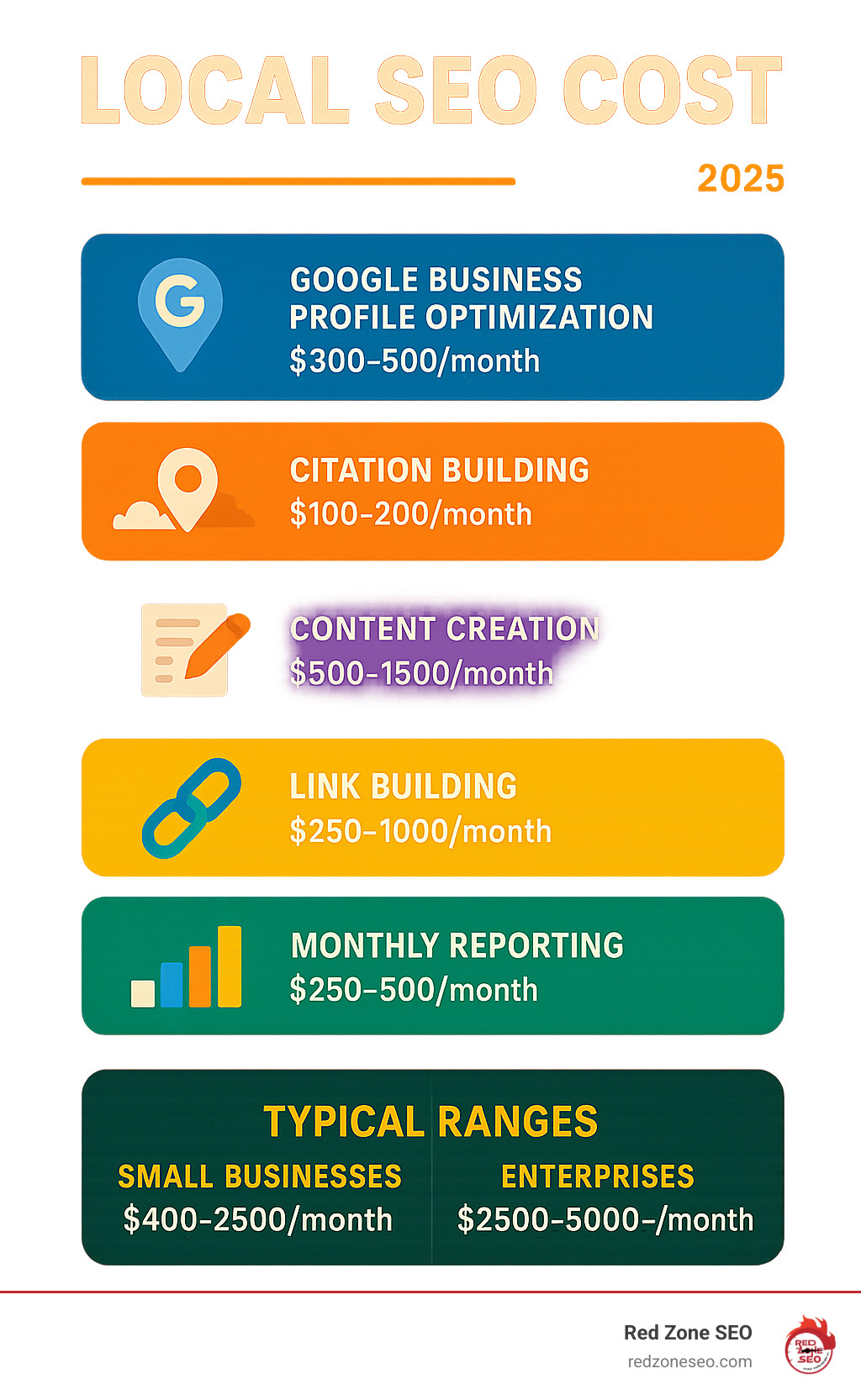
- Small-business local SEO: $400–$2,500
- Enterprise / multi-location: $2,500–$5,000+
- One-time projects: $1,000–$3,000
- Hourly consulting: $75–$150
Why the spread? Three variables matter most:
- Competition in your industry and city.
- Number of physical locations you must optimize.
- Depth of services you need—basic listing cleanup or full-scale content, links, and technical work.
If 93 % of online journeys begin with a search engine, showing up in those results is no longer optional; it’s survival. In the next sections you’ll learn how pricing is structured, what each tier includes, and how to decide which level is the right investment for your company.
Must-know terms:
• local seo packages
• seo audit cost
What Is Local SEO and Why Does It Matter?
Local SEO is the practice of positioning your business in front of nearby customers the exact moment they search phrases like \"roof repair near me\" or \"best tacos Austin.\" Unlike traditional SEO\u2014which can target anyone in any city\u2014local SEO focuses on geo-signals that push you into Google's Local Pack (the map with three listings) and on Google Maps.
Key benefits in one glance:
- Drives high-intent foot traffic and phone calls.
- Levels the playing field against national brands.
- Builds trust through consistent NAP (name, address, phone) data and review responses.
- Produces measurable wins: click-to-call, direction requests, form fills.
- Creates lasting competitive advantages in your service area.
- Generates higher conversion rates than traditional advertising methods.
Core Building Blocks
- Google Business Profile (GBP) Optimisation: This is the cornerstone of local SEO. It involves more than just listing your name and address. A fully optimised profile includes selecting the most accurate primary and secondary categories, utilising all relevant attributes (e.g., \"wheelchair accessible,\" \"free Wi-Fi\"), uploading high-quality, geotagged photos and videos regularly, creating weekly Google Posts to announce offers and news, and actively using the Q&A feature to address common customer questions. Filling out the Products and Services sections with detailed descriptions and pricing also provides Google with crucial context about your business.
- Citations & NAP Consistency: Citations are mentions of your business's Name, Address, and Phone number (NAP) across the web. Consistency is paramount. Discrepancies like \"St.\" vs. \"Street\" or \"(555)\" vs. \"555-\" can confuse search engines and erode trust. A thorough local SEO campaign includes a citation audit to find and correct inconsistencies, followed by building new citations on reputable national, local, and industry-specific directories (e.g., Yelp, TripAdvisor, industry association sites). This process often involves working with data aggregators like Data Axle and Neustar Localeze to distribute correct information widely.
- On-Page Local Signals: Your website must clearly signal your location and service areas to search engines. This is achieved by including your city and state in title tags, meta descriptions, headers, and body copy. Creating dedicated landing pages for each physical location is essential for multi-location businesses. Implementing
LocalBusiness schema markup provides search engines with structured data about your NAP, hours, and services, which can lead to rich results in search.
- Local Content Creation: Content that demonstrates your local expertise and community involvement is a powerful ranking factor. This goes beyond generic blog posts. Think about creating neighborhood guides, writing about local events you sponsor or participate in, developing case studies of local clients, or creating FAQ pages that answer questions specific to customers in your area (e.g., \"What are the building permit requirements in Austin?\"). This content not only attracts local links but also resonates deeply with your target audience.
- Review Generation and Management: Online reviews are a massive trust signal for both customers and Google. A proactive strategy is needed to encourage a steady stream of genuine reviews from happy customers. Equally important is managing your reputation by responding to all reviews\u2014positive and negative\u2014in a timely and professional manner. A thoughtful response to a negative review can often win over prospective customers by demonstrating your commitment to customer service.
- Local Link Building: Earning backlinks from other locally relevant and authoritative websites tells Google that your business is a trusted part of the community. This isn't about quantity, but quality. Valuable local links come from sponsoring a local sports team, partnering with a nearby non-competing business for a promotion, joining the local Chamber of Commerce, or getting featured in a local news blog.
- Technical SEO Foundations: A poor user experience can negate all other local SEO efforts. Key technical elements include ensuring your website is mobile-responsive (as most local searches happen on mobile devices), has fast loading speeds (users expect pages to load in under three seconds), and is secure with an SSL certificate (HTTPS). A logical site structure with clear navigation and internal linking between your service and location pages is also critical for both users and search engine crawlers.
- Local Keyword Research: Understanding the specific phrases your local customers use is fundamental. This means targeting keywords with local intent, such as \"plumber in Henderson\" (geo-modified keyword) or \"emergency plumber near me\" (proximity-based keyword). Tools like Google Keyword Planner, Ahrefs, and Semrush can help identify these terms, but also consider surveying your actual customers to learn the language they use to describe their needs.
The Local Search Landscape Today
The local search environment has evolved dramatically. Google processes over 8.5 billion searches daily, with \"near me\" searches growing by 500% over the past few years. Mobile searches for \"where to buy\" plus \"near me\" have increased by over 200% in recent years.
Consumer behaviour patterns show that:
- 76% of people who search for something nearby visit a business within 24 hours
- 28% of local searches result in a purchase
- 72% of consumers who perform a local search visit a store within five miles
- 18% of local mobile searches lead to a sale within one day
These statistics underscore why local SEO isn't just helpful\u2014it's essential for survival in today's digital marketplace.
Industry-Specific Considerations
Different industries face unique local SEO challenges:
Healthcare & Medical: Must comply with HIPAA regulations while building trust through reviews and local content. Medical practices often compete in highly saturated markets where reputation management becomes crucial.
Legal Services: Face intense competition in major metros. Personal injury and family law firms often invest heavily in local SEO due to high case values and lifetime customer worth.
Home Services: Plumbers, electricians, and contractors benefit enormously from emergency-related searches. These businesses often see immediate ROI from local SEO investments.
Restaurants & Food Service: Heavily dependent on reviews, photos, and accurate hours. Menu updates, seasonal promotions, and event hosting require constant GBP management.
Retail & E-commerce: Must balance online and offline presence, often requiring location-specific inventory management and local pickup options.
How Local SEO Affects Revenue
Ready-to-buy searchers convert at dramatically higher rates than social scrollers. A plumbing company ranking in the top three for \"emergency plumber Las Vegas\" can book jobs within minutes\u2014often earning five or more dollars for every dollar invested in optimisation. Because listings, content, and links keep working long after they're built, the ROI compounds month after month.
The revenue impact extends beyond immediate conversions. Strong local SEO presence:
- Increases brand recognition in your service area
- Builds customer trust through consistent online presence
- Reduces customer acquisition costs over time
- Creates barriers to entry for new competitors
- Provides valuable customer insights through search data
Businesses that invest in comprehensive local SEO strategies typically see 20-30% increases in local organic traffic within the first six months, with continued growth as their digital footprint strengthens.
How Much Does Local SEO Cost on Average?
Why Quotes Differ: 6 Factors That Push Prices Up or Down

-
Industry Competition
High-stakes niches—personal injury law, cosmetic surgery, luxury real estate—require exponential content and link budgets compared with a local pet groomer. CPC data in Google Ads is a quick proxy: higher CPC → harder to rank → higher SEO spend.
-
Number of Locations
One bakery in Henderson, NV is simpler than a chain of ten across Nevada and Florida. Each location needs its own GBP, citations, unique page copy, and review stream.
-
Scope of Work
Some firms only need a one-time clean-up; others need ongoing content, schema fixes, and digital PR. The more disciplines involved—technical, creative, outreach—the steeper the quote.
-
Current Website Condition
A modern, mobile-responsive site with clean code requires less technical work than a 2015 WordPress theme with broken plugins. Sites with existing penalties, duplicate content, or technical debt need extensive remediation before local SEO tactics can be effective.
-
Competitive Landscape Analysis
Markets with established players who've invested heavily in SEO require more aggressive strategies. A new restaurant competing against chains with national SEO budgets faces different challenges than one in an underserved area.
-
Business Goals and Timeline
Companies needing rapid results for seasonal businesses or grand openings require intensive, front-loaded campaigns. Businesses with longer timelines can spread investments more evenly, often reducing monthly costs.
Understanding Market Saturation
Some industries face particular challenges that drive costs higher:
Oversaturated Markets:
- Personal injury law (average CPC: $50-$100+)
- Cosmetic surgery ($40-$80 CPC)
- Insurance services ($30-$60 CPC)
- Real estate in major metros ($20-$50 CPC)
Moderately Competitive:
- Dental practices ($10-$30 CPC)
- HVAC services ($15-$35 CPC)
- Auto repair ($8-$25 CPC)
- Fitness centers ($5-$20 CPC)
Lower Competition:
- Pet grooming ($3-$12 CPC)
- Local retail ($2-$10 CPC)
- Specialty services ($5-$15 CPC)
- Niche professional services ($8-$20 CPC)
The Multi-Location Complexity Factor
Businesses with multiple locations face exponentially more complex challenges:
2-5 Locations: Manageable with systematic approach, typically 1.5-2x single location cost per additional location.
6-20 Locations: Requires dedicated management systems, often 1.2-1.5x cost per additional location due to economies of scale.
20+ Locations: Enterprise-level complexity requiring custom solutions, dedicated account management, and sophisticated reporting systems.
Each additional location requires:
- Unique Google Business Profile setup and management
- Location-specific citation building (50-100 per location)
- Customised landing pages with unique content
- Individual review management strategies
- Location-specific link building campaigns
- Separate tracking and reporting systems
Technical Complexity Considerations
Website technical factors significantly impact pricing:
Simple Sites (WordPress, Squarespace): Basic technical SEO needs, standard pricing applies.
E-commerce Platforms: Require product schema, inventory management integration, and complex site architecture optimisation.
Custom Applications: May need specialized technical expertise, API integrations, and custom tracking solutions.
Legacy Systems: Often require complete overhauls or workarounds that increase project complexity and cost.
Choosing a Pricing Model That Fits
Three common ways agencies bill for local SEO:
1. Monthly Retainer (Most Popular)
- Average: $1,200–$2,000
- Best for: continuous growth, algorithm updates, and steady content/link output.
- Strength: predictable budget, compounding results.
2. Project-Based
- Typical: $1,000–$3,000
- Best for: audits, GBP setup, citation overhauls.
- Strength: clear deliverables and end date—ideal for testing the waters.
3. Hourly Consulting
- Range: $75–$150
- Best for: technical guidance when you already have an in-house team.
- Strength: pay only for the exact expertise or training you need.
Use retainers for long-term market share, projects for specific fixes, and hourly rates for specialised advice.
Is Local SEO Worth It? Understanding ROI & Common Traps

Data says 88 % of companies are happy with their local SEO returns; 40 % see 5× or better ROI. Why? Assets like citations, links, and content keep earning clicks long after you create them—unlike ads that stop the moment you pause spending.
Setting a Sensible Budget
- Allocate 6-15 % of your overall marketing budget.
- If you’re brand new, plan at least $500/month for 6 months to gain traction.
- Scale investment once revenue from local search grows.
Avoiding the “Cheap SEO” Pitfall
$199-per-month deals often rely on spun content, spam links, or fake reviews. The short-term bump can lead to long-term penalties that cost thousands to fix. Stick with providers who follow Google’s EEAT guidelines and explain their tactics in plain English.
Frequently Asked Questions
How does small-business local SEO cost compare to enterprise?
- Small business: $400–$2,500/mo, usually one location.
- Enterprise: $2,500–$5,000+/mo, multiple locations, tougher competition, advanced reporting.
How long until I see results?
Most firms notice meaningful gains in 3–6 months; highly competitive metros may need 9–12. Early wins usually appear in GBP views and calls before organic rankings surge.
Freelancer vs. agency—which should I hire?
- Freelancer: lower cost, direct contact, great for straightforward campaigns.
- Agency: broader skill set, redundancy, and scalability—ideal for multi-location or aggressive growth goals.
Conclusion: Invest Wisely, Grow Locally
Local SEO isn’t a cost to fear—it’s an asset that can compound just like any other smart investment. Determine where your business stands, match a service tier to your competitive reality, and partner with a provider that uses transparent, white-hat tactics.
At Red Zone SEO we specialise in data-driven local campaigns for businesses in Austin, Las Vegas, Henderson, and beyond. Ready to claim more map placements and foot traffic? View our transparent pricing or request a custom plan today: Red Zone SEO Pricing.
Your local customers are already searching. Let’s make sure they find you first.