
Why is a technical SEO audit important for your website? It's the foundation that determines if search engines can find, understand, and rank your content. Without a solid technical base, even the best content and marketing efforts will fall short. A technical audit is crucial for improving search engine accessibility, boosting rankings, enhancing user experience, and increasing organic traffic.
Think of it as a health check-up for your website. Just as you wouldn't build a house on a weak foundation, you can't expect your online presence to thrive with underlying technical problems. With 99% of searchers sticking to page one of Google, technical issues holding your site back mean you're missing out on potential customers every day.
An audit examines everything from page load speed to crawlability, identifying invisible problems that could be costing you rankings and revenue. The good news is that most technical SEO issues have straightforward solutions once you know what to look for. That's where a comprehensive audit becomes your roadmap to better performance.
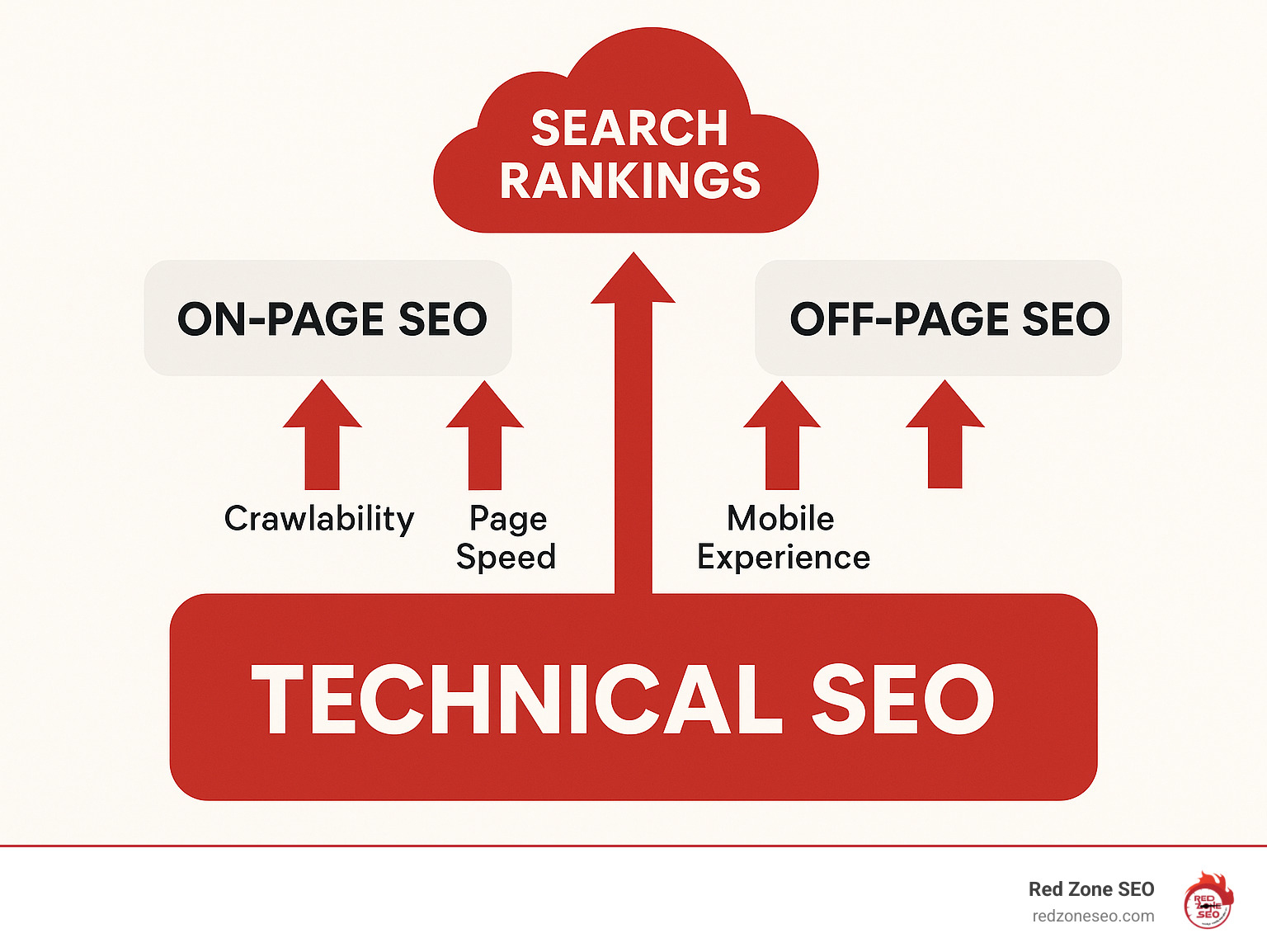
Quick look at why is a technical seo audit important:
You've built a stunning website with engaging content, but it's invisible in search results. What went wrong? The answer often lies in the technical foundation. Why is a technical SEO audit important? It reveals the hidden, complex issues that can make or break your online success, regardless of how great your site looks or how compelling your content is.
Think of your website as an iceberg. The design and content are just the tip visible above the water. Below the surface is a complex technical structure that search engines must steer. If this foundation is flawed with issues like slow code, confusing architecture, or security vulnerabilities, even brilliant content will struggle to gain visibility. With 45.1% of all search result clicks coming from organic searches, technical SEO is the essential discipline for capturing a massive share of potential traffic and ensuring your marketing investments pay off.
Modern SEO is built on three interconnected pillars:
You can create the most insightful article in your industry (on-page SEO) and earn a backlink from a major news outlet (off-page SEO), but if a misconfigured robots.txt file blocks search engines from seeing that page, your efforts are wasted. If your page takes ten seconds to load, users will leave before they ever read your content, rendering your efforts useless. At Red Zone SEO, our comprehensive audits reveal these foundational issues, providing the stable platform needed for all your marketing efforts to succeed.
More info about our SEO Audit services
Over 3.5 billion Google searches happen daily, but a staggering 99 percent of searchers stick to page one. If you're not there, you're effectively invisible to the vast majority of potential customers. Technical SEO is often the deciding factor in whether you even get a chance to compete for those top spots.
Search engine bots crawl the web to find, evaluate, and index content. Technical issues like slow load times, broken links, or confusing URL structures act as roadblocks. The bot might exhaust its allocated "crawl budget" before reaching your most important pages, or it might conclude that your site provides a poor user experience and rank it lower as a result. A thorough audit identifies and provides a plan to remove these roadblocks, allowing bots to crawl and index your content efficiently. This improved accessibility directly translates to better rankings and increased organic visibility. Google explicitly rewards websites that follow technical best practices because it makes their job of organizing the world's information easier and ensures their users have a good experience.
Technical issues don't just frustrate bots—they drive away human customers. Why is a technical SEO audit important for your visitors? Because it directly impacts their experience, which in turn influences their perception of your brand.
Since 76% of consumers research a company's website before engaging, your site is often their first impression. Technical problems at this critical stage can cost you business before you even have a chance to make your pitch.
More info about WordPress SEO Services
When we conduct a technical SEO audit at Red Zone SEO, we perform a comprehensive, multi-faceted evaluation of your website's invisible infrastructure. Why is a technical SEO audit important to understand in detail? Because knowing what we look for helps you appreciate the depth and value of this process. We methodically identify issues, from critical errors to subtle opportunities for improvement. Our audit is a full health checkup to ensure your site is technically sound, robust, and ready to compete at the highest level.
Key elements we examine include crawlability, indexability, site architecture, page speed, mobile-friendliness, security, and structured data. Each component is crucial for how search engines find, understand, and ultimately rank your website.

If search engines can't crawl (access) and index (store) your pages, your content is effectively invisible. We perform a deep dive into:
Disallow: /, can accidentally block your entire site from being indexed, making it disappear from search results.rel="canonical") tell search engines which version of a duplicate page is the "master" copy to be indexed. We verify these are implemented correctly using tools like the URL Inspection Tool to consolidate ranking signals.A well-organized site is easy for both users and search engines to steer and understand. We look for:
your-site.com/services/technical-seo) are like clear street signs, helping users and search engines understand the page's content at a glance.More info about E-commerce Store SEO
Page speed is a critical ranking factor, officially measured by Google's Core Web Vitals:
We use tools like Google PageSpeed Insights to diagnose and recommend fixes for speed issues, such as optimizing images, minifying code, and improving server response times.
Structured data (or schema markup) is a standardized code vocabulary that you add to your site's HTML. It doesn't change how the page looks to a user, but it provides explicit clues to search engines about the meaning of your content. This helps them understand if your content is a recipe, an event, a product, or an FAQ page. An audit checks for the correct implementation and identifies new opportunities. The reward for using structured data is eligibility for rich results—the visually improved search listings with star ratings, prices, or FAQ dropdowns that stand out on the results page and can significantly increase click-through rates.
More info about SEO for Small Business
When answering why is a technical SEO audit important, a key question is how to conduct one effectively. At Red Zone SEO, we find the most powerful audits combine the speed and scale of automated tools with the strategic insight and contextual understanding of human expertise. It's like diagnosing a car: a computer can pull error codes instantly, but an experienced mechanic is needed to interpret those codes, understand the interplay between systems, and determine the most effective and lasting fix.

Automated SEO tools like Semrush, Ahrefs, and Screaming Frog act as tireless digital assistants. These site crawlers can systematically examine thousands of pages in minutes, providing rapid data collection on a massive scale. They excel at identifying issues like broken links, redirect chains, missing meta tags, incorrect hreflang attributes, and thin content pages. Their scalability and efficiency are essential for large, complex websites, as they can uncover site-wide patterns that would be impossible to spot manually. However, these tools have a critical limitation: they are great at telling you what is wrong, but they often can't explain the why or prioritize the how in the context of your specific business goals. A tool might flag a page with a noindex tag as an error, without understanding it's an intentional choice for a private thank-you page.
This is where human expertise becomes invaluable. An experienced SEO professional provides contextual analysis that tools cannot. We can differentiate between a critical error and an intentional configuration. Through user journey testing, we steer your site as a real customer would, attempting to complete key actions like filling out a contact form, signing up for a newsletter, or completing a purchase. This process uncovers user experience frustrations—like a confusing checkout flow or a form that doesn't work on mobile—that automated tools completely miss.
The most critical part of a manual review is strategic prioritization. Not all SEO issues are created equal. An expert can determine which fixes will have the highest impact with the lowest effort. We also perform validation of automated findings to filter out the false positives and noise that tools often generate. Most importantly, a manual review ensures business goal alignment, connecting every technical recommendation to a tangible business outcome, such as increased leads, sales, or user engagement.
| Feature | Automated Audit | Manual Audit |
|---|---|---|
| Speed | Extremely fast, scans thousands of pages quickly | Slower, methodical, and time-intensive |
| Scale | Ideal for large, complex websites and initial data gathering | Best for deep dives on critical pages and user pathways |
| Cost | Varies by tool subscription (monthly/annual fees) | Higher initial cost due to expert time and analysis |
| Accuracy | Can produce false positives/negatives; lacks context | High, based on expert interpretation and validation |
| Insight | Provides raw data, issue lists, and generic recommendations | Delivers strategic, prioritized, and actionable insights |
| Best For | Data gathering, initial scan, ongoing monitoring, pattern detection | Prioritization, strategy, complex issues, UX analysis, business alignment |
The most effective audits use a hybrid approach. We leverage automated tools for comprehensive data gathering and to establish a baseline. Then, we apply our deep human expertise to interpret that data, prioritize fixes based on business impact, and create a strategic roadmap that aligns perfectly with your unique goals.
An audit report sitting in an inbox has zero value. At Red Zone SEO, we believe the real magic happens when those findings are translated into a clear, prioritized, and actionable roadmap. This is where understanding why is a technical SEO audit important comes to life—it's the bridge between identifying problems and executing solutions that drive tangible improvements and boost your online presence.
After identifying a list of issues, the next critical step is prioritization. Not all problems are created equal, and trying to fix everything at once is a recipe for paralysis. We focus on what will move the needle most, starting with the "low-hanging fruit"—issues that are relatively easy to fix but deliver significant SEO and user experience improvements. Concurrently, we identify high-impact foundational issues that are essential for long-term health, even if they require more development resources.
To make these decisions objectively, we often use an impact/effort framework like ICE:
For example, fixing a robots.txt file that's blocking key pages might score: Impact=10, Confidence=10, Ease=9. This is a top priority. In contrast, refactoring an entire legacy CSS file might score: Impact=7, Confidence=8, Ease=2. This is still important but requires more planning. This framework facilitates clear communication and collaboration with your development team, ensuring our recommendations are impactful, feasible, and align with their workflow.
A comprehensive audit culminates in a strategic roadmap—a step-by-step guide that serves as the blueprint for your digital success. It transforms a list of problems into a project plan. Our roadmap includes:
This structured approach turns SEO into an ongoing, manageable process of refinement, not just a one-time, overwhelming fix.
More info about our SEO Audit Cost
Our work doesn't stop after implementation. We continuously monitor your website's performance to measure the impact of our changes and ensure ongoing technical health. We track a range of Key Performance Indicators (KPIs), including:
By analyzing data from tools like Google Analytics and Google Search Console, we can directly correlate technical fixes to tangible business outcomes. Technical SEO isn't a "set it and forget it" task. Search engine algorithms evolve, new content is added, and websites change. We recommend regular check-ups to identify and resolve new issues before they can harm your rankings, ensuring sustained performance and growth over the long haul.
More info about our SEO Strategies for Start Ups
You've learned why is a technical SEO audit important, but you might still have questions about the specifics. Here are detailed answers to some of the most common ones we hear from clients.
While every site is unique, certain issues appear frequently across industries and platforms. Here are the usual suspects we find that can significantly impact performance:
The ideal frequency depends on your site's size, complexity, and how often you publish new content or make changes. As a general guideline:
A technical SEO audit is a specialized component of a broader, more general SEO audit.
You can certainly get started on your own, and it's a great way to learn about your site's health. Free tools like Google Search Console are invaluable, providing direct feedback from Google on crawl errors, indexing status, and Core Web Vitals. Tools like Google's PageSpeed Insights or Screaming Frog's free version can also help you identify low-hanging fruit like broken links or large images.
However, a comprehensive audit requires deeper expertise. The real challenge isn't just finding issues, but understanding their root cause, prioritizing them based on business impact, and developing a strategic plan to fix them—especially for large or complex sites. An expert can interpret nuanced data, diagnose site-wide systemic problems, and craft a redirect strategy that preserves link equity during a migration. Think of it this way: you can check your tire pressure, but you'd go to a mechanic to rebuild the engine. While you can find a broken link, a professional is needed to diagnose a site-wide indexing problem that's costing you thousands in revenue.
At Red Zone SEO, we don't just run reports. We translate complex technical data into a clear, actionable plan, explaining why is a technical SEO audit important for your specific business and how to fix issues effectively for long-term growth.
More info about our Henderson SEO services
So, why is a technical SEO audit important? In the simplest terms, it's the essential health check-up that ensures your website is built to win in the competitive digital marketplace. While compelling content and beautiful design grab the spotlight, technical SEO works tirelessly behind the scenes to ensure your audience can actually find and enjoy your site. Issues like slow load times, broken links, and poor mobile navigation are not just minor annoyances; they are symptoms of a weak foundation that can drain your website's potential, frustrate users, and cost you revenue every single day.
A technically sound website creates a powerful ripple effect of benefits. It builds a solid digital foundation, leading to improved website health, greater user trust, and a significant competitive advantage. When your site works flawlessly for both search engines and humans, users stay longer, engage more deeply, and convert at higher rates. This sends strong positive signals to Google, further boosting your visibility in a virtuous cycle of growth.
An audit sets you up for long-term success. It is not about a temporary, quick-fix boost but about building a robust, resilient platform that supports sustainable growth for years to come. At Red Zone SEO, our data-driven strategy moves beyond generic checklists to prioritize solutions that deliver the biggest impact for your unique business goals. We believe every business deserves a website that works as hard as they do.
Don't let hidden technical issues undermine your marketing efforts and hold your business back. An optimized website is a reliable, high-performing asset that consistently attracts qualified organic traffic and drives conversions. It's a strategic investment in your brand's future that pays dividends long after the audit is complete.
Take the first step towards a technically sound website with our expert Las Vegas Search Engine Optimization services. Let's build a digital presence that doesn't just compete—it thrives.