
SEO of ecommerce websites is the process of making your online store more visible in search engine results to drive organic traffic and sales. It involves strategic keyword research, on-page optimization, technical improvements, and building site authority.
Quick Overview: Core Components of E-commerce SEO
Consider this: 43% of all e-commerce traffic comes from organic search. While paid ads offer quick visibility, they require constant investment. The moment you stop paying, your traffic vanishes. SEO, in contrast, builds sustainable growth that compounds over time.
More importantly, customers trust organic results more than paid ads, and this trust translates directly into sales. Successful e-commerce SEO hinges on understanding search intent. A search for "best wireless headphones" (research phase) is different from "buy Sony WH-1000XM4 headphones" (purchase phase).
Your SEO strategy must capture customers at every stage of their buying journey, building a reliable path from initial search to final purchase.
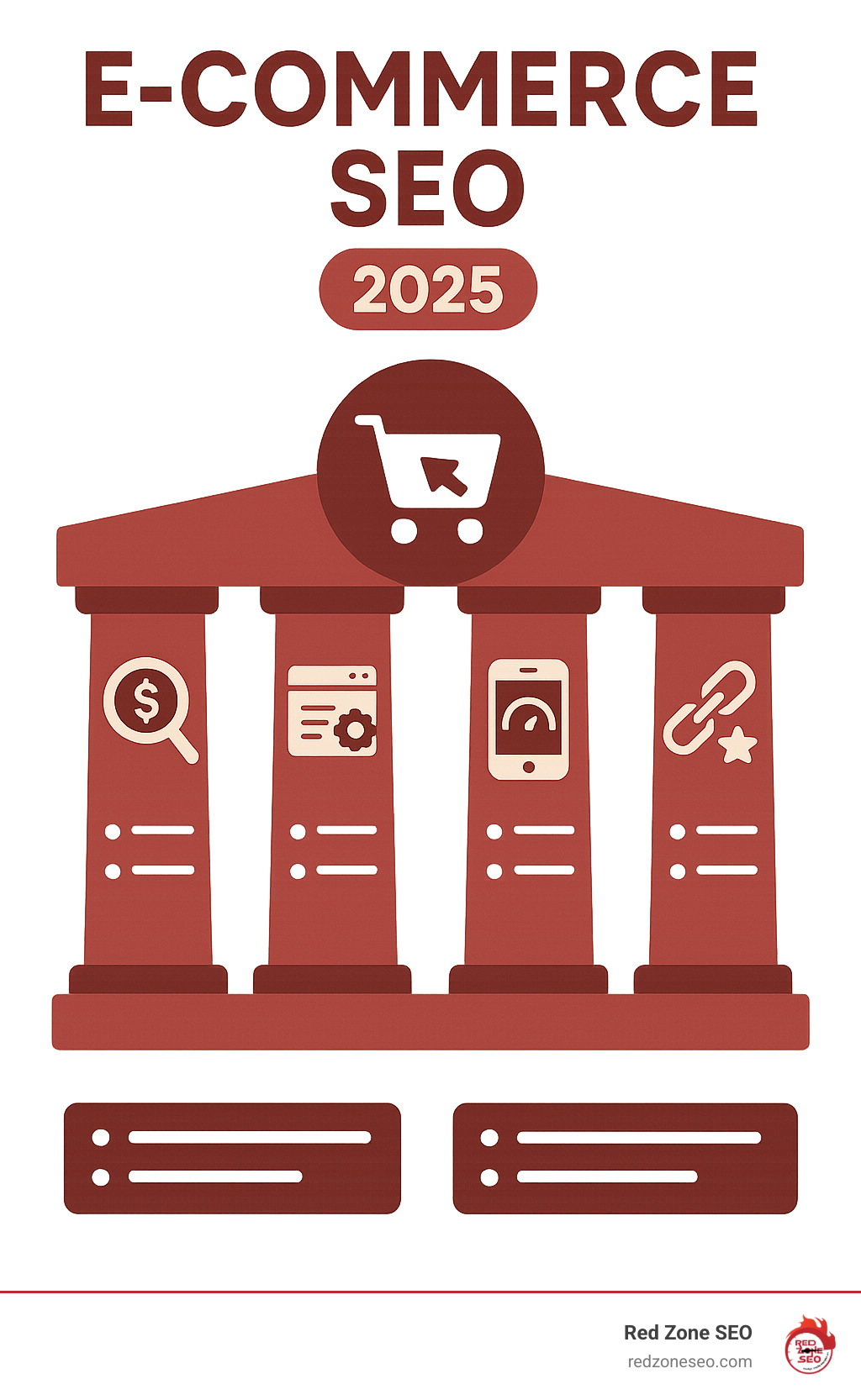
Key terms for seo of ecommerce websites:
Keyword research is the map that leads you directly to customers ready to buy. A successful seo of ecommerce websites strategy is built on understanding what customers actually search for, not what you think they search for.
Search intent is the 'why' behind a search query. Understanding it allows you to meet customers at each stage of their buying journey.
At Red Zone SEO, we use a combination of powerful tools to uncover high-value keywords.
More info about Keyword Research
Your keyword strategy must adapt depending on whether you sell to businesses (B2B) or consumers (B2C).
| Feature | B2B E-commerce SEO | B2C E-commerce SEO |
|---|---|---|
| Target Audience | Businesses, procurement managers, decision-makers | Individual consumers, families, gift-buyers |
| Buying Cycle | Longer sales cycle, multiple stakeholders, research-heavy | Shorter cycle, often emotional or impulse-driven |
| Keyword Focus | Problem/solution terms, technical specs, part numbers, "wholesale," "supplier" | Brand names, product categories, emotional triggers, "best," "cheap," "deal" |
| Content Strategy | Educational content, case studies, detailed specifications | Product reviews, buying guides, lifestyle content |
| Search Behavior | Specific technical terms, industry jargon, comparison research | Broader terms, visual searches, mobile-friendly queries |
B2B customers have longer sales cycles and search for technical specs, part numbers, and supplier-related terms, requiring in-depth, educational content. B2C searches are often driven by immediate needs, brand names, and emotional triggers, requiring compelling product presentations that convert quickly.
On-page SEO turns your website pages into conversion machines that appeal to both customers and search engines. For the seo of ecommerce websites, what helps your customers almost always helps your rankings.
More info about Content Optimization
Your product and category pages are the core of your store. Each element must be optimized.
sony-wh-1000xm4-headphones.jpg) and detailed alt text. Alt text improves accessibility and helps your images rank in Google Image Search.yourstore.com/category/product-name.
A guide to URL structure from Google
Structured data (schema markup) is code added to your site's HTML that helps search engines understand your content. It creates eye-catching "rich snippets" in search results that dramatically increase click-through rates.
For e-commerce, these are essential:
Key Product Schema Properties:
Implementing schema gives you a significant competitive advantage over plain search listings.
Google's guide to product markup
Content marketing attracts customers who aren't ready to buy, establishes your brand as an authority, and earns valuable backlinks. It's a crucial support system for your product pages.
Focus on strategic content that solves customer problems:
More info about Content Marketing for Small Businesses
Technical SEO is the foundation of your online store. If search engines can't efficiently find, crawl, and understand your site, even the best products and content will remain invisible. For seo of ecommerce websites, a solid technical backbone is non-negotiable.
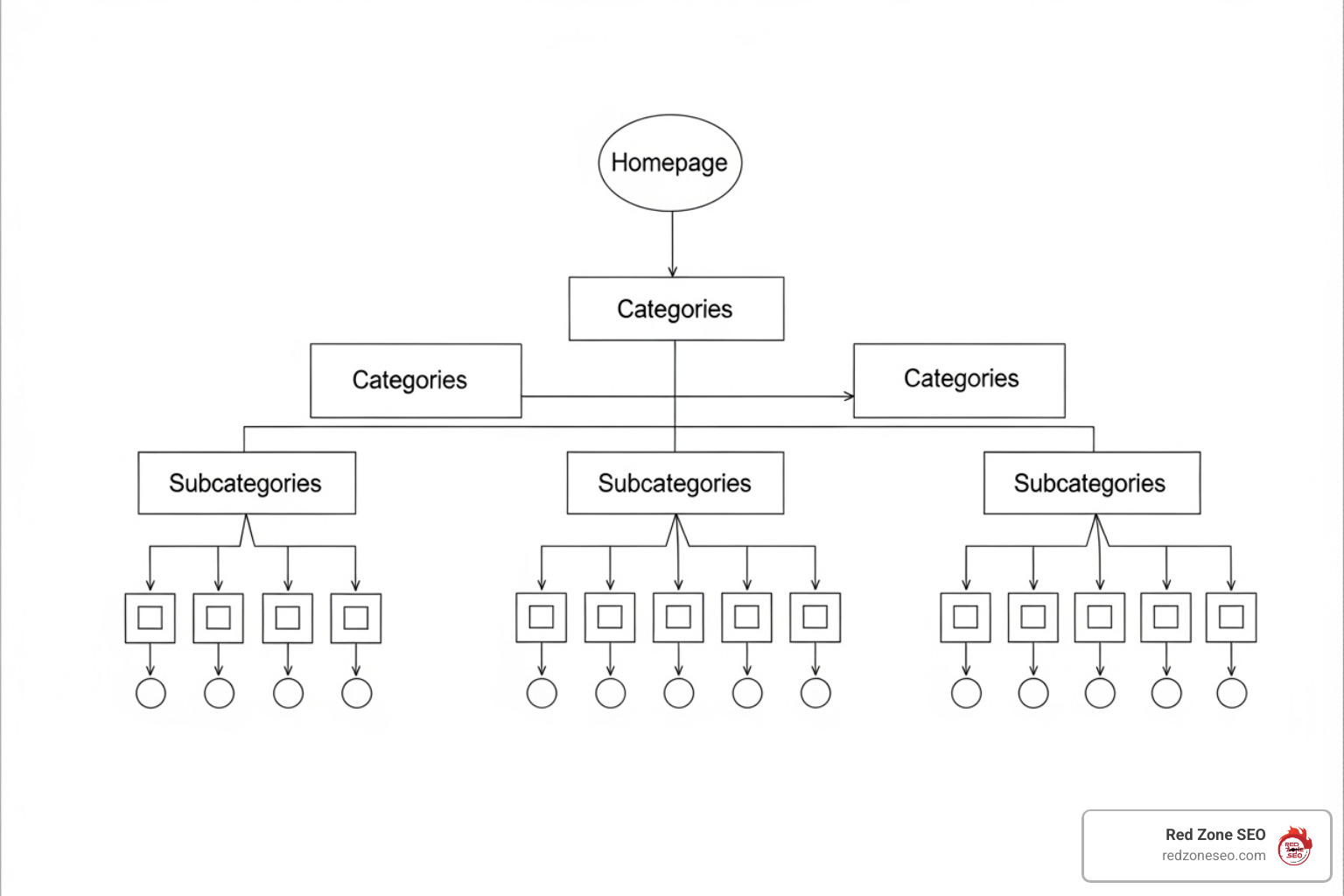
Your site architecture is the blueprint for your store. Follow two golden rules: keep it simple and scalable, and ensure every page is three clicks or fewer from the homepage. This flat structure helps both users and search engines.
A logical hierarchy looks like this: Homepage > Category Pages > Sub-Category Pages > Product Pages. This approach is intuitive, distributes ranking power effectively, and scales easily as your inventory grows. Reinforce this structure with clear breadcrumbs and a strategic internal linking strategy.
More info about performing an SEO Audit.
Site speed is a critical ranking factor, as over half of users will abandon a page that takes more than three seconds to load. Google's Core Web Vitals measure this user experience:
Improve these metrics by compressing images, minifying code (HTML, CSS, JavaScript), leveraging browser caching, and using a Content Delivery Network (CDN) to serve content from servers closer to your users. Use Google's PageSpeed Insights to diagnose and track improvements.
E-commerce sites face unique technical problems. Here's how to manage them:
noindex tags or canonicals on filtered URLs that offer little search value.More info about Shopify Store SEO.
Even a technically perfect store needs authority to rank. In seo of ecommerce websites, authority is built primarily through backlinks—digital 'votes of confidence' from other reputable websites. When a trusted site links to you, it signals to Google that your store is credible.
Quality beats quantity every time. One relevant link from a respected industry publication is worth more than a hundred low-quality links. Google evaluates links based on the linking site's authority, its relevance to your niche, and the context of the link.
Effective link building focuses on providing real value and building genuine relationships. Here are strategies that work:
Some of your most powerful off-page signals come directly from your customers.
Customer reviews are SEO gold. They provide a constant stream of fresh, user-generated content on your product pages, often including valuable long-tail keywords. More importantly, they are powerful trust signals. Research shows that 90 percent of consumers consider reviews when making a buying decision. When you use Review schema, star ratings appear directly in search results, dramatically boosting click-through rates.
While not a direct ranking factor, social signals (likes, shares, and engagement) are also important for seo of ecommerce websites. Social media activity increases brand visibility and drives traffic to your site. This surge in traffic and engagement sends positive signals to Google about your site's popularity and relevance, indirectly boosting your SEO efforts.
If you're not measuring your seo of ecommerce websites efforts, you can't manage them effectively. At Red Zone SEO, we use a data-driven approach focused on the metrics that matter most to your bottom line, ensuring every action we take is optimized for profitability and ROI.
Focus on KPIs that directly connect SEO efforts to business growth:
Effective e-commerce SEO requires a professional toolkit. Here are the essentials we use to drive results:
Free Essentials: Google Search Console is your direct line to Google, providing performance data and technical issue alerts. Google Analytics offers deep insights into user behavior on your site. Google PageSpeed Insights helps diagnose and fix site speed issues.
Premium Power Tools: Ahrefs and Semrush are indispensable for competitive analysis, advanced keyword research, and backlink tracking. Screaming Frog is our go-to for comprehensive technical site audits to uncover issues like broken links and duplicate content.
When it comes to seo of ecommerce websites, many business owners have the same questions. Here are straight answers to the most common ones.
SEO is a long-term investment, not an overnight fix. You can typically expect to see initial positive movement within 3-6 months, such as improvements in keyword rankings and traffic for less competitive terms. However, significant, revenue-driving results often take 6-12 months or longer to materialize.
The timeline depends on factors like your industry's competition, your site's current authority, and the resources dedicated to the campaign. Unlike paid ads, the results from SEO are sustainable and compound over time, delivering increasing returns.
This isn't an either-or question; the most effective strategy uses both. SEO builds long-term, sustainable traffic and customer trust at a lower cost over time. Once you earn a ranking, you don't have to pay for every click. Paid ads deliver immediate visibility, making them ideal for testing new products, running promotions, and generating sales while your SEO gains momentum.
Use them together: run ads for quick data and sales while your SEO strategy builds a foundation for lasting, profitable growth.
Yes, you can absolutely handle many SEO basics yourself, especially for a smaller store. Tasks like writing unique product descriptions, optimizing title tags, and creating helpful blog content are manageable and impactful.
However, seo of ecommerce websites becomes significantly more complex as you grow. Advanced technical SEO (like managing faceted navigation or crawl budget), large-scale link building, and in-depth competitive strategy require specialized expertise and expensive tools. For most growing stores, hiring an agency provides a better ROI and allows you to focus on what you do best: running your business.
Seo of ecommerce websites isn't just another marketing tactic; it's a fundamental business asset for long-term, sustainable growth. By mastering keyword research, on-page optimization, technical performance, and authority building, you create a powerful engine for attracting and converting customers 24/7.
This isn't a "set it and forget it" task. The digital marketplace is constantly evolving, and a successful strategy requires continuous, data-driven adaptation. While your competitors burn cash on short-term paid ads, you can build lasting dominance in organic search, creating an asset that grows in value over time.
At Red Zone SEO, we've seen how a professional SEO strategy transforms online stores from invisible to industry leaders. The question isn't whether you can afford to invest in SEO. The real question is: can you afford to let your competitors be the only answer when customers search for your products?
Get your free SEO analysis today and find what's possible when you stop competing on price and start dominating on visibility.