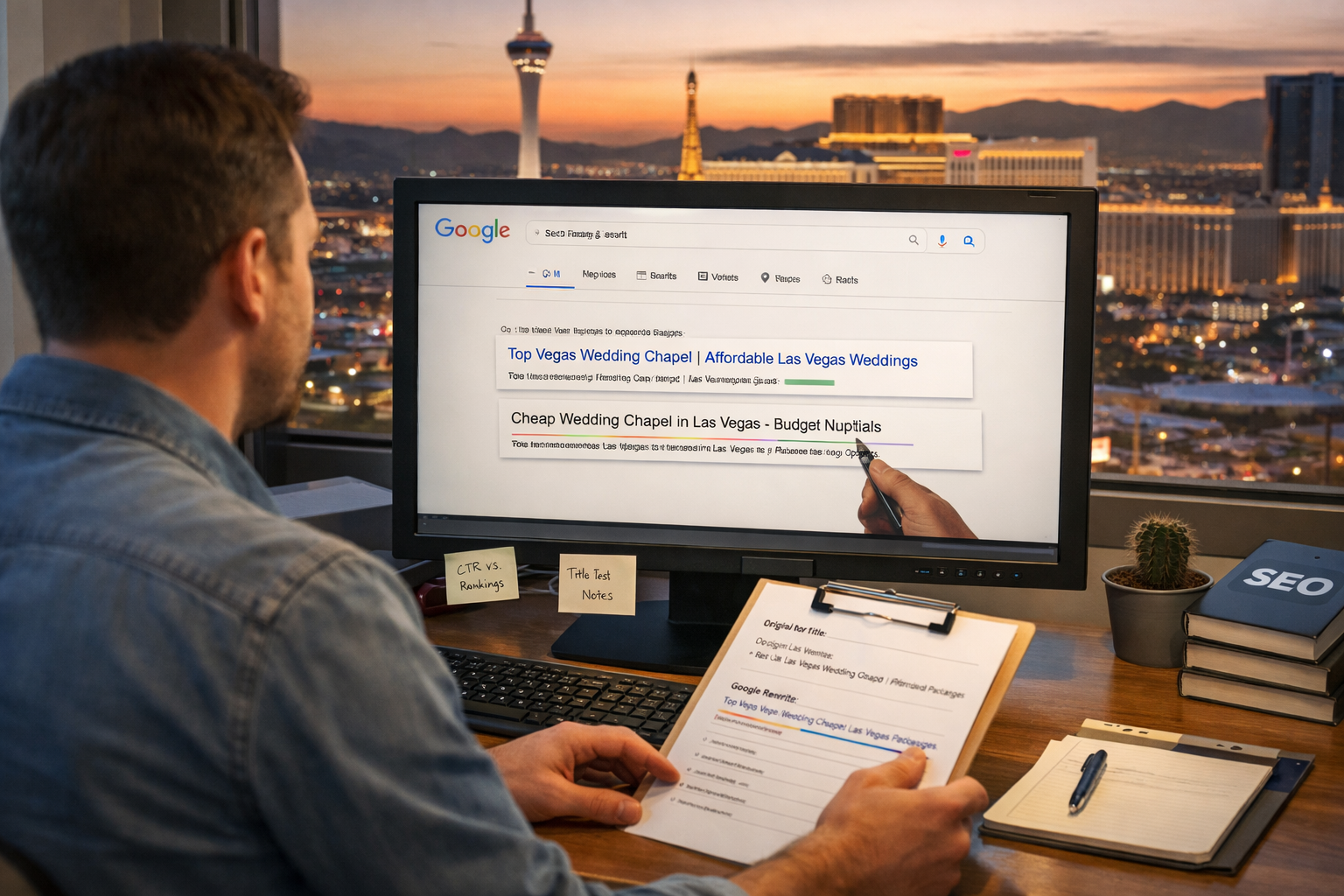
It can be frustrating to search your business in Google, spot your page in the results, and realize the title showing in search is not the title you wrote. If you have ever wondered why Google rewrites title tags, you are not alone. This is a common issue for small business websites, especially when pages were built quickly, copied from templates, or written without a clear content strategy.
For businesses in Las Vegas, Henderson, and across Clark County, title rewrites matter because they affect how clearly your page matches local search intent. A changed title does not always mean something is broken, but it can be a sign that Google thinks your current title is weak, repetitive, misleading, or not the best label for the page.
This FAQ explains google rewriting page titles in plain English, covers the most common triggers, and shows what small businesses can do next without chasing myths or expecting full control over SERP titles. If you are comparing providers or trying to diagnose a page issue, this article also connects the topic to broader content marketing for small businesses and local search engine optimization Las Vegas strategy.
When Google rewrites your title tag, it means the search result is showing a different clickable title than the one in your page’s HTML <title> element. Google calls these “title links.” In many cases, Google uses the title tag you provide. In other cases, it may generate a different version based on other signals on the page or around the page.
Those signals can include:
For example, imagine a Las Vegas company has a service page with this HTML title:
Home | ABC Digital
But the visible page heading says:
Las Vegas WordPress SEO Services for Small Businesses
If someone searches for a service-related phrase, Google may decide the heading is a more accurate and useful label than “Home | ABC Digital.” In that case, the result may display a title closer to the heading or combine the heading with the brand.
That is the basic answer to why Google changes meta titles: Google wants the title link in search results to help users quickly understand what the page is about. If your supplied title does not do that well, Google may substitute something else.
This is especially common on small business sites where pages are built from the same template and many titles end up sounding nearly identical. It also happens on local pages where location wording is unclear. A company may want to rank in Henderson, but the title only mentions Nevada or uses generic branding instead of the actual service and city combination searchers use. If Search Console is showing impressions for terms like search engine optimization henderson but no clicks, title clarity is worth checking.
No. A rewritten title does not mean your page cannot rank, and it does not automatically mean Google distrusts your site. It simply means Google chose a different title link presentation for a specific result. Sometimes that alternative title is better. Sometimes it is worse. The real question is whether the rewrite improves or weakens how your page appears for the searches that matter.
Usually not. Rewrites tend to happen page by page and query by query. One service page may show your title tag exactly as written, while another shows a modified version. This is one reason business owners get confused. They assume there must be one sitewide switch or penalty causing the issue. In reality, Google is evaluating title quality at the page level and often in the context of the search itself.
If you want to understand google rewriting page titles, it helps to look at the patterns that trigger it most often. These are practical issues, not mysterious penalties.
Generic titles are among the biggest rewrite triggers. Common examples include:
These titles do not tell Google or the user what the page specifically offers. On a small business website, every important page should clearly communicate a service, topic, or location.
For example, a better title for a local service page would be:
WordPress SEO Services in Las Vegas | RedZone SEO
That gives Google a clear subject, city, and brand without being vague.
Duplicate titles are one of the most common small business SEO problems. A business may have separate pages for Las Vegas, Henderson, and Clark County services, but the title tag is identical on all three. If Google sees the same or nearly the same title repeated across multiple URLs, it may rewrite one or more of them to better distinguish the pages.
This is very common on service area pages, blog category pages, and WordPress sites using broad SEO defaults. If your title tags are duplicated, Google has to work harder to understand which page is most relevant for each query.
If the title promises one thing but the page is mainly about something else, Google may choose a different title that better matches the actual content.
Example:
In that situation, Google may pull language from the heading, navigation, or brand references because the title tag looks unsupported by the page itself.
This is where content quality matters. Strong content marketing for small businesses helps reinforce the topic signaled by the title. If the title says the page is about local SEO help in Henderson, the page should clearly discuss that service, that audience, and that market.

Titles written only for keywords often get rewritten. Examples include:
Even when the terms are relevant, this style reads poorly. Google often shortens, rearranges, or simplifies titles that look repetitive or unnatural.
Good seo title tag optimization is not about stuffing every variation into one line. It is about writing a concise, descriptive title that aligns with the page and the likely search intent.
There is no magic character limit that guarantees Google will keep your title, but overly long titles are more likely to be rewritten or truncated. If your title starts with your slogan, legal name, or generic wording before it gets to the actual topic, Google may choose a shorter or more relevant alternative.
Example of weak structure:
Trusted Since 2009, Family-Owned, Customer-Focused, Results-Driven Agency | Las Vegas SEO Services for Businesses
The important topic is buried late. A tighter version is more likely to hold up:
Las Vegas SEO Services for Small Businesses | Brand Name
If your H1 is clearer than the title tag, Google may lean on the heading. This often happens when a page title is written by a template and the H1 is customized manually.
Example:
Google may decide the H1 does a better job labeling the page. That is not necessarily bad, but it does tell you the title tag needs work.
Many sites append the brand to every title, which can be fine. The problem starts when the brand dominates the title or when sitewide phrases make many titles sound the same.
For instance, if every title is:
RedZone SEO | Results-Driven Digital Marketing Agency in Nevada
then Google has very little page-level context to work with. The title should identify the specific page first, then add the brand if helpful.
Google may use anchor text from links when it appears to describe the page more clearly than the HTML title. This can happen if your menu says “WordPress SEO Services” but the title says “Web Solutions.” If multiple internal links refer to the page one way, and the title says something else, Google may favor the clearer label.
Local businesses often run into rewrites because city and service intent are weak or inconsistent. A page may target Las Vegas but mention Henderson in the copy, use Nevada in the title, and have a heading that says Clark County. That mixed messaging creates ambiguity.
If you are seeing impressions for search terms like search engine optimization henderson but no clicks, look closely at whether the title clearly matches the geographic intent. Google may be trying to make your title more specific than you did.
Sometimes the title is not the root issue. If a page is thin, outdated, or nearly identical to another URL, Google may rewrite the title because the page lacks strong unique signals. This is why title work should not happen in a vacuum. Titles, headings, body copy, internal links, and intent all need to line up.
Not every title rewrite needs fixing. One of the biggest misunderstandings in SEO is assuming any Google change equals damage. In many cases, a rewrite is neutral or even helpful.
Sometimes Google improves the title. For example, if your title says:
Our Services | Brand Name
and Google shows:
Las Vegas SEO Services | Brand Name
that is probably a better result for searchers. It clarifies the page topic and may improve click-through rate.

A title rewrite matters most when it weakens performance. If your page still ranks where expected and click-through rate remains normal for its position, the rewrite may not be worth urgent attention. Search results are dynamic, and Google can test different title presentations over time.
This is where Search Console helps. Look at:
If there is no meaningful negative movement, do not assume the rewrite itself is an SEO emergency.
Sometimes Google shortens punctuation, drops a separator, removes a repeated brand name, or slightly reorders words. That is not a serious issue. It is just presentation. Many business owners spend time chasing cosmetic differences that have little business value.
Google may show one version of a title for a broad search and another for a more specific local search. For example, a page about SEO services may show a more location-heavy title when the query includes Las Vegas or Henderson. That variation does not necessarily mean your original title failed. It may simply mean Google is tailoring the title link to the search context.
One of the most important trust points here is this: a rewritten title does not automatically hurt rankings. Google’s title link generation is mostly about how the result is presented, not direct ranking suppression. The bigger concern is usually click-through rate.
If your title is rewritten into something weaker, less specific, or less persuasive, users may skip it. If the rewritten title is more relevant, CTR may improve. That is why the practical question is not just “Did Google rewrite it?” but “Did the page become less attractive or less accurate in search?”
You cannot force Google to use your exact title every time, but you can make rewrites less likely by following sound title tag best practices. The goal is not total control. The goal is to give Google a strong title it has little reason to replace.
The title should describe the actual page, not the broad business. Put the most important subject first.
Good examples:
These work because they identify the page topic clearly before adding the brand. You can see the same principle on RedZone SEO’s page for Las Vegas SEO experts.
A service page should sound like a service page. An FAQ should sound like an FAQ. A blog post should sound educational if the intent is informational.
If the page helps answer a question like why google rewrites title tags, the title should reflect that. If the page is about hiring an agency in Las Vegas, the title should focus on the service and location instead.
Your title tag and H1 do not need to be identical, but they should be closely aligned. If the title says “Affordable SEO Services in Las Vegas,” the heading should not suddenly pivot to “Internet Marketing Solutions for Any Budget” unless the page truly covers that same promise in a clear, consistent way.
Think of the title and H1 as a pair. If they support each other, Google is less likely to search for alternatives.
Every core service page, city page, and educational article should have its own specific title. This matters for local businesses with multiple nearby markets. Las Vegas, Henderson, and Clark County pages should not all recycle the same wording with just minor edits unless the page content is genuinely distinct.
Weak pattern:
Better pattern:
Trying to fit every version into one title often backfires. Pick the primary topic and one natural qualifier. That usually beats a cluttered line trying to target every city, service, and audience at once.
Instead of:
SEO Las Vegas Henderson Clark County SEO Services Internet Marketing WordPress SEO
use:
Las Vegas SEO Services for Small Business Websites | Brand
Branding can help if people know your business or if the title still has room. But if the page topic gets diluted by the brand, simplify. On many local business pages, the service and city matter more than the full company descriptor.
This sounds obvious, but it is the heart of seo title tag optimization. A title should make immediate sense to a searcher scanning results on a phone. If it sounds robotic, bloated, or unclear, Google may think it can do better.
Here are a few practical examples relevant to small businesses:

Weak: Home | Smith & Co.
Better: Henderson Landscaping Services | Smith & Co.
Weak: Services | RedZone SEO
Better: Search Engine Optimization Las Vegas for Small Businesses | RedZone SEO
Weak: Blog Article 12
Better: Why Google Rewrites Title Tags and What to Fix
If you are asking how to stop Google from rewriting titles completely, the honest answer is that you cannot guarantee it. No SEO agency can promise full control over SERP titles. What you can do is reduce the triggers:
For local companies, title rewrites often sit inside a broader visibility problem. If you run a business in Las Vegas or Henderson, here are the first things worth checking before you keep editing titles over and over.
Many business owners look only inside WordPress or an SEO plugin. That is not enough. Search your brand, service pages, and target queries in Google to see how the titles actually appear. Then compare that with what is set in your site.
If you use WordPress, title issues can also come from theme settings, duplicate SEO plugin control, or archive templates. This is one reason WordPress SEO services can be useful when title behavior seems inconsistent across the site.
Look at the page that seems to have the title problem and check which queries it earns impressions for. If impressions are coming from terms you did not intend, the title may not be the only issue. The page may be semantically broad, thin, or unclear.
If your data shows impressions for search engine optimization henderson but very low engagement, ask:
This quick check catches many problems. If your title says one thing, the heading says another, and the intro says something more general, Google has mixed inputs. Tightening those three elements often improves title stability.
Las Vegas area businesses often create multiple near-identical local pages. If your Las Vegas page, Henderson page, and Clark County page have similar titles and similar copy, Google may rewrite them because the distinction is weak.
Each page should answer a different need or audience angle. If not, you may need consolidation instead of endless title edits.
A title that says “Affordable SEO Services” should be backed by content that explains what that means. A title that says “Las Vegas SEO Experts” should not lead to a short page with no real explanation of process, service fit, or local market context. The more the page earns its title, the less Google needs to improvise.
On some websites, the title tag generator adds the site name twice, inserts category names automatically, or prefixes every page with “Home.” These template problems are common on smaller sites and can trigger rewrites even when the page itself is decent.
Do not start by fixing random low-value pages. Start with pages already getting impressions or landing page sessions. For RedZone SEO, that may mean looking first at pages tied to demand and core services, such as Las Vegas SEO experts or search engine optimization Las Vegas. Improvements on pages that already surface in search usually create clearer learning faster.
Title tags do not live on their own. One reason people struggle to fix rewrites is that they treat the title like an isolated line of code. In reality, Google evaluates the title in the context of the page.
If your title says “Why Google Rewrites Title Tags,” the page should actually explain:
If instead the page gives a thin overview and quickly pivots to selling services, Google may look for a different phrase on the page that better describes what is really there.
A lot of title issues come from writing for phrases instead of intent. A small business may want to target “Las Vegas SEO help,” but if the page is educational, the title should frame the educational answer first. If the page is transactional, the title should frame the service.
For instance:
Both could include relevant keywords, but the framing changes based on what the page is supposed to do.
Google is more likely to rewrite titles when a page feels muddled. This often happens on pages trying to be everything at once: service page, city page, article, and lead generation page all in one. Clarity wins.
If a page is meant to support your service cluster on common SEO problems, keep it educational. Then naturally point readers toward the relevant service pages, such as search engine optimization Las Vegas or WordPress SEO services, when they need implementation help.
Internal links are not just navigation. They help clarify what a page is about. If a page about title rewrites is linked from related pages using descriptive anchors, that can support Google’s understanding. On the other hand, if every internal link says “click here” or “learn more,” you lose a chance to reinforce the page topic.
This is where strategic content work matters. Strong site architecture and consistent topical linking are part of good content marketing, not just technical SEO.

For Las Vegas area businesses, city pages are a common trouble spot. A Henderson page with only a city name swapped into otherwise generic copy does not send strong page-level signals. The title may say “Henderson SEO Services,” but if the content is mostly boilerplate, Google may not trust that label as much as you expect.
To reduce that risk, local pages should include:
Fixing title rewrites is not about changing ten things in one day and hoping for the best. A more reliable approach is to make focused changes, monitor performance, and learn what improves clarity and CTR.
Choose a few important pages with one of these signs:
Do not just change the title tag. Also review:
The point is to strengthen the title’s support system.
Do not judge the result the next morning. Depending on the page and crawl behavior, changes can take time to be reflected consistently. Watch for patterns over several weeks rather than reacting to one search result snapshot.
The best outcome is not simply “Google used my exact title.” The best outcome is that the page attracts the right clicks. If a revised title improves relevance and CTR, that matters more than whether every word appears exactly as entered.
If Google keeps changing the title even after improvement, take that as a clue. The title may still not match the content, or the page may not be distinct enough. In those cases, additional content revision, page consolidation, or better internal linking may be the right next step.
Many title tag issues can be improved internally, especially if the problems are obvious. But there are times when outside review saves time and prevents more confusion.
If title rewrites show up alongside poor rankings, duplicated local pages, weak content, low CTR, and confusing page intent, you likely need a broader SEO diagnosis. The title is just the visible symptom.
WordPress sites often have layered title controls from themes, plugins, archives, and custom templates. If titles differ between what you set and what the page outputs, or if category and site name settings are polluting titles, technical review can help. That is often where specialized WordPress SEO services are valuable.
For businesses serving Las Vegas, Henderson, and Clark County, local page overlap is common. If Google seems unsure which city page to show, or if it rewrites titles in ways that blur the location intent, a local SEO review can help clarify page purpose and internal linking structure.
When titles keep being rewritten because the pages themselves are thin or generic, editing tags alone will not solve the issue. That is a content problem. Stronger page structure, better service explanations, cleaner FAQ support, and more useful local context often make title stability easier. This is where content marketing and SEO work together.
There is a lot of outdated advice around title tags. If you are hearing rigid character-count rules, promises that one formula will stop all rewrites, or recommendations to force every keyword variation into the title, it is time for a more grounded approach. A good SEO review should explain what is happening, what matters most, and what to test next.
Businesses looking for local strategic help can explore RedZone SEO’s work as Las Vegas SEO experts and review broader service support in search engine optimization Las Vegas.
Google may show a different title because it believes another source better describes the page for searchers. That alternative may come from your heading, visible page text, anchor text, or other page signals. Common triggers include generic titles, duplication, weak alignment with the page, awkward keyword stacking, and unclear local intent.
No. You cannot fully prevent rewrites in every situation. What you can do is reduce the reasons for rewrites by using unique, descriptive titles that match the page content and search intent. The goal is not perfect control. The goal is to make your original title the strongest option available.
Usually the main effect is on presentation and click-through rate, not a direct ranking loss. A rewritten title can still correlate with a broader page quality issue, but the rewrite itself is not the same as a ranking penalty. The practical test is whether clicks and query relevance improve or decline.
The most common mistakes are:
You should consider a review when:
The short answer to why google rewrites title tags is that Google wants title links in search results to be clear, useful, and relevant. If your title tag is generic, duplicated, unsupported by the page, or weaker than other signals, Google may generate a different version.
That does not always mean you have a serious SEO problem. Sometimes the rewrite is harmless. Sometimes it helps. But when rewrites make your listing less clear, weaken your local relevance, or contribute to low CTR, they are worth reviewing as part of a bigger page-quality and intent check.
For small businesses in Las Vegas, Henderson, and Clark County, the practical fix is usually not a trick. It is better page labeling, better content alignment, stronger local clarity, and more disciplined title writing across service and city pages.
If you are seeing rewrites, weak CTR, or inconsistent SERP titles and want a practical next step, would it help to ask RedZone SEO for a quick review of one page or title tag issue and get a direct answer on what to fix first? You can contact RedZone SEO with the URL and query you are concerned about.