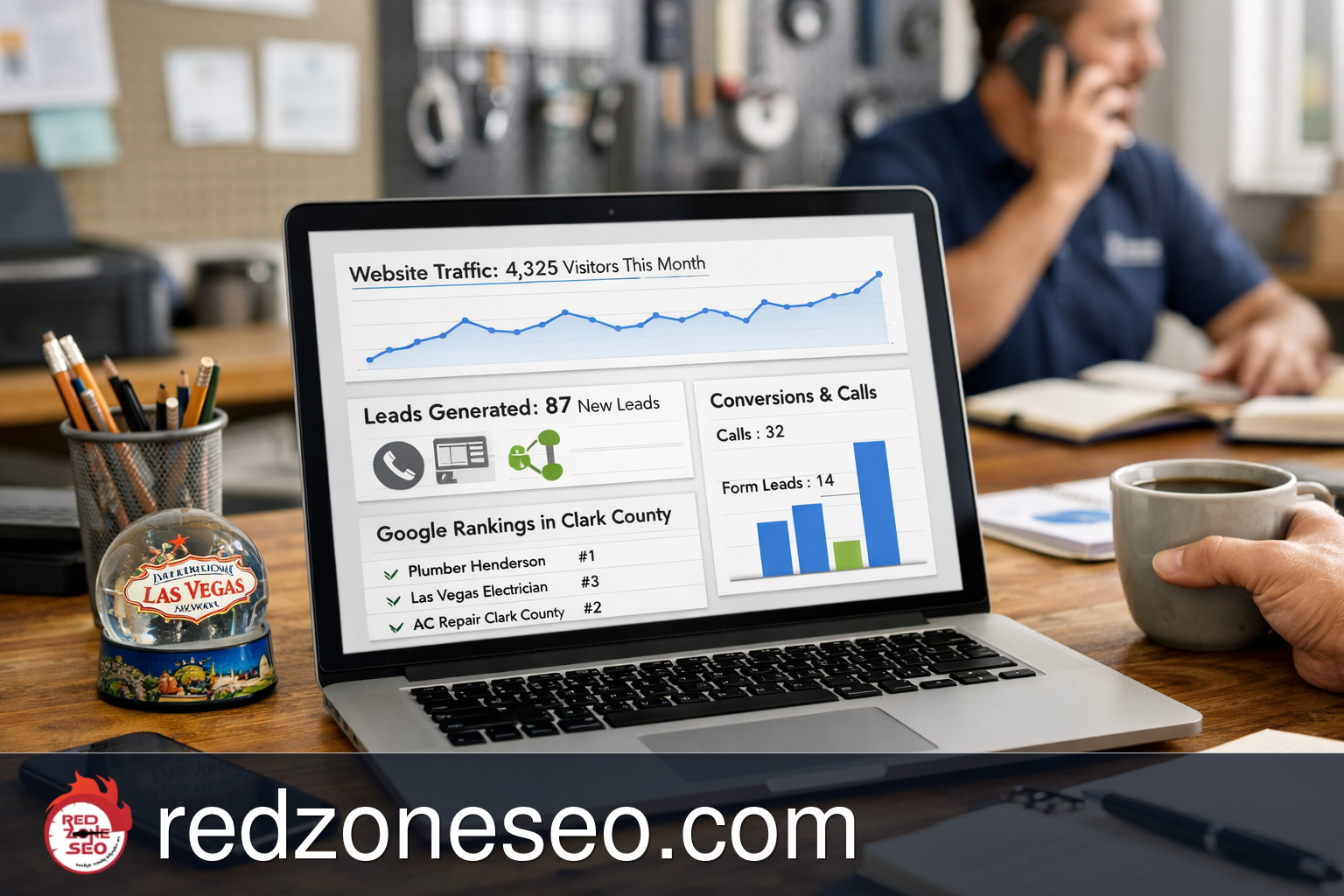
If you are paying for SEO every month, your reporting should answer one practical question: is this work creating real business progress?
That is where many small businesses in Las Vegas, Henderson, and across Clark County get frustrated. They receive dashboards, ranking screenshots, and traffic graphs, but they still cannot tell what matters, what is noise, and what should happen next. Good monthly SEO reporting metrics should make decisions easier, not harder.
This FAQ-style guide explains which numbers deserve your attention, which vanity metrics can mislead you, and how to tell whether your current reporting reflects meaningful progress in Search Engine Optimization (SEO) in Clark County. The goal is simple: help you read your reports with more confidence and know when it makes sense to ask for a direct review.
For a small business, monthly SEO reporting is not about collecting more data. It is about knowing whether the work being done is helping the business grow. If you run a local service company, law office, dental practice, contractor business, retail shop, or WordPress-based site in Clark County, your reporting should show whether your SEO investment is moving you closer to more qualified traffic, more calls, more form submissions, and more booked work.
Without useful reporting, it becomes hard to tell:
This matters even more for businesses trying to keep SEO affordable. If your budget is limited, every month of work should connect to a result or at least to a clear next-step priority. That is one reason business owners often compare ongoing SEO with one-time SEO work. If you are thinking through that decision, read One-Time SEO Fixes vs Monthly SEO Retainers: Which Costs Less Long Term?, because reporting expectations are very different between those two models.
Monthly reporting also creates accountability. SEO does take time, but that does not mean you should wait for months with no clear explanation of what changed. A useful report should show what improved, what stalled, what likely caused it, and what action should happen next.
Search behavior in Clark County is local, competitive, and often mobile. A Henderson business may be trying to rank for service terms in its immediate area, while a Las Vegas company may be fighting for visibility in a much larger, more competitive search environment. A report that only shows broad site numbers can hide whether you are actually gaining visibility in the places that matter.
For example:
That is why plain-language reporting, local examples, realistic expectations, and affordable decision-making all matter. Trustworthy SEO reporting should help an owner understand the numbers without needing an enterprise analytics background.
When people ask about the most important monthly SEO reporting metrics, the best answer is not one number. It is a connected set of numbers that tell a business story. For most small businesses, the core numbers are:
Everything else should support those four.
Organic traffic means visits from unpaid search results. But raw traffic totals do not tell you enough. A useful report should separate more traffic from better traffic.

For example, a Henderson plumber does not just need more sessions. That business needs visits from people searching for plumbing help in Henderson, Las Vegas, or nearby service areas in Clark County. A good report should show:
This is where organic traffic and conversions must be looked at together. If traffic grows but it lands mostly on low-intent blog content and never reaches a contact form, service page, or call action, that may not reflect meaningful business growth.
Rankings still matter, but they need context. Your report should track keyword movement for terms that match your business goals, not just a random list of phrases that make the report look busy.
Useful ranking reporting often includes:
For a Clark County business, local intent usually matters more than broad national visibility. Ranking for “roof repair Henderson” or “SEO company Las Vegas” is generally more meaningful than ranking for a generic national phrase that does not produce local leads.
This is where the difference between keyword rankings vs leads becomes important. If rankings improve but calls and form fills stay flat, something may be wrong. That can mean:
If your business depends heavily on nearby customers, it is also worth reading Local SEO vs. Traditional SEO: What Las Vegas Businesses Should Focus On so you can tell whether your reporting should lean more toward map visibility, service-area performance, or broader organic growth.
This is where many seo reports for small business either become useful or fall apart. If your monthly report does not clearly show conversions, it is incomplete.
Depending on the business, conversions may include:
Not every small business has perfect tracking in place. That is normal, especially on older WordPress sites. But a strong monthly report should at least explain what is being measured, what is missing, and what needs to be fixed. That is a major part of WordPress SEO reporting, because form tracking, thank-you pages, click-to-call tracking, and plugin settings are often inconsistent on WordPress sites that have been updated over time by multiple vendors.
A useful report should show which pages are helping the campaign and which ones need work. This connects SEO to actual site performance.
Important page-level indicators include:

This kind of SEO KPI tracking for small businesses is practical because it leads directly to decisions. If a Las Vegas service page is getting impressions but few clicks, title tag and meta description updates may help. If the page gets clicks but no leads, the problem may be the page content, the offer, the call path, or the way local trust signals are presented.
For businesses targeting Las Vegas, Henderson, or the wider Clark County area, local visibility deserves its own section in the report. Good local SEO reporting metrics often include:
For many local companies, map visibility influences phone calls faster than broader organic growth. That is why local metrics should not be mixed into a generic SEO report and left unexplained. Local performance should be tracked separately and tied back to real business outcomes.
Some metrics look impressive on a chart but do not tell you enough by themselves. This is where business owners can get pulled into vanity reporting.
Impressions show how often your site appeared in search results. They can be helpful, especially as an early signal of increased visibility, but impressions alone do not mean traffic, leads, or revenue growth.
If impressions rise, ask:
A page can gain thousands of impressions from low-intent searches and still produce no business value. That is why impressions and clicks need context, not celebration on their own.
Clicks matter more than impressions, but they are still not the finish line. A page can attract more visitors because it ranks for educational searches that do not match your service area or buying stage.
For example, a Clark County HVAC company may get more blog traffic from a general maintenance article. That can be useful if it supports the funnel and introduces new prospects to the business. But it should not be presented as equivalent to growth in leads from high-intent searches like “AC repair Henderson” or “emergency HVAC Las Vegas.”
A long keyword list can make a report look active. But if the agency is not tying ranking changes to leads, important pages, or business outcomes, the report is missing the point.
Ranking movement should help answer:
If your report stops at rankings, it is not enough.
SEO tools often show site health percentages, warning counts, and technical scores. Those numbers can be useful for an SEO team internally, but they should not dominate a small business report unless they are tied to actual performance or risk.

A useful explanation sounds like this: “We fixed indexing issues on your Henderson service pages so Google can crawl and understand them more clearly.”
A weak explanation sounds like this: “Your site health score improved from 82 to 91.” That may be true, but by itself it does not tell the owner what changed or why it matters.
Links matter in SEO, but simply reporting “more backlinks” can be misleading. Small businesses should care more about relevance, quality, and whether authority-building work supports their actual service market.
If link reporting is included, it should answer questions like:
Quantity-only link reporting is often just noise.
Small businesses in Clark County should read monthly reports through a local lens. Search behavior in Las Vegas and Henderson can differ by service area, neighborhood coverage, urgency of the service, and mobile intent. That means your report should not only show that numbers moved. It should show whether they moved in the places and search categories that matter to your business.
If you serve specific cities, zip codes, or neighborhoods, your report should reflect that. A useful report should show whether your visibility is improving in the locations you actually want leads from.
Examples:
One month can be noisy. Search volume changes, seasonality, local events, competitor moves, and Google updates can all affect short-term numbers. That is why monthly reporting should compare current results to the prior month and also look at broader trends when needed.
Ask:
Realistic timelines matter here. SEO often shows leading indicators before it shows strong lead growth. You may first see better indexing, more impressions, improved average positions, and stronger click volume before consistent conversion growth appears. That does not mean the campaign is failing. It means the report should explain where you are in the process.
Reports should lead to decisions. In most cases, monthly reporting should produce action items such as:

If month after month passes with no recommended next steps, that is a warning sign. SEO Maintenance and Performance Tracking should be active, not passive.
If you are wondering what to include in monthly SEO reporting, the answer is not “everything.” The right report should be complete enough to guide decisions and simple enough to understand. For most small businesses, it should include the following:
The first section should answer:
If the report starts with technical jargon and no business explanation, it is harder for the owner to use.
Data from Google Search Console can help explain:
Google Search Central documentation is useful for definitions, but your SEO provider should translate performance data into plain English for your business.
This section should focus on issues that matter, not every minor warning from a scanning tool. Important examples include:
This is especially important in WordPress SEO reporting, since many small business sites in Las Vegas and Henderson are built on WordPress and often collect technical issues over time.
A useful report should show what was actually done during the month and what comes next. This helps owners connect the monthly fee to real work and clear priorities. If you want to compare scopes before signing with any provider, What Should Be Included in an SEO Proposal Before You Sign? is a useful companion article.
The simplest test is whether the report helps you make a business decision. If it does not, the reporting may be too shallow, too vague, or too focused on vanity metrics.
If you are not sure whether the reporting is strong enough, ask these questions:
If you are also comparing providers or trying to understand how affordable campaigns are typically structured, read How Henderson SEO Companies Structure Monthly Work for Affordable Campaigns. It helps explain what monthly work should look like beyond the report itself.

For most small businesses, the most important monthly SEO reporting metrics are qualified organic traffic, keyword visibility for high-intent searches, leads, and conversions. Those four show whether you are becoming easier to find, attracting the right visitors, and turning visibility into business opportunities.
No. Rankings are useful, but they are not enough by themselves. A keyword can move up and still produce no business value if the term is low intent, the page is weak, or conversion tracking is missing. Rankings should always be reviewed alongside traffic quality and conversions.
That depends on competition, site condition, local market strength, and campaign scope. Many businesses first see early signals such as improved indexing, more impressions, better keyword positions, and stronger click growth before they see steady lead growth. Meaningful business progress is usually easier to judge over several months than in a single report. A trustworthy provider should set realistic expectations instead of promising instant results.
A local business should expect to see reporting that reflects the local market: service + city keyword visibility, Google Business Profile performance, local landing page results, qualified organic traffic, and conversions such as calls or form fills. If the campaign is local but the report has no clear local section, something important is missing.
It makes sense when your report feels busy but unclear, when rankings improve without lead growth, when call or form tracking is incomplete, when you do not know whether your current SEO spend is justified, or when you suspect the wrong KPIs are being emphasized.
If your current SEO reports leave you with more questions than answers, that is a sign to get a second set of eyes on them. You should not have to guess whether the right KPIs are being tracked for your type of business, your service area, or your website setup.
Red Zone SEO works with small businesses in Las Vegas, Henderson, and across Clark County, and that matters here because local reporting should look different depending on the market, service type, and site structure. A WordPress service business, a local professional office, and a multi-city contractor should not all be judged by the exact same monthly dashboard.
If you are unsure whether your current reports reflect real progress, ask Red Zone SEO for a direct review of what should actually be tracked for your business. That review can help clarify:
If you want another helpful comparison before that conversation, Local SEO vs. Traditional SEO: What Las Vegas Businesses Should Focus On can help you see whether your reporting should lean more local, more traditional, or a mix of both.
The best monthly SEO reporting metrics are not the ones that look most impressive on a graph. They are the ones that help a small business owner understand whether SEO is producing better visibility, better traffic, and better opportunities to win business.
In most cases, that means focusing on qualified traffic, rankings in the right search categories, leads, conversions, and the action items those numbers should drive next. It also means separating vanity metrics from business metrics, keeping local intent in view, and being realistic about timelines.
If you look at your current reports and still cannot tell whether they reflect meaningful progress, ask a direct question: are we tracking the numbers that actually matter for this business in this market? If you want a straight answer on what should be measured for your site, your goals, and your Clark County audience, you can reach Red Zone SEO at https://redzoneseo.com/contact and ask for a direct review of what your SEO reporting should include.