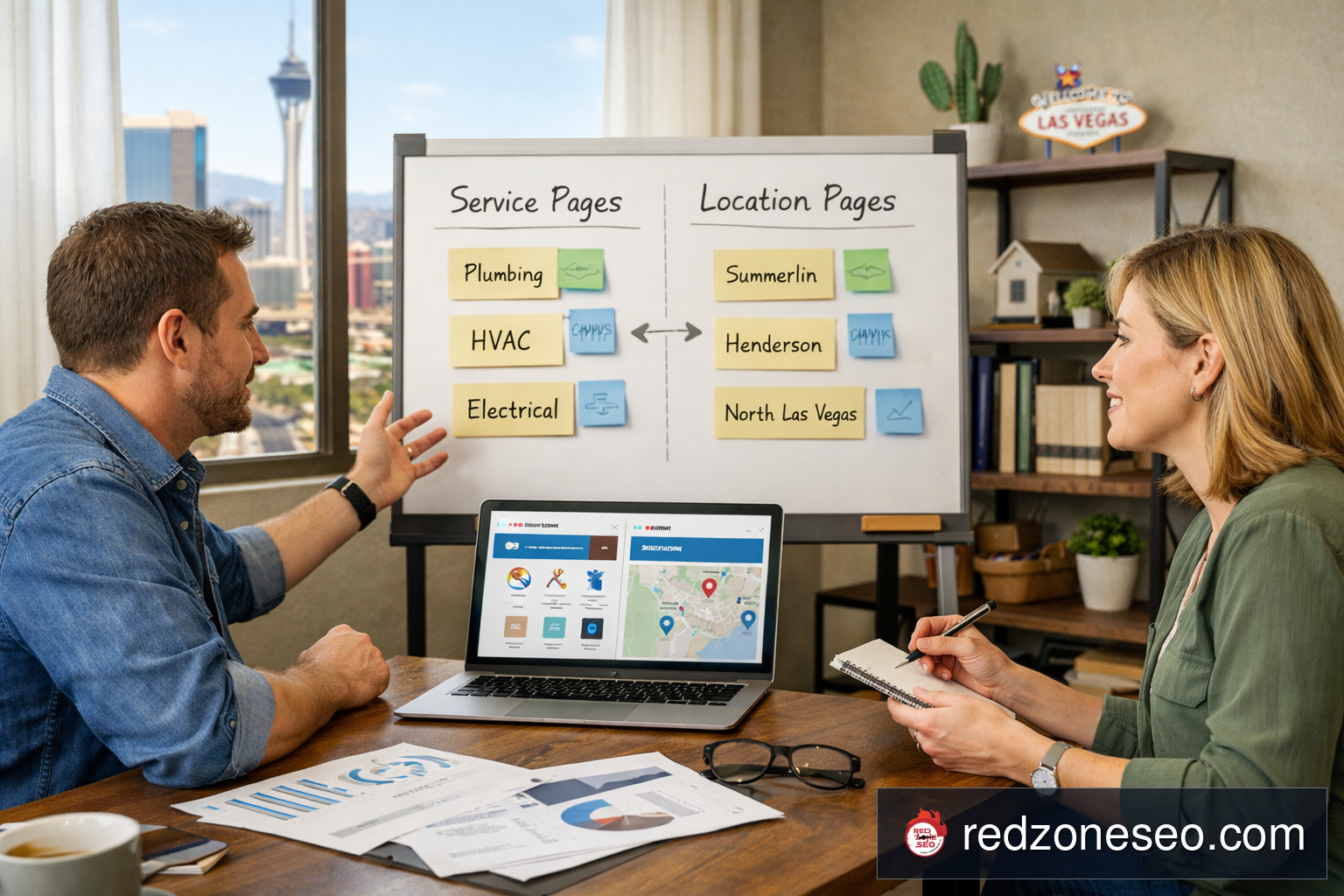
One of the most common page-structure problems in a las vegas local seo strategy is simple to describe but easy to get wrong: a business offers several services, serves multiple parts of the valley, and is not sure whether to build more service pages, more city pages, or both.
For many small businesses in Las Vegas, Henderson, and across Clark County, the wrong move is not doing too little. It is building too many pages that say almost the same thing. That often leads to thin content, weaker relevance, confused visitors, and local pages that do not clearly match what people are actually searching for.
This guide explains how to decide when distinct services deserve separate pages, when more location pages are unnecessary, and how to avoid a site structure that creates more confusion than visibility.
When a business asks, “Should I create separate pages for each service or more pages for each area I serve?” the real question is usually this:
What are people searching for first: the service itself, or the location variation of the same service?
That is the core difference between service intent and location intent.
Service intent means the searcher is focused on what they need. Examples include searches like “website seo help,” “wordpress seo services,” “content marketing,” or a business owner looking for affordable guidance on local visibility. In local markets, people may still add a city, but the service type is doing most of the work.
Location intent means the searcher is primarily trying to find a provider in a certain place. Searches like “seo services henderson” or “henderson seo services” show that city-modified intent can matter. But that does not automatically mean every business needs a separate page for every neighborhood, zip code, or nearby area.
For many Las Vegas small businesses, the bigger structural gap is not geographic coverage. It is service-type coverage.
If your website has one broad page trying to rank for everything you do, but your services are meaningfully different, that page may be too vague to rank well or convert well. On the other hand, if your site already has one strong service page and you keep cloning it into “Summerlin,” “Enterprise,” “Spring Valley,” and “Paradise” versions without meaningful differences, that often creates thin local SEO content.
A practical local seo site structure las vegas decision starts with this question: are you expanding by service, or just relabeling the same service by area?
This happens all the time. A business starts offering more than one thing, but instead of building clear service pages, it builds more local pages.
For example, imagine a business that offers:
If all of that sits on one generic “digital marketing Las Vegas” page, the page may be trying to do too much. Creating five more pages like “digital marketing Henderson,” “digital marketing Clark County,” and similar variations does not fix the underlying problem. It just spreads the same unclear message across more URLs.

The better move may be separate service pages that explain what each service is for, who it fits, what problems it solves, and what a buyer should do next.
If you want more background on broader local visibility priorities, see Local SEO vs. Traditional SEO for Las Vegas businesses.
Many businesses assume local SEO means producing as many city or neighborhood pages as possible. That is not how a strong las vegas service area business seo plan usually works.
More pages only help when those pages serve a clear user purpose and provide genuinely different information. If they do not, they can weaken the site instead of helping it.
Thin local pages often share the same structure:
That is where the location pages vs service pages decision becomes important. If the page is really about the service, the service should usually be the main page. The city can be included naturally in the title, headings, copy, internal linking, and overall local signals when appropriate.
Google’s local and search quality guidance consistently points toward relevance, clarity, and helpful content rather than mass-produced doorway-style pages. A page should exist because it helps the user, not because it gives you another place to swap a city name.
Las Vegas businesses often serve overlapping areas. Someone in Henderson may search for a provider in Las Vegas. Someone in Las Vegas may be open to a provider serving all of Clark County. That means local intent is real, but the boundaries are not always strict.
If your site creates a page for every nearby area without enough differentiation, several problems can follow:
This is especially important for businesses with one physical location or one primary service area. Separate local pages are not automatically bad, but they need a reason to exist beyond “we also serve there.”
For a related breakdown, read Local SEO for Las Vegas service businesses and when to skip neighborhood pages.
If your business offers truly different services, separate pages usually make sense. This is one of the most practical upgrades in separate service pages local seo.
Create separate pages when people searching for service A are not really looking for service B.
For example:

Each of those pages can target a different problem, different search phrasing, and a different conversion conversation.
If two services need different examples, deliverables, timelines, or expectations, they probably deserve their own pages.
Take these examples:
Those are not just minor variations. They are distinct service conversations.
A common local SEO problem is the overloaded “services” page that includes:
That kind of page often becomes broad, repetitive, and weak at conversion. It does not give search engines a clear relevance signal, and it does not give buyers a clean path to the right next step.
Separate service pages can improve both. They let you explain each offer clearly and match the page more closely to the search.
This is the decision point many small businesses care about most. You do not need a separate page for every slight wording change. But you also should not force very different services onto one page just to keep the site small.
Two services are different enough for separate pages if most of the following are true:
If only the wording changes, but the service itself is basically the same, separate pages may not be necessary.
Different enough:
Probably not different enough:
There are real city-modified searches in the market, including phrases like “henderson seo services” and “seo services henderson.” That tells you location-modified intent exists. But it does not mean your site needs dozens of thin pages to chase every phrase.
A better approach is to ask:

If the answer is no, expand the service page instead of multiplying near-duplicates.
Yes. A business does not need multiple physical locations for separate service pages to help.
That is because service pages support relevance around what you do, not just where you are. One physical location can still support multiple clear service pages if the services are truly distinct and the content is useful.
This is one reason google business profile service pages matter indirectly. Your Google Business Profile may help people discover you locally, but your website still has to explain the actual service clearly once the visitor lands there.
When page structure goes wrong, the pattern is usually predictable.
Some sites have pages for Las Vegas, Henderson, Summerlin, and Clark County, but only one vague service page. That often means the site is emphasizing geography before clarity.
If the service itself is unclear, more local pages rarely solve the problem.
Not every phrase deserves its own URL. Many keyword variations should be handled inside one strong page rather than split into several weak ones.
This is where businesses overdo wordpress local seo pages or location targeting. WordPress makes page creation easy, but easy publishing can lead to unnecessary page sprawl.
This is one of the most common errors in local seo for small businesses las vegas. The pages may technically be different URLs, but to users and search engines they add little value.
Warning signs include:
A page that mentions SEO, local SEO, content marketing, WordPress help, and internet marketing in a few short paragraphs may feel efficient, but it often creates weak topical focus.
That makes it harder to rank and harder to convert. Buyers want to know they found the right page for their exact need.

Separate pages can improve relevance and lead quality, but they are not instant ranking buttons. A better structure helps only when the content is useful, the site is technically sound, internal linking supports it, and the business can compete on quality.
That is why it helps to review related guidance like FAQ on how Las Vegas businesses can improve local SEO rankings and Common local SEO mistakes Las Vegas businesses should avoid.
A cleaner structure does more than organize the site. It can improve relevance, usability, and conversion quality.
When each major service has its own page, search engines get a clearer signal about what each page should rank for. That does not guarantee rankings, but it does reduce ambiguity.
A focused local SEO page is usually more relevant for local SEO searches than a broad digital marketing page that only mentions local SEO once.
Visitors make decisions fast. If they land on a page and cannot tell whether you handle their specific issue, they leave.
Separate service pages help them self-sort. Someone looking for WordPress SEO help can land on a WordPress-specific page. Someone trying to improve map visibility can land on a local SEO page. That improves conversion clarity.
Once your main services have clear pages, supporting blog content can reinforce them naturally. That is a stronger long-term structure than pushing all authority into a generic services page and hoping it ranks for everything.
For example, an article about page structure, service intent, or local visibility can link directly into the most relevant service page instead of a catch-all page.
Rankings matter, but lead quality matters more. If a cleaner structure helps the right visitors land on the right page, the business gets better conversations.
That can mean fewer vague inquiries and more prospects who already understand the service they need. For small businesses on a limited budget, that matters. It saves time and makes marketing decisions easier.
If your site needs more coverage, expand in this order:
This approach usually works better than building location pages first and trying to force service clarity into them later.
Some page-structure decisions are straightforward. Others are not.

You may want outside help if:
This is especially true when the business wants affordable guidance, not a bloated rebuild. Often the right answer is not “add twenty pages.” It is “fix the few pages that should exist, and stop creating overlap.”
Ask whether they solve different problems, attract different searches, and require different explanations. If the buyer questions, deliverables, and intent differ, separate pages usually make sense. If the content would be nearly identical except for wording, keep them together.
Because they often create thin or repetitive content, split relevance across similar URLs, and confuse both users and search engines. In Las Vegas-area markets, businesses commonly serve overlapping areas, so cloning the same page into many nearby locations often adds little value.
No. A service-area business should only build local pages when there is a clear reason for that page to exist and enough unique value to justify it. Otherwise, stronger service pages with clear area coverage are often the better move.
Yes. Separate service pages can improve relevance around what the business offers, even with one location. Local SEO is not only about addresses. It is also about matching user intent with clear, useful service content.
Start by listing your actual service categories and identifying which ones are truly distinct. Then decide which deserve their own pages based on search intent, service differences, and conversion clarity. After that, improve internal linking and review whether any current city pages are unnecessary or overlapping.
If you are stuck between building more city pages or creating separate service pages for local SEO, the most useful next step is to get a plain-English opinion on your current structure before you add anything else.
For many companies doing local SEO for small businesses Las Vegas, the real issue is not a lack of pages. It is a mismatch between service intent and location intent. A Las Vegas plumber who offers drain cleaning, water heater repair, and leak detection may need separate service pages because those searches mean different things. A service-area business that already has one Las Vegas page and one Henderson page usually does not need dozens of near-duplicate neighborhood pages just to mention Summerlin, Green Valley, or Spring Valley. That is where thin content starts to pile up, and rankings and lead quality can both suffer.
If you want a practical answer, send Red Zone SEO the pages you already have and ask one specific question: which of these should be separate service pages, which should stay combined, and which local pages are probably not helping? That kind of review is often enough to clarify your local SEO site structure Las Vegas plan without wasting time rebuilding the wrong sections first.
A helpful review should look at whether your services are truly different enough to support their own page, whether your current google business profile service pages align with the searches you want, and whether your wordpress local seo pages are repeating the same message across too many URLs. It should also set realistic expectations: better structure can improve clarity, rankings, and conversion paths, but it will not magically rank every variation overnight.
If you want to compare your situation first, these related guides may help: Local SEO for Las Vegas service businesses and when to skip neighborhood pages, Common local SEO mistakes Las Vegas businesses should avoid, and FAQ on how Las Vegas businesses can improve local SEO rankings.
Still unsure? Contact Red Zone SEO for a page structure review with your main service list and current location pages, and ask for a direct recommendation on what to split, what to keep, and what to remove for a cleaner las vegas local seo strategy.