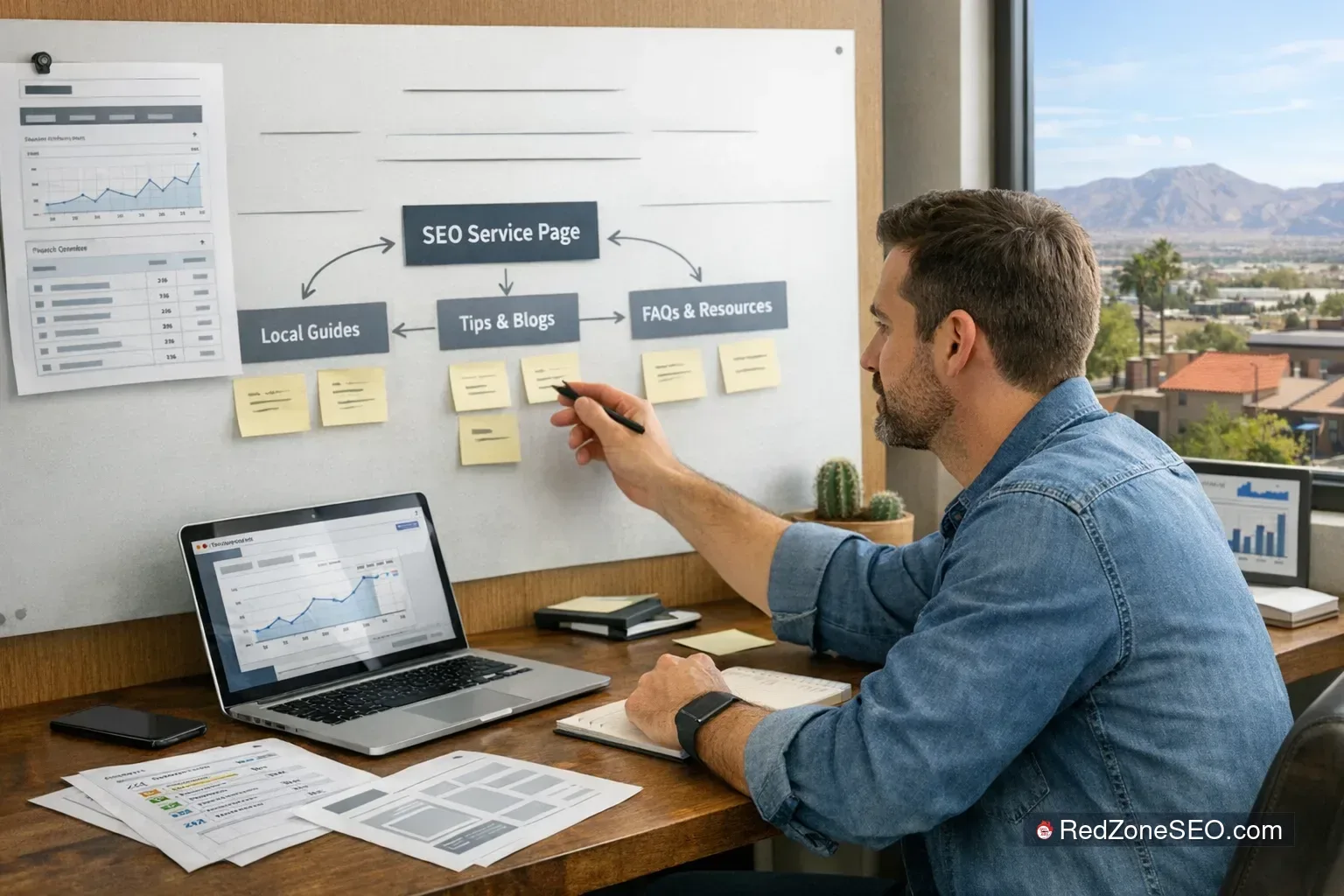
If you want a Henderson SEO service page to do more than sit on your site with a city name added to the headline, it usually needs support. That support should not be random blog posting. It should be planned content that answers nearby questions, covers related decision points, and links back to the main page in a way that helps both visibility and conversions.
This matters because a page targeting henderson seo services is often trying to rank for several valuable terms at once: seo henderson, henderson seo, henderson seo company, and search engine optimization henderson. In Google Search Console, those kinds of terms can show impressions before they show clicks. For example, demand cues like search engine optimization henderson with 62 impressions and 0 clicks, or henderson seo with 74 impressions and 0 clicks, often mean the page exists but is not yet strong enough, distinct enough, or helpful enough to earn action.
Below is a practical look at how supporting content should work around a Henderson service page, how to avoid keyword overlap, and how small businesses can build a content plan without wasting budget on articles that compete with the page they are supposed to help.
A service page has an important job, but it is a narrow job. It needs to explain the service, show who it is for, clarify the local relevance, and give the visitor a clear next step. That does not leave much room to answer every related question a buyer has.
For a page focused on henderson seo services, the visitor may also be wondering:
If you try to force all of that into one city service page, the result is usually bloated copy, weak structure, and confusing intent. The page stops being a focused service page and starts acting like a mixed-use article, FAQ, and sales page at the same time.
That is one reason many local pages stall. They are technically live, but they are not well supported. Search engines can crawl them, but they do not see a strong surrounding content structure that reinforces the topic. Users can land on them, but they may not get enough confidence to click through, call, or request a proposal.
Another issue is search behavior. A person searching search engine optimization henderson may not be ready to choose a provider immediately. They may still be comparing options, checking what should be included, or trying to understand whether they need a one-time fix or a monthly retainer. If your site only has the service page and none of the support content around those questions, you leave a gap in the decision path.
That is where content marketing for local SEO becomes practical, not theoretical. The purpose is not to flood the site with generic posts. The purpose is to create a page hierarchy where the main Henderson service page targets the core commercial term, while support articles answer adjacent questions that naturally lead readers back to that page.
This is also why a good henderson seo company should not recommend “just publish more blogs” without first mapping how each article supports the main page. Support content only helps when the roles are clear.
Think of the Henderson service page as the main destination page. It should target the broad service intent: someone looking for SEO help in Henderson. Supporting articles should target the surrounding questions and subtopics that show up before, during, or after that decision.
For example:
Each of those articles helps the main page do its job by covering a nearby question without trying to replace the main page.
Supporting articles should extend the topic, not duplicate it. That sounds simple, but this is where many local businesses lose traction.
A competing page tries to rank for the same core term, with the same intent, using nearly the same framing. A supporting page answers a related question from a different angle and then points the reader back to the service page when the service itself becomes the next logical step.
For a page targeting henderson seo services, good support articles often fall into a few categories.
These articles answer practical questions a business owner asks while evaluating SEO:
This content helps because it addresses hesitation and confusion. It also gives you natural internal linking opportunities back to the service page.
These are useful when the business owner already suspects something is wrong:
Problem posts work well because they match real search behavior. They also help qualify the reader. Someone reading a post like that is often much closer to needing actual help.
These articles help the reader judge whether an SEO plan makes sense:
On the Red Zone SEO site, these are already strong natural support pieces. For example, readers can learn more from What Should Be Included in an SEO Proposal Before You Sign?, compare options in One-Time SEO Fixes vs Monthly SEO Retainers, or review budget priorities in What Henderson SEO Services Should Small Businesses Prioritize First on a Limited Budget?.
This is where content marketing for local SEO becomes useful. The article should answer a question adjacent to the main service intent, such as:
These pieces help because they build topical support around the service page without rewriting the service page in article form.
Ask one question before publishing a support article: If this page ranked instead of the Henderson SEO service page, would that be a problem?
If the answer is yes, the article is probably too close to the commercial page.
For example, an article titled “Best Henderson SEO Services for Businesses” would likely compete. An article titled “How Supporting Content Improves a Henderson SEO Service Page Without Cannibalizing It” supports.
This distinction matters for timeline expectations too. Support content usually helps gradually. It can improve internal relevance, capture adjacent impressions, and move readers toward the service page, but it is not a shortcut that instantly forces a local page to rank. A realistic content strategy is cumulative.
The best support content ideas do not come from a random content calendar. They come from actual search behavior, page gaps, and sales questions.
If your Search Console data shows terms like:
that tells you there is at least some demand around the main topic. But support content should not just repeat those exact phrases in multiple new posts. Instead, use those terms to understand the broader intent cluster around the page.
Look for impressions with weak or zero clicks. Those often reveal topics where your site has partial relevance but not enough page support, stronger messaging, or better alignment. If henderson seo and search engine optimization henderson are showing impressions with no clicks, that can point to several needs:
What do prospects ask before they sign? Those questions are content opportunities. Common ones include:
Those are useful because they map to buying intent without turning into a generic blog.
Henderson is not just “Las Vegas with a different city name.” A content strategy for multi-location businesses should reflect the differences between service areas, page needs, and local intent. If a business serves both Las Vegas and Henderson, it should not automatically duplicate content across both markets.
A practical approach is to create support content that clarifies:
Here are the kinds of articles that can reinforce a main SEO page without colliding with it:
Notice that none of those directly replace the service page. They answer the surrounding questions.
If you want a broader look at how content fits into small-business SEO work, Red Zone SEO also covers content marketing for small businesses.
Most content mistakes are not dramatic. They are structural. A business keeps publishing, but the content does not support the pages that actually need help.
This is the biggest problem. If the main page targets henderson seo services, you do not need three more blog posts that all try to rank for “Henderson SEO services,” “SEO services in Henderson,” and “best SEO Henderson services.” That spreads relevance across multiple URLs and makes the site less clear.
Some businesses create one article for Las Vegas, then change the city name to Henderson and publish it again. That usually produces thin local relevance. Search engines and users both notice when the content is mostly a swap job.
If you serve Henderson, the content should include a real local reason for existing. That can mean unique questions, local service area concerns, different page priorities, or different conversion barriers.
An article that never links back to the Henderson service page is not really support content. It is just an isolated post.
Every support article should have a reason to point the reader back to the service page, and that link should feel earned. For example, after explaining how to diagnose a weak page, the article can point to the Henderson SEO service page or the next-step consultation page.

Some businesses publish informational content that gets reads but does not connect to a service decision. This is especially wasteful for small budgets.
Support content should not be all top-of-funnel awareness. It should also help with mid-funnel comparison and bottom-funnel decision support. That is where budget-conscious content performs better.
Content works best when the roles are planned first:
If you skip that hierarchy and just publish what sounds interesting, the site becomes difficult to interpret. Your strongest page may never receive the support it needs.
Support content is not a fast-ranking promise. It is a reinforcement system. Depending on the site’s age, crawl patterns, page quality, competition, and how well the content aligns with actual intent, it can take time for improvements to show up in impressions, clicks, and conversions.
That is why cost-conscious businesses should prioritize fewer, more intentional articles rather than publishing volume for its own sake.
Internal linking should be simple enough to maintain and specific enough to show clear page relationships.
Your Henderson SEO service page should be the central destination for the local commercial topic. Supporting articles should link into it from relevant sections using natural anchor text.
Examples of natural anchor patterns include:
You do not need to force the exact same anchor every time. Variation is normal as long as the destination remains clear.
The relationship should go both ways. The service page can include a short “Related resources” or “Helpful next reads” section that links to highly relevant support pieces. This helps users self-educate without leaving the topic cluster.
For example, a Henderson SEO page could naturally reference:
Those links support decision-making without distracting from the service itself.
A practical content structure for seo henderson does not require every article to link to every other article. That creates clutter. Instead, build small chains:
That is usually enough to create structure without confusion.
Internal links should appear right after a point where the reader naturally needs the next page. For example:
This is better than dropping a pile of links in a generic paragraph at the end.
Small businesses usually do not need a giant publishing schedule. They need the right pages in the right order.
A practical seo content strategy for small businesses often starts like this:
There is no universal number, but most small businesses do not need dozens to begin. A focused group of 3 to 6 strong support articles can do more than 20 weak ones if each article covers a different question and links back to the main page correctly.
For example, one cluster might include:
That already gives the Henderson service page meaningful reinforcement.
A supporting article targets a related question with a different intent. A competing page targets the same buyer action and the same core keyword as the service page.
If your main page is trying to convert readers looking for henderson seo services, a support article should not also be built to rank for that exact phrase as its primary target. It should target a nearby concern, such as cost, structure, prioritization, or content planning.
Usually not overnight. Support content can begin helping once it is indexed, linked, and crawled well, but meaningful improvement often takes time. You may first see signs like:
That timeline depends on the site’s baseline strength and how targeted the content is. A realistic provider should not promise a fast jump just because a few support articles were added.
Usually, fix the page enough that it deserves support. If the service page is thin, confusing, or missing a clear conversion path, supporting articles will have less impact. You do not always need a full redesign first, but you should make sure the service page has:
Then build the surrounding content.
Start by checking three things:
If Search Console shows impressions for terms like seo henderson, henderson seo services, or search engine optimization henderson but nobody clicks, that can mean your snippet is not compelling, your page is not differentiated, or the site lacks the support structure that helps Google trust the page as a strong destination.
A content review makes sense when you already have a Henderson page but are not sure what should be built around it next.
This is especially true if:
A useful review should look at real query patterns, current page roles, obvious overlap issues, and internal linking gaps. It should also be budget-aware. Small businesses do not need an inflated content plan. They need the next few moves that are most likely to support local growth.
That means reviewing:
If that is the stage you are at, the next step should feel straightforward. Ask for a practical review that focuses specifically on the Henderson service page, the support content it needs, and the gaps that are limiting performance now.
Yes, if it is mapped correctly. Some visitors are not ready to submit a form on the first page they land on. A support article can answer their concern, remove uncertainty, and move them back to the service page with more confidence.
No. Some should be city-specific if the question is local. Others can be broader if they still support the Henderson page and fit the site structure. The key is intent separation, not forcing the city name into every headline.
No. The same structure helps many local service businesses. The principle is the same: keep the main service page focused, use support content to answer nearby questions, and connect the pages with clear internal links.
Choose the article closest to the biggest decision gap. For many businesses, that is often a budget, proposal, or prioritization topic because those are the questions that stop people from taking the next step.
Check whether they rank for useful adjacent queries, whether they send readers to the service page, and whether they fit a clear page hierarchy. If they are isolated, repetitive, or targeting the same phrase as the main page, they may be doing less than you think.
A Henderson service page does not need random blog support. It needs the right supporting content in the right roles. The main page should target the commercial local intent. The articles around it should answer adjacent questions, avoid keyword overlap, create smart internal linking paths, and help the reader move toward a decision.
That is the difference between publishing content and building a content system.
If you want help figuring out what support content should be built around your Henderson page, what gaps exist now, and what the next local growth steps should be, request a practical review from Red Zone SEO. You can contact Red Zone SEO for a Henderson-focused content marketing and SEO review, or call (702) 489-0881 to ask for a proposal focused on supporting content for service pages, internal linking, and the most budget-conscious next moves for better local visibility.