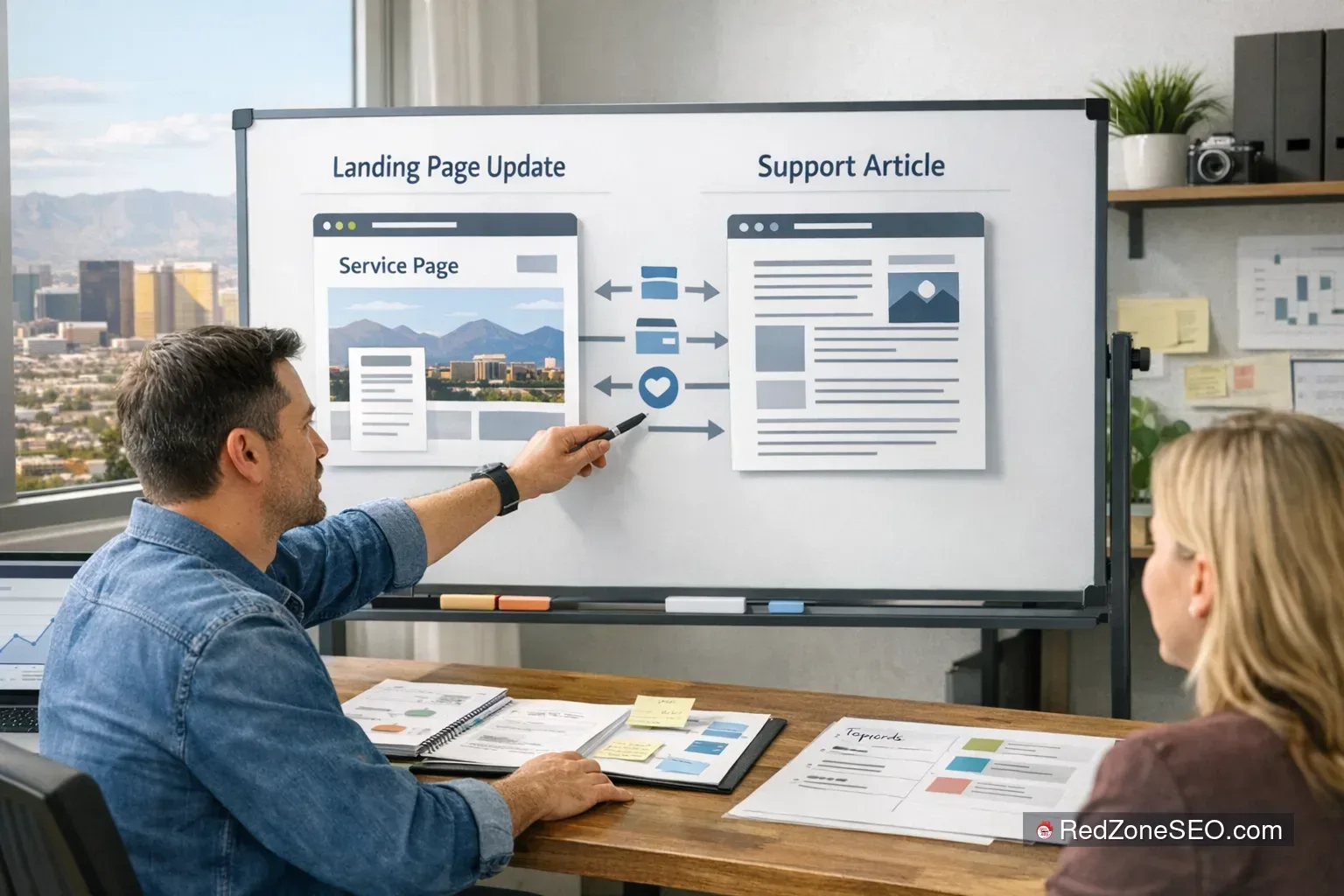
Deciding when to create a support article SEO teams can use without weakening a main page is one of the most common content planning questions for local businesses. If you run a company in Las Vegas, Henderson, or elsewhere in Clark County, you may already have a service page that ranks a little, converts a little, and feels like it is trying to do too much at once.
That is usually the real issue. A landing page has one job. A support article has another. When both jobs get forced onto one page, rankings can flatten, conversions can drop, and content becomes harder to manage over time.
This guide gives you a practical framework for deciding whether to expand an existing page, leave it alone, or publish a separate article that supports it. The goal is not to create more pages just to chase keywords. The goal is to match page intent, help users, improve internal linking, and support local growth in Clark County without creating a messy site structure.
For small businesses, content decisions are rarely just about writing. They affect rankings, lead quality, user experience, and budget. A page that tries to target every variation of a topic can become unfocused. A site that publishes separate articles for every minor keyword can become thin and hard to maintain. The right answer sits somewhere between those two extremes.
In practical terms, this is why the choice matters:
For example, a Clark County roofer might have a core service page for roof repair. That page should explain the service, areas served, signs of a roofing issue, and how to contact the company. But a separate article on “roof leak after monsoon storm in Henderson” might deserve its own article if it answers a narrow problem users actually search. That article can then link back to the roof repair page.
The same pattern works for legal, medical, home services, dental, auto, and B2B businesses across Las Vegas and Henderson. The challenge is not whether you can write more content. The challenge is whether the additional topic should strengthen the main landing page or live beside it as supporting content for local SEO.
Google Search Central guidance consistently emphasizes helpful, people-first content and clear site structure. In plain language, that means each page should have a clear reason to exist. If you cannot explain the difference between two pages in one sentence each, they are probably too close together.
Many local businesses build one service page and keep adding sections every time a new keyword idea appears. After a while, the page includes:
None of those topics are automatically bad. The problem is that they do not all serve the same search intent.
On the other side, some businesses publish too many small posts such as “best time to call a plumber Las Vegas,” “plumber near me advantages,” and “what does emergency plumbing mean in Clark County.” That creates thin content, clutter, and weak internal competition.
A practical Clark County SEO content strategy needs to avoid both extremes. It should give core pages enough depth to convert, while using support articles for topics that genuinely deserve their own search intent match.
If you want a simple rule, start here:
That is the heart of the support article vs landing page SEO decision.
A landing page should help a visitor quickly understand:
A strong landing page is usually built around commercial intent. That can be a service page, location page, or service-plus-location page, depending on the site structure.
Examples:
These pages should be focused. They can include supporting details, but every section should help the reader move closer to a decision.
A support article should answer a related informational question that is useful before, during, or after the buying decision. It may also target comparison intent or a narrow problem that does not belong in full on the main page.
Examples:
These are not service pages. They help a buyer think through a question. They can support trust and relevance, but they should not replace the main landing page.
Red Zone SEO already covers this type of content well in posts like what should be included in an SEO proposal before you sign and one-time SEO fixes vs monthly SEO retainers. Those topics are useful because they answer questions that matter to decision-making without trying to be the main service page themselves.
| Page Type | Main Purpose | Typical Search Intent | Primary CTA Role |
|---|---|---|---|
| Landing page | Convert service or location interest | Commercial | Consultation, quote, call, inquiry |
| Support article | Answer a question or comparison topic | Informational or mixed | Guide the reader to the relevant service page or consultation |
This distinction matters because page intent shapes everything else: title tag, headings, internal links, depth, calls to action, and how the page fits in the site structure.
For seo content planning for local businesses, the biggest clue is usually this question:
Is the user trying to hire someone now, or understand something first?
If the answer is “hire now,” improve the landing page. If the answer is “understand first,” a support article may be the better fit.
That does not mean every question needs a separate page. It means the page should match the dominant user need.
Not every content idea deserves a new page. Often the best answer is to strengthen what already exists. If you are wondering when to update a landing page, these are the clearest signals.
If the idea can be answered in a short, useful section without changing the page purpose, it probably belongs on the landing page.
Examples:
These are supporting details, not standalone intents.
If the variation still points toward hiring a provider, keep it close to the main page.
For example, “SEO audit services for small businesses” and “small business SEO audits in Las Vegas” may be different phrases, but they likely belong under one well-structured service page if the user intent is essentially the same.
Creating separate pages for every close variation often causes overlap instead of growth.
Sometimes a business thinks it needs more articles when the real problem is that the service page is too short, too generic, or missing key decision-making information.
Before creating new support content, ask whether the landing page already includes:
If not, expanding the landing page is usually the better first move.
Sometimes the added topic is too important to the buying decision to split away.
Example: if a potential SEO client always wants to know what an audit includes before scheduling a call, that summary belongs on the audit-related landing page. You can still publish a deeper article on the subject, but the core answer should remain visible on the main page.
This is where businesses over-split. They move essential buyer information into blog posts, then wonder why the service page does not convert well.
Do not create a new article just because a phrase looks different. If the intent is the same, a new page can create cannibalization rather than growth.
Bad examples of over-splitting:
Those are not three article ideas. They are usually one service intent.
If a page already earns visibility or traffic, improving structure may be more valuable than splitting it apart. This might involve:
Given that the Red Zone SEO homepage and SEO-related core pages already attract some landing activity, support content should reinforce those pages, not distract from them.

In the short term, yes, updating one page is often cheaper than creating a separate article. But “cheaper” only helps if the page still serves the right intent. If forcing everything onto one page makes it harder to rank or convert, the lower content cost can lead to weaker long-term performance.
That is the real tradeoff in content marketing strategy for service pages: lower immediate workload versus stronger long-term topic coverage.
Now the other side of the decision. A support article is worth publishing when it does a distinct job that the landing page should not try to do in full.
This is the clearest sign. If users are trying to understand, compare, or evaluate, a support article often makes more sense.
Examples:
These questions support sales, but they are not the core service page itself.
A good landing page should stay on track. If a narrow issue needs a detailed explanation, that is often better handled in a separate article.
Examples for local businesses:
Those are focused questions. They deserve focused answers.
If one article can support more than one landing page, that is a strong sign it should exist independently.
For example, an article on how to review an SEO proposal might support pages for audits, retainers, local SEO, and general search engine optimization. That makes it a strong support asset rather than a random blog post.
Support articles are useful when they meet people before they are ready to contact a provider. That is especially important for budget-conscious small businesses doing research before committing to monthly marketing work.
A service page should not become a giant research guide. A support article can handle that role and then link people toward the correct service page when they are ready.
Strong support content should not sit alone. It should connect naturally to the pages that matter most.
For example:
That is how supporting content for local SEO strengthens site architecture instead of creating clutter.
If a single landing page starts trying to cover:
then it is probably too broad for one page.
This answers a common FAQ directly: How do I know if a topic is too broad for a single landing page? Usually, the page is too broad when it serves more than one primary intent and would be clearer as a main service page plus one or more tightly related support articles.
For businesses in Clark County, some questions deserve a separate article because local nuance changes the answer.
Examples:
That local angle can make the article more useful and more relevant than a generic nationwide post.
Good intent matching is helpful. Bad splitting creates problems fast. Here are the mistakes local businesses make most often.
This is one of the biggest content planning errors. Businesses see multiple related phrases and assume each one needs a page. It usually does not.
That approach creates:
If the intent is the same, build one stronger page.
The opposite problem is just as common. A service page becomes so long and mixed that it stops feeling like a service page.
That can hurt conversions because users have to scroll through too much educational detail before they understand what to do next.
A service page can be detailed. It should not feel like six pages stacked together without structure.
If the answer is essential for conversion, keep at least a concise version on the landing page.
Examples of content that often belongs on the landing page in summary form:
You can still create deeper support content, but do not force readers to leave the page to understand the basics.
Support content is not an island. If it does not point users and search engines toward the main service or location pages, a lot of its value is wasted.
Every support article should answer:
If you cannot answer those questions, the article may not be strategic enough to publish yet.
For Clark County businesses, generic content often underperforms compared to content that reflects real local search behavior and local decision factors.
Local relevance does not mean stuffing city names everywhere. It means using examples and scenarios that fit the market. For example:
That is more useful than writing a generic article that could belong to any city in the country.
Every extra article needs future updates, internal link reviews, and quality control. If your team has limited bandwidth, fewer stronger pages usually beat a larger pile of weak ones.
This matters when business owners ask, Is it cheaper to keep updating one page instead of creating separate support articles? It can be, but only if one page can still handle the topic cleanly. If separate intent exists, forcing everything into one page may save money up front while reducing usefulness over time.
A support article should exist because users need it, not because the site needs “more blog content.” Good support content often falls into one of these buckets:
If the idea does not fit one of those buckets, think carefully before publishing it.
If you want a practical process, use this framework before assigning any new piece of content. It works well for small business sites, service companies, and multi-location businesses.
Ask: is this page supposed to convert, educate, compare, or troubleshoot?

Do not start with the keyword. Start with the page purpose.
Ask what the searcher likely wants:
If the intent is mostly commercial, improve the landing page. If the intent is mostly informational or comparative, consider a support article.
If a buyer needs the answer before contacting you, at least a concise version should appear on the landing page.
This is important because support articles should support conversions, not block them. The main page still needs enough information to stand on its own.
If yes, add it to the landing page. If not, and the answer requires a fuller explanation or a different structure, create a support article.
Examples:
Before creating a new article, ask whether you already have a page targeting nearly the same intent. If yes, update or consolidate instead of splitting.
This protects against cannibalization and keeps your site architecture cleaner.
A support article should usually have:
This is one reason a broader content marketing strategy for service pages matters. You are not just writing pages. You are building pathways between them.
Ask whether the answer changes based on Clark County geography, business model, or competition.
Examples:
If local context materially changes the answer, that can strengthen the case for a dedicated article.
Create or keep it on the landing page if:
Create a support article if:
Example 1: Local SEO service page
You have a page for local SEO services in Las Vegas and want to add “how long does local SEO take?” That likely belongs as a landing-page FAQ or short section because it is a common buyer question tied closely to the service.
Example 2: SEO pricing confusion
You want to explain why quotes differ across providers in Las Vegas and Henderson. That deserves a support article because it has comparison and buyer-education intent. It can then support audit and retainer pages.
Example 3: Multi-location structure question
You serve both Henderson and Las Vegas and want to target whether one agency should manage both markets. That is strong support-article material because it addresses a specific strategic question with broader implications.
Example 4: Narrow local issue
A Clark County business asks why one city page performs while another does not. That is not just a section on a generic SEO page. It is a distinct troubleshooting topic that can support multi-location SEO content.
Sometimes the page-vs-article decision is obvious. Other times it is not. A second opinion can help when the risk of choosing wrong is high.
This often means the page is attracting interest but not matching the user’s decision stage clearly enough. It may need better service-page structure, a stronger CTA flow, or support content that handles objections without overloading the main page.
If you already have several posts and pages touching the same topic, a review can help determine whether to:
This is especially common on older WordPress sites where content accumulated over time without a clear plan.
Multi-location businesses often struggle with how much to put on city pages versus support articles. If your company serves Las Vegas, Henderson, and broader Clark County, a second opinion can prevent duplicate city content and help you build pages with distinct roles.
For many small businesses, the bigger risk is not publishing too little. It is paying for content that does not fit the site well. If your budget is tight, content planning should be more selective, not less.
That is where a practical SEO review or proposal can be more useful than ordering random blog posts. If you are comparing provider approaches, it also helps to know what should be included in an SEO proposal before you sign.
Some businesses first need page consolidation, internal linking fixes, or service-page upgrades before they need more article production. Others benefit from ongoing support because the site already has strong landing pages and needs topic expansion around them.
If you are weighing those options, this related article on one-time SEO fixes vs monthly SEO retainers can help frame the tradeoff.
A topic is usually too broad when the page tries to serve multiple primary intents at once. If the page is half sales page, half educational guide, half comparison article, it is doing too much. A good test is this: if the page needs separate sections for service details, deep FAQs, troubleshooting, comparisons, and city-specific strategy, some of that content may need to become support articles.
Not if the roles are clear. A well-planned support article should reinforce the main page, not replace it. The risk comes when both pages target the same intent with slightly different wording. To avoid that, make sure the service page stays focused on commercial intent and the support article answers a distinct informational or comparison question. Then connect them with smart internal links.
Sometimes, yes. But cheaper is not always better if one page becomes overloaded and less effective. Updating one page makes sense when the new topic is a subpoint, FAQ, or closely related commercial variation. A separate support article makes sense when the topic has distinct intent, requires detail, or can support multiple related pages.
Topics that often deserve separate articles include:
These work well because they answer real decision-stage questions without bloating the landing pages.
Review the current page’s role, the user intent behind the new topic, and whether the answer is essential to conversion. Then map where internal links would go. If that still feels unclear, get a practical SEO review focused on page purpose and local growth rather than just ordering more content. For some businesses, that review matters as much as choosing from the best SEO companies in Clark County, because strategy mistakes at the planning stage can affect every page built afterward.
A strong local content plan usually has three layers:
These target the main commercial terms and should stay conversion-focused.
These answer the questions that come up before someone signs, calls, or requests a proposal.
Each support article should lead readers toward the most relevant next step, and each landing page should make space for links to deeper educational content when it helps the user make a decision.
That is the practical version of seo content planning for local businesses. It is not about publishing the most pages. It is about giving each page a clear role in the buying journey.
If you remember one thing from this article, make it this: do not decide based on keyword phrasing alone. Decide based on page purpose, user intent, and conversion role.
A landing page should stay focused on helping the right visitor take the next step. A support article should answer a real adjacent question in enough depth to be useful. When those roles are clear, your content works better for rankings, users, and long-term maintenance.
For businesses in Las Vegas, Henderson, and across Clark County, this decision is especially important because local SEO often depends on a clean page structure, strong internal linking, and content that reflects how people actually search and compare options in your market.
If you are unsure whether your current page should be expanded, split, or supported by a new article, Red Zone SEO can help you talk through which option fits your situation best. A practical review can look at page intent, overlap risk, internal links, and local growth goals so you do not spend money building the wrong content. To discuss your page plan for Las Vegas or Henderson, call (702) 489-0881 or contact Red Zone SEO to request a consultation focused on the right next move for your site.