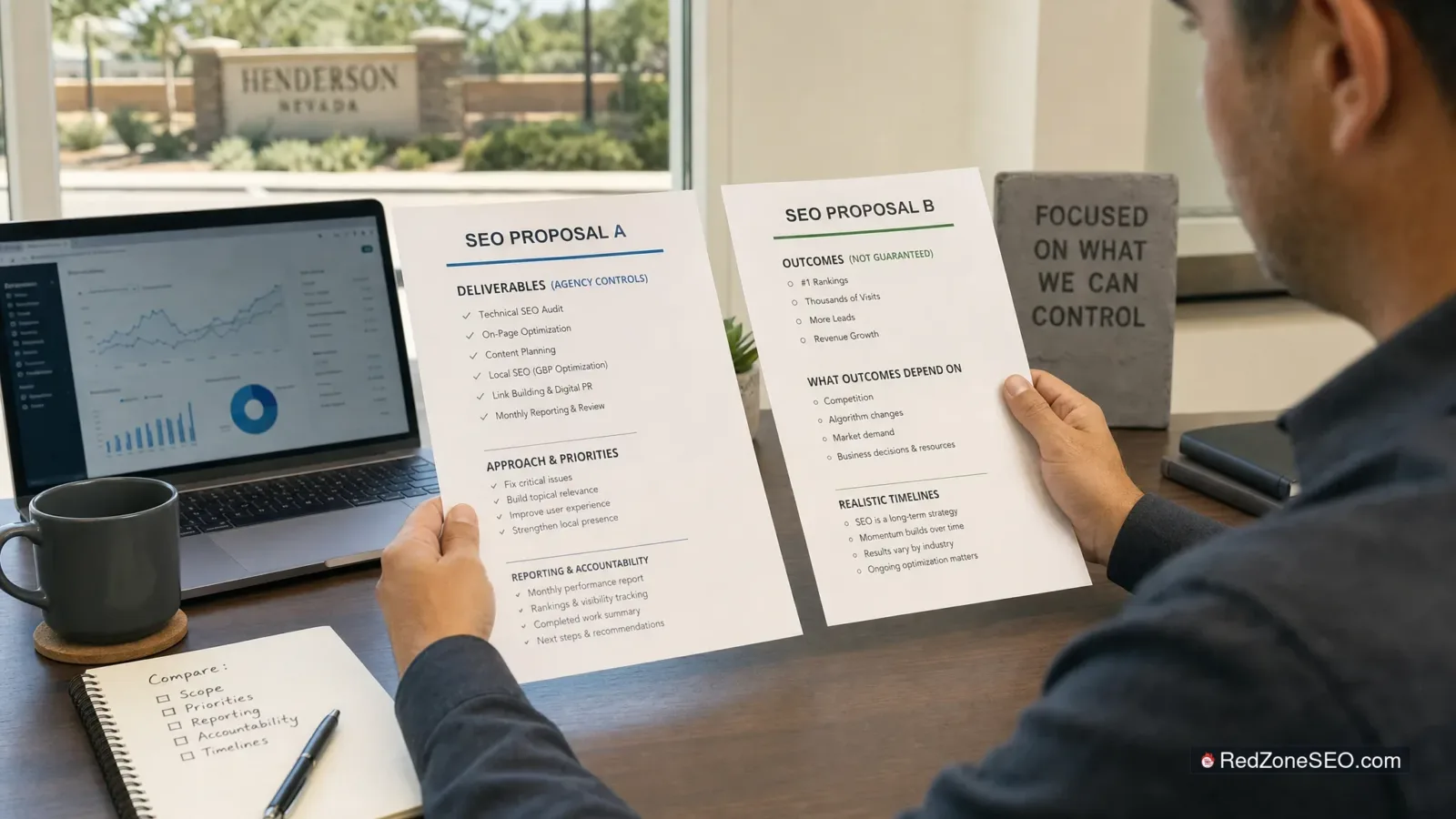
SEO Proposal Deliverables vs. Outcomes: How Henderson Businesses Can Compare Agency Promises
When you compare SEO proposals, it is easy to focus on the promised result: better rankings, more traffic, more calls, or more leads. Those goals matter, but they are not the same as the work an agency can actually control. A credible SEO proposal separates deliverables—the specific work the agency will perform—from outcomes—the business results the work is intended to influence.
For Henderson businesses competing across Las Vegas and Clark County, that distinction is important. Search visibility can be affected by competition, search demand, website history, review activity, business location, Google updates, and the choices of other companies in the market. An SEO agency can commit to a documented strategy, technical improvements, local optimization, content, reporting, and ongoing adjustments. It cannot honestly guarantee a specific ranking position, lead total, or revenue amount.
This guide explains how to compare SEO proposal deliverables vs. outcomes, what realistic SEO agency promises look like, and which questions can help you choose a campaign based on your goals, budget, and local competitive situation.
SEO Deliverables and SEO Outcomes Are Not the Same Thing
An SEO deliverable is a piece of work that can be planned, completed, reviewed, and reported. An outcome is a change in search performance or business activity that may follow from that work but is influenced by factors outside an agency’s direct control.
For example, a Henderson home service company may receive a proposal that includes a technical website audit, optimization of service pages, Google Business Profile recommendations, local content planning, link-building outreach, and monthly reporting. Those are deliverables. The agency can show what was found, what was changed, what content was published, what opportunities were pursued, and what data was reviewed.
“Rank number one for every Henderson service keyword in 30 days” is an outcome promise. It is not a reliable deliverable because no agency controls Google’s ranking systems, every competitor’s marketing activity, the wording of every search query, or the search results layout shown to each user.
That does not mean an agency should avoid performance discussions. A useful proposal should discuss the goals the campaign is designed to support. For example:
- Improve visibility for priority service and location searches.
- Correct technical problems that may prevent important pages from being crawled or understood.
- Create or improve pages that answer questions prospective customers search before contacting a business.
- Strengthen local business information and location relevance.
- Track organic visibility, qualified traffic signals, conversions, and important changes over time.
The difference is accountability. A professional proposal says what the agency will do, why those actions are prioritized, how progress will be measured, and what decisions may be needed along the way. It does not treat search rankings as though they can be purchased like a fixed inventory item.
A Simple Henderson Example
Imagine two proposals for a Henderson dental practice.
The first says: “We will get you on page one for dentist Henderson.”
The second says: “We will begin with a technical and local visibility review, evaluate existing service pages and location signals, identify content gaps, prioritize the highest-value fixes, optimize agreed-upon pages, monitor search performance and conversion tracking, and report completed work and next priorities monthly.”
The first proposal sounds more exciting, but it gives the business owner very little to evaluate. The second proposal gives the owner a scope, a process, and a basis for accountability. It can still include a discussion about the goal of becoming more competitive for relevant Henderson searches, but it does not make a promise that no agency can fully control.
If you want a broader checklist before comparing scopes, review what should be included in an SEO proposal before you sign.
What an SEO Agency Can Honestly Commit To
SEO agencies can and should make clear commitments about the work they will perform. The exact monthly SEO campaign scope should vary based on the condition of the website, the business model, the number of locations, the available budget, and the level of competition. Still, strong proposals usually identify tangible work categories and explain how they will be prioritized.
1. Discovery, Audits, and Strategic Planning
At the beginning of a campaign, an agency can commit to reviewing the current site, search landscape, business goals, existing analytics setup, local presence, and priority pages. An audit does not guarantee that every issue can or should be fixed immediately. It does provide a documented starting point.
A practical audit phase may address:
- Whether important pages can be crawled and indexed.
- Broken links, redirects, duplicate pages, and page organization.
- Mobile usability and site performance concerns.
- Title tags, headings, page intent, internal links, and structured data opportunities.
- Service page gaps, location page gaps, and weak content.
- Google Business Profile completeness and consistency of business information.
- Competitor visibility for relevant Henderson, Las Vegas, and Clark County searches.
- Conversion tracking or measurement gaps that make results hard to interpret.
A proposal should state whether this is a one-time initial audit, a recurring review, or both. It should also say whether the agency will implement fixes directly, send recommendations to your web developer, or use a combination of both.
2. Technical SEO Improvements
Technical SEO work is often less visible to a business owner than a new blog post or an updated page, but it can be important. An agency can commit to identifying and addressing agreed technical priorities. Examples include correcting broken internal links, improving redirect handling, resolving indexing problems, improving page metadata, or identifying duplicate content issues.
However, a proposal should not list “technical SEO” as a vague catch-all. Ask what it means in practical terms for your site. A new WordPress website with basic configuration problems may need different attention than an established multi-location site with hundreds of service-area pages.
For WordPress SEO, scope may also include review of plugins, XML sitemaps, page templates, and settings that affect search visibility. The agency should explain what it will configure, what requires developer access, and what may need approval before changes are made.
3. On-Page and Content Work
An agency can commit to optimizing identified priority pages, writing approved content, updating existing content, improving internal linking, and creating a content plan around real customer questions. These SEO proposal deliverables should be countable or otherwise clearly defined.
For example, instead of “we will optimize your website,” a clearer scope might identify:

- The number or type of priority pages reviewed during the initial phase.
- Whether service pages, location pages, category pages, or blog content are included.
- Whether copywriting, publishing, revisions, and client approvals are included.
- How local terms are used without creating thin or duplicated city pages.
- How pages will support customer questions at different stages of the buying process.
A Henderson business should not assume that adding the word “Henderson” to every page is a local SEO strategy. Search engines look for useful, relevant pages. Content should accurately explain the services, service area, expertise, process, and customer needs the business can address.
4. Local SEO and Business Profile Support
For businesses serving customers in Henderson, Las Vegas, or across Clark County, local SEO can be a meaningful part of the campaign. Deliverables may include a review of the Google Business Profile, category recommendations, service information improvements, local landing page recommendations, citation consistency work, review-response guidance, or local content planning.
Google’s own Google Business Profile Help materials make clear that profile information, reviews, and local business management are ongoing considerations. That does not mean profile work produces a guaranteed map-pack position. It means the profile should be accurate, complete, and aligned with the business’s real-world operations.
A credible proposal will also distinguish between a business with one verified Henderson location and a business that serves Henderson from another city. The appropriate local strategy may differ, especially when service-area rules, location pages, and market competition are involved.
5. Link Building and Authority Development
Link building can be part of an SEO campaign, but it requires careful explanation. An agency can commit to research, outreach, digital PR work, content promotion, relationship-building, and reporting on placements or opportunities. It should not promise a fixed ranking increase simply because links are included.
Ask whether the proposal explains:
- What type of links or mentions the agency will pursue.
- Whether outreach, content support, or placement fees are included or separate.
- How quality and relevance are evaluated.
- How acquired links will be reported.
- Whether the strategy avoids manipulative tactics that could create long-term risk.
The best scope is not necessarily the proposal that promises the largest number of links. It is the one that explains the approach and connects it to your website, market, and growth priorities.
6. Reporting, Meetings, and Decision Points
SEO reporting expectations should be stated clearly. Reporting is more useful when it explains what changed, what work was completed, what data is showing, and what should happen next. A spreadsheet full of keyword positions without context is rarely enough for a small business owner making budget decisions.
An agency can honestly commit to recurring reports and planned conversations that cover:
- Completed deliverables and work in progress.
- Technical issues found and resolved.
- Organic visibility and traffic trends in context.
- Priority keyword groups rather than only isolated rankings.
- Website calls, form submissions, appointments, or other tracked actions when tracking is available.
- Content performance and page-level opportunities.
- Local profile activity and review-related observations where relevant.
- Recommendations requiring business-owner approval or internal support.
Reporting does not guarantee good news every month. It does create a regular process for reviewing evidence and adjusting priorities.
What No Agency Can Guarantee in Search Results
Search results are influenced by many changing factors. Google explains in its How Google Search Works documentation that its systems evaluate many signals to return useful results. Competition, relevance, query intent, location, website quality, search-result features, and algorithm changes can all affect what a user sees.
Because of that, no agency can honestly guarantee:
- A permanent first-page or number-one ranking for a specific keyword.
- A particular map-pack placement.
- A fixed number of organic leads, calls, booked jobs, or sales.
- A specific traffic increase by a set date.
- That every page will be indexed or rank for every variation of a target phrase.
- That competitors will not improve their own sites, content, reviews, links, or local presence.
- That Google will not change the way results are displayed for an important search.
This is especially relevant in Southern Nevada. A business in Henderson may compete with companies physically located in Henderson, businesses in Las Vegas that serve Henderson, national brands, directories, marketplaces, and advertisers. The competitive set can also differ by service. A niche B2B service, a medical provider, a law firm, a contractor, and a restaurant do not face the same search landscape or decision cycle.
Goals Are Appropriate; Guarantees Are Not
A responsible agency should discuss goals. In fact, a campaign without goals is difficult to prioritize. The difference is in the wording and the evidence behind the plan.
Reasonable performance discussions may include questions such as:
- Which services have the strongest revenue or margin importance?
- Which locations matter most in the next six to twelve months?
- Which pages currently receive qualified organic visits?
- What types of calls, form requests, appointments, or quote requests count as meaningful conversions?
- Where are competitors more visible, and what appears to support their visibility?
- What improvements would make the site more useful for potential customers after they arrive?
The campaign can then be built to influence those goals. But the proposal should describe the work and the measurement framework rather than turning projections into promises.
Why “Guaranteed Results” Should Trigger More Questions
A guarantee can sound reassuring when business owners are trying to control marketing costs. Yet a guarantee without a documented strategy often hides an unclear scope. It may rely on narrowly selected, low-value keywords, short-term tactics, or conditions that make the promise difficult to evaluate.
If a proposal claims guaranteed results, ask:
- Which exact result is guaranteed, and how is it measured?
- Which search terms, locations, devices, and search-result types are included?
- What work will be performed to pursue that result?
- What happens if Google changes the results or the business’s market changes?
- Does the guarantee focus on a keyword that rarely produces qualified customers?
- Are there fees, required add-ons, long commitments, or exclusions not obvious in the headline promise?
Businesses should be cautious about marketing claims that cannot be supported. The Federal Trade Commission’s truth-in-advertising guidance is a useful general reminder that advertising claims should be truthful and supported. For SEO, a transparent scope and honest reporting are more valuable than a dramatic promise that lacks detail.
Deliverables vs. Outcomes: A Practical Comparison Table
Use the table below when reviewing a proposal. The left column contains work an agency can generally control and document. The right column contains results an agency may seek to influence but cannot guarantee.
| Controllable SEO Deliverables | Influenced but Uncontrollable SEO Outcomes |
|---|---|
| Complete an initial technical, content, and local SEO audit. | Immediate ranking gains after the audit is delivered. |
| Prioritize documented fixes based on business goals and site condition. | A specific ranking position for every target search. |
| Optimize agreed service, location, or category pages. | First-page visibility for all related keyword variations. |
| Write, edit, or publish content included in the approved scope. | A guaranteed amount of organic traffic from that content. |
| Improve internal links, titles, headings, structured data, and page clarity where appropriate. | How Google will weigh each change against competing pages. |
| Review and improve local business information and Google Business Profile elements where permitted. | A guaranteed placement in local map results. |
| Conduct link research, outreach, and report acquired placements or activities. | A fixed authority score, traffic gain, or ranking lift. |
| Set up or review conversion tracking and report available data. | A guaranteed number of calls, form submissions, or sales. |
| Provide monthly reporting, strategy updates, and next-step recommendations. | That every reporting period will show linear improvement. |
This comparison does not make outcomes irrelevant. Outcomes are the reason businesses invest in SEO. The point is to judge an agency on whether it has a sound, measurable plan for influencing those outcomes—not on whether it makes promises outside its control.
How to Read an SEO Proposal for Scope, Priorities, and Accountability
Two proposals may both say “SEO,” “content,” and “local optimization,” yet include very different levels of work. Reading beyond the headline price is essential. Before comparing proposals, write down what your business needs most: more visibility for a service, stronger local presence, support for a new Henderson location, better website conversion paths, recovery from technical problems, or a more consistent monthly marketing process.

Start With the Business Objective
A proposal should reflect your actual operating priorities. A single-location Henderson business may need a focused campaign around a small set of core services and local search opportunities. A multi-location company may need a clearer system for location pages, business profiles, local content, tracking, and avoiding duplicate or conflicting information across markets.
Ask whether the proposal connects its work to:
- Your most valuable services or product categories.
- The locations you can genuinely serve.
- Your current website condition and content gaps.
- Your sales process and what counts as a qualified inquiry.
- Your internal ability to approve content, provide subject-matter input, and implement recommendations.
A generic proposal may be less useful than a smaller, more focused scope that addresses the actual bottleneck.
Look for Defined Milestones
SEO work is ongoing, but that does not mean it should be unstructured. A practical plan defines milestones around audits, fixes, pages, reporting, and decisions. The exact sequence can vary, but a proposal should indicate how the campaign moves from diagnosis to implementation to refinement.
Common milestones may include:
- Initial review: Access is gathered, current performance is reviewed, major technical and local issues are identified, and priority services or locations are confirmed.
- Strategy and prioritization: The agency presents recommended actions based on impact, effort, dependencies, and business goals.
- Foundational implementation: Agreed technical fixes, tracking improvements, page updates, or profile improvements begin.
- Content and authority work: Priority pages are improved or created, internal linking develops, and outreach or promotional work begins where appropriate.
- Monthly analysis and adjustment: Completed work, search trends, conversion signals, competitive changes, and the next priorities are reviewed.
Milestones are not ranking deadlines. They are operating checkpoints. They help you determine whether the work is moving, whether approvals are holding up progress, and whether the plan needs to adjust.
Clarify What Is Included, Excluded, and Dependent on You
A strong SEO proposal makes boundaries visible. For example, content writing may be included but photography, web development, paid media, custom design, reputation management, or extensive platform changes may not be. There is nothing wrong with exclusions if they are clear.
Also ask about client responsibilities. SEO campaigns can slow down when a business cannot provide website access, approve content, verify location details, answer questions about services, or respond to recommendations. A transparent agency identifies those dependencies early instead of treating them as an afterthought.
Compare Scope Before Price
A lower monthly price can be a good fit if the scope matches your needs. It is not automatically a better value if it includes minimal work, generic reports, or broad promises without a plan. Similarly, a higher proposal is not automatically better simply because it lists more activities.
Compare the number, quality, and relevance of priority actions. For a useful perspective on why the same service can receive widely different quotes, read why SEO quotes vary for small businesses in Las Vegas and Henderson.
When you review costs, ask what the campaign is intended to accomplish first. If the website has major technical barriers, a heavy content schedule may not be the first priority. If the site is technically sound but has no useful pages for key services, content and on-page work may deserve more of the early budget. If a business operates multiple real locations, location architecture and local data management may need a more substantial scope.
SEO Proposal Red Flags Henderson Businesses Should Watch For
Not every short proposal is a problem, and not every detailed proposal is strong. Still, certain patterns should lead to follow-up questions before you commit to a monthly SEO campaign.
Ranking, Traffic, or Lead Guarantees Without a Method
“Guaranteed page-one rankings,” “guaranteed leads,” or “instant local dominance” are warning signs when the proposal does not explain the underlying strategy. A credible agency may identify goals and opportunities, but it should also identify the work required and the factors that may affect pace.
Vague Activity Lists
Terms such as “SEO maintenance,” “monthly optimization,” “citation work,” “content,” or “link building” need explanation. Ask for enough detail to understand what happens each month. You do not need every task pre-scripted forever, but you should know the categories of work, the intended priorities, and how completion will be reported.
Keyword Lists Without Business Relevance
A long list of keywords can look impressive, but it may include phrases with little connection to your services or customer intent. Some proposals focus on easy-to-rank terms that produce little value. Ask how the agency selected the keyword groups and whether the terms match the searches that could lead to qualified inquiries.
One Identical Plan for Every Business
Henderson SEO services should account for the specific business. A restaurant, property management company, contractor, medical office, retailer, and professional service firm have different local search needs. A multi-location business also has different challenges from a single-location company. If the proposal could be sent unchanged to every business in Clark County, it may not be sufficiently tailored.
No Discussion of Website Access, Approval Process, or Implementation
Recommendations alone do not always improve a website. Ask who will make changes, how approvals work, and how the agency will handle items requiring a developer or platform access. If that process is missing, execution may become slower and less accountable than expected.
Reports That Focus Only on Rankings
Rankings are one signal, but they are not the entire story. Search results vary by location, device, personalization, and result type. Better reporting combines visibility data with completed work, page performance, organic engagement, conversion tracking where available, and next-step recommendations.
Pressure to Choose Based Only on Price or a Limited-Time Promise
SEO is a business decision, not a rush purchase. A proposal should give you enough information to compare scope, process, communication, and fit. If you are deciding between a one-time cleanup and a continuing engagement, it may help to review one-time SEO fixes versus monthly SEO retainers before deciding what type of commitment fits your situation.
How to Choose a Campaign Based on Budget, Timeline, and Local Competition
The right SEO campaign is not always the largest scope or the lowest quote. It is the scope that addresses your most important needs within a budget you can sustain long enough to evaluate the work responsibly.
Set a Practical Budget Priority
If your budget is limited, ask the agency to identify the work that should come first and why. A focused campaign might begin with critical technical corrections, priority service-page improvements, local profile accuracy, and measurement setup before moving into a broader content or authority program.
Do not assume every SEO task must happen at once. A prioritized plan is often more realistic. The proposal should explain what is being deferred, what risk that creates, and when it may make sense to expand the scope.

Use a Timeline Based on Work and Evidence, Not a Ranking Deadline
Meaningful SEO progress does not follow a universal calendar. The timing depends on the site’s current condition, the amount of work required, how quickly changes can be implemented, the competitive landscape, and whether users are actually searching for the targeted services.
For many businesses, the earliest phase should produce visible operational progress: an audit, a prioritized plan, tracking review, completed fixes, improved pages, or documented local updates. Search performance may take longer to develop, and it may not move in a straight line. A practical agency should explain what can be reviewed in the early stages and which indicators deserve attention as the campaign matures.
For example, a Henderson business might initially monitor whether critical pages are properly indexed, whether priority page improvements are complete, whether search impressions are changing for relevant terms, whether organic users are reaching better-aligned pages, and whether tracked inquiries are becoming more meaningful. None of those signals alone guarantees future revenue, but together they provide a more informed picture than a single rank report.
Account for Henderson and Clark County Competition
Local competition changes both scope and pace. Henderson businesses may be competing not only with nearby companies but also with Las Vegas providers that have larger websites, longer marketing histories, more locations, stronger brand recognition, or more established review profiles. In some industries, search results also feature directories, map results, paid listings, and Google’s own result features before traditional organic pages appear.
That is why a campaign should begin with realistic market questions:
- Which services are most important to grow?
- Which areas can the business serve consistently?
- Which competitors own prominent local and organic visibility?
- Does the current site have pages that satisfy the search intent for priority services?
- Are there technical, content, local, or authority gaps that must be addressed first?
- What can the business provide to make the website more credible and useful to customers?
For multi-location businesses, the strategy should also avoid treating every city page as a copy-and-paste exercise. Each location needs accurate business information and useful, differentiated content that reflects the services and market it actually supports.
Choose a Partner That Explains Tradeoffs Clearly
Good SEO planning includes tradeoffs. A business may need to choose between a faster initial technical cleanup, a deeper content investment, improved local location coverage, or a longer-term authority-building effort. The agency should help you understand those choices without pretending every goal can be achieved immediately on a limited budget.
Red Zone SEO campaign services are designed around practical priorities, documented work, and ongoing adjustments rather than unsupported ranking promises. You can review Red Zone SEO campaign services to see how an organized SEO campaign can bring technical, content, local, and reporting work into one clear process.
Frequently Asked Questions About SEO Proposals
Can an SEO agency guarantee first-page rankings or a specific number of leads?
No agency can truthfully guarantee first-page rankings, a specific map placement, or a fixed number of leads from organic search. Rankings and lead volume are affected by Google’s systems, competition, search demand, user behavior, website conversion quality, reputation factors, and other variables outside an agency’s full control.
An agency can discuss goals, evaluate opportunities, and explain how its work is intended to improve visibility and qualified traffic. It should commit to the strategy, deliverables, reporting, and communication process—not to an outcome it cannot control.
What deliverables should be listed in a monthly SEO proposal?
The correct monthly SEO campaign scope depends on your needs, but a proposal should clearly identify the work categories included. Common deliverables include an initial audit, technical fixes or recommendations, on-page optimization, content planning or production, internal linking, local SEO work, Google Business Profile support, link-building activities where appropriate, conversion tracking review, monthly reporting, and strategy meetings.
Ask for clarity about quantities or priorities when it matters. For example, determine whether content writing is included, how many priority pages are in scope, whether the agency publishes changes, and how local SEO work will be documented.
How long should a Henderson business expect to wait for meaningful SEO progress?
There is no honest universal deadline. Early progress should often be visible in the form of completed audits, prioritized recommendations, implemented fixes, improved pages, tracking improvements, or local profile updates. Search performance can take longer and depends on your starting point, implementation speed, competitive pressure in Henderson and Las Vegas, and the quality of the overall strategy.
Ask the agency what it expects to complete in the initial phase, what indicators it will monitor, and how it will adjust if the data suggests a different priority. Be cautious if the answer is a guaranteed ranking date rather than a documented work plan.
How can I compare two SEO proposals when the scopes and prices are different?
Put the proposals into the same categories: audit and strategy, technical work, on-page optimization, content, local SEO, link building, tracking, reporting, communication, implementation, and exclusions. Then compare what each proposal says it will do, how it will prioritize the work, and how it will report completion.
Also compare the business fit. A lower-cost plan may make sense for a narrow cleanup project. A broader campaign may be appropriate if you need ongoing content, local optimization, and support across multiple locations. The key is to compare relevant scope and accountability before deciding based on price alone.
Is a cheaper SEO proposal a good value if it promises more results?
Not necessarily. A lower price can be a good value when the proposed work is focused, realistic, and appropriate for your needs. It becomes harder to evaluate when it pairs a vague scope with big promises about rankings, traffic, or leads.
Instead of asking which proposal promises the most, ask which one explains what will be done, why it matters, how progress will be measured, and what limitations or dependencies exist. That approach gives you a stronger basis for selecting an SEO partner.
Choose the Proposal You Can Actually Evaluate
The most useful SEO proposal is not the one with the boldest outcome claim. It is the one that shows a clear connection between your business goals, the work the agency will complete, the priorities for your market, and the reporting you will receive. For a Henderson or Clark County business, that means accounting for real local competition while keeping the campaign focused on the services, locations, and customer actions that matter most.
Before you sign, bring the proposal back to a few practical questions: What work is included? What is excluded? What happens first? How will the agency report progress? Which results are goals rather than guarantees? And does the scope make sense for the budget and local competition?
If you are comparing proposals, bring an existing scope, a budget range, or a growth priority to Red Zone SEO for a practical review of what is included, what may be missing, and which commitments are realistic for local growth in Henderson and Las Vegas. You can request a practical SEO proposal review or call (702) 489-0881 to talk through which option fits your situation best.