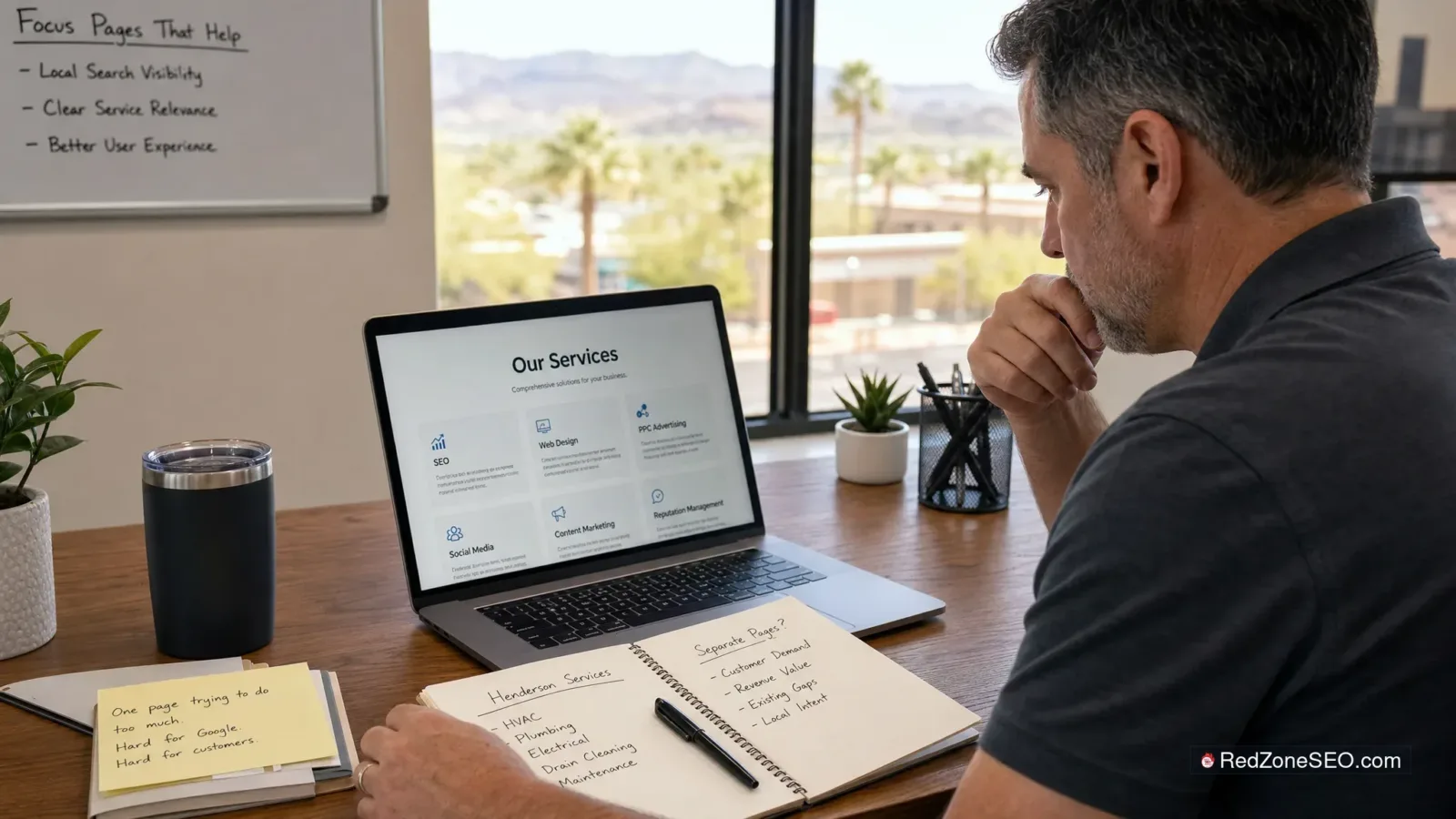
A single “Services” page can be a practical starting point for a new business website. It becomes a problem when that one page tries to represent every meaningful service your Henderson business offers without clearly explaining any of them.
If a customer searches for one specific need, such as “water heater repair Henderson,” “commercial landscaping Henderson,” “estate planning attorney Henderson,” or “WordPress SEO Henderson,” Google and the customer both need to quickly understand whether your business provides that exact service. A broad page that lists ten services in a few short paragraphs often does not provide enough clarity.
This does not mean every small offering needs its own page. It does mean that businesses with distinct, valuable services should review their website structure before assuming a generic page is enough for local SEO.
Many Henderson businesses have a website page titled “Our Services” that contains a short list like this:
That list may accurately describe the business, but it usually does not answer the questions a searcher has. What types of repairs? What gets installed? Does the company handle homes, offices, or both? Which service is appropriate for the customer’s issue? What areas does the business serve?
Consider a Henderson home-services company that offers air conditioning repair, AC installation, heating repair, maintenance plans, and indoor air quality work. If all five services are compressed into one generic page, the page has to compete for several different search intents at once. Someone looking for immediate AC repair has different questions than someone comparing replacement options. Those searches deserve different explanations, service details, and calls to action.
The same issue appears across local industries:
When multiple services are hidden within a generic page, the website can become difficult to interpret. The page may still rank for the business name or broad category terms, but it can miss opportunities from people searching for a specific service in Henderson, Las Vegas, or the surrounding Clark County market.
The goal is not to build pages simply to increase page count. The goal is to give each high-value service a clear, useful place on the website when customers search for it separately.
A broad service page can struggle for two connected reasons: it is less precise for search engines and less persuasive for prospective customers.
Searches carry intent. A person searching “Henderson roof repair” is likely dealing with a current problem. A person searching “roof replacement Henderson” may be researching a larger project, comparing materials, or looking for an estimate. A generic roofing page may mention both, but it often lacks the specific information that makes either searcher feel understood.
Search engines look for helpful, well-organized pages that clearly address a topic. Google’s guidance on helpful, reliable, people-first content supports a simple principle: create content because it is useful to people, not because you want to manufacture rankings. A detailed repair page and a detailed replacement page can both be useful when they genuinely explain different services and customer decisions.
By contrast, a generic page can send mixed signals. Its title may be broad, its headings may be vague, and its body copy may devote only a sentence or two to each offering. That leaves little depth for Google to evaluate and little evidence for a customer deciding whether to call.
Local SEO for multiple services is not just about adding “Henderson” repeatedly to a page. The business needs to explain what it offers, who it helps, and how a particular service works in the local market it serves.
For example, a Henderson property management company might have separate customer needs around tenant placement, rental listing support, maintenance coordination, and property marketing. A property owner searching for tenant placement is not necessarily looking for a general overview of property management. A dedicated page can explain the scope of that service, who it is for, what questions to ask, and how it relates to the company’s broader work.
Clear local relevance also improves customer confidence. People want to know that a business understands the service they need, not just the industry category it belongs to.
A customer arriving from a specific search should not have to scan a crowded page, open several tabs, or guess whether the business handles their situation. When visitors cannot find a direct answer, they often return to search results and compare another option.
Dedicated service pages can improve the path from search to inquiry by giving visitors a focused page with:
That clarity matters for both search visibility and lead quality. It helps customers self-select the service they need before they contact the business.

Not every website needs a major rebuild. But the following signs suggest that your service page SEO structure may be holding back useful search opportunities.
If your primary page lists six, ten, or more distinct services but gives each one only a short paragraph, it may be too broad. A long page is not automatically bad, but length does not solve a structure problem. The question is whether visitors can quickly find meaningful information about each service.
If calls and form submissions often begin with “Do you do this?” or “Do you handle that type of job?” your website may not be communicating the scope of your work clearly enough. Those customer questions are often a useful source of service-page topics.
Separate pages are most justified when services involve different customer concerns, sales conversations, timelines, or outcomes. For instance, a Henderson accounting firm may offer tax preparation, bookkeeping, payroll support, and business advisory services. Each is a distinct reason a prospect may search and contact the firm.
Likewise, an SEO agency offering local SEO, SEO audits, link building, content marketing, and Answer Engine Optimization should not assume one broad SEO page answers every prospect’s question. The service areas overlap, but a business owner looking for an audit may be at a different stage than one seeking a monthly SEO campaign.
When a site is structured around generic language, leads can be vague: “I need help with marketing” or “Can you tell me what you do?” A focused service page cannot guarantee better leads, but it gives customers the context needed to ask more informed questions.
Look at your main navigation, service menu, and homepage links. If high-revenue services are hard to find, hidden in a dropdown, or only mentioned in a block of text, they may need clearer internal linking and a dedicated page.
For a budget-conscious business owner, this review is often more valuable than immediately ordering a large batch of new pages. Start by determining whether important services are missing, buried, or competing with each other on one URL.
On a limited budget, do not begin by creating pages for every variation of every service. Prioritize based on business value and customer demand.
If people use a clear phrase to describe a service, that service is a strong candidate for its own page. Examples include “emergency plumbing,” “kitchen remodeling,” “tax preparation,” “commercial cleaning,” “estate planning,” or “local SEO.”
Ask your staff which services customers request most often. Review inquiry forms, sales notes, call topics, and recurring customer questions. This is practical demand information, even before deeper keyword research begins.
A service page should support a business priority, not just a possible keyword. Services that produce stronger revenue, lead to repeat work, support a larger contract, or represent an area where the company wants to grow should receive attention first.
For example, a Henderson contractor may do small repairs and full remodels. Both matter, but the business may choose to build a detailed bathroom remodeling page first if that service is more strategic and has a clearly different customer journey.
Compare your core offerings with your existing URLs. If a key service appears only as a sentence on the homepage or as a bullet in a general list, that is a likely gap. A careful site review can identify whether the page truly needs to be created or whether an existing page needs to be improved and linked more clearly.
This is one reason it helps to understand what Henderson SEO services small businesses should prioritize first. The best first step is rarely “publish more content.” It is usually fixing the most important gap in the customer path.
A dedicated page needs enough real material to stand on its own. It should explain a distinct service, not rephrase the same paragraph with a different keyword.
For example, a landscaping company could reasonably have separate pages for landscape design, irrigation repair, artificial turf installation, and ongoing maintenance if each service has different needs, steps, considerations, and customer questions. It would be much harder to justify separate pages for “landscape maintenance in Henderson,” “landscape maintenance near Henderson,” and “best Henderson landscape maintenance” if the pages say nearly the same thing.
Google warns against doorway pages created mainly to capture search traffic while offering little unique value. A good service-page plan avoids that problem by focusing on distinct services and useful information—not repetitive pages with swapped locations or keyword phrases.

Separate service pages SEO work best when every page helps a customer make progress. A useful page does not need to be padded with generic claims or repetitive city references. It needs to be specific.
The title and H1 should identify the service plainly. “AC Repair in Henderson” is clearer than “Comfort Solutions for Every Home.” Branding can be included, but the customer and search engine should not have to decode what the page is about.
Describe what the business does and what the service is intended to solve. Avoid vague wording such as “quality solutions tailored to your needs.” Replace it with practical information about the work, customer situation, service scope, or decision process.
For a local SEO page, that might mean explaining the difference between optimizing a Google Business Profile, improving location and service pages, correcting technical issues, building internal links, and publishing useful supporting content.
Show the visitor when the service is appropriate. A page about commercial cleaning could describe recurring office cleaning, move-in or move-out cleaning, and cleaning needs after a renovation, if those are actually offered. A page about SEO audits could explain that an audit is useful when rankings have stalled, service pages are unclear, or a site has technical and content gaps.
FAQs can answer the practical questions that prevent a customer from taking the next step. Keep them tied to the service page rather than copying the same FAQ block across the entire site.
Examples include:
Service pages should connect naturally. An AC repair page can link to maintenance and replacement pages. A business tax preparation page can link to bookkeeping support. An SEO audit page can link to ongoing SEO campaign information.
This helps visitors navigate the site and helps search engines understand relationships among pages. Google’s SEO Starter Guide also emphasizes clear organization, descriptive titles and headings, and useful links.
For businesses evaluating broader search engine optimization support, Red Zone SEO provides search engine optimization services in Las Vegas that can be structured around the services, locations, and site gaps that matter most to the business.
Adding pages without a plan can create a new set of problems. The following mistakes are common when businesses try to move beyond one generic page.
Not every task, product feature, or closely related phrase deserves a dedicated URL. If two offerings are essentially part of the same customer decision, one stronger page with clear subsections may be better.
For example, a page about “residential plumbing repair” can often cover faucets, toilets, drains, and leak detection in sections if these are part of one repair service. Separate pages become more reasonable when the services have meaningful differences in intent, scope, or buyer questions.
Thin variations create confusion. Changing a headline from “Henderson” to “Las Vegas” while leaving the rest of the page intact is not a strong multi-location SEO strategy. The same applies to copying one service description across several pages and replacing a few terms.
If a business serves Henderson and Las Vegas, city pages should only be created when they can provide useful, accurate distinctions such as service area details, location-specific contact information where applicable, local project considerations, or genuinely helpful regional context. Otherwise, a well-built service page that accurately states its service area may be more appropriate.
A new page can remain isolated if nothing links to it. Add logical links from the homepage, relevant service hubs, related blog content, and navigation where appropriate. Then make sure the page links back to relevant supporting and next-step pages.
This is an SEO website structure issue, not merely a writing issue. Strong content is less useful if visitors and search engines have no clear route to find it.
Repeating “Henderson” and the service name in every sentence makes a page difficult to read. Local relevance should come from accurate service details, natural references to the area served, and content that answers a local customer’s actual questions.

New pages must be discovered, crawled, and indexed before they can appear in search results. Then they need time to earn visibility against pages already competing for similar searches. Content quality, site authority, technical condition, internal linking, local relevance, and competition all affect progress.
Publishing useful service pages is an important foundation, but it is not a switch that produces instant local rankings. Businesses should plan for ongoing review: confirm indexing, assess user engagement, improve weak sections, and add supporting content where it helps.
A manageable service-page plan can be completed in stages. The point is to repair the highest-impact gaps first rather than trying to rewrite the entire website at once.
Make a simple list of everything your business actually offers. Include core services, higher-value services, recurring services, and services that customers ask about by name. Do not begin with a keyword list; begin with the business reality.
For every service, ask:
If the answers are mostly yes, the service may deserve a dedicated page. If not, it may belong as a section on a broader page.
For most small businesses, starting with three high-value missing or weak pages is more realistic than planning twenty new URLs. Build the pages that can make the clearest difference to customer understanding and local search relevance.
That may mean improving an existing main service page, creating two focused pages, and adding internal links before moving to the next group of services.
A useful structure often looks like this:
The overview page should introduce the service categories and link visitors to the dedicated pages. It should not attempt to duplicate every detail on those pages.
After pages are published, review whether they are indexed, whether internal links are working, which pages attract relevant visitors, and where customers still appear confused. SEO is an ongoing process of improvement, not a one-time content upload.
If you are deciding how much structure your current site needs, it may also help to review whether a basic Henderson SEO plan is enough to compete. The answer depends on your market, the condition of your site, the services you need to promote, and how much unresolved competition exists around those searches.
No. Separate pages are justified for services that are distinct, valuable, and commonly sought on their own. Minor variations, closely related tasks, and services with little unique information may fit better as sections within a broader service page. Build pages because they improve customer understanding and site organization, not simply because more pages appear better.
Start with services that combine three factors: clear customer demand, meaningful business value, and an obvious gap on your existing website. Look at the services that generate the most inquiries, revenue, repeat business, or strategic opportunity. Then check whether each has a clear, useful page already. Prioritizing a few important gaps is usually more effective than producing many thin pages.
They can create problems if the pages are nearly identical or exist only to target small keyword variations. Similar services can have separate pages when each page provides genuinely different information, answers different customer questions, and supports a distinct service decision. When the services overlap heavily, one comprehensive page with organized sections may be the better choice.
There is no fixed timeline. A new page must first be crawled and indexed, and visibility can change based on competition, technical health, internal links, content quality, and the site’s broader local SEO signals. Treat new service pages as foundational work that should be monitored and improved over time, rather than expecting immediate ranking movement.
If your Henderson business offers several distinct services but relies on one generic page, the issue may be less about a lack of SEO effort and more about a website structure that does not clearly reflect what customers are searching for.
Red Zone SEO can review your current service-page structure, identify high-value services that are missing or buried, and outline a realistic Henderson-focused growth plan before more search opportunities are lost. To request a practical SEO review, call (702) 489-0881 and ask for a diagnostic of your service pages, internal links, and local SEO priorities.