An SEO content strategy is a planned approach to creating and optimizing content to rank high in search engines and attract your target audience. A complete strategy involves understanding your audience and goals, performing keyword research, creating high-quality content, handling on-page and technical optimization, building links, and continuously measuring performance to improve.
With a staggering 93% of all online experiences starting with a search engine, this isn't just a statistic—it's your biggest opportunity. If your business isn't visible when people search, it's missing out on countless potential customers.
An SEO content strategy is your roadmap to getting found. It connects you with people who need what you offer, turning online searches into real business. It might sound complex, but we'll break it down into simple, actionable steps.
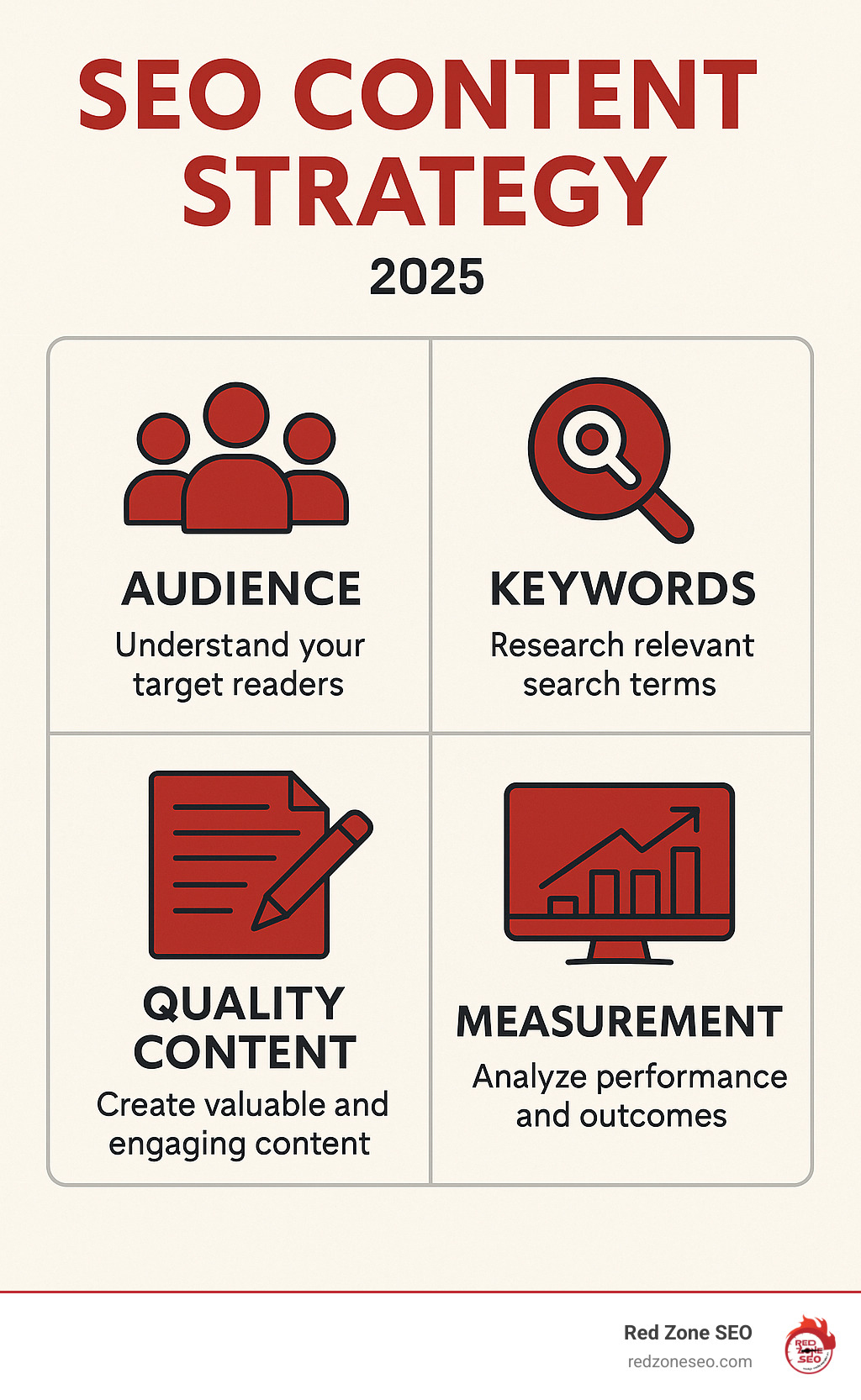
Quick seo content strategies definitions:
Is your business a hidden gem online? A great website that isn't bringing in customers needs an effective SEO content strategy. Think of it as the engine that drives organic traffic, boosts search engine visibility, and transforms your brand into a trusted authority. If your content isn't optimized for search, your business remains a secret. We're here to help you get found.
SEO content isn't just about clicks; it's about building trust and establishing expertise. When your content consistently answers questions and solves problems, search engines like Google reward you with higher rankings. This cycle leads to more visibility, engagement, and sustainable growth. Google's algorithms are always evolving, prioritizing "helpful, reliable, and people-first content," which is the foundation of long-term digital marketing success.
More info about SEO for Online Business
SEO content is created for a dual purpose: to provide immense value to your audience and to rank well in search engines. It's not about stuffing keywords into an article. It's about delivering genuine help while ensuring search engine crawlers can find and understand that value.
SEO content comes in many forms:
For every piece, we focus on smart keyword integration, user-friendly formatting, and strategic linking. The best pages are written for the user first, not just the search engine. This holistic approach ensures your content is appreciated by both your audience and search engines.
More info about Content Marketing for Small Businesses.
An SEO content strategy is an absolute must-have. Here's why:
While some focus on quick-win tactics, we believe dedicating resources to creating valuable content yields far greater, more sustainable benefits. Prioritize your audience, and Google will reward you—it's as simple as that!
Before creating content, you need a solid blueprint. A successful seo content strategy begins with thoughtful planning and research. We start by digging into your business goals, ideal customers, competitors, and existing content. This foundational work allows us to set clear Key Performance Indicators (KPIs) and ensure every piece of content serves a purpose, guiding your audience through their buyer's journey.
First, we must get clear on two questions: Who are we trying to reach, and what do we want them to do? Your business goals—whether increasing organic traffic by 20%, generating 50 qualified leads per month, or boosting online sales by 15%—shape the type of content we create and the metrics we use to define success.

Next, we develop a detailed 'customer avatar' or 'persona.' This involves understanding your ideal customer's pain points, goals, demographics, and online behavior. We analyze your current customers, survey your audience, research your competitors' audience, and assess your unique offerings to pinpoint who benefits most from your services. By understanding your niche and crafting detailed personas, we create personalized content that truly resonates and solves your audience's specific problems, making them feel seen and understood.
target audience is the core of our strategy.
More info about SEO Strategies for Startups.
Understanding the competitive landscape is not optional; it's essential for carving out your space. We identify your direct and indirect SEO competitors—those who rank for the keywords you're targeting, even if they don't offer the same products or services. Our analysis involves:
This intelligence allows us to build a strategy that is not only informed by your own goals but is also designed to outperform the competition.
Once we know who we're talking to, we find out how they search. Modern keyword research is about understanding context and the reason behind a search. It's not about cramming keywords into your content; it's about becoming the best answer to your audience's questions.
We use advanced tools like Ahrefs, SEMrush, and AnswerThePublic to find relevant topics, not just isolated words. We explore broad Head Terms (e.g., 'digital marketing') and specific Long-Tail Keywords (e.g., 'digital marketing for small businesses in Austin'). Long-tail keywords often have lower competition, higher conversion rates, and make up the vast majority of all Google searches. We analyze Search Volume (how many people are searching) and Keyword Difficulty (how hard it is to rank) to find 'low-hanging fruit' you can rank for quickly while building toward more competitive terms.
Our goal is to build topic clusters: a central 'pillar page' on a broad topic (e.g., "SEO Content Strategy") linked to several 'cluster' pages that cover specific sub-topics in greater detail (e.g., "How to Do Keyword Research," "On-Page SEO Checklist"). This structure signals deep expertise to search engines, improves internal linking, and keeps visitors engaged on your site longer.
Keywords are the bridge between your audience's questions and your content's answers.
More info about Keyword Research.
Matching your content to the reason someone is searching is the most crucial piece of the keyword puzzle. If your content doesn't align with user intent, it won't rank well, and visitors will leave immediately. We break down searcher intent into four main types:
| Intent Type | User Goal | Example Query | Ideal Content Type |
|---|---|---|---|
| Informational | To learn something, find an answer | "What is SEO content?" | Blog posts, guides, tutorials, "how-to" articles, FAQs, definitions. |
| Navigational | To find a specific website or page | "Red Zone SEO contact" | Homepage, "Contact Us" page, "About Us" page, specific product/service pages. |
| Commercial | To research before making a purchase | "Best email marketing tools for small business" | Product reviews, comparison articles, "best of" lists, buying guides, case studies. |
| Transactional | To complete an action (e.g., buy, sign up) | "Buy running shoes online" | E-commerce product pages, service pages with clear CTAs, sign-up forms, booking pages. |
Aligning your content with these intents is vital. A user searching for "best running shoes" wants reviews and comparisons (Commercial), not a history of footwear (Informational). A perfect match between what the user wants and what your content provides makes users happy and sends strong positive signals to search engines, forming the foundation of a successful content piece.
types of searcher intent are the foundation of effective content creation.
With our blueprint ready, it's time to build. This stage is about crafting content that ranks well, engages your audience, and provides real value. We focus on creating helpful, reliable, and people-first content, as Google increasingly prioritizes user experience and quality.
In a world saturated with information, quality stands out. Google's algorithms reward content demonstrating Experience, Expertise, Authoritativeness, and Trustworthiness (E-E-A-T). While not a direct ranking factor, E-E-A-T is a crucial framework for creating content that satisfies users and, by extension, search engines.
We also prioritize originality and information gain, introducing new concepts, unique data, or fresh perspectives to differentiate your content from the thousands of similar articles online. While AI tools can assist with brainstorming and outlining, we believe the best results come from human authors who can provide this unique value. Relying solely on AI can lead to generic, uninspired content that Google's helpful content system is designed to de-rank. Our human-first approach ensures authenticity, depth, and a competitive edge.
E-E-A-T guidelines are our north star for content quality.
Great content needs to be perfectly optimized so search engines can understand its topic and relevance. On-page SEO is the practice of optimizing individual pages to rank higher and earn more relevant traffic.

Here are the critical elements we optimize for every single page:
yourdomain.com/seo-content-strategies instead of yourdomain.com/p=123).More info about Content Optimization can help you refine these elements.
Technical SEO ensures your website's foundation is solid, making it easy for search engines to crawl, index, and understand your content. Without a strong technical base, even the best content can fail to rank.
robots.txt files, creating and submitting XML sitemaps, and fixing crawl errors reported in Google Search Console.Ignoring these technical aspects is like building a skyscraper on a foundation of sand. Your content won't go far without a high-performing technical foundation.
More info about WordPress SEO Services and how we handle these technical details.
Great content needs pathways to bring in visitors. Strategic linking builds these digital roads, both within your website (internal links) and from the wider web (external links or backlinks). This crucial step builds your site's authority, shares valuable "link equity," and boosts your content's ranking in search results, amplifying its reach and impact.
Internal links connect one page on your website to another on the same site. They are a simple but incredibly powerful tool that you have complete control over. We use them strategically to:
Internal Linking Best Practices We Follow:
More info about SEO for Small Business and how we implement effective internal linking.
External links, or backlinks, are links from other websites to yours. They act as digital endorsements or "votes of confidence" and are one of Google's most important ranking factors. Earning high-quality backlinks is a cornerstone of our seo content strategies.
How do you earn these valuable links?
The golden rule for backlinks is quality always trumps quantity. A single link from a highly authoritative, relevant site like a major industry publication is far more valuable than hundreds of low-quality links from spammy directories. Our focus is on earning links that build your site's long-term authority and reputation, while actively avoiding and disavowing toxic links that could harm your rankings.
More info about Link Building Services and how we can help you build a robust backlink profile.
SEO isn't a "set it and forget it" task. Think of your website as a garden that needs continuous care to thrive. The digital world is always changing—competitors publish new content, search engine algorithms evolve, and user behavior shifts. Your seo content strategies must be a continuous cycle of research, creation, sharing, and measurement. This data-driven "long game" is how we ensure sustainable, long-term growth.
Over time, even the best content can experience "content decay," where rankings and traffic drop as information becomes outdated. Regular maintenance is essential to keep your content fresh, accurate, and powerful. A systematic content audit is the key.
Our maintenance plan involves a quarterly content audit where we:
This systematic process ensures your website's authority is concentrated on your best, most effective content, signaling to Google that your site is a well-maintained and trustworthy resource.
More info about SEO Audit and how we can help you keep your content in top shape.
As the saying goes, "If you can't measure it, you can't improve it." We use a mix of tools and key metrics to track performance, find opportunities, and demonstrate the return on your investment (ROI).
Key metrics we track include:
We use tools like Google Search Console, Google Analytics, and Bing Webmaster Tools to gather this data. By constantly analyzing performance, we can make informed, data-driven decisions to fine-tune your strategy and double down on what delivers the best results.
In crowded industries, basic SEO may not be enough. To dominate your niche, we employ advanced strategies:
These sophisticated techniques are what we specialize in to help our clients succeed in the most highly competitive markets.
More info about Ecommerce Store SEO and how we tackle competitive online markets.
It's natural to have questions about seo content strategies. Diving into SEO can feel like learning a new language, with its own jargon and concepts. Here are some of the most common questions we get, answered with our expert insights.
SEO is a marathon, not a sprint. While minor technical changes can be indexed and show effects quickly, impactful results from a content strategy take time to build. Generally, you can expect to see initial positive signals, like ranking improvements and an increase in search impressions, within 4 to 6 months. However, achieving a significant impact on business goals (like a substantial increase in organic traffic, leads, and sales) typically takes 6 to 12 months, and sometimes longer in highly competitive industries.
This timeline depends on factors like market competition, your budget and resources, the consistency of your content creation and promotion efforts, and your website's existing authority and technical health. SEO is a long-term investment, but the payoff is sustainable, high-quality organic traffic that acts as a business asset for years to come.
While AI tools are powerful assistants for brainstorming and outlining, the answer is no, you should not rely solely on AI to write your SEO content. Here's why:
At Red Zone SEO, all content is written and edited by real people. We believe the best results come from human authors who can lend genuine experience and expertise. AI is a tool to complement our workflow, not replace it.
This is a great question, and the answer is that both are crucial components of a balanced and effective seo content strategies. They work hand-in-hand for optimal growth.
Creating New Content is essential for expansion. It allows you to target new keywords, address different stages of the customer journey, reach new audiences, and build your topical authority in new areas.
Updating Old Content (a "content refresh") is one of the most efficient and high-impact SEO activities you can perform. Existing content often has some authority, rankings, and backlinks. By updating it with fresh information, improved readability, new data, and better on-page SEO, you can regain lost rankings and boost performance, often with far less effort than ranking a brand-new page from scratch. It's often considered low-hanging fruit for quick traffic gains.
A smart strategy allocates resources to both. We recommend regular content audits to identify high-potential refresh opportunities while maintaining a consistent schedule for publishing new, high-quality content to continuously expand your online footprint.
There is no single "ideal" length for an SEO article. The best answer is: your content should be as long as it needs to be to comprehensively cover the topic and satisfy the user's search intent.
We've covered the essential roadmap for digital success, from blueprinting your approach and crafting high-impact content to amplifying your reach and measuring results. An effective SEO content strategy is not a one-time task but a continuous cycle of research, creation, amplification, and measurement. The digital landscape is always evolving, and staying ahead means adapting and consistently providing genuine value.
This commitment to quality and continuous improvement, driven by data-driven decisions, is what paves the way for long-term growth. It's how you attract more customers and establish your business as a trusted authority in your industry.
That's where we at Red Zone SEO come in. We specialize in providing data-driven, proven SEO solutions designed to deliver measurable results. We take the guesswork out of SEO, helping you attract the right customers and achieve your business goals. Whether you're based in Austin, expanding across Florida, or building your brand in Henderson NV, Nevada, or Las Vegas, we're ready to help you simplify SEO and rise through the ranks.
Ready to transform your online presence? Let's get started.