
What is the difference between on-page and off-page SEO? Simply put, on-page SEO includes optimizations you control directly on your website, like content and site structure. Off-page SEO involves actions taken elsewhere on the internet to build your site's authority, such as earning backlinks and brand mentions.
Here's the key breakdown:
Think of it like building a house. On-page SEO is the solid foundation and internal structure. Off-page SEO is your curb appeal and neighborhood reputation that makes others want to visit.
As one SEO expert puts it: "What you rank for is largely determined by on-page factors, while how high you rank in the search results is largely determined by off-page factors."
Both work together like yin and yang. You can't achieve lasting SEO success with just one. A well-built house in a bad neighborhood won't attract visitors, and a beautiful house with a cracked foundation won't stand. For any business, this balance is crucial for growth.
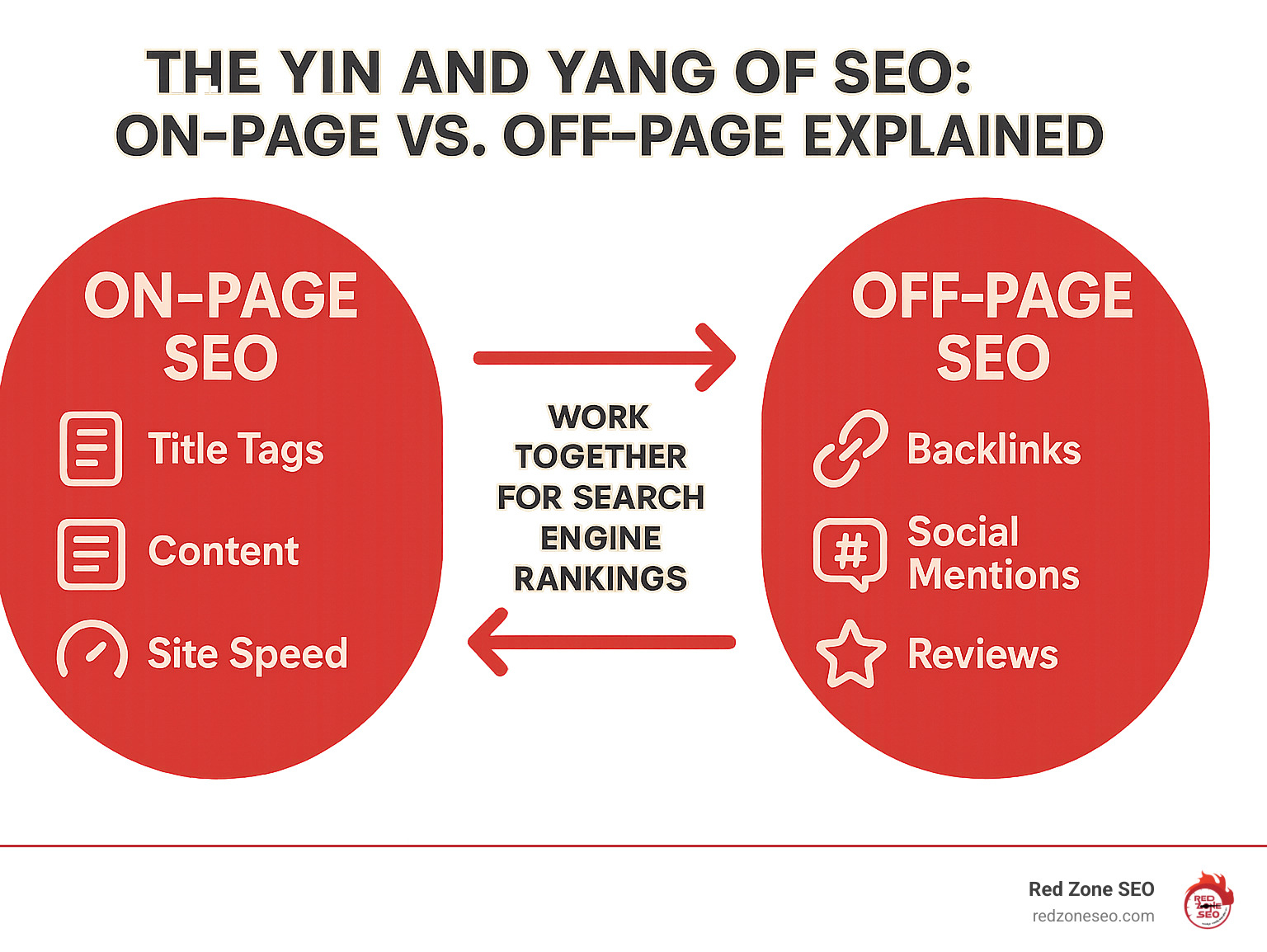
What is the difference between on-page and off-page seo terms to remember:
On-page SEO is where your journey begins. It encompasses every optimization you make directly on your web pages to rank higher, from the words you write to the code behind them. The beauty of on-page SEO is that you have complete control; you can start improving your site today without waiting for external validation.
Why is it so foundational? On-page SEO is how you communicate your content's relevance and purpose to search engines. Without it, Google struggles to understand what your pages are about, and your valuable insights may never reach your target audience. The goal is to make your content clear to search engines while providing an excellent experience for users. A great starting point is a comprehensive audit to identify priorities. For a detailed roadmap, see our An in-depth On-Page SEO Checklist.
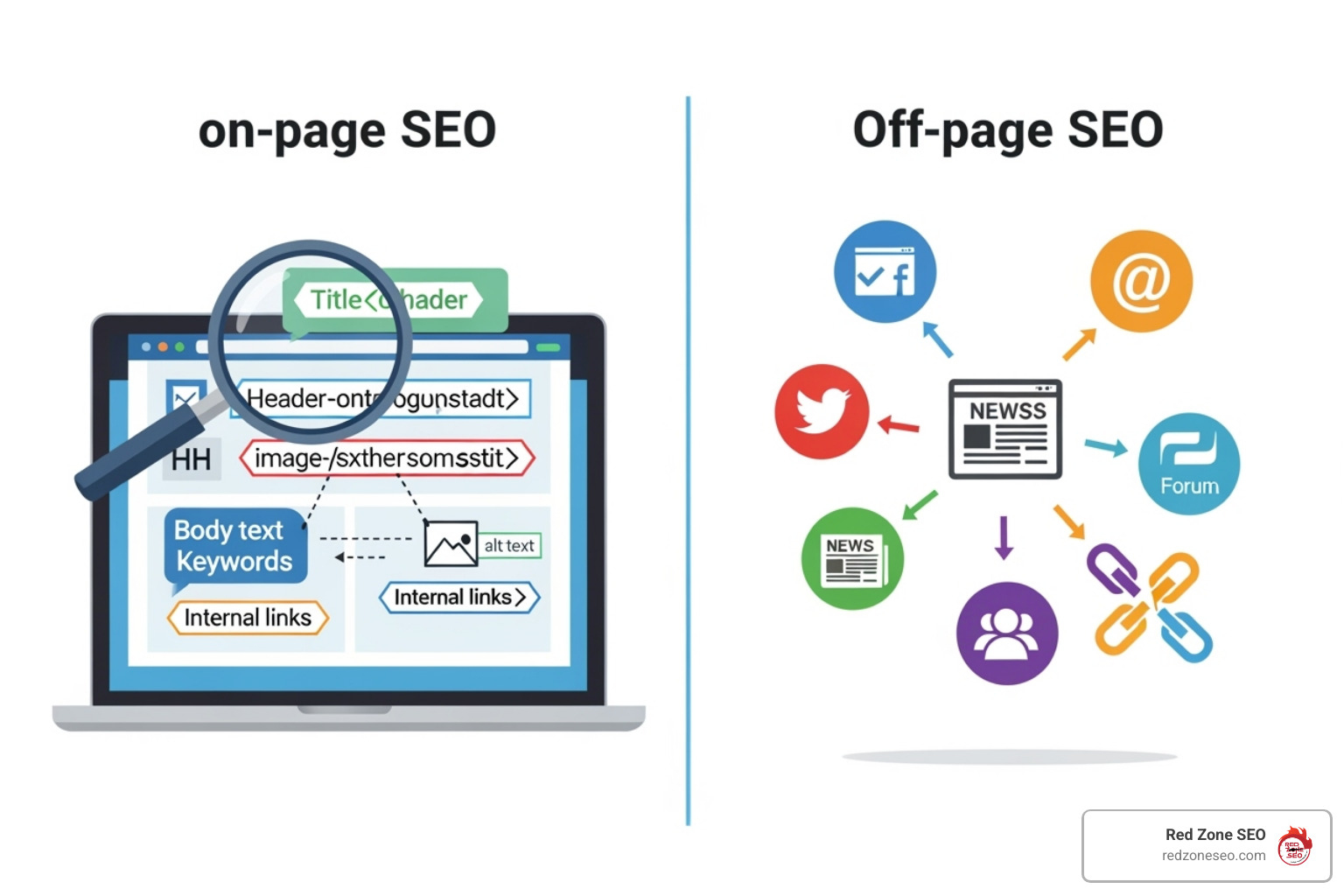
On-page SEO involves several key elements working together to create an experience that users and search engines love.
yoursite.com/on-page-seo-guide) are user-friendly and provide immediate context about the page's content.For more on refining these elements, explore our Content Optimization strategies.
Technical SEO is the behind-the-scenes work that ensures search engines can find, crawl, and understand your site. It's a critical part of your on-page foundation.
robots.txt file are essential.Regular technical audits are key to maintaining a strong foundation. We can help you Run a comprehensive SEO Audit to ensure your site is technically sound.
If on-page SEO is perfecting everything inside your website, off-page SEO is building your reputation out on the wider internet. It encompasses all the efforts that happen away from your site to build authority and demonstrate trustworthiness. While on-page SEO signals relevance, off-page SEO is about building authority.
It's about earning trust from the digital community so that search engines see your site as a credible resource worth recommending. You can't directly control these external factors, but you can influence them by creating valuable content and building relationships. This is a long-term strategy that requires patience and a focus on genuine value.

Building off-page authority involves several key strategies that work together to paint a picture of credibility for search engines.
Sustainable off-page success comes from authentic relationship building and value creation. Our Professional Link Building Services focus on earning high-quality, relevant links that build lasting authority.
Now that we've explored both sides, let's clarify what is the difference between on-page and off-page SEO. The distinction boils down to location and control: where the optimization occurs and how much direct influence you have.
On-page SEO involves everything you do on your site. Off-page SEO is everything that happens off your site to improve its reputation. The table below summarizes the key differences:
| Aspect | On-Page SEO | Off-Page SEO |
|---|---|---|
| Goal | Relevance: Telling Google what your page is about | Authority: Telling Google how important your page is |
| Control | Direct Control: You make changes yourself | Indirect Influence: You earn signals from external sources |
| Focus | Content & Code: Keywords, structure, user experience | Relationships & Reputation: Backlinks, mentions, social signals |
| Key Tactics | Keywords & Structure: Title tags, content quality, site speed | Backlinks & Mentions: Link building, brand awareness, reviews |
The dynamic of control versus influence is central to understanding the two approaches. With on-page SEO, you are in the driver's seat. You can update a title tag, rewrite content, or improve site speed immediately. You control the HTML, the content, and the site structure.
With off-page SEO, you can only influence outcomes. You can't force another site to link to you or compel someone to share your content. Instead, you earn these signals by creating valuable content and building relationships, much like digital public relations. This requires patience, but the third-party validation it generates carries immense weight with search engines.
On-page and off-page SEO answer different questions for search engines.
On-page signals relevance. By optimizing your content, headings, and structure, you're telling Google, "This page is about X." This helps search engines match your content to relevant search queries.
Off-page signals authority. Once Google knows your page is about X, it looks at external signals like backlinks and brand mentions to determine how trustworthy your content is. This tells Google not just what you should rank for, but how high you should rank compared to the competition.
These two work in synergy. Great on-page content naturally earns off-page links, and strong off-page authority boosts the ranking potential of all your well-optimized pages.
On-page and off-page SEO aren't competing priorities; they're dance partners, each making the other more effective. The real magic of SEO happens when they work in harmony. Think of it as a symbiotic relationship that strengthens your entire digital presence.
Your on-page SEO creates a solid, well-structured foundation that users love and search engines can easily understand. Your off-page SEO then acts as an amplifier, broadcasting your content's value to the world. This synergy plays out in a powerful feedback loop: great on-page content naturally earns off-page links and mentions, and that strong off-page authority, in turn, boosts the rankings of all your pages.

Trying to choose between them is like asking if a bicycle needs both wheels. You need both to get where you're going smoothly and effectively.
For businesses starting their SEO journey, there's a logical sequence that delivers the best results.
This foundational approach is especially effective for new businesses. Our guides on SEO Strategies for Start Ups and SEO for Small Business detail this systematic process.
Remember the timeline: on-page changes can yield results in weeks, while off-page SEO is a long-term investment that builds momentum over months. Consistency is key.
Business owners often have questions about the nuances of SEO. Here are our answers to the most common ones we hear regarding what is the difference between on-page and off-page SEO.
This is like asking a parent to choose a favorite child. The truth is, neither is more important; both are essential for long-term success. On-page SEO is foundational—it ensures your site provides a great experience and is understood by search engines. Off-page SEO builds the competitive authority needed to stand out. A balanced strategy that integrates both is the only way to achieve sustainable rankings. All the backlinks in the world won't help a site with a poor user experience, and a perfectly optimized site will struggle to rank without authority.
SEO timelines vary based on competition, your site's current state, and the consistency of your efforts. Generally, on-page changes can show results within a few weeks to a couple of months, as search engines can quickly crawl and process these improvements. Off-page SEO is a long-term strategy, with initial impacts often appearing in 3-6 months. Building significant authority can take 6-12 months or more. SEO is a marathon, not a sprint, and the results from consistent effort compound over time.
Absolutely. Many business owners can handle basic on-page SEO tasks like writing quality content and optimizing title tags. However, off-page SEO, particularly strategic link building, requires significant time and expertise. Building relationships and earning high-quality links is a complex process. While DIY SEO is a great starting point, partnering with an experienced SEO team is often recommended for competitive markets or complex websites to accelerate results and ensure best practices are followed.
As we've seen, the answer to what is the difference between on-page and off-page SEO isn't about choosing a side. It's about understanding their harmony. Like yin and yang, they are two essential halves of a complete, powerful SEO strategy.
Your on-page efforts build a solid, user-friendly foundation. Your off-page efforts build the external reputation and authority that tells the world your foundation is worth visiting. They create a virtuous cycle: great content earns authority, and great authority amplifies your content's reach.
At Red Zone SEO, we've seen this integrated approach deliver lasting growth that withstands algorithm updates and competitive pressure. We don't just optimize websites; we build comprehensive digital reputations that both search engines and customers trust.
Success in SEO is an ongoing journey of improvement. By balancing a well-optimized website with a strong external reputation, you position your business for sustainable growth. The most successful businesses invest in both, becoming the most helpful and trustworthy resource in their field.
To build a powerful, unified SEO strategy that drives measurable results, explore our Las Vegas Search Engine Optimization services. Let us help you achieve the SEO harmony your business deserves.