
Want to improve your ecommerce site structure seo contextual links? A logical structure and smart internal linking are essential for any online store. They help to:
Think of your website as a physical store. If it's disorganized, customers will leave. The same is true online; a poorly structured ecommerce site can lose a significant amount of organic traffic and potential sales. This is where a clear site structure and internal links become critical. They guide both users and search engine crawlers, making your site easier to steer while signaling which pages are most important.
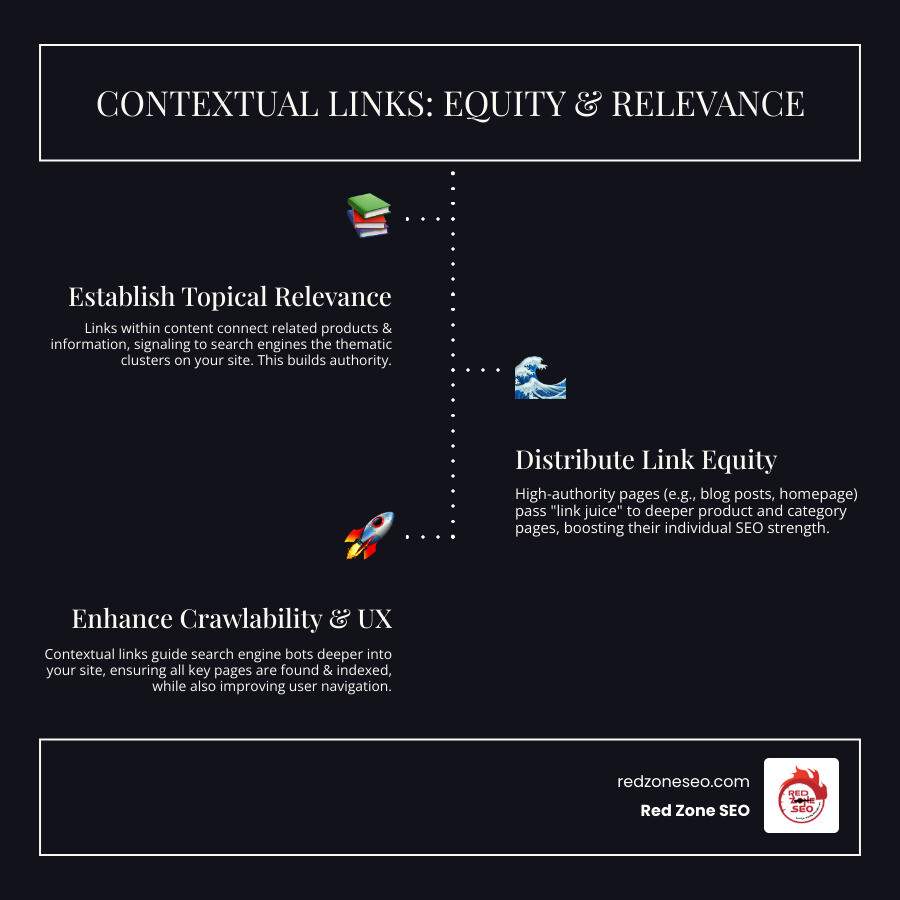
Contextual links are a key part of this strategy. These are links placed directly within your content, such as a product description or blog post. They connect related ideas and products, creating a more helpful and organized experience. This helps Google understand the relationships between your pages, which can provide a serious boost to your search rankings.
Basic ecommerce site structure seo contextual links terms:
Imagine your ecommerce website as a well-organized library. Each page is a book that needs to be in the right section, with clear signs (your links) to guide visitors. Without this thoughtful organization, both human visitors and search engine bots can get lost, leading to frustration and lost business opportunities.
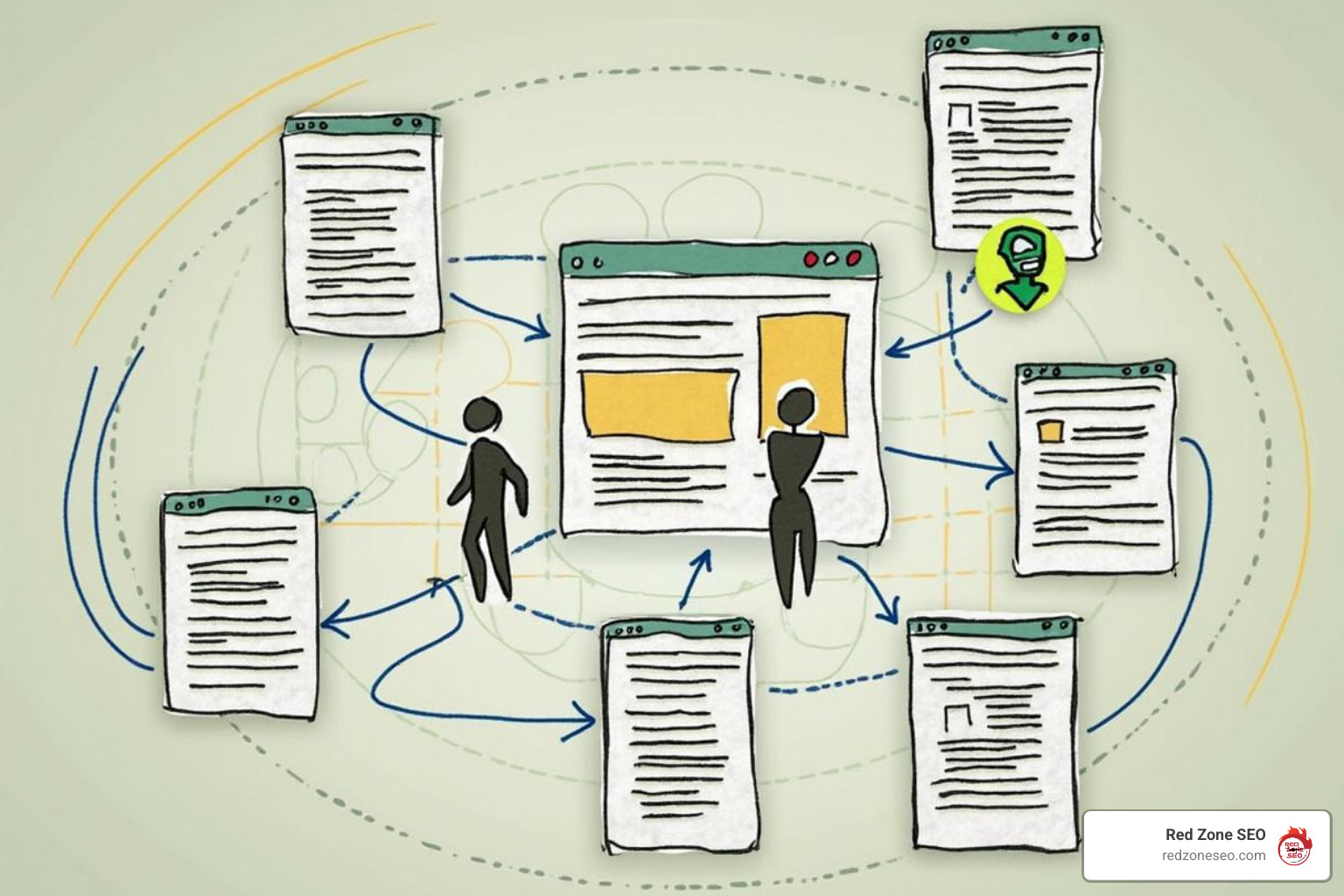
At Red Zone SEO, we believe a well-designed site hierarchy is the backbone of any thriving online store. We advocate for a shallow, pyramid-like structure where your most important pages are at the top and everything else branches out logically. For example, a user journey should be intuitive: Homepage > Men's Clothing > Shirts > Men's Graphic Tee. A widely accepted industry best practice is the "3-click rule," which suggests any page on your site should be accessible within three clicks from the homepage. While not a rigid SEO mandate, it's a crucial usability guideline. If users have to click endlessly to find a product, their frustration grows, and they are more likely to leave. This is a strategic must-have for great ecommerce site structure seo contextual links.
A shallow structure allows customers to find products quickly, creating a seamless experience. Search engines also favor this efficiency, as it allows them to crawl and index your entire site more effectively. If users must click too many times, they might "pogo-stick"—bounce back to the search results—signaling to Google that your site wasn't helpful. A logical hierarchy also ensures that "link equity" (PageRank) flows from authoritative pages like your homepage to your product and category pages, boosting their visibility. This streamlined structure can also help you earn sitelinks in SERPs, making your business stand out in a mobile-first indexing world.
No one wants to play hide-and-seek with products on a website. A crystal-clear site navigation allows users to effortlessly find products, browse categories, and find related items. This ease of use is a direct driver of sales and conversions. A logical structure builds user confidence and reduces friction in the buying journey.
Poor navigation is a major deterrent for online shoppers. For instance, studies show that 37% of users cite poor navigation as a reason for abandonment. A bad user experience has lasting consequences, as 88% of users are less likely to return after a bad UX. At Red Zone SEO, we've seen how a well-structured site builds trust, reduces bounce rates, and leads to higher conversion rates. Features like faceted navigation (product filters) can dramatically improve the user experience by allowing customers to narrow down vast catalogs. However, they must be handled carefully from an SEO perspective to avoid creating thousands of low-value, duplicate pages that can harm your site's performance.
Search engines like Google rely on signals to understand your site's content and importance. Google's web crawler, Googlebot, steers your site by following internal links. A logical structure, supported by robust internal linking, ensures Googlebot can efficiently crawl and index all your important pages. This process helps optimize your "crawl budget"—the finite resources Google allocates to crawling your site. A clean structure prevents Googlebot from wasting this budget on unimportant pages (like filtered results) and ensures it spends time indexing your valuable product and category pages.
Internal links also establish clear relationships between your pages, creating a semantic map of your site. When a "Men's Running Shoes" category page links to individual shoe product pages, Google understands the connection. The more internal links a page receives from other important pages, the more significant Google perceives it to be. Conversely, "orphan pages"—those with no internal links pointing to them—are often invisible to search engines. These pages might be old landing pages or products that were removed from a category but not deleted. They represent wasted content and missed indexing opportunities. Our strategies at Red Zone SEO ensure no page is left behind, making your entire product catalog visible and accessible.
Beyond standard navigation menus, contextual links are a powerful tool for helping both search engines and customers understand your content. These are hyperlinks woven naturally into the text of your product descriptions, blog posts, or category page introductions.
Navigational links are like the large signs in a grocery store, providing general guidance. Contextual links are like a helpful clerk pointing you to a specific product while you're reading about a related topic. They are dynamic and matched to the surrounding text, which allows you to build topical authority by showing how ideas and products are semantically connected. For example, a blog post on "The Best Hiking Boots for Summer" can link directly to specific "waterproof hiking boots" or "lightweight hiking socks." This helps the customer and sends a clear signal to Google that these pages are topically related, which is incredibly valuable for SEO.
Contextual links are a win-win, benefiting both SEO and user experience. For SEO, they send strong ranking signals to Google. When an authoritative blog post links to a specific product page, it shares some of its "link equity," which can boost that product's visibility in search results. From a user's perspective, these links are very helpful. A link in an article about a new gaming console could take a reader to "compatible gaming headsets" or a "console setup guide." This anticipates user needs, guides them to related items for cross-selling, and smooths out the buying process, potentially increasing the average order value.
Contextual links are the threads that tie your ecommerce site structure seo contextual links strategy together. They help create "virtual silos" or "topic clusters" by grouping related content, which reinforces the relevance of your categories and subcategories. This model involves creating a central, authoritative "pillar page" on a broad topic (e.g., a comprehensive guide to coffee brewing) and surrounding it with "cluster pages" that cover related sub-topics in detail (e.g., blog posts or category pages for "French presses," "pour-over kits," and "espresso machines"). By linking from the pillar to the clusters and back, you signal to Google that you are an expert on the entire topic, boosting the authority of all related pages.
These links are especially powerful for connecting informational content (like blogs and guides) to your transactional pages (products and categories), bridging the gap between research and purchase. However, it's about balance. Insights from Google suggest that category pages shouldn't be overloaded with text, as it can confuse the page's primary intent. A category page's main job is to showcase products. Adding a few concise, helpful paragraphs with contextual links to subcategories or buying guides is effective. Turning it into a massive article can send mixed signals to search engines about whether the page is for reading or for buying. At Red Zone SEO, we focus on placing strategic content that informs users without diluting the page's commercial purpose.
Contextual links act as express lanes for search engine crawlers. By embedding links within content, you ensure that even "deep" pages, like specific product variants not featured in the main navigation, are found and indexed by Google. This effectively "flattens" your site's architecture from a crawling perspective. A product page that is four clicks from the homepage can be reached in a single click if it's linked from a popular blog post, making it seem more important to Google.
Furthermore, contextual links are brilliant for distributing "PageRank" (Google's measure of a page's importance) across your site. Your homepage and cornerstone content naturally accumulate link equity from external backlinks. By strategically placing contextual links from these powerful pages to your product and category pages, you pass on that authority. This is a deliberate strategy to boost the organic ranking of crucial transactional pages that might otherwise struggle to gain authority on their own.
Think of your internal links as pathways guiding visitors and search engines through your online store. Building this framework is a strategic art that requires careful planning. We start by identifying your cornerstone content—authoritative, in-depth pieces central to your brand—and your high-priority product or category pages. These pages deserve the most internal links to signal their importance and make them easy to find. Every part of your site, from product descriptions and blog posts to category pages, offers opportunities for smart internal linking.

Anchor text, the clickable text in a link, is incredibly important. It tells users and search engines what to expect on the linked page. The golden rule is to make anchor text descriptive, relevant, and natural. Avoid vague phrases like "Click here." Instead, use descriptive words. For example, link to your shoe section with text like "explore our collection of durable hiking boots."
While using relevant keywords in anchor text is smart, avoid keyword stuffing. Google understands context, and a natural variety of anchor texts pointing to the same page is often more beneficial than repeating one exact phrase. A healthy anchor text profile includes a mix of types:
alt text as the anchor text. Always write descriptive alt text.This natural approach helps Google better understand your page's topic. For more information, Google offers its own helpful guide on writing good anchor text.
Where you place links is as important as the words you use. Within product descriptions, link to related accessories (e.g., from a camera page to compatible lenses), complementary products (e.g., from a shampoo page to the matching conditioner), or buying guides that help users make a decision. On category pages, use introductory text to link to specific subcategories or cornerstone blog posts. Blog posts are goldmines for contextual links; use them to link directly to any products or categories you mention, turning readers into customers.
Don't forget your high-performing pages. By linking from these authoritative pages to newer products or pages that need an SEO boost, you can effectively share valuable 'link equity' across your site. Finally, if you have user-generated content (UGC) like reviews or Q&A sections, look for natural linking opportunities, ensuring they are moderated and relevant.
Contextual links work best as part of a complete internal linking ecosystem. Here’s how they integrate with other key link types to create a robust ecommerce site structure seo contextual links framework:
Navigational Menus (Primary & Secondary): These are your main guides, providing the fundamental site structure. They should be logical, consistent, and reflect your most important categories, making it easy for users to find top-level pages from anywhere on the site.
Breadcrumb Links: These act as a secondary navigation aid, showing users their location in the site hierarchy (e.g., 'Home > Laptops > Gaming Laptops'). They improve user orientation, reduce bounce rates, and help search engines understand your site structure. When implemented with breadcrumb schema, they can also improve your appearance in search results.
Faceted Navigation: These are the product filters (size, color, brand) that are essential for user experience on large ecommerce sites. However, they can create massive duplicate content issues for SEO by generating unique URLs for every filter combination. This must be managed carefully with techniques like rel="canonical" tags pointing to the main category page, nofollow attributes on filter links, or using AJAX to load results without creating new, indexable URLs.
HTML Sitemaps: Usually found in the footer, an HTML sitemap provides a clear, hierarchical list of your site's pages. It's a user-friendly directory and serves as a backup for search engine crawlers to find pages they might have missed.
Footer Links: These typically link to essential but non-primary pages like 'About Us,' 'Contact,' 'Shipping Policy,' and key categories. They ensure these important pages are accessible from anywhere on the site.
Related Product Modules: Sections like 'Customers also bought' or 'You might also like' are powerful internal linking tools. They connect relevant products, improve the user journey, and help search engines find more of your product pages, which is especially useful for deep-level product variants.
Even with the best intentions, it's easy to make mistakes in your internal linking strategy. Steering clear of these common pitfalls is as vital as implementing best practices.
First, avoid over-optimization. Cramming keywords into every anchor text can appear spammy to Google and may even lead to penalties. Also, be wary of link dilution; too many links on a single page reduces the authority passed by each one. Quality over quantity is key. Other common issues include:
Above all, ignoring user experience for perceived SEO gains is a recipe for disaster. A positive user experience often translates to positive SEO results.
Some of the trickiest linking mistakes are technical and can silently undermine your ecommerce site structure seo contextual links efforts.
robots.txt disallows, or nofollow attributes to avoid wasting crawl budget.nofollow: Using nofollow on internal links is a common mistake that prevents authority from flowing to other important pages on your site, effectively trapping that page's value and creating dead ends in your site's link graph.<a> tags with href attributes to ensure crawlers can follow them. Relying on JavaScript onClick events for navigation can make pages invisible to search engines. You can check how Google renders your page with its URL Inspection Tool to check rendered HTML.Beyond technical issues, content and user experience mistakes can also derail your linking strategy.
A powerful internal linking structure is not a "set it and forget it" project. It requires ongoing maintenance. A regular audit is essential to find and fix issues before they harm your SEO.
Mastering internal linking is key to a strong ecommerce site structure seo contextual links strategy. Here are some of the most common questions we hear:
There is no single magic number. While an old Google guideline mentioned keeping links to a "reasonable number" (often interpreted as under 100), modern SEO focuses on user value. A page overloaded with irrelevant links can feel cluttered and also dilutes the "link equity" passed by each link. The more links on a page, the less authority each one passes.
The best practice is to prioritize relevance and user experience. Only add a link if it genuinely helps the user or provides valuable context. A long, comprehensive guide might naturally have many helpful links, while a simple product page might only have a few. Furthermore, the location matters; links within the main body content are generally considered more valuable than a long list of links in a footer.
This is a crucial distinction for a solid linking strategy.
Navigational links are part of your site's fixed architecture. They include your main menu, sidebar categories, breadcrumbs (e.g., Home > Apparel > Shirts), and footer links. Their primary job is to provide a consistent structure and help users steer the entire site.
Contextual links are embedded naturally within the body of your content, like in a paragraph of a blog post or a product description. For example, a link on the phrase "French press coffee maker" within an article would be a contextual link. They appear organically within the flow of information and are highly specific to the topic being discussed.
Both link types are vital, but contextual links provide stronger, more specific topical signals to search engines because the surrounding text gives them powerful context, reinforcing the semantic relationship between the source content and the destination page.
Identifying under-linked pages is a critical optimization task. Here are a few key strategies to find these opportunities:
Use a site crawler: SEO spider tools like Screaming Frog or Sitebulb can crawl your website just like a search engine. They can identify "orphan pages" (pages with zero internal links) and "low-linked pages." These pages are often invisible to search engines and need to be linked from relevant pages on your site.
Check Google Search Console's "Links" report: This report provides direct feedback from Google. Under the "Internal links" section, you can see which of your pages have the most and fewest internal links. This helps you spot important pages that Google may see as being under-linked.
Identify high-value pages with low link counts: Combine business intelligence with SEO data. Make a list of your most important pages (e.g., high-converting products, key categories, cornerstone content). Then, use a crawler to check their internal link counts. If a vital page has few incoming links, it's a prime candidate to receive more ecommerce site structure seo contextual links from other relevant, high-authority pages.
nofollow attribute on internal links?As a general rule, no. You should almost never use nofollow on internal links. The nofollow attribute tells Google not to pass any PageRank through that link. Using it internally effectively traps link equity on a page and prevents it from flowing to other important pages on your site. It can also prevent Google from finding the linked page. The only rare exceptions might be for links to non-essential pages you don't want indexed, like login pages, or as part of a complex strategy to manage crawl budget on sites with massive faceted navigation, but even then, other methods are often preferred.
This depends on the size and dynamism of your site. For a large ecommerce store that is constantly adding new products and content, a quarterly audit is a good practice. For smaller, more static sites, a semi-annual audit may be sufficient. However, you should always perform a full internal link audit after any major site change, such as a website migration, a URL structure change, or a major redesign, to catch and fix any issues that were introduced.
In the dynamic world of e-commerce, your site's structure and internal linking are not just technical details; they are fundamental pillars of your online success. A thoughtfully organized website, improved by strategic ecommerce site structure seo contextual links, creates a seamless experience for customers and provides a clear roadmap for search engines.

Think of it as spinning a strong, logical web across your site. Each strand is a link connecting different parts of your store. The core ideas are simple: structure is the foundation, and a clear hierarchy makes your site easy to steer. Contextual links build authority and relevance, passing value where it matters most. This strategy offers a dual benefit, boosting both SEO performance and user experience, which leads to higher rankings, more traffic, and increased conversions.
Finally, continuous improvement is key. The digital landscape is always evolving, so regular audits and adjustments to your linking strategy are essential for sustained growth. At Red Zone SEO, we specialize in data-driven SEO solutions that deliver measurable results. We understand the unique challenges and opportunities of e-commerce and have deep expertise in crafting robust site structures and effective internal linking strategies that can transform your online presence.
Don't let potential customers get lost in a confusing digital store. Let's work together to build a website that is a model of clarity and efficiency. Take the next step in mastering your site's SEO with our expert strategies and watch your website evolve into a powerful, revenue-generating machine.