
SEO for retail websites is the practice of optimizing your online store to rank higher in search results, attract more customers, and increase sales through organic traffic. With over 68.7% of all clicks going to the top three organic results, getting your retail website visible in search is no longer optional—it's essential for survival.
Quick Answer: Essential Components of Retail Website SEO
For example, one small electronics store saw its online sales jump 127% after implementing basic SEO strategies. This isn't luck—it's the power of being found when customers are actively searching for what you sell.
Your customers behave the same way you do: when they need something, they start with a Google search. They compare options and make purchase decisions before ever visiting a website directly. If your retail website isn't ranking on the first page, you're essentially invisible, as only 0.63% of searchers click on websites listed on page two of Google's results.
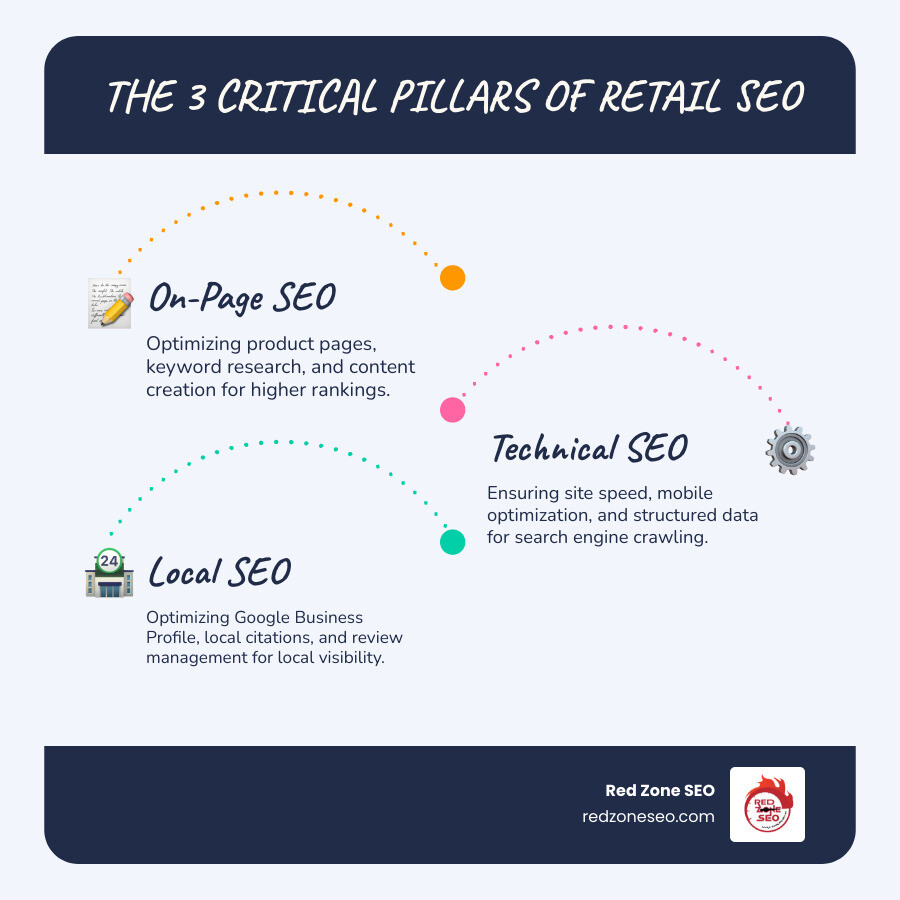
Modern retail SEO combines three critical pillars:
This creates a massive opportunity. With 76% of U.S. adults shopping on smartphones and 87% of consumers researching local businesses with Google, the potential reach is enormous for businesses that get SEO right.
Find more about seo for retail websites:
Building a successful retail website is like constructing a house: you need a solid foundation and blueprint. In SEO for retail websites, this means understanding what customers search for and creating a logical site structure that serves both visitors and search engines.
Consider a small outdoor gear retailer who targeted the broad keyword "outdoor gear" and saw no traffic. By shifting to specific terms like "lightweight camping cookware for backpacking" and "waterproof hiking boots for wide feet," their organic traffic increased by 340%. The secret was matching their products with what real customers were actually typing into Google.
Effective keyword research hinges on understanding user intent. We focus on commercial and transactional keywords—terms people use when they're ready to buy, like "best running shoes for flat feet" or "buy wireless headphones." Your secret weapon is long-tail keywords. These longer, specific phrases (e.g., "organic cotton baby onesies for sensitive skin") have lower search volume but convert at a much higher rate because the searcher's intent is so clear. The majority of Google searches are long-tail, offering a chance to outrank larger competitors.
Competitor keyword analysis reveals what's working for your rivals and uncovers gaps you can exploit. Finally, keyword mapping assigns these valuable keywords to specific pages, ensuring every page has a clear purpose. For example, a category page targets "women's running shoes," while a product page targets a specific model like "Nike Air Zoom Pegasus 40."
Tools like Google Keyword Planner provide invaluable data about search volumes and competition levels to expand your strategy.
A confusing site structure will drive customers away, just like a disorganized department store. A search-friendly site structure serves both your human customers and search engine crawlers, leading to better rankings and more sales.
Scalable architecture is crucial for growth, ensuring your site works for 10,000 products as well as it does for 100. The key is a logical hierarchy that flows from broad to specific, such as Homepage → Category → Subcategory → Product. This guides both users and search engines through your catalog.
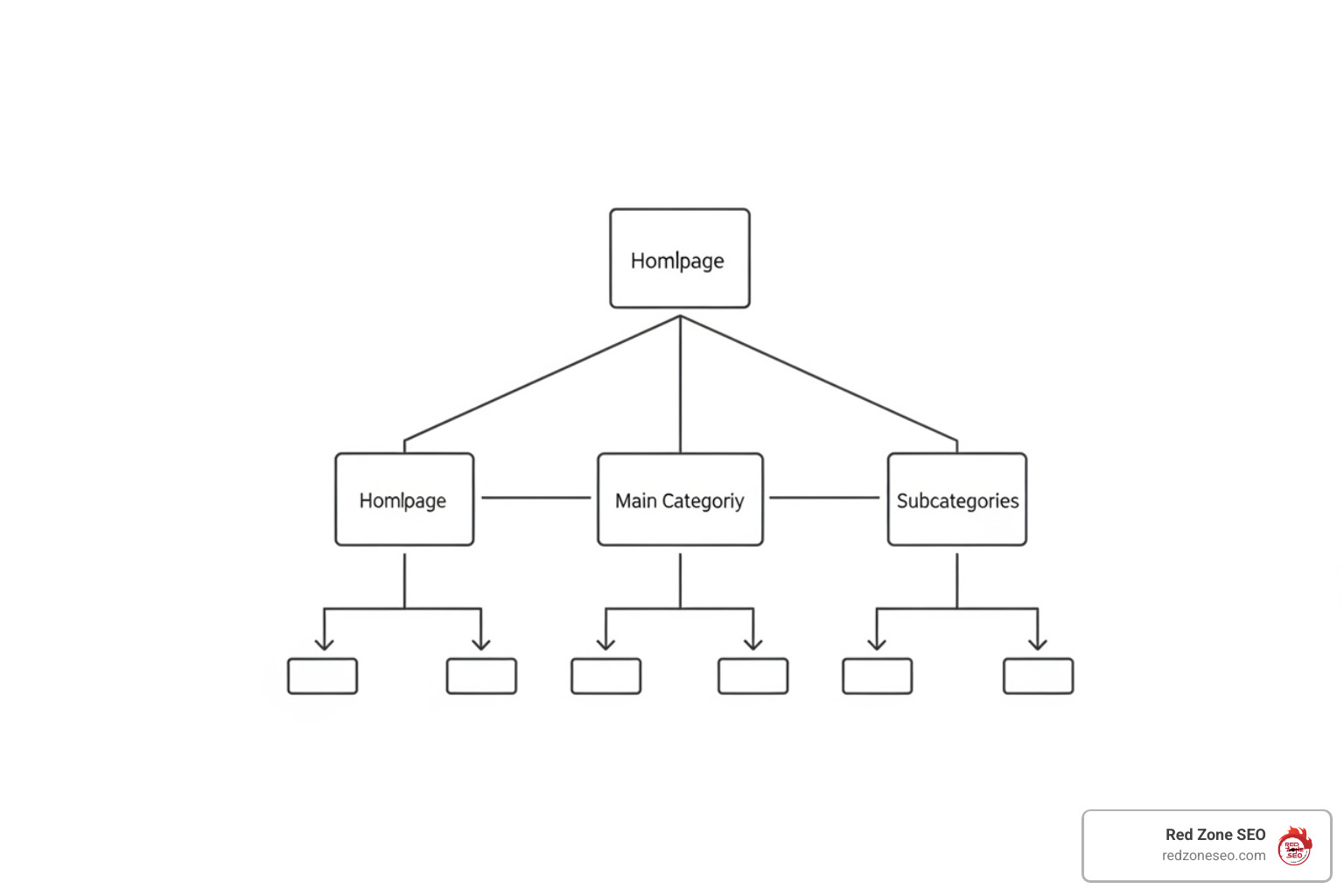
Category page optimization is vital, as these pages capture broad commercial intent from shoppers who are still browsing. Your product page structure should be consistent so customers always know where to find specs, reviews, and the buy button.
Use SEO-friendly URLs that are clean and descriptive (e.g., yourstore.com/womens-shoes/nike-air-zoom-pegasus) instead of confusing ones. Finally, breadcrumb navigation acts as a roadmap, helping users steer and creating internal links that clarify your site's structure for search engines.
Our comprehensive approach to E-commerce Site Structure & Contextual Links ensures your retail website becomes a well-organized destination that both customers and search engines love.
Think of your website as your digital storefront. When someone finds you in search results, they need to instantly understand what you sell and why they should choose you. On-page SEO for retail websites is the art of making every page work harder to attract customers and convert them into buyers.
Your product pages must charm both Google's algorithms and real humans. Avoid copying manufacturer descriptions, which Google sees as duplicate content. Instead, craft unique product descriptions that tell a story and paint a picture for customers who can't physically interact with the product. For key products, a detailed description provides immense value and ranking potential.
Your title tags are the ~60 character clickable headlines in search results. We make them strategic with "click magnet" words like "buy," "best," or "free shipping." Your meta description is your ~105 character elevator pitch to convince someone to click.
Use strategic header tags to organize content. Your H1 tag should feature your main keyword (the product name), while H2 tags can break down features and benefits. Use canonical tags to solve duplicate content issues that arise from product variations (e.g., different colors or sizes).
Social proof and reviews are game-changers. With 90% of consumers checking reviews before purchasing, they are essential for building trust. Reviews also provide fresh, keyword-rich content that helps pages rank, often incorporating valuable long-tail keywords naturally.
See these elements in action on this example of an optimized product page. For more insights, check out our guide on Content Optimization.
In retail, visuals are everything, but they can also be SEO goldmines. Every image needs descriptive alt text. This helps visually impaired users and gives context to search engines. Instead of "image1.jpg," we write descriptions like "Red leather women's handbag with gold clasp and adjustable strap."

Use SEO-friendly file names (e.g., red-leather-handbag.jpg) instead of generic ones. Crucially, image compression and modern file formats like WebP are essential for fast loading times without sacrificing quality. Optimized images can also rank in image search, creating another path for customers to find you.
Content marketing attracts customers earlier in their buying journey. Create helpful content that builds authority and trust. In-depth buying guides like "The Complete Guide to Choosing Your First DSLR Camera" and how-to articles like "How to Care for Your Leather Boots" target informational searches and position your brand as an expert.
Product video tutorials are also highly effective, as 76% of consumers have bought something after watching one. This strategy of targeting informational queries casts a wider net, building a relationship with potential customers long before they're ready to buy. Learn more with our guide to Content Marketing for Small Businesses.
Behind the beautiful photos and compelling descriptions, a whole technical world is working to ensure customers can find and use your site. Let's look at the engine that drives your retail website's success.
Technical SEO is the powerful engine that keeps your seo for retail websites running smoothly. Site speed is critical: 53% of users abandon slow sites that take more than three seconds to load. We use tools like Google's PageSpeed Insights to diagnose and fix speed issues.
Google measures user experience with Core Web Vitals: Largest Contentful Paint (LCP) for loading speed, Interaction to Next Paint (INP) for responsiveness, and Cumulative Layout Shift (CLS) for visual stability. Meeting these metrics is key to good rankings.
Google now uses mobile-first indexing, meaning it primarily ranks your site based on its mobile version. A flawless responsive design is non-negotiable. SSL certificates (HTTPS) are also essential to secure customer data and improve rankings. Finally, an XML sitemap acts as a directory for search engines, helping them efficiently find all your product pages. Our E-commerce SEO Audit Checklist covers these technical foundations.
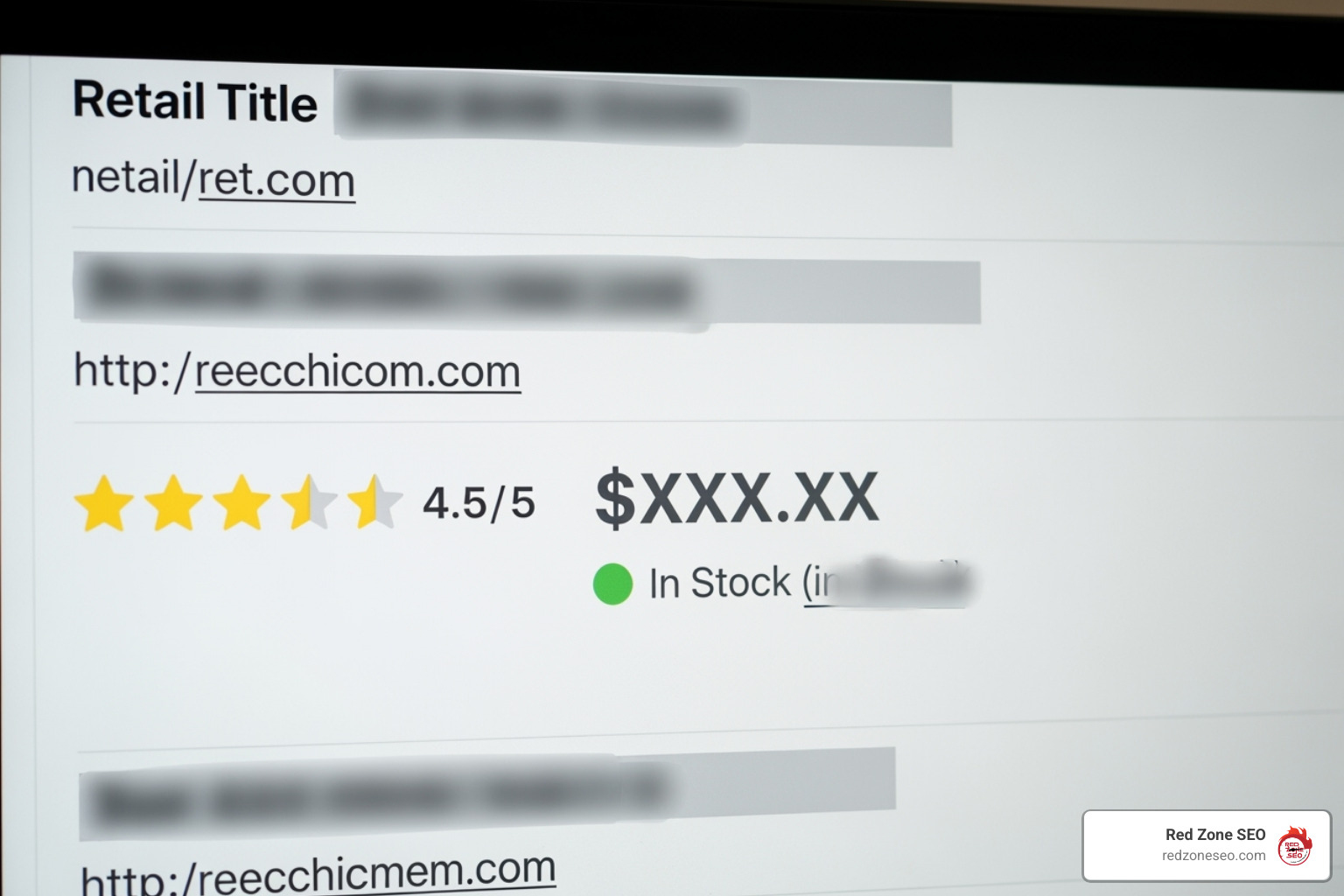
Structured data (or schema markup) is code that gives your search listings superpowers, allowing them to show prices, star ratings, and availability directly in the results. For retail, this is incredibly powerful. Product schema (for item details), Review schema (for star ratings), and Local Business schema (for store info) are vital.
This turns your listings into rich snippets—improved search results that stand out from the competition. The result is a significantly higher click-through rate (CTR). We always validate our implementation using the Schema Markup Validator to ensure everything works perfectly.
Google rewards sites that provide a great user experience. Simple navigation and clear calls-to-action (CTAs) are foundational. With 76% of U.S. adults shopping on smartphones, mobile usability is paramount for modern seo for retail websites.
Google also monitors user behavior signals like dwell time (how long people stay) and bounce rate (how many leave after one page). A positive user experience signals value to Google, which often correlates with better search rankings over time. Our expertise in Shopify Store SEO emphasizes creating websites that are not just search-engine friendly, but genuinely enjoyable for people to use.
If your perfectly optimized website sits on an island, it won't reach its full potential. Off-page and local SEO build your reputation across the web and ensure nearby customers can find your physical store.
Backlinks are digital endorsements. When other reputable websites link to yours, they're vouching for your credibility, and Google takes notice. Link building strategies are about earning these endorsements, where quality trumps quantity every time.
Digital PR involves creating newsworthy content or stories that naturally attract media attention and high-quality links. Thoughtful guest blogging on relevant sites your customers read can also drive traffic and authority. We also find unlinked brand mentions across the web and request that a link be added. Our focus is always on earning links from established, high domain authority websites to protect and build your reputation.
For physical stores, local SEO is critical for survival. With 87% of consumers using Google for local business research, you need to be visible for "near me" searches.
Your Google Business Profile (GBP) optimization is your digital storefront's front window. It's often the first impression a customer has and must be complete and accurate. A complete GBP includes your accurate name, address, and phone number (NAP), business categories, website, hours, products, and high-quality photos. NAP consistency across all online directories (like Yelp) is crucial for building trust with search engines.
Create geo-targeted content, like blog posts about local events, to improve local rankings and connect with your community. Finally, actively manage online reviews by encouraging happy customers and responding professionally to all feedback, as reviews directly impact whether someone chooses to visit your store.
We've seen the same avoidable mistakes in SEO for retail websites repeatedly. Here's how to steer clear of them:
We get many questions about seo for retail websites. Here are the most common ones, with straight answers to help you make informed decisions.
While both aim for search visibility, e-commerce SEO is unique. It focuses on optimizing hundreds or thousands of product pages at scale. Each page targets specific, transactional keywords (e.g., "buy Nike running shoes online") to drive sales. Structured data is also more critical in e-commerce to generate rich snippets with prices, stock status, and reviews in search results, which directly impacts click-through rates.
SEO is not an overnight fix, so it's crucial to set realistic expectations. Most businesses begin to see initial traction—improved rankings and more organic traffic—within 4-6 months. However, SEO is an ongoing, long-term strategy. The real value comes from consistent effort, as the results have compounding returns over time. Think of it as an investment that grows stronger, building on itself to create sustainable growth.
The cost of retail SEO varies. Key factors influencing cost include the scope of work (a local boutique vs. a national retailer), the level of market competition, and your website's current technical health. You can build an in-house team or work with an agency like Red Zone SEO, which gives you access to a full team of experts without the overhead. We provide data-driven, proven solutions custom to your business goals, focusing on delivering a strong return on your investment. For more details on local optimization costs, see our guide on Local SEO Cost.
We've covered the essentials of SEO for retail websites, from keyword research and site architecture to technical, on-page, and local strategies. While it may seem like a lot, every successful online retailer started on this same path.
SEO is a crucial, long-term investment that builds sustainable growth. Unlike paid ads, which stop when you stop paying, organic traffic is an asset that compounds over time. These visitors are highly valuable because they are actively searching for solutions you provide, leading to higher conversion rates and a stronger return on investment.
A data-driven approach removes the guesswork from marketing. We measure what's working to continuously refine your strategy for maximum impact. At Red Zone SEO, we've seen this approach transform businesses, like the electronics store whose sales jumped 127% after implementing a targeted SEO strategy.
Your customers are searching for you right now. The question is, will they find you or your competitors? Whether you run a boutique in Austin, have stores across Florida, or operate a national e-commerce site, the principles of being found online are the same.
Ready to transform your retail website from invisible to irresistible? The digital aisle is waiting. Don't let potential customers slip away.
Contact us today to build a winning strategy for your retail business. Let's conquer the digital marketplace together.