Why technical seo is important is a critical question for any business with an online presence. The answer is straightforward: technical SEO is the invisible foundation that allows search engines to find, understand, and rank your website. Without it, even the best content and backlinks will fail to deliver results, like a beautiful house built on quicksand.
Technical SEO directly impacts:
Consider that mobile devices account for more than half of all internet traffic, and if a website takes more than three seconds to load, most people will leave. These statistics highlight that technical SEO isn't just for search engines; it's for your customers. A solid technical foundation makes every other marketing effort more effective.
Simple why technical seo is important word guide:
Imagine building a beautiful house with stunning design, only to find the foundation is cracked and the plumbing is faulty. No matter how great it looks, it's fundamentally flawed. This is what happens when a website ignores technical SEO. Why technical seo is important becomes clear when you see it as the foundation that makes your content and link-building efforts succeed.
Technical SEO involves optimizing your website's infrastructure so search engines can efficiently crawl, index, and render your content. Without this, your brilliant content strategy will struggle.
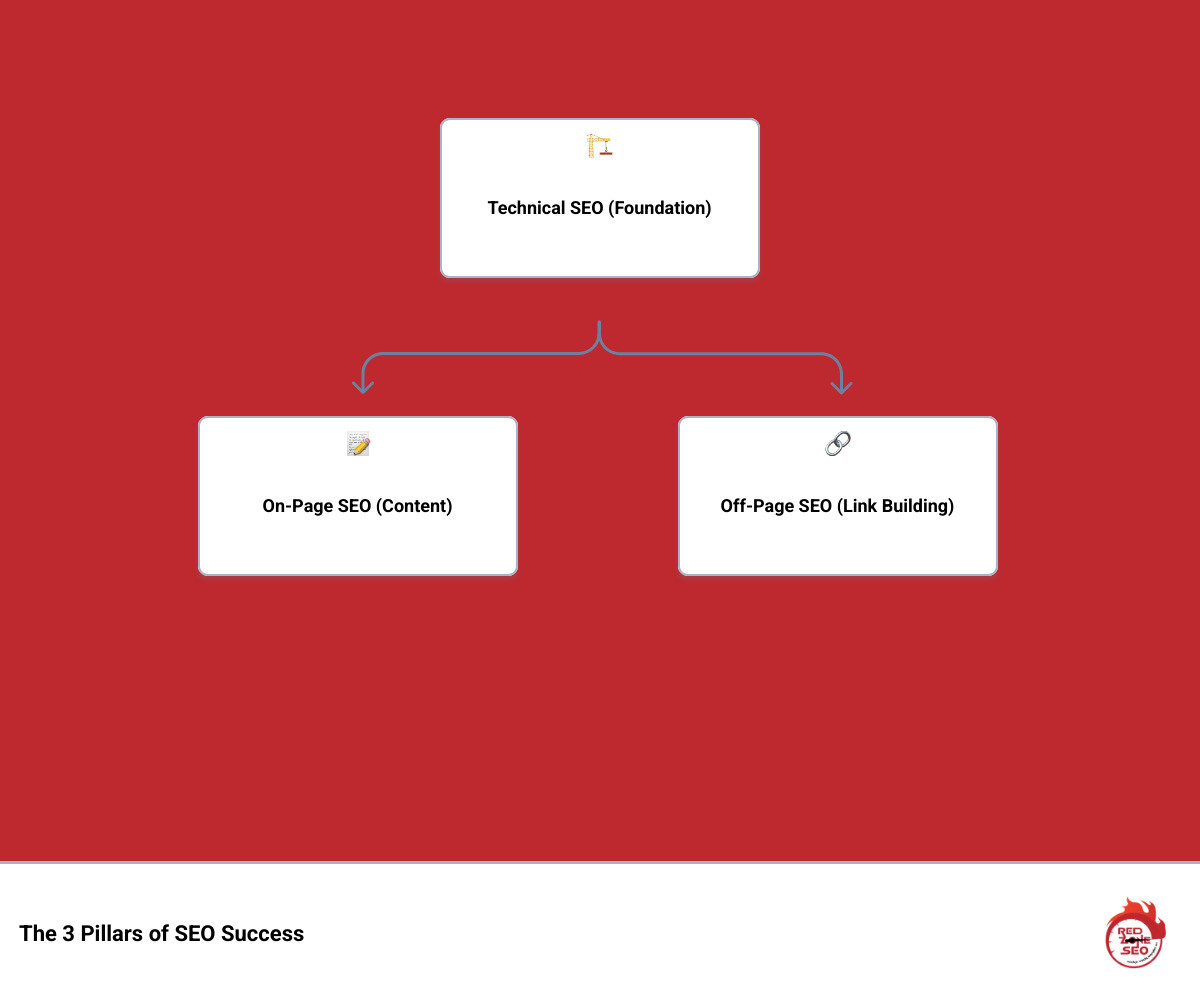
To understand technical SEO's role, it's helpful to see how it fits with the other two pillars of SEO:
On-Page SEO: This involves optimizing elements on your actual web pages. It includes keyword research, writing compelling headlines and meta descriptions, and creating high-quality content. Think of it as furnishing the rooms in your house. Our On-Page SEO Definition guide covers this in detail.
Off-Page SEO: This refers to actions taken outside of your website to build authority and trust. The primary component is link building—earning links from other reputable sites. Social media mentions and online reviews also contribute. This is like building your reputation in the neighborhood.
Technical SEO: This is the foundation supporting both on-page and off-page efforts. It covers site speed, mobile-friendliness, security, and site architecture. If your technical SEO is poor, it's like having an unstable foundation that prevents visitors from safely entering your beautifully decorated house.
Even with perfect on-page SEO and great backlinks, technical issues can render those efforts worthless. That's why technical seo is important—it enables everything else.
Search engines like Google use automated programs called crawlers (or Googlebot) to find content. They follow links from site to site to find new pages. This findy process is called crawling.
After crawling, Google must process and understand the page's content, a process called rendering. Finally, it stores this information in a massive database called the search index. This indexing process makes your page eligible to appear in search results. If a page isn't indexed, it's invisible to searchers.
Technical SEO helps manage this process with key tools:
Robots.txt: This file tells crawlers which parts of your site to access or ignore, helping you manage your crawl budget—the resources Google allocates to crawling your site. As Google notes in their guide on What crawl budget means for Googlebot, this is especially vital for large sites.
XML Sitemaps: This is a list of all important URLs on your site that you want search engines to index. Submitting a sitemap via Google Search Console helps Google find your content efficiently.
Google Search Console: This free tool is your direct line of communication with Google. It reports on crawl errors, indexing status, and other technical health issues, providing invaluable insights into how Google sees your site.
If search engines can't crawl and index your site properly, all other SEO work is wasted. This is the fundamental reason why technical seo is important.
Now we know what technical SEO is, let's explore why technical seo is important for your search rankings. It's not an optional feature; it's a make-or-break factor that determines whether your business gets found online.
Search engine algorithms aim to deliver the best user experience. Technical SEO directly influences how well your site aligns with this goal. A technically sound website gets its content found faster, grows traffic more predictably, and converts visitors into customers more effectively.
Imagine clicking a search result only to find a page that takes forever to load. You'd hit the back button immediately. This scenario highlights why technical seo is important for user engagement.

Page Speed: A confirmed Google ranking signal. Research shows a 3-second load time can increase bounce rate by 32%. Slow sites lead to high bounce rates, signaling a poor user experience to Google.
Mobile-Friendliness: With more than half of all internet traffic comes from mobile devices, Google uses mobile-first indexing. This means the mobile version of your site primarily determines your ranking.
Site Navigation: Clear navigation helps users find what they need and helps search engines understand your site's structure.
Trust is built on concrete technical signals. Both users and search engines look for signs that your website is secure and legitimate.
HTTPS and SSL: Google has used HTTPS as a ranking signal since 2014. The padlock icon builds user confidence and is essential for data protection.
Website Security: A secure, malware-free site is fundamental. A hack can destroy user trust and cause rankings to plummet.
These elements contribute to Google's E-A-T (Expertise, Authoritativeness, Trustworthiness) framework. A fast, secure site sends powerful trust signals.
Technical SEO drives business results and a strong return on investment (ROI).
Higher Rankings & Traffic: Removing technical roadblocks clears the path for your content to rank higher, leading to more increased organic traffic.
Improved Conversions: A smooth, fast user experience encourages visitors to take action, leading to better lead quality and more conversions.
Competitive Advantage: Many businesses neglect their technical foundation. By prioritizing it, you gain a significant edge. When combined with strong off-page strategies like link building, a technically optimized site delivers far greater value.
The bottom line is that why technical seo is important comes down to building sustainable business growth.
Building a technically sound website means creating a digital foundation that both search engines and users can rely on. That's why technical seo is important—without these core components, even the best marketing efforts fall flat.

Slow websites lose customers. To measure user experience, Google introduced Core Web Vitals (CWV) as ranking factors:
To improve these metrics, focus on technical optimizations like image compression, enabling browser caching, code minification (removing unnecessary characters from code), and using a Content Delivery Network (CDN) to serve assets from locations closer to the user. Use Google's PageSpeed Insights tool to monitor performance.
Google now primarily uses the mobile version of your site for ranking, a practice called mobile-first indexing explained. This means your mobile site is not just an alternative; it is the most important version of your site for SEO.
Responsive design is the industry standard, allowing your site's layout to automatically adapt to any screen size. Key technical elements include using the meta viewport tag to instruct the browser on how to control the page's dimensions and scaling. Beyond that, good mobile usability means ensuring tap targets (like buttons and links) are large enough to be easily pressed, and that text is readable without zooming. You can test your site's mobile performance with Google's Mobile-Friendly Test.
A well-organized site is easier for users and search engines to steer and understand. A logical structure helps distribute authority (or "link equity") throughout your site and establishes topical relevance.
/services/technical-seo) instead of cryptic ones with numbers and parameters (e.g., /cat.php?id=54&sid=987).Structured data is a standardized format of code (often JSON-LD) that you add to your pages to help search engines understand your content in greater detail. This understanding can lead to rich snippets in search results—improved listings that stand out and can significantly improve click-through rates.
Google supports dozens of structured data markups for different content types. Popular and effective types include:
Tools like the Schema Markup Generator can help you create the necessary code, which should then be validated with Google's Rich Results Test to ensure it's implemented correctly.
Even well-built websites develop technical issues over time. Regular maintenance is key, but knowing how to troubleshoot common problems can prevent them from sabotaging your rankings.

Crawl errors are roadblocks that stop search engines from accessing your content. The most common types are:
Use the Coverage report in Google Search Console for crawl issues to find these errors. For pages that have moved permanently, use 301 redirects to pass ranking power to the new URL. Regularly audit and fix broken internal links to prevent dead ends for users and crawlers.
Duplicate content doesn't cause a direct penalty, but it confuses search engines about which version of a page to rank. This dilutes your ranking signals and wastes your crawl budget. Common causes include:
http://, https://, www., and non-www.). You should choose one canonical version and use 301 redirects to consolidate the others.Staging or Development Sites: If your test site is accidentally indexed by Google, it can create site-wide duplication.
Canonical Tags: The primary solution is the canonical tag (rel="canonical"). It tells search engines which URL is the master version of a page. Every page should have a self-referencing canonical tag to prevent issues.
For websites serving multiple countries or languages, you need to ensure the right content reaches the right audience.
Getting hreflang implementation right is critical for global SEO. Tools like Aleyda Solis' Hreflang Generator Tool can help. Proper international SEO is why technical seo is important for global growth.
A technical SEO audit is like a health check-up for your website. It helps you find and fix issues that could be harming your rankings. Understanding why technical seo is important becomes clear when you see what an audit can uncover.
Essential tools for an audit include Google Search Console, Screaming Frog SEO Spider, Google PageSpeed Insights, and comprehensive tools like Ahrefs or Semrush Site Audit. For complex websites or if you lack the time, consider seeking professional SEO audit services.
Use a tool like the Screaming Frog SEO Spider to crawl your site just as a search engine would. Enter your URL and start the crawl. This process helps you:
Next, ensure Google can find and store your important pages.
Finally, check the technical elements that impact user experience and on-page optimization.
Technical SEO can seem complex, but understanding the basics is crucial. Here are answers to some of the most common questions we receive at Red Zone SEO.
It depends on your website's size and complexity:
Yes, to an extent. Many basic fixes are manageable, especially with the right tools, but it's important to know your limits.
This is a common point of confusion. Here's a simple way to think about it:
Both are essential, but technical SEO is the prerequisite. Your on-page efforts, including content optimization, can only succeed on a solid technical foundation. That's why technical seo is important—it enables all other SEO activities to be effective.
Think of your website as a house. You can have beautiful decor (content) and a great reputation (backlinks), but if the foundation is cracked, the entire structure is at risk. That's exactly why technical seo is important—it's the invisible but essential foundation for all of your digital marketing efforts.
Technical SEO is not a one-time fix but a continuous process of improvement. Every crawl error you fix and every millisecond you shave off your load time contributes to a better user experience. This, in turn, is rewarded by search engines with increased rankings and traffic, creating a positive feedback loop that drives business growth.
Your competitors might be focused on the more visible aspects of SEO, but by ensuring your technical foundation is solid, you gain a powerful competitive advantage. A fast, secure, and well-structured website allows your content to shine and your marketing investments to reach their full potential.
Start with the basics: check your site speed, fix crawl errors, and ensure your site is mobile-friendly. These foundational improvements can make a significant difference.
If you want to ensure your website is built on the strongest possible foundation, investing in technical excellence is a game-changer. By turning your technical foundation into a competitive advantage, you can build sustainable success on a solid, unshakeable digital base.