What are on page seo factors that can make or break your website's search engine rankings? On-page SEO refers to the practice of optimizing elements on your website that you can directly control. This includes everything from the quality of your content and the structure of your HTML to your site's technical performance and the overall user experience.
The main on-page SEO factors include:
On-page SEO is critical because many of the signals Google uses to rank web pages come directly from these on-page elements. Think of it as your website's foundation; without solid on-page optimization, achieving strong search rankings is nearly impossible.
The good news is that unlike off-page factors like backlinks, on-page SEO is completely within your control. By understanding which elements matter most, you can start improving them today to improve your site's ability to rank for both search engines and human visitors.
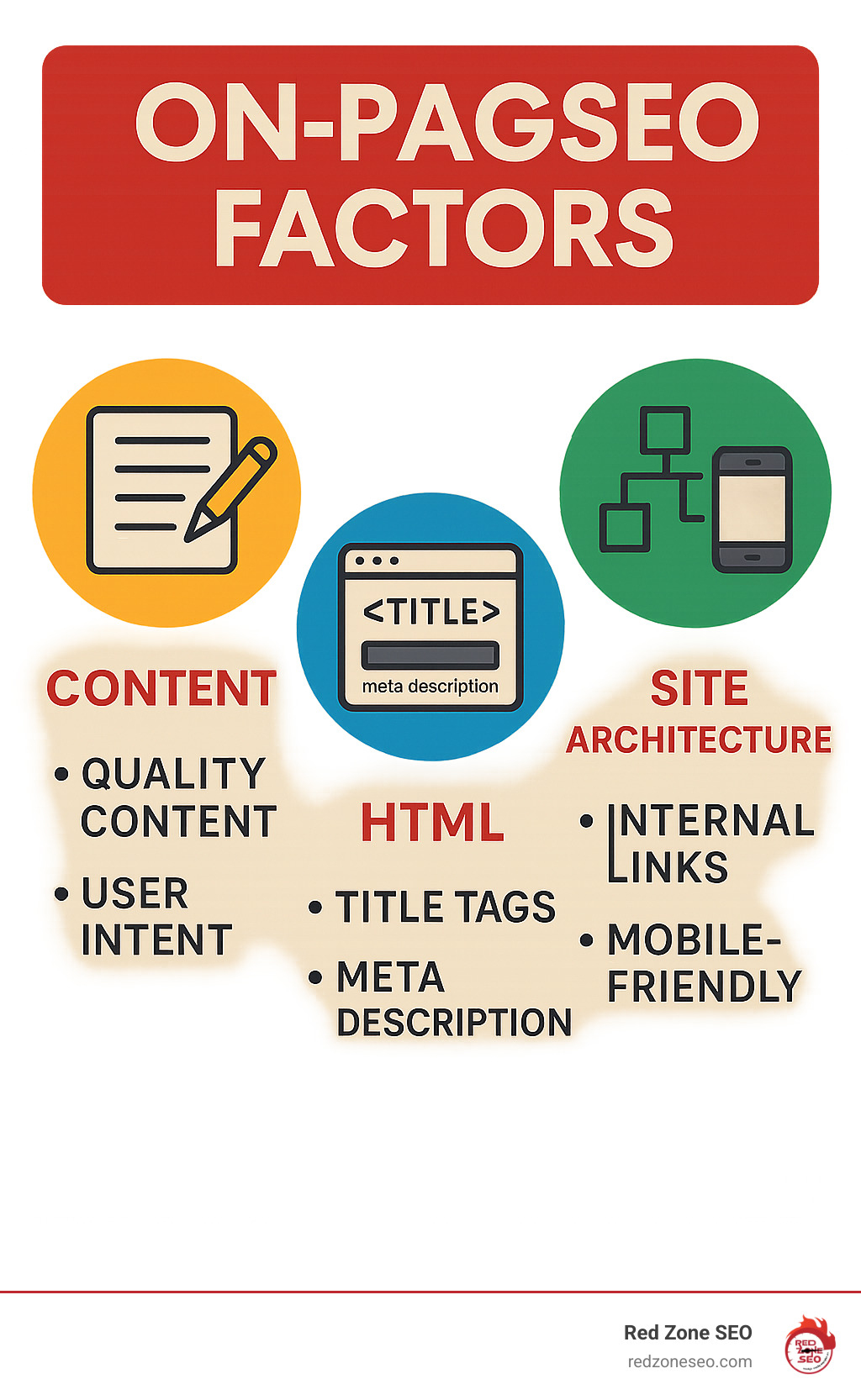
What are on page seo factors terms to know:
Content is the heart of your website. Without engaging, valuable content that speaks directly to your visitors' needs, even the most technically perfect website won't attract or keep customers. Modern SEO isn't about tricking search engines; it's about genuinely helping people find what they're looking for. When someone searches online, they have a specific goal, and your job is to provide the solution.
This is where content quality and user intent become crucial. Gone are the days of keyword stuffing. Today's approach focuses on understanding the underlying reason for a search query. We start with thorough keyword research to understand the language your customers use, then craft content that is both useful and natural.
Google's E-E-A-T (Experience, Expertise, Authoritativeness, and Trustworthiness) guidelines are central to this. You must demonstrate genuine knowledge, back up claims with data, and build trust. We also focus on readability with short paragraphs and clear subheadings, ensure content freshness by keeping information current, and use visual assets like images and videos to improve engagement.
Creating content that resonates means sharing information that is interesting, helpful, and comes from a place of real knowledge. This is the essence of Google's people-first content philosophy.
Our content creation is guided by E-E-A-T:
Google's helpful content guidelines ask a simple question: "Is this genuinely useful to humans?" The best content offers something new, whether it's original research, a unique perspective, or a more comprehensive resource. While there's no magic content length, we aim for at least 500 words to provide comprehensive coverage, ensuring every word earns its place. This approach forms the foundation of our SEO Content Strategies.
Keywords are the bridge connecting what people search for with the solutions you provide. Our Keyword Research process is about understanding intent, not just search terms.
Keyword placement still matters. We include the target keyword within the first 100-150 words and sprinkle variations throughout conversationally. As Google's "How Search Works" report confirms, keywords remain a basic signal for relevance. The key is using natural language that matches how real people search and speak.
Content relevance is fundamental. Your content must align with what a searcher is actually looking for.
Search intent alignment means understanding the four main types of queries:
To ensure relevance, we provide comprehensive answers that cover related subtopics. We structure content with descriptive subheadings that mirror search queries, leading with the answer and then providing supporting details. This creates a satisfying user experience that leads to higher rankings.
Think of HTML elements as the structural blueprint for your content. While visitors see the polished design, Google's crawlers read the HTML code to understand what's important and how your content is organized. What are on page seo factors that matter most to search engines? Your HTML elements are crucial because they are the road signs that guide crawlers.
Optimizing HTML serves a dual purpose: it helps search engines understand your page, which can improve rankings, and it directly influences your Click-Through Rate (CTR) from search results. Your title tag and meta description are often a user's first impression. Getting this structure right is foundational work we examine in every SEO Audit.
Your title tag and meta description are your digital storefront window. They are often the first thing potential visitors see in search results.
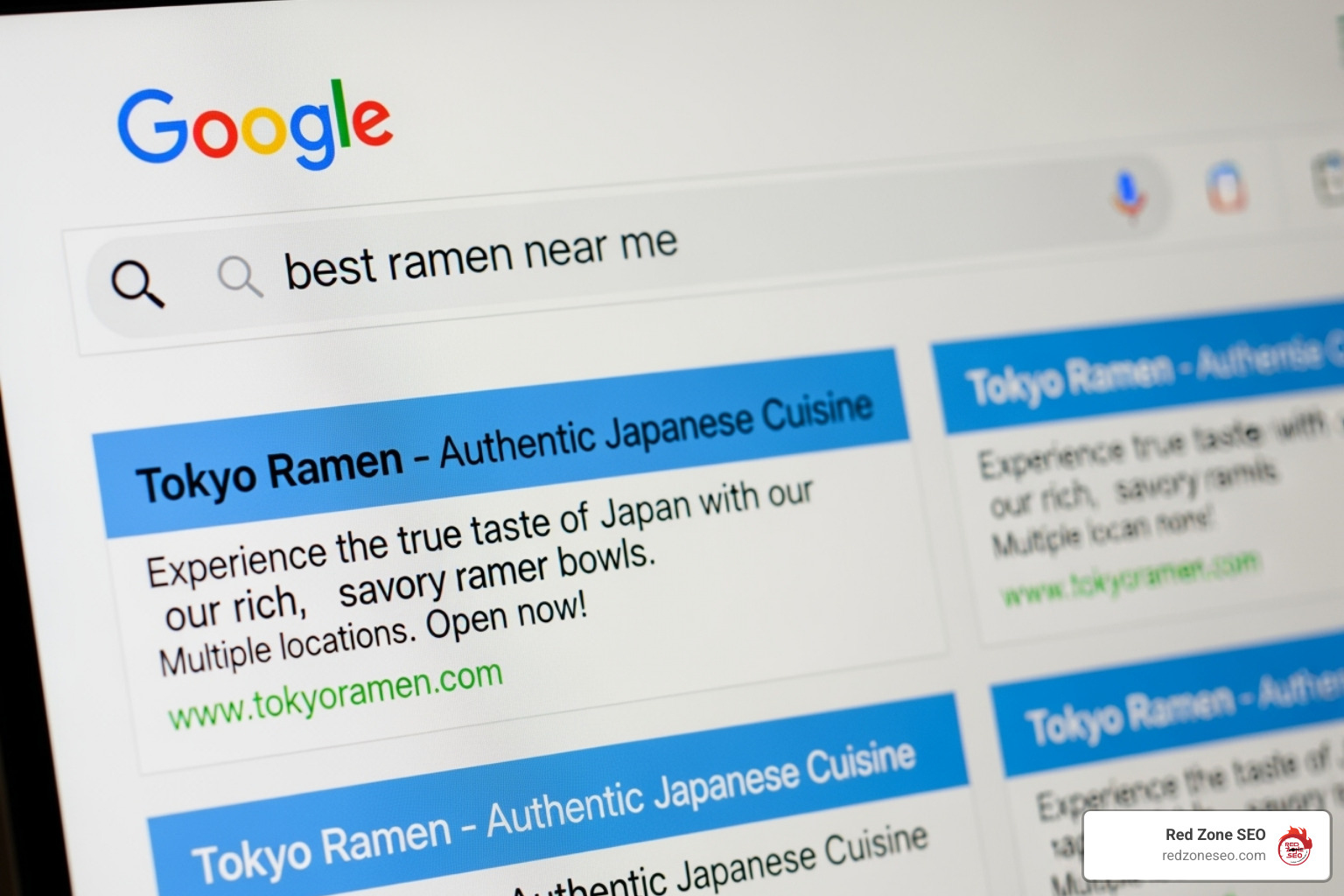
Title tags are a significant ranking factor, appearing as the blue clickable headlines in search results. We craft titles to be between 50 and 60 characters to avoid being cut off. Each title should be unique, include the primary target keyword near the beginning, and accurately describe the page's content.
Meta descriptions are not a direct ranking factor but are critical for attracting clicks. They are your 160-character elevator pitch. We write them to be between 120-160 characters, include the target keyword naturally, use active voice, and often include a clear call to action.
Headings (H1, H2, H3, etc.) act like chapter titles, guiding readers and search engines through your content and establishing a clear hierarchy.
Your H1 tag is the main headline; there should be only one per page. It should contain your primary keyword and state the page's topic. Google's guidance on H1 tags confirms their importance. H2 tags introduce major subtopics, and H3 tags break those down further.
This structure makes content skimmable, which is crucial as most users scan a page before committing to reading it. Well-crafted headings improve user experience and help Google understand the relationship between different content sections. Using keywords naturally in subheadings provides additional context about your content's depth.
Images improve user engagement and are powerful SEO tools when optimized correctly.
Image alt text is a written description that serves three purposes: it displays if an image fails to load, is read by screen readers for visually impaired users, and provides context to search engines. We write descriptive alt text under 125 characters, including relevant keywords naturally.
Other key optimizations include:
on-page-seo-factors.png instead of IMG_001.png to give search engines context.Making your site accessible is not just good practice; it's smart SEO that aligns with Google's focus on user experience.
Your website's architecture is the technical foundation upon which your content and design rest. When we discuss what are on page seo factors for site architecture, we're focusing on how your site is structured and optimized for users and search engines. A slow, confusing, or mobile-unfriendly site will struggle to rank, regardless of content quality.
Site architecture directly impacts critical areas Google evaluates: user experience (UX), crawlability (can Google find your content?), and indexability (can your pages be added to search results?). Technical performance, especially site speed and mobile-friendliness, are confirmed ranking factors. Improving your site's architecture can deliver dramatic results. Our guide on How to Conduct a Technical SEO Audit can help you identify key areas for improvement.
URLs are the addresses for your web pages and should be clear, logical, and easy to understand for both humans and search engines.

Follow these best practices for URL structure, as advised by Google's advice on simple URLs:
yourwebsite.com/on-page-seo-factors is far better than yourwebsite.com/page?id=12847.-), not underscores (_), as Google treats hyphens as word separators./seo-guide/ are better than /2024-seo-guide/ because they don't need to be changed when the content is updated.Links are the highways of the internet. A strategic linking plan is crucial for on-page SEO.
Internal links connect pages on your own website. They help search engines find new content and understand your site's structure. They also distribute link equity (ranking power) from strong pages to other pages on your site. For users, internal links guide them to related content, improving engagement and reducing bounce rates. Always use descriptive anchor text (e.g., "learn about our SEO services") instead of generic phrases like "click here."
External links point from your site to other websites. Linking to high-quality, authoritative sources shows Google that your content is well-researched and trustworthy. It also provides additional value to your readers. The key is to link out judiciously to relevant, credible resources. Our comprehensive SEO services cover both internal and external linking strategies.
Page speed is a confirmed ranking factor. Slow websites frustrate users and hurt rankings. Google's Core Web Vitals are metrics designed to measure real-world user experience.
The three core vitals are:
You can check your site's performance with the Google PageSpeed Insights tool. Common fixes include compressing files, optimizing images, and leveraging browser caching.
With mobile search volume far surpassing desktop, Google now uses mobile-first indexing. This means it primarily uses the mobile version of your site for indexing and ranking. If your site isn't mobile-friendly, your rankings will suffer on all devices.
Responsive design is Google's recommended approach. It allows your website to automatically adapt its layout to fit any screen size, from smartphones to desktops. This ensures a consistent and positive user experience everywhere.
A good mobile user experience includes touch-friendly navigation, readable text without zooming, and fast loading times. As stated in Google's mobile-first indexing announcement, a mobile-optimized site is no longer optional—it's the foundation of a modern online presence.
Once you've mastered the fundamentals of what are on page seo factors, advanced strategies can provide a significant competitive advantage. These techniques help you earn special search features, attract local customers, and give search engines richer context about your content. Our SEO for Small Business services are designed to incorporate these tactics effectively.
Rich results are improved search listings that display extra information like star ratings, prices, or event dates. They grab attention and can significantly boost your click-through rate (CTR).
The key to earning rich results is schema markup, a type of code that helps search engines understand your content more deeply. By using vocabulary from Schema.org, you can explicitly label elements on your page. While not a direct ranking factor, schema makes your listings more visible and informative.
Common schema types include:
You can test your implementation with Google's Schema Markup Validator to ensure it's working correctly.
Featured snippets are the answer boxes that appear at the very top of search results, often called "position zero." Winning a featured snippet can drive a significant amount of traffic.
Snippets come in several formats, including paragraphs, lists, and tables. The strategy for capturing them involves:
By creating content that serves as the definitive answer to a specific query, you increase your chances of being featured.
For local businesses, specific on-page factors can attract nearby customers who are ready to buy.
Our Local SEO Packages integrate these on-page signals to help businesses dominate their local markets.
Here are concise answers to some of the most common questions we receive about on-page SEO.
The time it takes to see results varies. Google can index changes in hours or days, but significant ranking improvements depend on factors like your website's authority, the competitiveness of your keywords, and your site's technical health. While some initial improvements may appear within weeks, substantial organic traffic growth typically takes several months. On-page SEO is an ongoing effort—a marathon, not a sprint.
While they overlap, they have different focuses. On-page SEO concentrates on the content and HTML elements of individual pages to make them relevant for specific queries (e.g., content quality, keywords, title tags). Technical SEO focuses on the site-wide infrastructure to ensure it's accessible, fast, and easy for search engines to crawl and index (e.g., site speed, mobile-friendliness, sitemaps).
Think of it this way: technical SEO is building a solid house foundation, while on-page SEO is furnishing and decorating each room to be useful and welcoming.
Absolutely. Many on-page SEO basics are accessible and can be implemented with the help of free tools like Google Search Console and various online SEO checkers. You can make significant progress by improving titles, content, and image alt text.
However, hiring an expert becomes valuable when you're in a competitive market or lack the time to keep up with Google's constant updates. At Red Zone SEO, we use data-driven strategies and premium tools to identify opportunities and achieve measurable results, allowing you to focus on running your business.
Understanding what are on page seo factors is the key to open uping sustainable online growth. It's not about a single trick, but a holistic strategy that blends high-quality content, flawless technical execution, and a user-centric design.
Your success hinges on three core pillars:
On-page SEO is not a one-time task; it's an ongoing process of refinement and adaptation. As search engines evolve and user behavior shifts, your strategy must evolve too. Advanced tactics like schema markup and featured snippet optimization can provide a powerful competitive edge.
At Red Zone SEO, we use data-driven strategies to measure impact and continuously refine our approach, ensuring your on-page efforts translate into real, measurable business results. We understand the intricate dance of on-page factors and how they work together to drive visibility and revenue.
Ready to see what a professionally optimized on-page strategy can do for your business? Let us map out a clear path to better rankings and more traffic.
Get a comprehensive SEO audit for your Las Vegas business today, or connect with our team to build your online success story, one optimized page at a time.