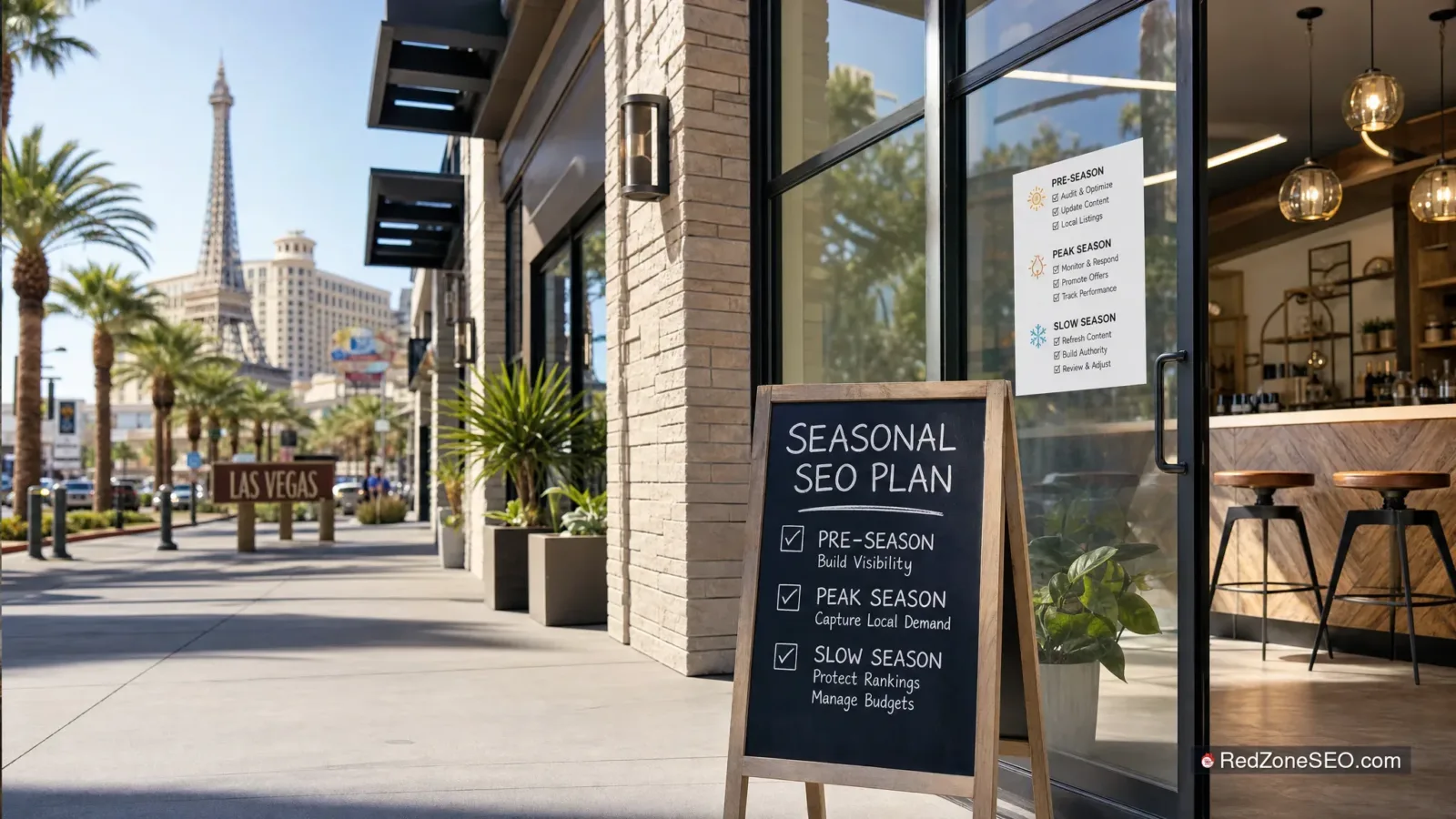
Seasonal local SEO in Las Vegas is not only for businesses that rely on holidays or tourist traffic. Many local service businesses experience predictable shifts in demand based on weather, conventions, school schedules, moving seasons, local events, and customer buying habits across Clark County.
A contractor may receive more calls before extreme summer heat. A cleaning company may see demand change around move-in periods. A local business serving events, hospitality, property managers, or residents may experience a surge when convention activity rises. Then there are slower months, when the phone is quieter and it is tempting to pause every marketing effort.
That is where a practical Las Vegas local SEO plan matters. Search visibility is not built only when demand is already high. The stronger approach is to prepare before demand peaks, keep local information accurate while customers are actively searching, and use slower periods to improve the pages and local signals that support future growth.
Local SEO helps a business appear when people search for a nearby provider, a service in a specific city, or an immediate solution. In Las Vegas, those searches can shift quickly. A business may see different demand from local residents, visitors, property owners, and organizations depending on the time of year.
This does not mean every Las Vegas business should build a new campaign around every event or season. It means the business should understand the periods when prospective customers are most likely to search, what they search for, and which pages need to be useful before those searches increase.
For example, a local service provider may notice that calls rise before a predictable busy season. If the company waits until that week to update service pages, request reviews, fix Google Business Profile details, and publish helpful content, there may not be enough time for those improvements to gain traction. SEO gains compound over time; they are not an instant switch for guaranteed rankings or lead volume.
Seasonality affects several parts of Las Vegas business SEO:
A seasonal plan should be based on real business patterns, not assumptions about the Las Vegas market. A company serving Summerlin may see a different pattern than one focused on Downtown Las Vegas, Henderson, North Las Vegas, or a wider Clark County service area. The goal is not to predict exact lead numbers. It is to use past evidence to decide what work should be scheduled first.
For a broader explanation of where local work fits beside wider organic visibility efforts, read Local SEO vs. Traditional SEO: What Las Vegas Businesses Should Focus On.
Before building a local SEO content calendar, identify what “seasonal” actually means for your business. A busy season may last several months, occur around a recurring event period, or show up as a short spike in phone calls. It is important to separate what you feel is busy from what your records show.
Small businesses do not need a complicated forecasting model to start. Review the last year or two of available information and look for repeat patterns. Useful sources include:
Search Console and lead data are especially useful together. Search data can show when visibility or interest changes, while lead records show whether that attention turns into meaningful inquiries. A rise in impressions without inquiries may point to an unclear page, a poor match between search intent and content, or a weak next step. A rise in calls with limited website traffic may indicate that your Google Business Profile deserves more attention.
Do not rely on a single metric. A service page could receive fewer visits but generate better leads than a general blog post. Similarly, a large jump in branded searches may reflect existing customer awareness rather than a new opportunity to reach local searchers.
Next, list the services that matter most during each period. Then identify the local areas that are genuinely relevant to those services. A Las Vegas business should not create city pages merely to mention every neighborhood in Southern Nevada. Each page needs a real purpose, useful details, and an honest description of the service area.
For example, if a business serves Las Vegas and Henderson, it may need distinct location-focused information when customers in those markets have different needs, service logistics, or demand cycles. The company should still keep core facts consistent: business name, phone number, primary services, hours, and policies should not conflict from one page or profile to another.
A basic planning table can be enough:

This creates a working local SEO content calendar rather than a collection of disconnected blog ideas.
The most important seasonal SEO work usually happens before customers begin searching at full volume. How far ahead depends on the website’s starting point, competition, the amount of work needed, and how established the business is online. For many businesses, planning several months ahead is more realistic than trying to make changes days before a rush.
A business with accurate listings, strong core pages, and a maintained Google Business Profile may be able to focus on targeted updates. A business with missing service information, thin location pages, inconsistent contact details, or technical site problems needs more lead time. No responsible provider should promise rankings by a seasonal deadline.
Start with the pages closest to revenue. A limited-budget business should generally prioritize its main service page, its most relevant location page, accurate Google Business Profile details, and technical basics before commissioning a large volume of seasonal articles.
For instance, if a Clark County service company has one page describing its primary service but the page does not explain who it serves, what areas it covers, how to request service, or what makes the offering relevant during the upcoming season, improving that page is usually more valuable than producing several broad posts.
Seasonal keyword research can uncover useful questions, but it should not lead to duplicate pages such as “summer service in Las Vegas,” “fall service in Las Vegas,” and “winter service in Las Vegas” when each page says nearly the same thing. Thin, repetitive pages make the site harder to maintain and less useful for customers.
Instead, use seasonality where it adds real value. A page can explain seasonal preparation, common timing concerns, scheduling considerations, local conditions, or service-specific questions. Update an existing strong page when the information belongs there. Create a new page only when there is a distinct customer need and enough helpful material to support it.
A practical content plan might include:
Businesses looking for a baseline framework can also review Effective Local SEO Strategies to Boost Your Las Vegas Business Visibility.
During a busy season, customers often want quick confirmation that you are active, local, reachable, and relevant to their immediate need. Your Google Business Profile and priority local pages can help provide that confirmation, but only if the information is current.
Google Business Profile seasonal updates can help communicate practical information to potential customers. Depending on the business, that may include adjusted hours, holiday closures, an updated service description, current photos, or a post about a seasonal service or timely offer.
Posts can be useful for promoting a seasonal service or offer, but they are not a substitute for a well-maintained website or complete business profile. Use them to support the customer journey, not as a one-time ranking tactic. The information should be accurate, clear, and consistent with what customers see on your website.
During high-demand periods, check:
Do not claim that a seasonal post will produce a specific ranking position or number of calls. Its practical value is helping customers receive current information when they encounter your profile.
Reviews often matter more during busy periods because customers may be comparing several nearby providers quickly. The right approach is to make review requests part of the normal customer process, not a rushed activity only when business is slow.

Ask customers for honest feedback after a completed service or appropriate interaction. Do not pressure them for a positive review, offer prohibited incentives, or create a process that selectively asks only customers you expect to praise the business. Respond to feedback consistently, thank customers for useful comments, and address concerns professionally when a response is appropriate.
Reviews should support trust, not replace operational quality. If recurring reviews mention unanswered calls, confusing scheduling, or unclear service expectations, that feedback may reveal a website or business-process problem worth fixing.
When demand is active, the customer should not need to hunt for basic answers. Priority pages should clearly state the service, the location or service area, who the service is for, and how to take the next step. A visitor on a mobile phone should be able to find a phone number or request option without scrolling through vague marketing language.
For multi-location operators, do not force one generic page to carry all the local context. A Las Vegas location and a Henderson location may share a brand and core services, but they can need different hours, driving directions, neighborhood references, service availability, or content priorities. Keep the brand consistent while giving each legitimate location its own accurate local information.
Reducing waste during a slow period is sensible. Turning off all SEO work is often less sensible, especially if the business expects to compete again when demand returns. Slow months are when a business has room to repair weak foundations, organize content, and prepare pages before the next rush.
Core local signals should stay consistent year-round. Do not remove core service pages simply because demand is temporarily lower. A strong service page has long-term value, supports local relevance, and gives future customers a reliable place to find information. Seasonal information can be updated, but the core page should remain available when the service is still offered.
If funds are limited, focus on the actions that make the website and business profile more useful:
Slower months can also be a good time to evaluate link building. The objective should be relevant, earned, and credible references to the business or useful content—not a sudden purchase of low-quality links because demand is down. Local SEO depends on a combination of useful content, clear local relevance, accurate business data, technical health, and trustworthy signals. There is no single shortcut.
For a practical look at common problems that can weaken local visibility, see Common Local SEO Mistakes Las Vegas Businesses Should Avoid.
Seasonal planning can lose value when it becomes reactive or overly broad. The following mistakes are common among businesses trying to capture a surge in Las Vegas local search demand.
Publishing a page or making profile changes after customers have already begun searching heavily is better than doing nothing, but it is not a complete plan. Give important page improvements, technical fixes, and content work enough lead time to be discovered, evaluated, and used by real visitors.
Las Vegas has frequent events and changing visitor activity, but not every event belongs in your marketing. Create event-related content only when it is genuinely useful to your audience and connected to the services you provide. A local service business should not publish generic event pages simply to attach its name to popular searches.
Copying the same page for Las Vegas, Henderson, and every nearby community adds little value. So does swapping a few seasonal words into nearly identical articles. Build pages around real differences in customer needs, location information, or service details. Otherwise, improve the stronger existing page.
Incorrect hours, a disconnected phone number, outdated website links, or inconsistent business details can cost opportunities at any time of year. These basics deserve routine maintenance, not emergency attention only when demand is high.
Rankings can be informative, but they do not tell the whole story. Track qualified calls, form submissions, appointment requests, page engagement, and the type of inquiry received. A ranking for a broad term is less valuable than a page that helps the right Las Vegas or Henderson customer take action.

Be cautious with any provider that promises first-page rankings or a fixed volume of leads before a specific local season. A better provider conversation covers the current site condition, priority pages, service areas, available resources, expected work, reporting, and realistic timing. Ask what will be done before, during, and after the busy period—and how the work supports the business after the seasonal spike ends.
A workable seasonal SEO plan is not necessarily a large plan. It is a plan that matches the business’s goals, website condition, service area, and available budget. For some Las Vegas businesses, the priority may be one core service page and Google Business Profile cleanup. For a multi-location operator, it may include separate location-page improvements, ongoing local content, review workflow support, technical monitoring, and measurement across markets.
Consider this order when budget is limited:
This sequence is not a promise that every business will see the same results. It is a practical way to avoid spending on secondary tactics while core pages and local information are incomplete.
Multi-location businesses should not assume demand rises at the same time or in the same way across every market. A Las Vegas location may attract different search behavior than a Henderson location. Review lead quality, calls, direction requests, service availability, and location-page performance separately where possible.
Use shared brand standards, but allow the campaign to reflect local reality. That can mean different priority services, different content topics, different Google Business Profile updates, or a different timing schedule for each location. The goal is not to manufacture differences. It is to avoid treating two distinct markets as though customer behavior is identical.
Start planning as early as practical, preferably months rather than days before a predictable busy period. The exact timeline depends on the current condition of the website, competition, needed technical work, and how much content or profile cleanup is required. Businesses with a well-maintained foundation can focus on targeted seasonal updates. Businesses with major gaps should begin sooner. SEO is ongoing work, not a guaranteed deadline-based result.
You can adjust spending based on business needs, but avoid assuming slow months are a reason to stop all local SEO. Use that time to maintain accurate local signals, improve high-priority pages, correct technical issues, update content, and plan ahead. A reduced, focused scope is often more useful than abandoning the foundation and trying to restart just before demand rises.
Yes, posts can help communicate timely services, offers, hours, or customer information when they are accurate and relevant. They work best as part of a broader approach that includes a complete profile, clear service pages, and reliable contact information. They should not be treated as a guarantee of rankings or lead volume.
Track each location separately when possible. Compare calls, forms, service requests, page performance, and local customer questions. Keep business information consistent, but tailor location pages, profile details, and planning schedules where legitimate differences exist. One campaign can support both locations without forcing the same seasonal message on each market.
A useful review should examine seasonal search opportunities, past lead patterns, Google Business Profile accuracy, priority service and location pages, technical issues, local content needs, review processes, service-area clarity, and a realistic schedule for the next busy period. It should also identify what to prioritize first within the available budget.
For additional answers about improving local visibility, visit FAQ: How Can Las Vegas Businesses Improve Their Local SEO Rankings?.
Seasonal demand does not require a completely different SEO strategy every few months. It requires a disciplined local SEO system: maintain accurate local business information, protect and improve core pages, use data from past searches and leads, prepare priority content before demand rises, and use slow periods to strengthen what will matter next.
If your Las Vegas, Henderson, or Clark County business has predictable busy seasons, event-driven demand, or slow months that make marketing decisions difficult, Red Zone SEO can help you turn those patterns into a practical local plan. Contact Red Zone SEO for a local SEO review to identify seasonal search opportunities, Google Business Profile gaps, priority pages, and realistic work to schedule before the next busy period. You can also call (702) 489-0881 to discuss local SEO help in Las Vegas.