SEO of ecommerce websites is the process of making your online store more visible in search engine results to drive organic traffic and sales. It involves strategic keyword research, on-page optimization, technical improvements, and building site authority.
Quick Overview: Core Components of E-commerce SEO
Consider this: 43% of all e-commerce traffic comes from organic search. While paid ads offer quick visibility, they require constant investment. The moment you stop paying, your traffic vanishes. SEO, in contrast, builds sustainable growth that compounds over time.
More importantly, customers trust organic results more than paid ads, and this trust translates directly into sales. Successful e-commerce SEO hinges on understanding search intent. A search for "best wireless headphones" (research phase) is different from "buy Sony WH-1000XM4 headphones" (purchase phase).
Your SEO strategy must capture customers at every stage of their buying journey, building a reliable path from initial search to final purchase.
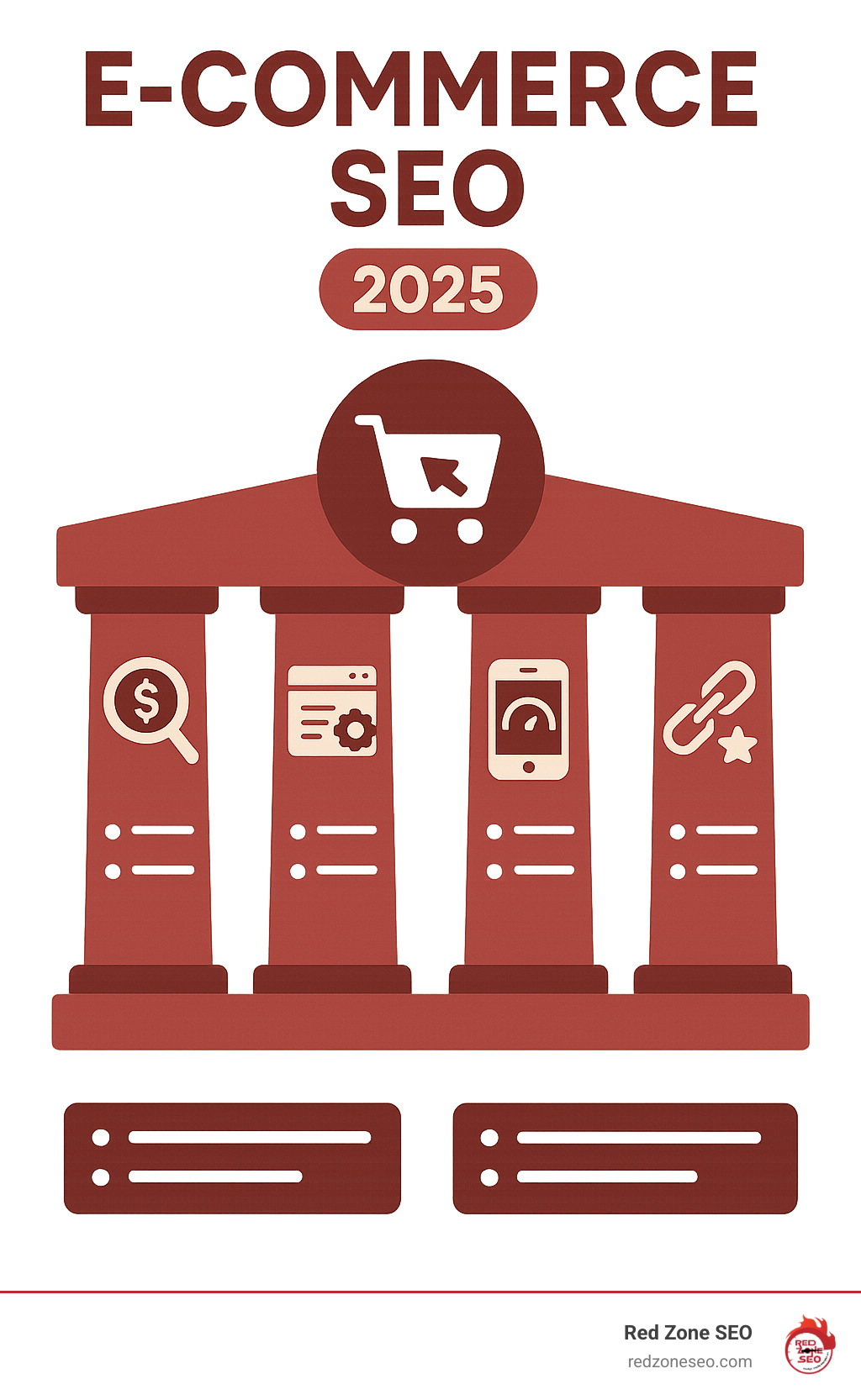
Key terms for seo of ecommerce websites:
Keyword research is the map that leads you directly to customers ready to buy. A successful seo of ecommerce websites strategy is built on understanding what customers actually search for, not what you think they search for.
Search intent is the 'why' behind a search query. Understanding it allows you to meet customers at each stage of their buying journey.
At Red Zone SEO, we use a combination of powerful tools to uncover high-value keywords.
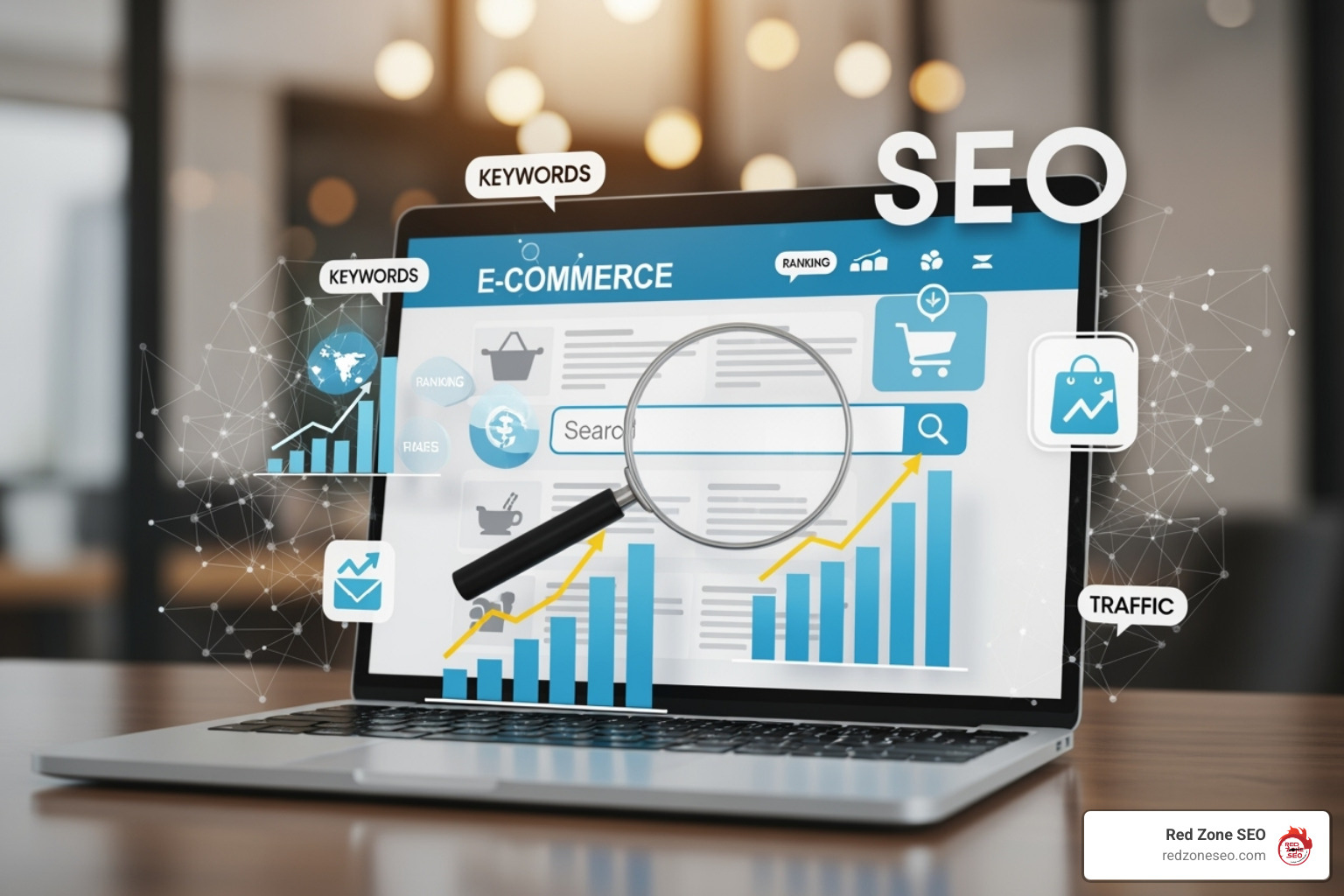
More info about Keyword Research
Your keyword strategy must adapt depending on whether you sell to businesses (B2B) or consumers (B2C).
| Feature | B2B E-commerce SEO | B2C E-commerce SEO |
|---|---|---|
| Target Audience | Businesses, procurement managers, decision-makers | Individual consumers, families, gift-buyers |
| Buying Cycle | Longer sales cycle, multiple stakeholders, research-heavy | Shorter cycle, often emotional or impulse-driven |
| Keyword Focus | Problem/solution terms, technical specs, part numbers, "wholesale," "supplier" | Brand names, product categories, emotional triggers, "best," "cheap," "deal" |
| Content Strategy | Educational content, case studies, detailed specifications | Product reviews, buying guides, lifestyle content |
| Search Behavior | Specific technical terms, industry jargon, comparison research | Broader terms, visual searches, mobile-friendly queries |
B2B customers have longer sales cycles and search for technical specs, part numbers, and supplier-related terms, requiring in-depth, educational content. B2C searches are often driven by immediate needs, brand names, and emotional triggers, requiring compelling product presentations that convert quickly.
On-page SEO turns your website pages into conversion machines that appeal to both customers and search engines. For the seo of ecommerce websites, what helps your customers almost always helps your rankings.
More info about Content Optimization
Your product and category pages are the core of your store. Each element must be optimized.
sony-wh-1000xm4-headphones.jpg) and detailed alt text. Alt text improves accessibility and helps your images rank in Google Image Search.yourstore.com/category/product-name.
A guide to URL structure from Google
Structured data (schema markup) is code added to your site's HTML that helps search engines understand your content. It creates eye-catching "rich snippets" in search results that dramatically increase click-through rates.
For e-commerce, these are essential:
Key Product Schema Properties:
Implementing schema gives you a significant competitive advantage over plain search listings.
Google's guide to product markup
Content marketing attracts customers who aren't ready to buy, establishes your brand as an authority, and earns valuable backlinks. It's a crucial support system for your product pages.
Focus on strategic content that solves customer problems:
More info about Content Marketing for Small Businesses
Technical SEO is the foundation of your online store. If search engines can't efficiently find, crawl, and understand your site, even the best products and content will remain invisible. For seo of ecommerce websites, a solid technical backbone is non-negotiable.
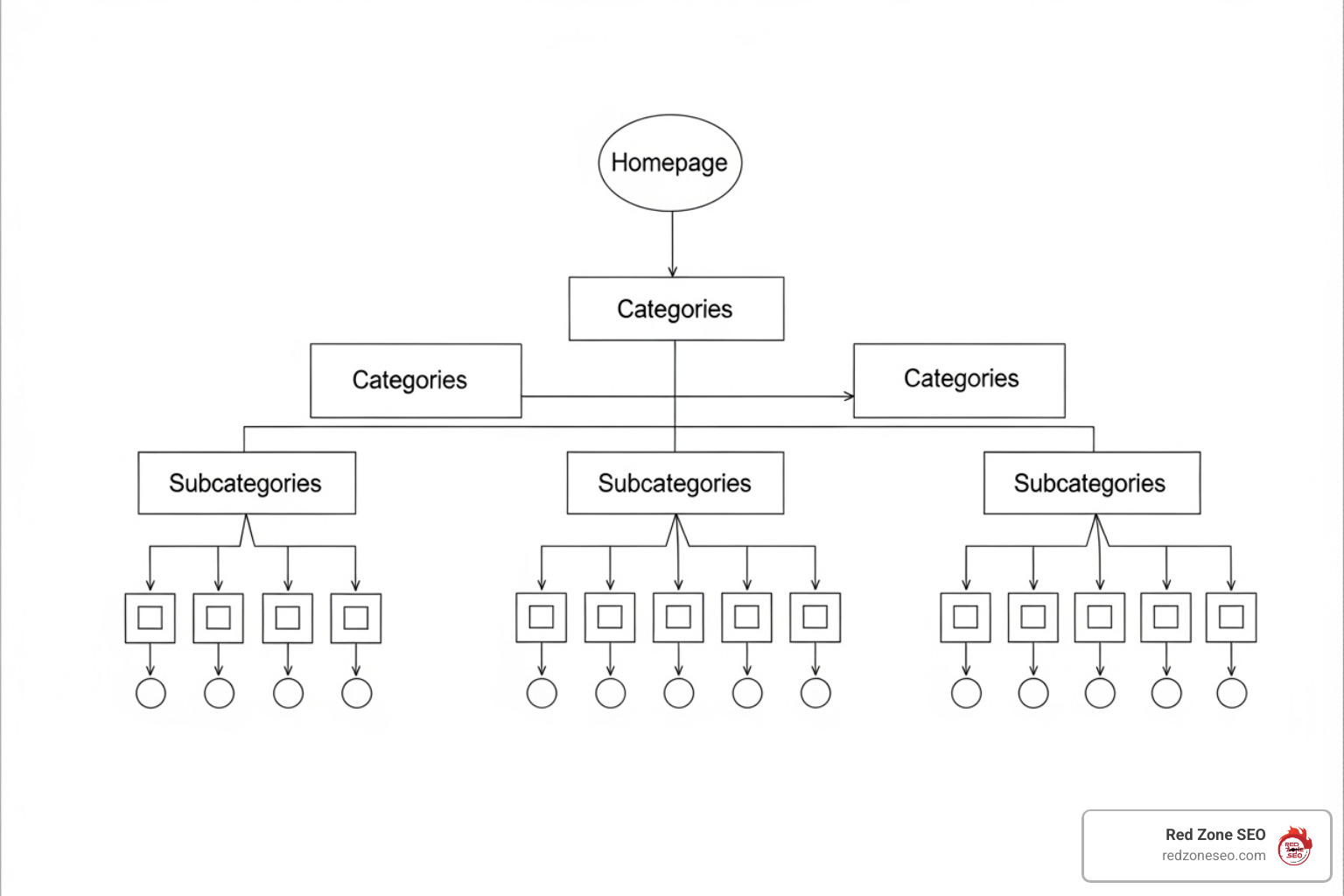
Your site architecture is the blueprint for your store. Follow two golden rules: keep it simple and scalable, and ensure every page is three clicks or fewer from the homepage. This flat structure helps both users and search engines.
A logical hierarchy looks like this: Homepage > Category Pages > Sub-Category Pages > Product Pages. This approach is intuitive, distributes ranking power effectively, and scales easily as your inventory grows. Reinforce this structure with clear breadcrumbs and a strategic internal linking strategy.
More info about performing an SEO Audit.
Site speed is a critical ranking factor, as over half of users will abandon a page that takes more than three seconds to load. Google's Core Web Vitals measure this user experience:
Improve these metrics by compressing images, minifying code (HTML, CSS, JavaScript), leveraging browser caching, and using a Content Delivery Network (CDN) to serve content from servers closer to your users. Use Google's PageSpeed Insights to diagnose and track improvements.
E-commerce sites face unique technical problems. Here's how to manage them:
noindex tags or canonicals on filtered URLs that offer little search value.More info about Shopify Store SEO.
Even a technically perfect store needs authority to rank. In seo of ecommerce websites, authority is built primarily through backlinks—digital 'votes of confidence' from other reputable websites. When a trusted site links to you, it signals to Google that your store is credible.
Quality beats quantity every time. One relevant link from a respected industry publication is worth more than a hundred low-quality links. Google evaluates links based on the linking site's authority, its relevance to your niche, and the context of the link.
Effective link building focuses on providing real value and building genuine relationships. Here are strategies that work:
Some of your most powerful off-page signals come directly from your customers.
Customer reviews are SEO gold. They provide a constant stream of fresh, user-generated content on your product pages, often including valuable long-tail keywords. More importantly, they are powerful trust signals. Research shows that 90 percent of consumers consider reviews when making a buying decision. When you use Review schema, star ratings appear directly in search results, dramatically boosting click-through rates.
While not a direct ranking factor, social signals (likes, shares, and engagement) are also important for seo of ecommerce websites. Social media activity increases brand visibility and drives traffic to your site. This surge in traffic and engagement sends positive signals to Google about your site's popularity and relevance, indirectly boosting your SEO efforts.
If you're not measuring your seo of ecommerce websites efforts, you can't manage them effectively. At Red Zone SEO, we use a data-driven approach focused on the metrics that matter most to your bottom line, ensuring every action we take is optimized for profitability and ROI.
Focus on KPIs that directly connect SEO efforts to business growth:
Effective e-commerce SEO requires a professional toolkit. Here are the essentials we use to drive results:
Free Essentials: Google Search Console is your direct line to Google, providing performance data and technical issue alerts. Google Analytics offers deep insights into user behavior on your site. Google PageSpeed Insights helps diagnose and fix site speed issues.
Premium Power Tools: Ahrefs and Semrush are indispensable for competitive analysis, advanced keyword research, and backlink tracking. Screaming Frog is our go-to for comprehensive technical site audits to uncover issues like broken links and duplicate content.
When it comes to seo of ecommerce websites, many business owners have the same questions. Here are straight answers to the most common ones.
SEO is a long-term investment, not an overnight fix. You can typically expect to see initial positive movement within 3-6 months, such as improvements in keyword rankings and traffic for less competitive terms. However, significant, revenue-driving results often take 6-12 months or longer to materialize.
The timeline depends on factors like your industry's competition, your site's current authority, and the resources dedicated to the campaign. Unlike paid ads, the results from SEO are sustainable and compound over time, delivering increasing returns.
This isn't an either-or question; the most effective strategy uses both. SEO builds long-term, sustainable traffic and customer trust at a lower cost over time. Once you earn a ranking, you don't have to pay for every click. Paid ads deliver immediate visibility, making them ideal for testing new products, running promotions, and generating sales while your SEO gains momentum.
Use them together: run ads for quick data and sales while your SEO strategy builds a foundation for lasting, profitable growth.
Yes, you can absolutely handle many SEO basics yourself, especially for a smaller store. Tasks like writing unique product descriptions, optimizing title tags, and creating helpful blog content are manageable and impactful.
However, seo of ecommerce websites becomes significantly more complex as you grow. Advanced technical SEO (like managing faceted navigation or crawl budget), large-scale link building, and in-depth competitive strategy require specialized expertise and expensive tools. For most growing stores, hiring an agency provides a better ROI and allows you to focus on what you do best: running your business.
Seo of ecommerce websites isn't just another marketing tactic; it's a fundamental business asset for long-term, sustainable growth. By mastering keyword research, on-page optimization, technical performance, and authority building, you create a powerful engine for attracting and converting customers 24/7.
This isn't a "set it and forget it" task. The digital marketplace is constantly evolving, and a successful strategy requires continuous, data-driven adaptation. While your competitors burn cash on short-term paid ads, you can build lasting dominance in organic search, creating an asset that grows in value over time.
At Red Zone SEO, we've seen how a professional SEO strategy transforms online stores from invisible to industry leaders. The question isn't whether you can afford to invest in SEO. The real question is: can you afford to let your competitors be the only answer when customers search for your products?
Get your free SEO analysis today and find what's possible when you stop competing on price and start dominating on visibility.
When you search for the average cost of search engine optimization, you’ll come across a wide range of numbers. (If you’re new to the topic entirely, this concise SEO overview on Wikipedia is a helpful primer.) That variance exists because SEO isn't a one-size-fits-all product you can pull off a shelf. It's a highly customized service, custom to the unique DNA of your business. The final cost is influenced by a multitude of moving parts: the depth of work required, the ferocity of competition in your industry, your specific growth goals, and the kind of partnership you form with your provider.
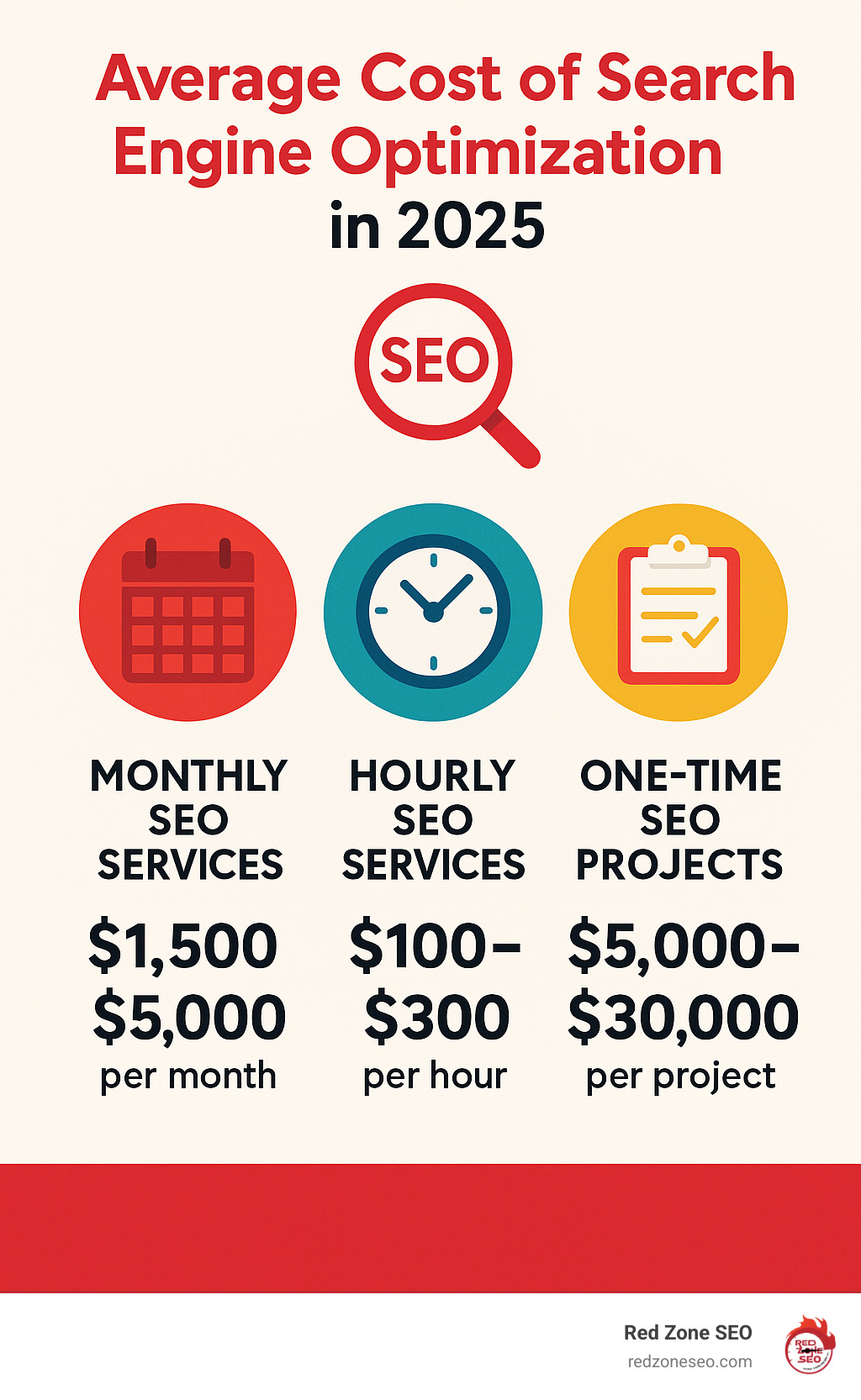
Here’s a quick snapshot of the most common SEO pricing benchmarks for 2025, which serve as a starting point for budgeting:
As a business owner, your goal is to shine online and attract customers who are actively searching for what you offer. Figuring out what SEO costs can, however, feel a bit like solving a puzzle. The truth is that there isn’t a single, universal price tag. Your ultimate investment will depend on your objectives, the competitiveness of your market, and the size (and current health) of your website.
Understanding these cost variables is critical. It helps you:
Learn more about average cost of search engine optimization:
The digital landscape is constantly evolving, and so are the strategies required to sustain meaningful rankings. Investing in SEO isn’t merely about "getting found" today; it’s about building a durable online presence that continually attracts your target audience tomorrow. That’s why experts recommend thinking of SEO as an ongoing investment rather than a one-off task. It requires consistent upkeep, algorithm-aware adjustments, and iterative optimization to protect and grow your visibility.
We understand that an “ongoing investment” can sound daunting. However, when executed well, SEO remains one of the most cost-effective marketing channels. Unlike paid ads—where costs accumulate with every click—organic traffic driven by SEO becomes effectively "free" once you’ve earned your rankings. This long-term value is why understanding the true cost of SEO is so important for strategic planning.
When you explore SEO services, you’ll usually encounter three distinct pricing models. Each comes with its own advantages and is best suited for different business scenarios. Mastering these models is the first step in clarifying the average cost of search engine optimization.
Monthly Retainer
The most popular—and often the most effective—model for sustained growth. A recurring monthly fee gives you continuous SEO support, proactive strategy, and performance monitoring. This model is ideal for businesses committed to long-term success, as SEO results build over time. Expect to invest $1,500 to $5,000 per month, with costs scaling up for complex sites or highly competitive sectors. A typical retainer involves an initial phase of auditing and strategy, followed by ongoing execution, content creation, link building, and reporting.
Hourly Consulting
Paying for expert time makes sense when you need help with a specific, well-defined task or require strategic guidance for your in-house team. This could include troubleshooting a technical issue (e.g., a structured data problem), conducting a focused keyword brainstorming session, or providing training on a particular aspect of SEO. Rates typically hover between $100 and $300 per hour, depending on the consultant's experience and specialty.
Project-Based Pricing
This model involves a fixed fee for a clearly defined scope of work with a specific start and end date. It's perfect for one-off needs like a comprehensive technical SEO audit, a website migration project, a penalty recovery effort, or a foundational content strategy development. The cost for a project typically ranges from $5,000 to $30,000, contingent on the complexity and duration of the work.
To make the numbers more tangible, let's break down what you can generally expect at different monthly investment levels. These are not rigid packages but representative scopes of work.
Budget Tier 1: Foundational SEO ($500 – $1,500/mo)
This tier is best suited for startups, small local businesses, or companies in low-competition niches that need to establish a solid baseline. The focus is on high-impact, fundamental tasks. Activities often include:
Budget Tier 2: Growth-Focused SEO ($1,500 – $5,000/mo)
This is the sweet spot for most small-to-medium-sized businesses aiming for significant growth and a competitive edge. It represents a balanced, full-service approach. This tier builds on the foundation with more proactive strategies:
Budget Tier 3: Aggressive & Enterprise SEO ($5,000+/mo)
This level is for established businesses in highly competitive markets or large enterprises that require a dominant online presence. The investment supports a resource-intensive, data-driven, and highly customized strategy.
Understanding the average cost of search engine optimization is just the beginning of your SEO journey. The actual price tag for your business's online success isn't a fixed number; it's a dynamic figure, carefully shaped by several interconnected factors. Imagine you're building a custom dream home: the final price isn't just about the square footage. It depends on the size of the plot, its location, the quality of materials, and all those special features you choose to make it uniquely yours. SEO investment works in much the same way.
From the unique complexity of your business and its online presence to the expertise of your chosen SEO partner, each element plays a crucial role in determining the ideal investment for your digital marketing budget. Let's dive deeper into these key influencing factors to help you understand what truly drives your final SEO price.
One of the most significant determinants of SEO cost is the size of your business and the sheer scale of your website. It makes sense, doesn't it? A sprawling, complex website with a vast array of products or services will naturally require a more extensive – and therefore more robust – SEO strategy than a simpler, more concise site.
For Small Business SEO, especially for startups and very small businesses, your SEO needs often center on building a strong foundation. You might have a brand new website or a limited number of offerings, and the goal is to get noticed. Our SEO for Small Business solutions are designed to establish that solid online presence right from the ground up. For startups, an initial investment, typically ranging from $750 to $1,500 per month, focuses on core keyword research, essential on-page optimization, and local SEO if you serve a specific geographic area. The challenge is often maximizing a limited budget by prioritizing the most impactful activities first. The aim here is to lay the groundwork and start attracting those crucial first organic visitors. For more detailed insights on getting started, be sure to check out our guide on SEO Strategies for Start Ups.
As businesses evolve into Medium-Sized Businesses, their SEO needs grow in complexity. These are often established companies looking for significant online expansion. Their strategies are typically growth-focused, aiming for things like expanding into new locations, gaining a larger share in specific market niches, or broadening their service offerings. This involves scaling content production, competing for more difficult national-level keywords, and earning higher-authority backlinks. This level of engagement, often requiring an investment between $1,500 and $5,000 per month, involves more in-depth content creation, more advanced technical SEO considerations, and competitive link building efforts to truly outrank those rivals in a wider market.
At the Enterprise level, SEO transforms into a highly sophisticated, large-scale operation. These companies often have colossal websites with thousands or even millions of pages, demanding intricate technical SEO solutions, vast content strategies, and aggressive outreach for link building. Challenges include managing faceted navigation, handling international targeting with hreflang, optimizing crawl budget, and sometimes implementing programmatic SEO for pages at scale. The ultimate goal here is market domination, maintaining a competitive edge, and managing brand reputation across an enormous digital footprint. The sheer volume of work involved, coupled with the necessity for highly specialized expertise and cutting-edge tools, naturally drives the investment significantly higher, often starting at $5,000 per month and going well beyond.
Your specific business objectives, the industry you operate within, and the competitive landscape are immense drivers of your SEO investment. Think of it like planning a road trip: driving across a quiet, open country road generally costs less in terms of fuel and effort than navigating a busy, congested city highway during rush hour.
If your business has aggressive growth goals, such as aiming to double organic leads within a tight timeframe or achieving a substantial traffic increase year-over-year, your SEO investment will understandably be more substantial. A goal of "increase traffic" is less intensive than "generate 50 qualified leads per month from organic search." The latter requires not just traffic, but the right traffic, plus on-site optimization to ensure those visitors convert. Achieving rapid, significant results often demands a more intensive, comprehensive strategy, meaning more content, more proactive link building, and more frequent technical optimizations. The urgency of your desired results directly correlates with the resources and effort needed to achieve them.
The industry competitiveness you face also plays a huge role. Highly competitive industries, such as legal services, healthcare, financial services, and SaaS (Software as a Service), naturally demand a higher SEO investment. Keywords in these sectors are often incredibly high-value because a single new client or customer can be worth thousands of dollars. This leads to fierce competition for those coveted top rankings. This means you'll need more sophisticated strategies, higher-quality content that demonstrates deep expertise (E-E-A-T), and more robust link-building efforts just to stand out from the crowd. For instance, legal keywords often have a significantly higher Cost Per Click (CPC) in paid search, which, as industry data shows, perfectly reflects their high value and the intense competition you'll face in organic search as well.
Finally, we always conduct a thorough analysis of your competitor landscape. If you're up against well-established brands with formidable online presences and significant existing SEO investments, outranking them will undeniably require a more substantial budget and a more strategic, often aggressive, approach. A competitive analysis looks at your rivals' backlink profiles, content quality and depth, keyword rankings, and overall site authority. This data helps benchmark the level of effort required. If your top competitor is publishing four in-depth articles a month and earning 20 high-quality backlinks, a plan that only includes one article and no link building will struggle to make progress. Understanding your competitor's current SEO performance is absolutely key to determining the amount of work required to surpass them.
The choice between partnering with an SEO agency, hiring a freelance SEO professional, or building an in-house team will also significantly influence the average cost of search engine optimization and, crucially, the breadth and depth of services you receive.
| Feature | SEO Agency | Freelancer | In-House Team |
|---|---|---|---|
| Expertise | Access to a bundled team of specialists (technical, content, link building). | Often brings highly specialized skills in a specific niche. | Deep product/company knowledge, fully dedicated. |
| Scope & Scalability | Ideal for large, complex projects; can scale services as your business grows. | Best suited for specific, project-based work with a defined scope. | Scalability depends on hiring capacity and budget. |
| Process | Proven processes and established workflows ensure consistency. | Processes can be more flexible but may vary. | Processes must be built from scratch. |
| Resources | Access to a wide range of premium tools and collective team knowledge. | May have limited access to expensive tools and resources. | All tool costs (~$500-$2k+/mo) are direct expenses. |
| Availability | Consistent availability and support from a dedicated team or account manager. | Availability can be variable, managing multiple clients and schedules. | Fully available during work hours, but subject to PTO/sick leave. |
| Cost | Monthly retainer ($1,500-$5,000+). | Hourly ($100-$300) or project-based. | Full-time salary + benefits + overhead ($70k-$150k+/year per hire). |
SEO Agencies offer a comprehensive, one-stop solution. You gain access to a diverse team of specialists without the overhead of hiring them individually. This model is excellent for businesses that need a complete, managed SEO strategy and want to scale their efforts efficiently.
Freelancers are a great option for businesses with specific needs, a limited budget, or an in-house team that needs support in a particular area (like technical audits or link building). They offer flexibility and deep niche expertise but may have limited bandwidth for large, ongoing campaigns.
Building an In-House Team provides the ultimate level of integration and brand alignment. However, it represents the highest potential cost. Beyond the competitive salary of an experienced SEO manager, you must also budget for benefits, payroll taxes, training, and the expensive suite of essential SEO tools (e.g., Ahrefs, Semrush, Screaming Frog).
While business size, competition, and provider type are the three heavy hitters behind the average cost of search engine optimization, several secondary variables can nudge your total investment up or down. Understanding them helps you avoid unwelcome surprises when you receive a proposal and allows for a more accurate comparison between potential partners.
The geographic scope of your target audience dramatically impacts the complexity and cost of an SEO campaign.
Need results “yesterday”? While SEO is inherently a long-term strategy, an accelerated timeline demands a front-loaded, more aggressive approach. This requires more resources—think extra content writers to produce assets faster, a larger outreach team to build links more quickly, or faster development cycles for technical fixes. That surge capacity translates into higher monthly retainers or premium project-based fees. For example, a business wanting to rank for "best Christmas gifts" that starts its campaign in October will require a much more intensive (and expensive) push than one that begins planning in March. Conversely, if you can adopt a slower, more methodical pace, your spend can be smoothed out over a longer horizon.
A well-built website with clean code, a logical architecture, and error-free analytics tracking is far easier (and cheaper) to optimize than one burdened with technical debt. An outdated CMS, a slow and clunky user experience, or a history of poor SEO practices can create significant problems. The deeper the technical debt—issues like a difficult HTTP to HTTPS migration, poor mobile usability, messy URL structures, internal redirect chains, keyword cannibalization, or widespread duplicate content—the larger the up-front audit and remediation phase will be. This initial cleanup is often a prerequisite for any future success and will increase the initial investment.
Your starting point in terms of content and brand recognition matters. Brands that already publish authoritative content, have in-house subject matter experts, or benefit from strong PR coverage often have a head start. They may require less foundational work to establish credibility (E-E-A-T: Experience, Expertise, Authoritativeness, and Trustworthiness). Meanwhile, newer brands with limited topical authority and brand recognition need a more aggressive content and outreach plan to build that credibility from scratch. This increases both the workload and the cost, as the agency must create a content engine and build brand signals that Google and users trust.
SEO is not a single activity but a collection of disciplines. Some agencies offer comprehensive retainers that include the full spectrum of services: technical SEO, on-page optimization, content creation, and link building. Others might allow you to select services a la carte. For example, you might only need a one-time technical audit to guide your development team, or perhaps you only require an ongoing content plan because you handle the technical aspects in-house. While a comprehensive package often provides the best long-term value and synergy between activities, an a la carte approach can be more budget-friendly if you have specific, isolated needs. It's crucial to understand exactly what is included in a proposal to ensure it aligns with your requirements and avoids paying for services you don't need.
A technical SEO audit tool is essential software that scans your website for technical issues that prevent search engines from crawling, indexing, and ranking your content. These tools are crucial for optimizing site performance, fixing errors, and aligning your site with Google's technical standards.
Top Technical SEO Audit Tools at a Glance:
If your website's traffic has plateaued or rankings are dropping, hidden technical issues are likely the cause. Research shows the average website has over 4,500 technical SEO problems that hurt its search visibility. Common issues include duplicate content (29% of pages), missing meta descriptions (34%), and failure to meet Core Web Vitals standards (88% of mobile sites).
The good news is that regular technical audits drive dramatic improvements. Websites with routine health checks see up to 61% increases in organic traffic and can reduce bounce rates by as much as 50%. A technical SEO audit tool is a health check-up for your website, ensuring its foundation is strong enough for Google to find, crawl, and rank your content.
Simple guide to technical seo audit tool:
Neglecting your website's technical health is like ignoring a crack in your house's foundation. Your content might be excellent, but hidden technical issues can prevent search engines from finding and ranking your site, making you invisible to potential customers.
Google's algorithms evolve constantly, with many updates focusing on technical aspects like site performance and user experience. Core Web Vitals, which measure loading speed, interactivity, and visual stability, are now crucial ranking factors. Yet, only about 12% of mobile pages pass all of Google's standards, meaning the vast majority of websites are missing out on better rankings due to technical shortcomings.
Ignoring technical SEO leads to predictable problems: traffic plateaus, slipping rankings, and lower conversions as users get frustrated with slow speeds or broken links. In severe cases, it can even lead to Google penalties. The average website has over 4,500 technical issues, including duplicate content on 29% of pages and missing meta descriptions on 34%. While you're stuck, your competitors are likely using technical SEO audit tools to get ahead.
In contrast, a proactive approach transforms your website into a powerful asset. Websites that conduct regular technical audits see remarkable results:
A proactive, data-driven strategy removes guesswork and allows you to focus on growth initiatives like Content Optimization. A comprehensive SEO Audit is the first step to open uping your website's true potential.
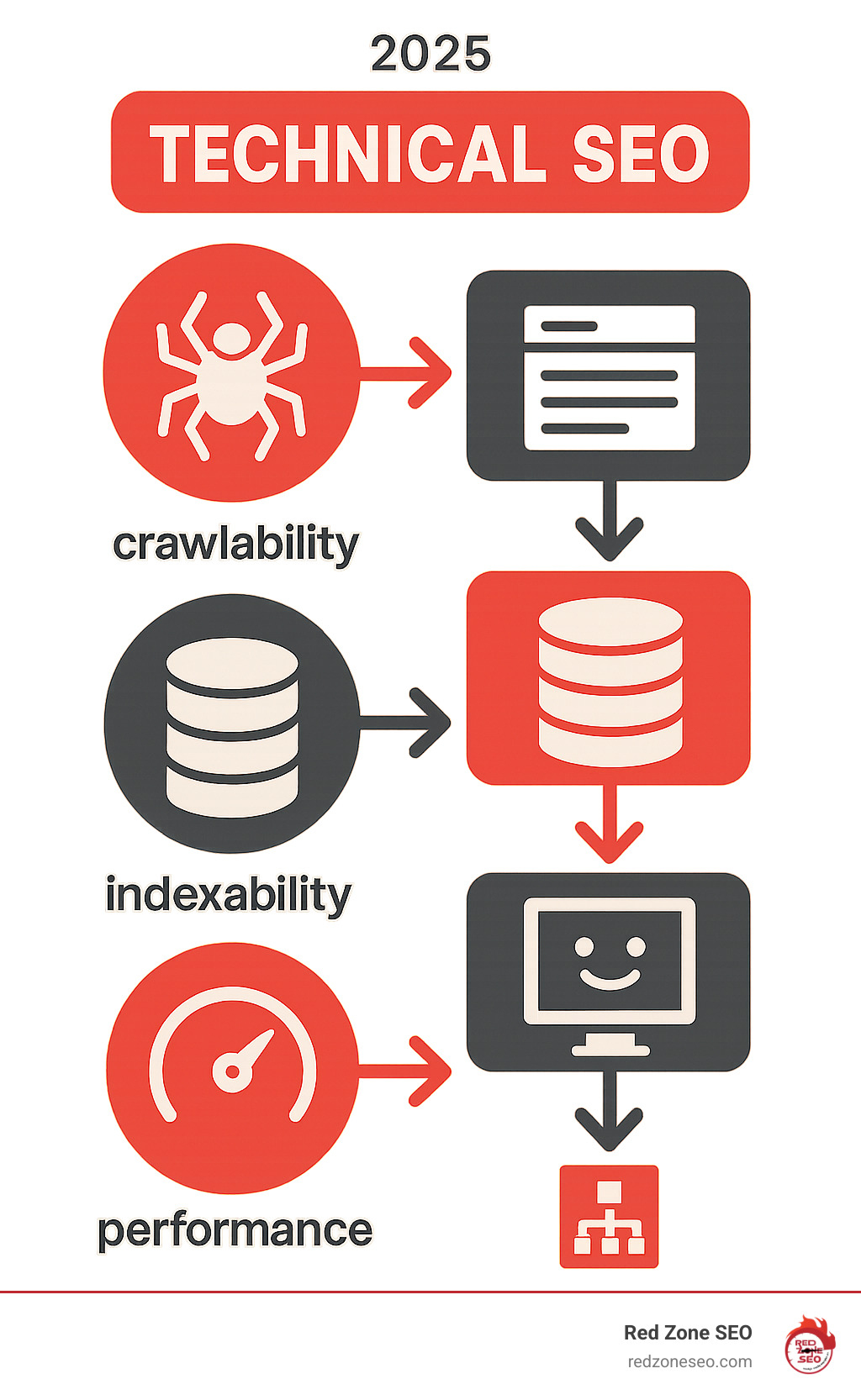
When choosing a technical SEO audit tool, look for one that not only identifies errors but also explains their impact and helps you prioritize fixes. The best tools provide a clear dashboard showing your site's overall health and a roadmap for improvement, covering the four pillars of technical SEO: crawling, indexing, performance, and architecture.
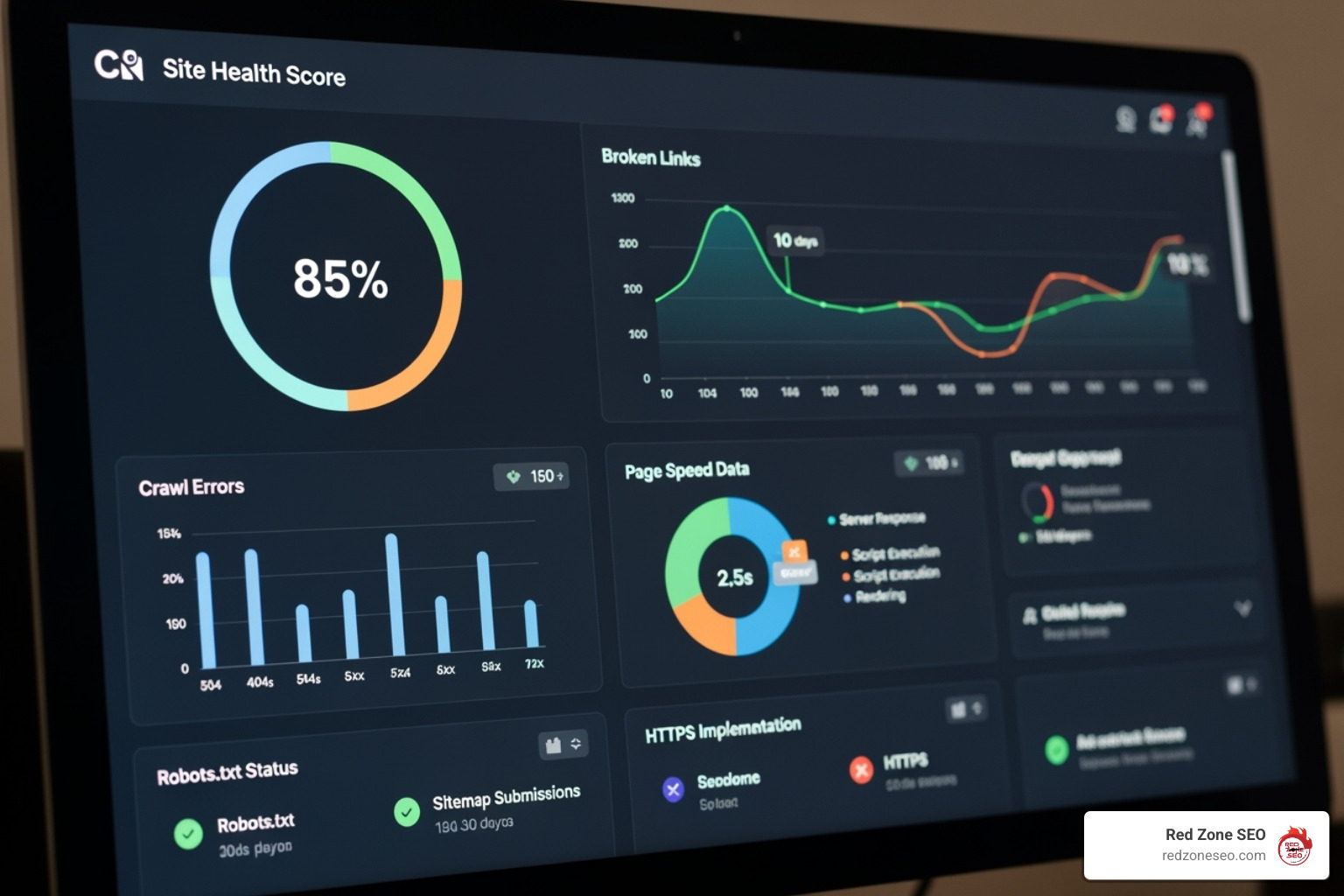
Before Google can rank your content, it must be able to find and understand it. A good audit tool simulates Google's crawler to find roadblocks. Key checks include:
robots.txt file is the first stop for search engine bots. A quality tool will check for syntax errors and ensure you aren't accidentally blocking important resources with a Disallow directive. It will also validate your XML sitemap, ensuring it's properly formatted, linked in your robots.txt, and doesn't contain broken links or non-canonical URLs. This gives search engines a clear map of your most important pages.rel="canonical" tag tells Google which version of a page is the definitive one. An audit tool verifies that these tags are implemented correctly, pointing to the right URLs and preventing common mistakes like pointing to a non-indexable page or having conflicting signals in your sitemap.While Google Search Console provides this data, a dedicated tool offers clearer explanations, historical tracking, and more actionable recommendations.
Site speed is a critical ranking factor and essential for a good user experience. Your tool should analyze Core Web Vitals, Google's official metrics for page experience. It should break down each component:
Your tool should also check for mobile-friendliness, which is non-negotiable since Google uses mobile-first indexing. It must check for mobile usability issues like small text or poorly spaced buttons. For modern sites, it's also vital that the tool can handle JavaScript rendering to see content that might otherwise be hidden from search engines. It should be able to differentiate between content available in the initial HTML (server-side rendered) and content that loads after the page is rendered in the browser (client-side rendered). Many tools integrate with PageSpeed Insights for comprehensive analysis.
Technical issues can undermine even the best content. An audit tool should act as a detective to uncover hidden problems:
Choosing a technical SEO audit tool depends on your specific needs and budget. Some are all-in-one platforms, while others are specialized crawlers. Here’s a look at the leading options to help you find the right match.
Semrush is a comprehensive SEO suite with a powerful Site Audit tool known for its user-friendly interface and extensive checks. It's ideal for businesses and agencies wanting an integrated solution.
Ahrefs is famous for its backlink data, but its Site Audit tool is a favorite among SEO professionals for its deep technical analysis and detailed reporting.
Screaming Frog is a powerful and flexible desktop crawler beloved by technical SEOs. While its interface is utilitarian, its capabilities are best for customized, in-depth audits.
SE Ranking offers a robust Website Audit tool at a highly competitive price point, making it an excellent choice for small to medium-sized businesses and budget-conscious agencies.
Selecting the right technical SEO audit tool isn't about picking the most expensive option; it's about matching a tool's capabilities to your specific needs, budget, and technical expertise. This framework will help you make an informed decision.

Before diving into features, assess your situation. What works for a large e-commerce site may be overkill for a small local business. Consider the following:
A key decision is whether to use a cloud-based SaaS tool or a desktop application.
If your budget is tight, several excellent free tools provide foundational data for a technical audit. While they require more manual analysis, they are an essential part of any SEO's toolkit.
Technical SEO can seem complex, but understanding the basics is key to a successful strategy. Here are answers to some of the most common questions we receive.
Think of your SEO strategy as building a house. On-page SEO (content) is the interior design, and off-page SEO (backlinks) is the location and curb appeal. Technical SEO is the foundation. If the foundation is cracked, the rest doesn't matter. A technical SEO audit tool ensures that foundation is solid by:
Technical SEO provides the bedrock upon which all other efforts, like SEO Strategies for Start Ups, are built.
A technical SEO audit is a specialized subset of a broader, more comprehensive SEO audit.
In short, the technical audit ensures your car's engine and chassis are in perfect working order. The comprehensive audit checks the engine, the paint job, the interior, and how it stacks up against other cars on the road.
The ideal frequency depends on your site's size and how often it changes, but a good rule of thumb is to conduct audits at regular intervals and after significant events.
Understanding your potential SEO Audit Cost can help you budget for this essential process.
Prioritization is key to avoiding overwhelm. A simple and effective method is to use an impact vs. effort matrix. Categorize each issue based on:
This creates four clear priority buckets:
robots.txt file.Yes, you can perform a basic technical audit yourself. Free tools like Google Search Console and PageSpeed Insights provide a wealth of data. However, there is a learning curve. These tools require more manual interpretation to diagnose problems and determine the right solutions.
Paid technical SEO audit tool options streamline the process with automated issue detection, prioritization, and step-by-step fix instructions. For large or complex websites, or if you're facing significant ranking issues, partnering with an expert is often more efficient. An agency has the specialized tools and experience to diagnose and solve deep-rooted problems, which is critical for the long-term health of any SEO for Online Business.
Your website's success begins with a flawless technical foundation. A technical SEO audit tool is not just another subscription; it's an essential health monitor that uncovers hidden issues and open ups growth opportunities.
The data is clear: with the average site having thousands of technical errors and most failing Core Web Vitals, a huge competitive advantage is available to those who are diligent. By making regular audits part of your strategy, you can get ahead of competitors struggling with slow speeds and crawl errors.
We've explored top tools like Semrush, Ahrefs, Screaming Frog, and SE Ranking. Each offers a unique approach, but all aim to help you build a website that search engines and users love. The key is to create a sustainable process of auditing and improving. This isn't a one-time fix; it's a commitment to ongoing excellence that future-proofs your site against algorithm changes.
At Red Zone SEO, we've seen how a data-driven strategy built on a solid technical base transforms businesses. We use the best tools and our deep expertise to turn technical challenges into measurable growth. Sustained success comes from treating technical SEO as a critical investment.
Ready to make technical health the cornerstone of your SEO success? Our team at Red Zone SEO specializes in comprehensive audits that drive real results. Find out how our Expert SEO Services in Las Vegas can lift your website's performance and secure your position at the top of the search results.
What does an SEO strategy look like? It's a comprehensive plan combining technical optimization, content creation, and authority building to help your business rank higher in search engines and attract more customers. A winning strategy isn't just about ranking higher—it's about attracting the right customers who are ready to buy.
An effective SEO strategy includes:
The reality is that 89% of marketers say SEO is successful, yet many businesses struggle without a clear roadmap. As one expert put it: "Strategy without tactics is the slowest route to victory. Tactics without strategy is the noise before defeat." This guide will break down what a modern SEO strategy looks like, giving you the blueprint to compete and win.
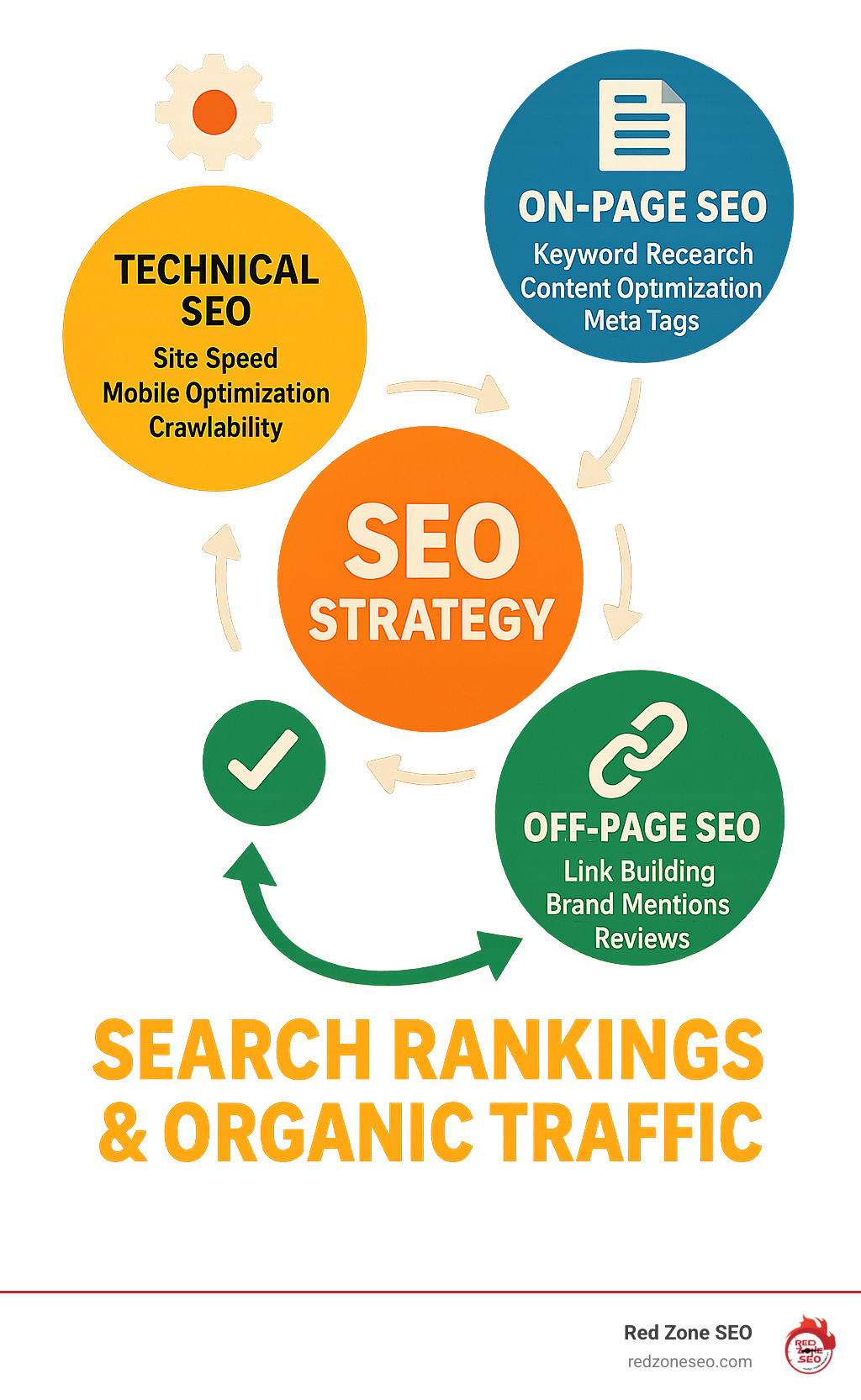
Easy what does an seo strategy look like glossary:
At Red Zone SEO, we believe a winning SEO strategy builds a strong online presence from the ground up. Think of it like a sturdy building: you need a solid foundation, a well-designed interior, and a great reputation. That’s why we focus on three interconnected pillars: Technical SEO, On-Page SEO, and Off-Page SEO. These components work in harmony to lift your business in search rankings. Neglect one, and the whole structure can falter.

This holistic approach is crucial because search engines like Google constantly refine how they rank websites to provide the best user experience. A deeper dive into the basic concepts of SEO reveals that these three pillars form the bedrock of any successful strategy.
Technical SEO ensures your website's engine runs smoothly, helping search engines easily find, understand, and index your content. If your technical foundation is weak, even the best content may go unseen. We kick things off with a thorough SEO Audit to pinpoint and fix any glitches.
Key technical elements include:
robots.txt files and site structure.On-Page SEO involves optimizing the content and HTML of individual pages to rank higher and attract relevant traffic. This is where we make your content shine for both humans and search engines.
Our Content Optimization services focus on:
Off-Page SEO is about building your website's authority and reputation across the internet. The more credible endorsements you get, the more authoritative your site becomes to search engines.
Our Link Building Services help build your digital reputation through:
Now that we've covered the three pillars, let's put them into action. A winning SEO strategy is a continuous, step-by-step process of research, creative thinking, and consistent effort that makes all parts of your online presence work together to attract customers.

This systematic approach is what separates effective SEO from random tasks, building a sustainable engine for organic growth. If you're just starting, understanding SEO Strategies for Start-ups can provide a fantastic head start.
Every great SEO journey begins with a map built on solid research. This phase is about understanding your audience, their needs, and your competition.
First, we dive into Keyword Research to uncover the exact words and phrases your potential customers use. We focus on long-tail keywords (e.g., "best sourdough bakery Las Vegas" instead of just "bread") which often reveal clearer purchase intent. Understanding Search Intent—whether a user is looking for information, ready to buy, or navigating to a specific site—is critical for attracting the right visitors.
Next is Competitor Analysis. We analyze why your competitors are ranking, identifying their top keywords, content strategies, and backlink profiles. This helps us spot opportunities they've missed. A Content Gap Analysis reveals topics where competitors rank but you don't, highlighting golden opportunities for new content. Our Keyword Research process is incredibly thorough, using top tools like Ahrefs, Semrush, Google Keyword Planner, and Google Search Console to gather necessary data.
With research in hand, we build a website structure that's easy for both users and search engines to steer. A well-organized site with clear Information Architecture keeps visitors happy, sending positive engagement signals to Google.
We often use a Pillar Pages and Topic Clusters model. A pillar page is a comprehensive guide on a broad topic, supported by cluster articles that dig into specific subtopics. These are all interlinked, establishing your site as an authority on the subject.
Intuitive User Navigation, clear Calls-to-Action (CTAs), and a smart Internal Linking Strategy guide users and spread "link equity" throughout your site. We also focus on User Experience (UX) Signals like readability and engaging visuals to keep users on your site longer. Finally, Mobile Responsiveness is non-negotiable, as More than 60% of organic search visits in the US come from mobile devices. Your site must work perfectly on phones.
Content is the fuel for your SEO engine. This step is about creating, optimizing, and maintaining high-quality content that resonates with your audience and satisfies search intent.
We develop a Content Calendar to ensure a steady stream of relevant content. Blogging remains a powerful way to attract organic traffic by targeting keywords and building authority. We focus heavily on E-E-A-T (Experience, Expertise, Authoritativeness, and Trust), showcasing your genuine knowledge and real-world experience to build credibility with Google and users.
Our primary rule is Writing for Humans. Content must be engaging and genuinely helpful, with keywords integrated naturally. We also ensure every piece is Optimized for Search Engines with a compelling Title Tag, a concise Meta Description to boost click-through rates, and proper Header Tags (H1, H2, H3) for structure. Our approach to Content Marketing for Small Businesses creates content that not only ranks but also converts.
Building your site's authority is an ongoing mission, and earning high-quality links is the secret weapon. We focus on earning links through value and relationships, not buying them.
Our dedicated Link Building Services are designed to build a strong, natural backlink profile that signals trust and authority to search engines.
The SEO world never stands still. Google updates algorithms, AI changes how people search, and user behavior shifts. What does an SEO strategy look like in this landscape? It must be adaptable, forward-thinking, and grounded in both current best practices and emerging trends.

At Red Zone SEO, we know that what worked five years ago might hurt your rankings today. Staying ahead of these advanced considerations is essential for survival. Whether you're a local business in Las Vegas or a national startup, understanding these factors can make the difference between getting lost and standing out.
Nobody likes a slow, clunky website. Page speed is a business-critical element, as data shows conversion rates drop by around 4.4% for every extra second of load time. Beyond speed, Google's Core Web Vitals measure the real-world user experience of loading, interactivity, and visual stability, directly impacting rankings.
Mobile-friendliness is the baseline expectation, with more than 60% of organic search visits coming from mobile. Key user experience signals like dwell time (how long people stay on your page) and bounce rate (how quickly they leave) tell Google if your content is truly helpful. Technical optimization isn't a one-time fix; it's an ongoing process of monitoring and improving with tools like PageSpeed Insights.
For most businesses, local search is where the next customer is found. A strong local SEO strategy is essential for plumbers, restaurants, and law firms alike.
Our Local SEO Packages are designed to help businesses dominate local search. If you're looking for a Henderson SEO Company, we understand the local market.
The integration of AI into search is the biggest shift in SEO today. Google's Search Generative Experience (SGE) provides AI-generated summaries at the top of results, changing how users find information. The key is to create content so valuable that it gets pulled into these AI overviews, building your authority.
While AI-generated content is fast, Google prioritizes content that is "helpful, reliable, and people-first." AI should be a tool to improve human creativity, not replace it. This is where E-E-A-T (Experience, Expertise, Authoritativeness, Trustworthiness) becomes critical. Google's Search Quality Rater guidelines emphasize content from people with real experience. You must demonstrate why you're qualified to speak on your topic.
As AI helps users ask more conversational questions, search intent becomes more nuanced. Your strategy must go beyond keywords to address the underlying needs behind each search. Our Search Engine Optimization Las Vegas services stay ahead of these shifts, focusing on connecting your business with customers who need you.
A winning SEO strategy isn't just about implementation; it's about continuously measuring performance, analyzing data, and adapting your approach. It's like tending a garden—you can't just plant seeds and walk away. You need to water, prune, and adjust based on what's growing.

At Red Zone SEO, we believe in transparency. We don't just promise results; we prove them with clear data. Without proper tracking, even the best strategy can lose momentum. A working SEO strategy shows consistent, measurable growth in the metrics that actually matter to your business.
Key Performance Indicators (KPIs) separate real success from vanity metrics. We focus on the metrics that directly impact your bottom line:
We present this data in clear, actionable reports using industry-standard dashboard tools—so you always know exactly how your investment is performing.
SEO is not a "set it and forget it" task. It requires regular tune-ups to keep everything running smoothly.
We provide monthly reports in plain English, showing what's working and what we're doing about it. This ongoing maintenance includes:
Our SEO for Small Business approach emphasizes this continuous refinement for sustained growth and measurable results.
You've explored the pillars, the blueprint, and the evolving landscape of SEO. Now, let's tackle some of the most common questions we hear at Red Zone SEO as you consider what a powerful SEO strategy looks like for your business.
This is the most common question, and the answer is that SEO is a long-term investment. It's like planting a tree—it takes time for the roots to grow before you see the fruit. While factors like your industry and competition play a role, most businesses can expect to see meaningful ranking improvements within 4 to 6 months of starting a well-executed strategy. The effects of SEO compound over time, so the longer you stick with it, the stronger and more sustainable your results become. It's a marathon, not a sprint.
Yes, you can technically do SEO yourself, as there are many online resources and tools available. However, SEO is a complex and constantly changing field that requires significant time, dedication, and specialized expertise to be effective. Many business owners find themselves overwhelmed by the technical jargon, algorithm updates, and the sheer amount of work involved.
While a DIY approach might work for very small businesses in non-competitive niches, most companies benefit from partnering with a professional agency like Red Zone SEO. We bring experience, advanced tools, and a data-driven approach to maximize your efforts and deliver measurable results. We handle the complexities so you can focus on running your business. If you're looking for the Best SEO Company Las Vegas to take that burden off your shoulders, we're here to help.
For a new website, the goal is to build a strong foundation and establish early authority. Here are the essential first steps:
So, what does an SEO strategy look like in today's digital world? It's a living, breathing system that evolves with your business and the ever-changing search landscape. It's not something you set up once and forget.
Think of it as tending a garden: technical excellence keeps your foundation strong, compelling on-page content attracts and engages your ideal customers, and robust off-page authority building establishes your credibility. The difference between success and failure online comes down to meticulous research, precise execution, and continuous measurement and adaptation.
At Red Zone SEO, we've seen how this comprehensive approach transforms businesses. We dig into the data, understand your unique market, and craft strategies that deliver measurable results. We handle the technical complexities, content nuances, and link-building intricacies so you don't have to.
The beauty of a well-executed SEO strategy is that its value compounds over time. Early efforts in foundation-building and content creation pay dividends as your authority grows, rankings improve, and more qualified customers find their way to your business. It's not just about getting more traffic—it's about attracting the right traffic that converts into real revenue.
Ready to open up your website's full potential? Learn more about how our proven SEO process works and let us help you craft a strategy that delivers the growth your business deserves.
Why is a technical SEO audit important for your website? It's the foundation that determines if search engines can find, understand, and rank your content. Without a solid technical base, even the best content and marketing efforts will fall short. A technical audit is crucial for improving search engine accessibility, boosting rankings, enhancing user experience, and increasing organic traffic.
Think of it as a health check-up for your website. Just as you wouldn't build a house on a weak foundation, you can't expect your online presence to thrive with underlying technical problems. With 99% of searchers sticking to page one of Google, technical issues holding your site back mean you're missing out on potential customers every day.
An audit examines everything from page load speed to crawlability, identifying invisible problems that could be costing you rankings and revenue. The good news is that most technical SEO issues have straightforward solutions once you know what to look for. That's where a comprehensive audit becomes your roadmap to better performance.
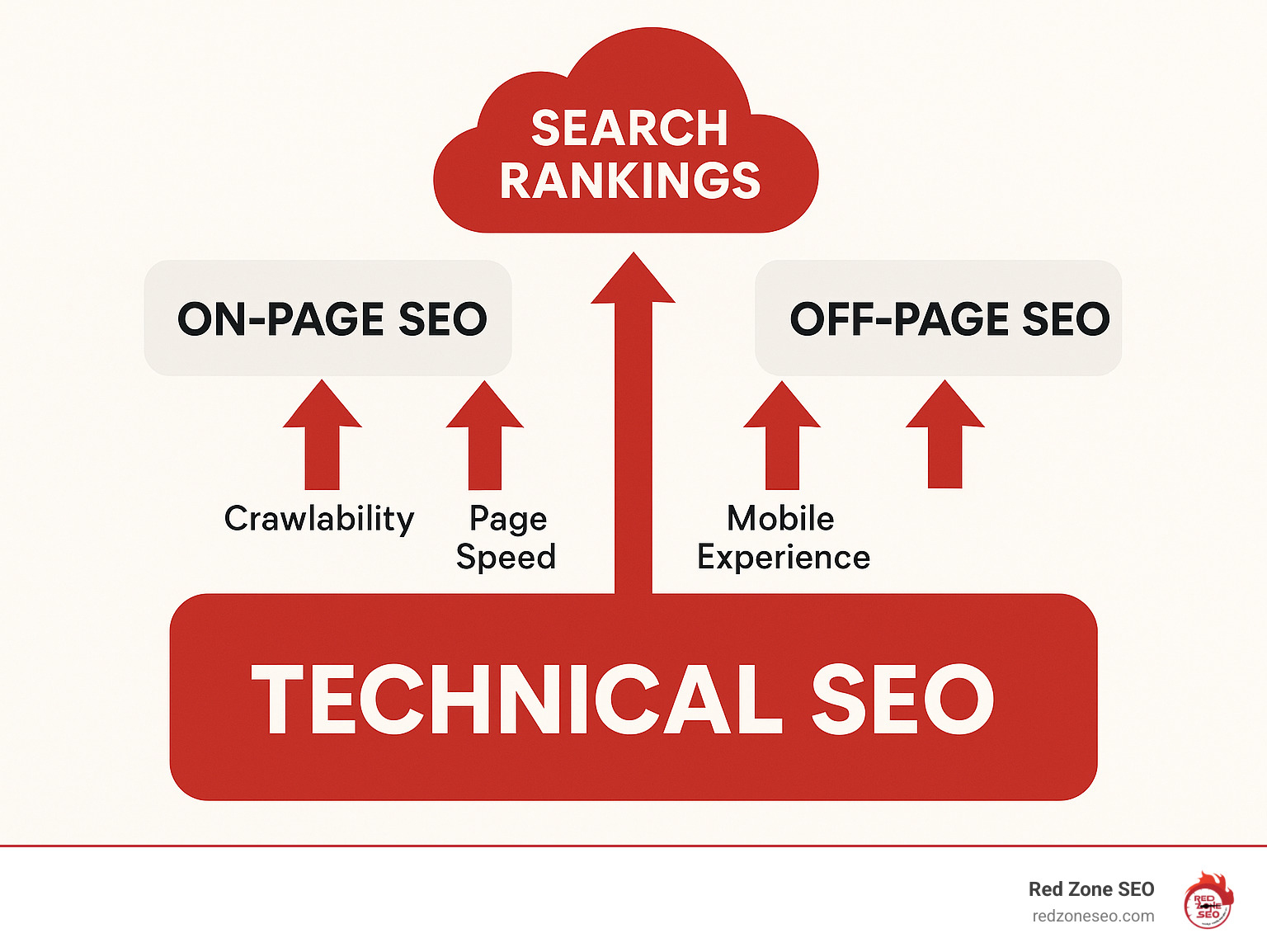
Quick look at why is a technical seo audit important:
You've built a stunning website with engaging content, but it's invisible in search results. What went wrong? The answer often lies in the technical foundation. Why is a technical SEO audit important? It reveals the hidden, complex issues that can make or break your online success, regardless of how great your site looks or how compelling your content is.
Think of your website as an iceberg. The design and content are just the tip visible above the water. Below the surface is a complex technical structure that search engines must steer. If this foundation is flawed with issues like slow code, confusing architecture, or security vulnerabilities, even brilliant content will struggle to gain visibility. With 45.1% of all search result clicks coming from organic searches, technical SEO is the essential discipline for capturing a massive share of potential traffic and ensuring your marketing investments pay off.
Modern SEO is built on three interconnected pillars:
You can create the most insightful article in your industry (on-page SEO) and earn a backlink from a major news outlet (off-page SEO), but if a misconfigured robots.txt file blocks search engines from seeing that page, your efforts are wasted. If your page takes ten seconds to load, users will leave before they ever read your content, rendering your efforts useless. At Red Zone SEO, our comprehensive audits reveal these foundational issues, providing the stable platform needed for all your marketing efforts to succeed.
More info about our SEO Audit services
Over 3.5 billion Google searches happen daily, but a staggering 99 percent of searchers stick to page one. If you're not there, you're effectively invisible to the vast majority of potential customers. Technical SEO is often the deciding factor in whether you even get a chance to compete for those top spots.
Search engine bots crawl the web to find, evaluate, and index content. Technical issues like slow load times, broken links, or confusing URL structures act as roadblocks. The bot might exhaust its allocated "crawl budget" before reaching your most important pages, or it might conclude that your site provides a poor user experience and rank it lower as a result. A thorough audit identifies and provides a plan to remove these roadblocks, allowing bots to crawl and index your content efficiently. This improved accessibility directly translates to better rankings and increased organic visibility. Google explicitly rewards websites that follow technical best practices because it makes their job of organizing the world's information easier and ensures their users have a good experience.
Technical issues don't just frustrate bots—they drive away human customers. Why is a technical SEO audit important for your visitors? Because it directly impacts their experience, which in turn influences their perception of your brand.
Since 76% of consumers research a company's website before engaging, your site is often their first impression. Technical problems at this critical stage can cost you business before you even have a chance to make your pitch.
More info about WordPress SEO Services
When we conduct a technical SEO audit at Red Zone SEO, we perform a comprehensive, multi-faceted evaluation of your website's invisible infrastructure. Why is a technical SEO audit important to understand in detail? Because knowing what we look for helps you appreciate the depth and value of this process. We methodically identify issues, from critical errors to subtle opportunities for improvement. Our audit is a full health checkup to ensure your site is technically sound, robust, and ready to compete at the highest level.
Key elements we examine include crawlability, indexability, site architecture, page speed, mobile-friendliness, security, and structured data. Each component is crucial for how search engines find, understand, and ultimately rank your website.

If search engines can't crawl (access) and index (store) your pages, your content is effectively invisible. We perform a deep dive into:
Disallow: /, can accidentally block your entire site from being indexed, making it disappear from search results.rel="canonical") tell search engines which version of a duplicate page is the "master" copy to be indexed. We verify these are implemented correctly using tools like the URL Inspection Tool to consolidate ranking signals.A well-organized site is easy for both users and search engines to steer and understand. We look for:
your-site.com/services/technical-seo) are like clear street signs, helping users and search engines understand the page's content at a glance.More info about E-commerce Store SEO
Page speed is a critical ranking factor, officially measured by Google's Core Web Vitals:
We use tools like Google PageSpeed Insights to diagnose and recommend fixes for speed issues, such as optimizing images, minifying code, and improving server response times.
Structured data (or schema markup) is a standardized code vocabulary that you add to your site's HTML. It doesn't change how the page looks to a user, but it provides explicit clues to search engines about the meaning of your content. This helps them understand if your content is a recipe, an event, a product, or an FAQ page. An audit checks for the correct implementation and identifies new opportunities. The reward for using structured data is eligibility for rich results—the visually improved search listings with star ratings, prices, or FAQ dropdowns that stand out on the results page and can significantly increase click-through rates.
More info about SEO for Small Business
When answering why is a technical SEO audit important, a key question is how to conduct one effectively. At Red Zone SEO, we find the most powerful audits combine the speed and scale of automated tools with the strategic insight and contextual understanding of human expertise. It's like diagnosing a car: a computer can pull error codes instantly, but an experienced mechanic is needed to interpret those codes, understand the interplay between systems, and determine the most effective and lasting fix.

Automated SEO tools like Semrush, Ahrefs, and Screaming Frog act as tireless digital assistants. These site crawlers can systematically examine thousands of pages in minutes, providing rapid data collection on a massive scale. They excel at identifying issues like broken links, redirect chains, missing meta tags, incorrect hreflang attributes, and thin content pages. Their scalability and efficiency are essential for large, complex websites, as they can uncover site-wide patterns that would be impossible to spot manually. However, these tools have a critical limitation: they are great at telling you what is wrong, but they often can't explain the why or prioritize the how in the context of your specific business goals. A tool might flag a page with a noindex tag as an error, without understanding it's an intentional choice for a private thank-you page.
This is where human expertise becomes invaluable. An experienced SEO professional provides contextual analysis that tools cannot. We can differentiate between a critical error and an intentional configuration. Through user journey testing, we steer your site as a real customer would, attempting to complete key actions like filling out a contact form, signing up for a newsletter, or completing a purchase. This process uncovers user experience frustrations—like a confusing checkout flow or a form that doesn't work on mobile—that automated tools completely miss.
The most critical part of a manual review is strategic prioritization. Not all SEO issues are created equal. An expert can determine which fixes will have the highest impact with the lowest effort. We also perform validation of automated findings to filter out the false positives and noise that tools often generate. Most importantly, a manual review ensures business goal alignment, connecting every technical recommendation to a tangible business outcome, such as increased leads, sales, or user engagement.
| Feature | Automated Audit | Manual Audit |
|---|---|---|
| Speed | Extremely fast, scans thousands of pages quickly | Slower, methodical, and time-intensive |
| Scale | Ideal for large, complex websites and initial data gathering | Best for deep dives on critical pages and user pathways |
| Cost | Varies by tool subscription (monthly/annual fees) | Higher initial cost due to expert time and analysis |
| Accuracy | Can produce false positives/negatives; lacks context | High, based on expert interpretation and validation |
| Insight | Provides raw data, issue lists, and generic recommendations | Delivers strategic, prioritized, and actionable insights |
| Best For | Data gathering, initial scan, ongoing monitoring, pattern detection | Prioritization, strategy, complex issues, UX analysis, business alignment |
The most effective audits use a hybrid approach. We leverage automated tools for comprehensive data gathering and to establish a baseline. Then, we apply our deep human expertise to interpret that data, prioritize fixes based on business impact, and create a strategic roadmap that aligns perfectly with your unique goals.
An audit report sitting in an inbox has zero value. At Red Zone SEO, we believe the real magic happens when those findings are translated into a clear, prioritized, and actionable roadmap. This is where understanding why is a technical SEO audit important comes to life—it's the bridge between identifying problems and executing solutions that drive tangible improvements and boost your online presence.
After identifying a list of issues, the next critical step is prioritization. Not all problems are created equal, and trying to fix everything at once is a recipe for paralysis. We focus on what will move the needle most, starting with the "low-hanging fruit"—issues that are relatively easy to fix but deliver significant SEO and user experience improvements. Concurrently, we identify high-impact foundational issues that are essential for long-term health, even if they require more development resources.
To make these decisions objectively, we often use an impact/effort framework like ICE:
For example, fixing a robots.txt file that's blocking key pages might score: Impact=10, Confidence=10, Ease=9. This is a top priority. In contrast, refactoring an entire legacy CSS file might score: Impact=7, Confidence=8, Ease=2. This is still important but requires more planning. This framework facilitates clear communication and collaboration with your development team, ensuring our recommendations are impactful, feasible, and align with their workflow.
A comprehensive audit culminates in a strategic roadmap—a step-by-step guide that serves as the blueprint for your digital success. It transforms a list of problems into a project plan. Our roadmap includes:
This structured approach turns SEO into an ongoing, manageable process of refinement, not just a one-time, overwhelming fix.
More info about our SEO Audit Cost
Our work doesn't stop after implementation. We continuously monitor your website's performance to measure the impact of our changes and ensure ongoing technical health. We track a range of Key Performance Indicators (KPIs), including:
By analyzing data from tools like Google Analytics and Google Search Console, we can directly correlate technical fixes to tangible business outcomes. Technical SEO isn't a "set it and forget it" task. Search engine algorithms evolve, new content is added, and websites change. We recommend regular check-ups to identify and resolve new issues before they can harm your rankings, ensuring sustained performance and growth over the long haul.
More info about our SEO Strategies for Start Ups
You've learned why is a technical SEO audit important, but you might still have questions about the specifics. Here are detailed answers to some of the most common ones we hear from clients.
While every site is unique, certain issues appear frequently across industries and platforms. Here are the usual suspects we find that can significantly impact performance:
The ideal frequency depends on your site's size, complexity, and how often you publish new content or make changes. As a general guideline:
A technical SEO audit is a specialized component of a broader, more general SEO audit.
You can certainly get started on your own, and it's a great way to learn about your site's health. Free tools like Google Search Console are invaluable, providing direct feedback from Google on crawl errors, indexing status, and Core Web Vitals. Tools like Google's PageSpeed Insights or Screaming Frog's free version can also help you identify low-hanging fruit like broken links or large images.
However, a comprehensive audit requires deeper expertise. The real challenge isn't just finding issues, but understanding their root cause, prioritizing them based on business impact, and developing a strategic plan to fix them—especially for large or complex sites. An expert can interpret nuanced data, diagnose site-wide systemic problems, and craft a redirect strategy that preserves link equity during a migration. Think of it this way: you can check your tire pressure, but you'd go to a mechanic to rebuild the engine. While you can find a broken link, a professional is needed to diagnose a site-wide indexing problem that's costing you thousands in revenue.
At Red Zone SEO, we don't just run reports. We translate complex technical data into a clear, actionable plan, explaining why is a technical SEO audit important for your specific business and how to fix issues effectively for long-term growth.
More info about our Henderson SEO services
So, why is a technical SEO audit important? In the simplest terms, it's the essential health check-up that ensures your website is built to win in the competitive digital marketplace. While compelling content and beautiful design grab the spotlight, technical SEO works tirelessly behind the scenes to ensure your audience can actually find and enjoy your site. Issues like slow load times, broken links, and poor mobile navigation are not just minor annoyances; they are symptoms of a weak foundation that can drain your website's potential, frustrate users, and cost you revenue every single day.
A technically sound website creates a powerful ripple effect of benefits. It builds a solid digital foundation, leading to improved website health, greater user trust, and a significant competitive advantage. When your site works flawlessly for both search engines and humans, users stay longer, engage more deeply, and convert at higher rates. This sends strong positive signals to Google, further boosting your visibility in a virtuous cycle of growth.
An audit sets you up for long-term success. It is not about a temporary, quick-fix boost but about building a robust, resilient platform that supports sustainable growth for years to come. At Red Zone SEO, our data-driven strategy moves beyond generic checklists to prioritize solutions that deliver the biggest impact for your unique business goals. We believe every business deserves a website that works as hard as they do.
Don't let hidden technical issues undermine your marketing efforts and hold your business back. An optimized website is a reliable, high-performing asset that consistently attracts qualified organic traffic and drives conversions. It's a strategic investment in your brand's future that pays dividends long after the audit is complete.
Take the first step towards a technically sound website with our expert Las Vegas Search Engine Optimization services. Let's build a digital presence that doesn't just compete—it thrives.
SEO consultant near Las Vegas services have become essential for local businesses looking to compete in one of America's most dynamic markets. With a population of over 640,000 and an economy that extends far beyond the Strip, Las Vegas presents unique opportunities and intense competition. To succeed here, a strong digital presence isn't just an advantage—it's a necessity.
The numbers tell a compelling story: 97% of users turn to search engines when looking for local businesses. This means your potential customers are actively searching for your services right now. The question isn't whether they'll find a business like yours; it's whether they'll find your business or a competitor first.
Las Vegas has evolved into a hub for technology, healthcare, real estate, and manufacturing, diversifying its economic landscape. This growth creates fierce competition across all industries, making an effective SEO strategy crucial for survival and growth. Unlike broad national campaigns, local SEO for Las Vegas requires a deep understanding of neighborhood dynamics, tourism patterns, and the unique search habits of both residents and visitors.
The challenge many business owners face is that SEO is an unregulated industry. With over 150 SEO options in the Las Vegas area alone, finding a qualified consultant is critical. The right partner brings market knowledge and technical expertise to steer Google's complex algorithms, while the wrong choice can waste months of time and thousands of dollars.
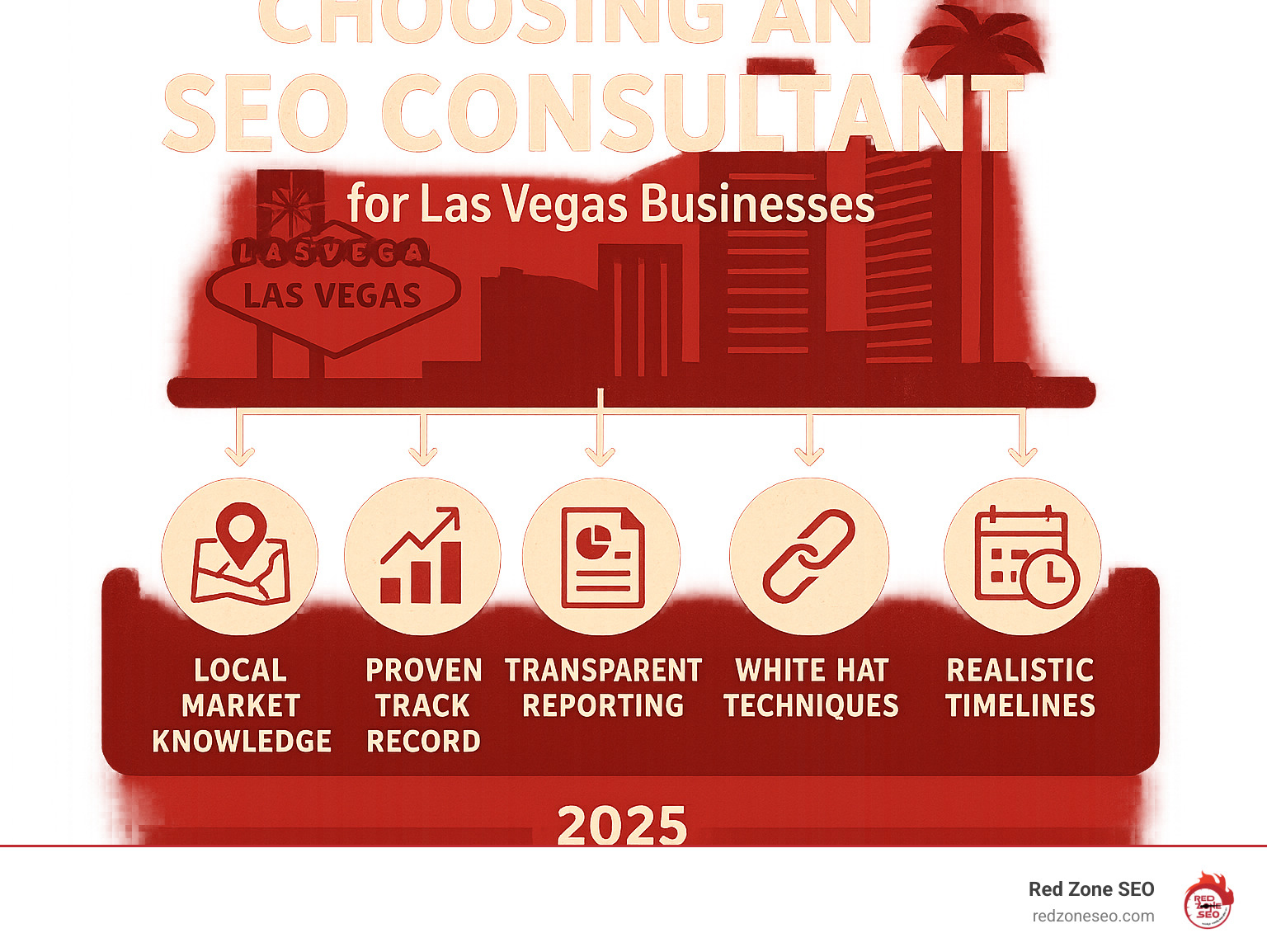
Picture the Las Vegas Strip at night—a dazzling array of lights all competing for attention. That same intense competition is happening online, 24/7, for every business in the city. In today's digital marketplace, your online presence determines whether customers find you or your competitors. When potential customers need your product or service, they turn to Google with high buyer intent, ready to make a purchase. If you're not visible in those search results, you're invisible to ready-to-buy customers.
SEO levels the playing field, allowing local businesses to compete with larger corporations by building genuine credibility. Unlike paid ads that stop when you stop paying, SEO is a long-term asset that provides sustainable growth. At Red Zone SEO, we focus on data-driven, proven SEO solutions that help businesses improve their online visibility and attract customers who are actively searching for their services.

Las Vegas is more than just a tourism and hospitality hub. The city boasts a thriving tech scene, a growing healthcare sector, and diverse manufacturing businesses. This economic diversity means there's no one-size-fits-all SEO approach. A restaurant on the Strip needs to capture both tourists and locals, while a medical clinic in Henderson focuses on residents. Understanding whether your business serves locals versus tourists and how to target specific neighborhoods like Summerlin or Downtown Las Vegas is crucial for success.
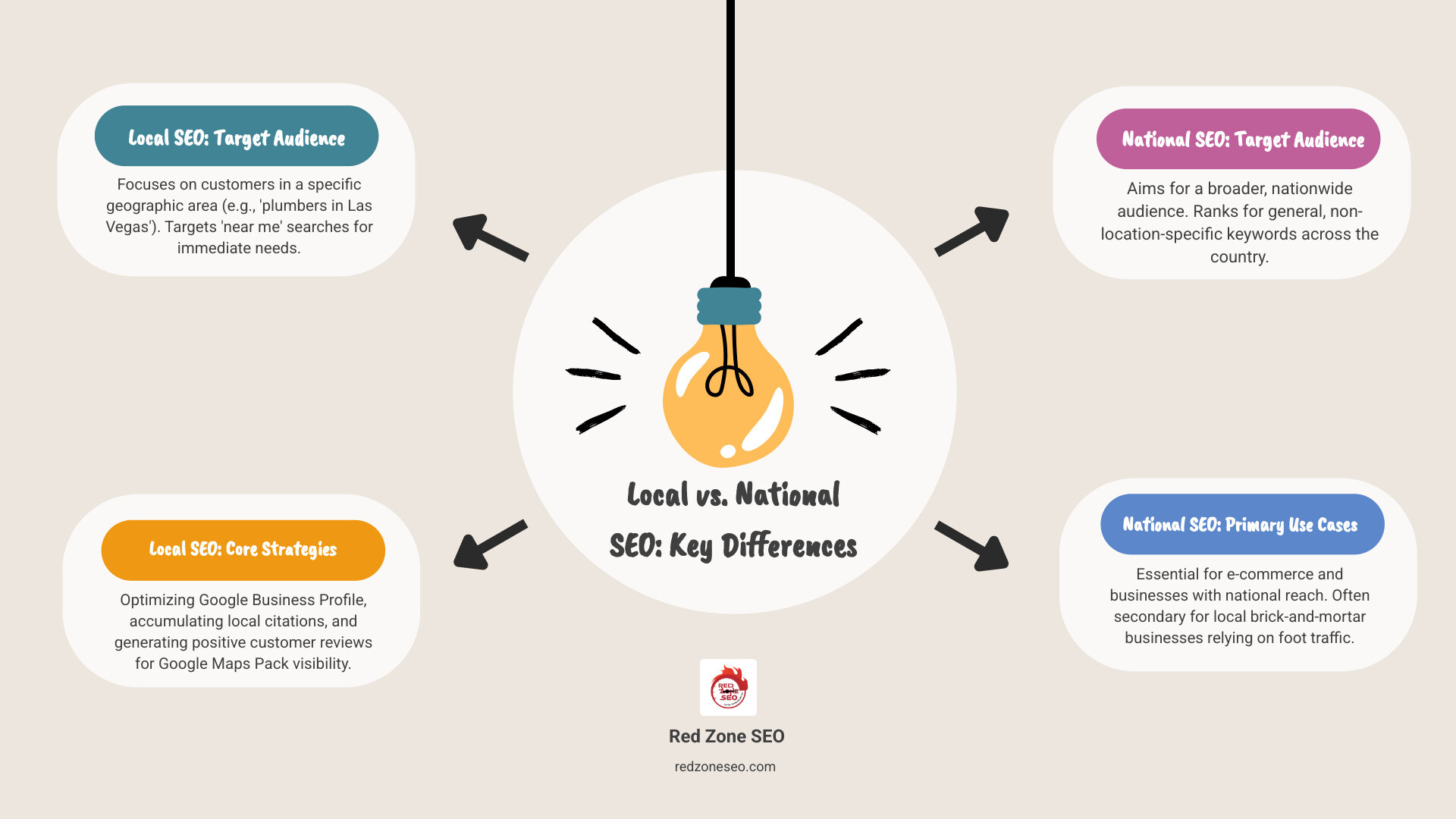
Understanding the difference between local and national SEO is vital. Local SEO focuses on getting your business found by customers in your immediate geographic area. The primary goal is to appear in the Google Maps Pack—the three business listings with a map at the top of local searches. This strategy targets local search intent (e.g., "plumbers in Las Vegas") and capitalizes on "near me" searches. With over 60% of customers finding businesses through local search, this is essential for most Las Vegas companies.
National SEO targets broader brand awareness without location modifiers, which is ideal for e-commerce businesses or national service providers. For most brick-and-mortar Las Vegas businesses, local SEO provides a much better return on investment. If you're interested in learning more, you can find detailed information on our Local SEO Packages page.
In a market like Las Vegas, not investing in SEO means directing potential customers straight to your competitors. This digital invisibility creates a cascade of problems. You face missed opportunities every day someone searches for your services and can't find you. For local businesses, this leads to declining foot traffic as consumers who can't find you online assume you aren't a viable option. Furthermore, businesses that rank highly on Google gain automatic credibility. Being invisible means you're constantly playing catch-up while competitors build their digital authority and establish themselves as the go-to choice in your industry.
Effective SEO is like building a landmark—it requires careful planning, a solid foundation, and constant attention to detail. A qualified SEO consultant near Las Vegas knows that success comes from an ongoing process that demands strategy, patience, and ethical practices. The difference between winning and losing often comes down to the approach.
White-hat tactics—the ethical, Google-approved methods—build sustainable success. In contrast, black-hat techniques like keyword stuffing or buying low-quality links offer risky shortcuts that can lead to severe penalties from Google. At Red Zone SEO, our data-driven approach ensures every decision is backed by real insights, not guesswork, to build something that lasts.

Before you can attract customers, your website needs a solid technical foundation. Technical SEO ensures your site is healthy and accessible to search engines. Key elements include site speed, as slow-loading pages cause users to leave, and mobile-friendliness, which is essential since most customers search on their phones. Behind the scenes, crawlability allows Google to find and index your content, while site security (HTTPS) builds trust with both visitors and search engines.
Once the foundation is set, on-page optimization fine-tunes each page. This includes crafting compelling title tags and meta descriptions that act as your digital storefront window, using header tags to structure content, and implementing internal linking to guide users and search engines through your site. The ultimate goal is a great user experience, which Google rewards with better rankings. Our Content Optimization services can help ensure every page is working for you.
Content is your opportunity to connect with customers by providing genuine value. This isn't about stuffing keywords; it's about creating helpful blog posts, service pages, and location pages that answer your audience's questions and establish you as an authority. A local HVAC company might write about preparing for summer heat, while a restaurant could share the story behind its signature dishes.
The secret sauce is keyword research—understanding the exact terms your customers use to find businesses like yours. This involves analyzing search volume, assessing competition, and mapping user intent to determine if a searcher is ready to buy or just browsing. Matching the right content to the right keywords is how your website starts appearing at the exact moment potential customers need you. Our systematic Keyword Research process removes the guesswork.
While on-page and technical SEO focus on your website, off-page SEO builds your reputation across the internet. The cornerstone of this effort is link building, which involves earning backlinks from other reputable websites. These links act as votes of confidence, telling Google that your site is trustworthy.
For Las Vegas businesses, local citations—mentions of your business name, address, and phone number (NAP) in online directories—are critical. Consistency across these listings is key to avoiding confusion for search engines. Online reviews also carry enormous weight, as positive feedback from happy customers directly boosts your local SEO. Finally, digital PR and guest posting expand your reach by getting your expertise featured on other relevant sites. Our Link Building Services focus on these sustainable strategies to strengthen your online reputation for the long haul.
Finding the right seo consultant near las vegas is a critical business decision. In a city with over 150 SEO agencies, the wrong choice can cost you months of progress and thousands of dollars. Since the industry isn't regulated, anyone can claim to be an expert. You need a true partner who is invested in your success. At Red Zone SEO, we believe a collaborative approach is what separates good consultants from great ones. Knowing what to look for and what questions to ask is key to finding a partner who will deliver real results.
When evaluating potential SEO partners, start with their experience and track record. Look for agencies that have demonstrated longevity and adapted to Google's many algorithm changes. Ask for case studies and client testimonials that prove their methods work. Specific examples of traffic growth or lead generation are far more valuable than vague promises.
Communication style and transparency are crucial. The best consultants provide clear, regular updates and grant you access to performance data. Look for a partner who is open about their process and results. Equally important is a deep understanding of the Las Vegas market. A consultant who grasps the unique blend of tourism and local commerce will outperform one using generic, cookie-cutter strategies. Finally, ensure they adhere to ethical, white-hat practices to protect your business from Google penalties.
The consultation is your opportunity to vet a potential partner. Here are some essential questions to ask:
Be on guard for these warning signs. The biggest red flag is a guarantee of #1 rankings. No legitimate agency can guarantee rankings on Google. Also, be wary of unrealistic promises of overnight success; quality SEO takes time. A lack of transparency about methods or results is another major concern. Avoid consultants who focus only on vanity metrics like rankings without connecting them to business goals like leads and sales. Finally, steer clear of one-size-fits-all packages, as every business needs a customized strategy.
Choosing between a local and remote consultant involves important trade-offs:
| Feature | Local Las Vegas Consultant | Remote/National Consultant |
|---|---|---|
| Market Knowledge | Deep understanding of local nuances, competition, and neighborhoods. | General understanding, relies on data without local context. |
| In-Person Meetings | Possible for strategy sessions and building rapport. | Relies on virtual communication only. |
| Local Networking | Can leverage local connections for PR and partnerships. | Limited or no local network. |
| Timezone | Aligned with your business hours for easy communication. | May have significant time differences. |
| Cost | May have competitive local pricing. | Varies widely, may be higher or lower. |
While remote consultants can be effective, a local seo consultant near las vegas brings invaluable market knowledge that distant agencies simply can't access.
Starting on an SEO journey is an investment in your business's future that requires patience, persistence, and realistic expectations. Any reputable seo consultant near las vegas will be upfront: there are no instant results in SEO. It's a marathon, not a sprint. Businesses that succeed with SEO understand it's a long-term strategy that builds momentum over time. If someone promises you a #1 ranking overnight, they are either misinformed or planning to use risky tactics that could get your website penalized.
Business owners rightly want to know about the cost. The answer depends on several factors, as SEO is not a one-size-fits-all service. Common SEO pricing models include monthly retainers for ongoing work, project-based pricing for specific tasks like a website audit, and hourly rates.
The investment required is influenced by the competitiveness of your industry, the scope of work needed, and your website's current condition. A business in a highly competitive niche will require a larger investment than one in a less crowded space. Similarly, a site with significant technical issues will need more foundational work upfront. While costs vary, it's crucial to view SEO as an investment in sustainable growth, not an expense. For more on our approach to value-driven solutions, see our Affordable SEO Las Vegas page.
This is one of the most common questions in SEO. While timelines vary, you can expect to see initial improvements within 3-6 months. During this phase, you may notice higher rankings for long-tail keywords and an uptick in organic traffic. These are the first signs that the strategy is working.
Significant growth typically occurs between 6-12 months. This is when the cumulative effect of content creation, technical fixes, and link building begins to pay off, leading to rankings for more competitive terms and a meaningful increase in leads and sales. Long-term success requires ongoing effort beyond the first year to maintain and build upon your results. Factors like your website's history, industry competition, and budget all influence how quickly you'll see progress. Patience and consistency are key.
Focusing solely on rankings is a mistake; what truly matters is how SEO impacts your business goals. Rankings alone don't pay the bills.
To track these metrics, Google Analytics and Google Search Console are essential and free tools. We also recommend starting with a comprehensive SEO Audit to establish a baseline. Success is seeing how a 150% increase in traffic translates to real revenue for your business.
SEO can feel complex, especially in a competitive market like Las Vegas. Here are answers to some of the most common questions we hear from local business owners.
While you technically can do SEO yourself, it's like asking if you should be your own mechanic—it's possible, but not always wise. SEO is a complex field that requires a significant time commitment to learn and execute properly, often 15-20 hours per week. You'd need to master technical SEO, content strategy, and link building while keeping up with Google's ever-changing algorithms (which you can read about in resources like this article on Google's algorithms).
The steep learning curve means mistakes can be costly, potentially setting your website back months or even earning a penalty. For a business in the intense Las Vegas market, hiring a professional SEO consultant near Las Vegas is an investment that allows you to focus on running your business while an expert handles the complexities of driving online growth.
Business owners often weigh the benefits of SEO against PPC (Pay-Per-Click) advertising. While both aim to increase visibility, they function very differently and serve distinct strategic purposes.
While PPC can provide valuable keyword data, a strong SEO strategy is the foundation for sustainable, long-term growth and a higher return on investment. It builds your brand's authority in a way that paid ads cannot.
Your Google Business Profile (GBP) is absolutely critical to your local SEO strategy. If your website is your digital headquarters, your GBP is your digital front door. It's what appears in the local pack—the three businesses highlighted with a map in local search results. Securing a spot here can dramatically increase calls and foot traffic.
Your GBP acts as a mini-website directly on Google, providing customers with your hours, address, phone number, photos, and reviews. This is especially important for mobile users who want information quickly. Managing reviews on your GBP is also crucial, as positive reviews directly influence your local rankings and build trust with potential customers. A well-optimized GBP works hand-in-hand with your website SEO to dominate local search results.
In the competitive landscape of Las Vegas, your business faces a choice: blend into the background or step into the spotlight with a strategic SEO approach. As we've explored, partnering with a skilled SEO consultant near Las Vegas is no longer a luxury but a critical component of sustainable growth.
Success in the Las Vegas digital market isn't about luck; it's about making informed, strategic decisions backed by data and local expertise. A winning strategy requires a solid technical foundation, compelling content that speaks to your customers, and authority-building efforts that earn Google's trust. Each piece works together to create an online presence that attracts and converts.
Choosing the right partner is paramount. The Las Vegas market demands more than generic solutions—it requires deep local knowledge and transparent, proven strategies. You need a consultant who understands the unique dynamics of this city and can craft a custom plan for your specific goals.
At Red Zone SEO, we build our reputation on data-driven, proven SEO solutions that deliver measurable results. We understand the pulse of Las Vegas business and combine technical expertise with a genuine commitment to your success. When your business grows, our community grows stronger.
The path forward is clear, but it requires taking the first step towards measurable growth. Every day you wait is another day your competitors gain ground. We're ready to be your partner in navigating the digital landscape of Las Vegas, changing your online presence from invisible to irresistible.
Take the next step with a comprehensive SEO plan
An ecommerce technical SEO audit is a deep dive into your online store's technical framework to find and fix issues that stop search engines from crawling, indexing, and ranking your pages. It's the key to opening your store's visibility in a world where 93% of online experiences begin with a search engine.
Think of your website as a house. Content and design are the paint and furniture, but technical SEO is the foundation, plumbing, and wiring. Without a solid technical base, the rest of your efforts can crumble. This is especially true for ecommerce sites, which have unique challenges like thousands of product pages, complex filtering systems, and frequent inventory changes. A single technical mistake can cascade across your entire catalog, making profitable pages invisible to search engines.
The stakes are high. A one-second delay in page load time can cut conversions by 7%. A poor mobile experience drives away a significant portion of the 67% of users browsing on mobile devices. An ecommerce technical SEO audit finds these silent ranking killers before they cause traffic to drop and competitors to surge ahead.
Core Areas of an Ecommerce Technical SEO Audit:
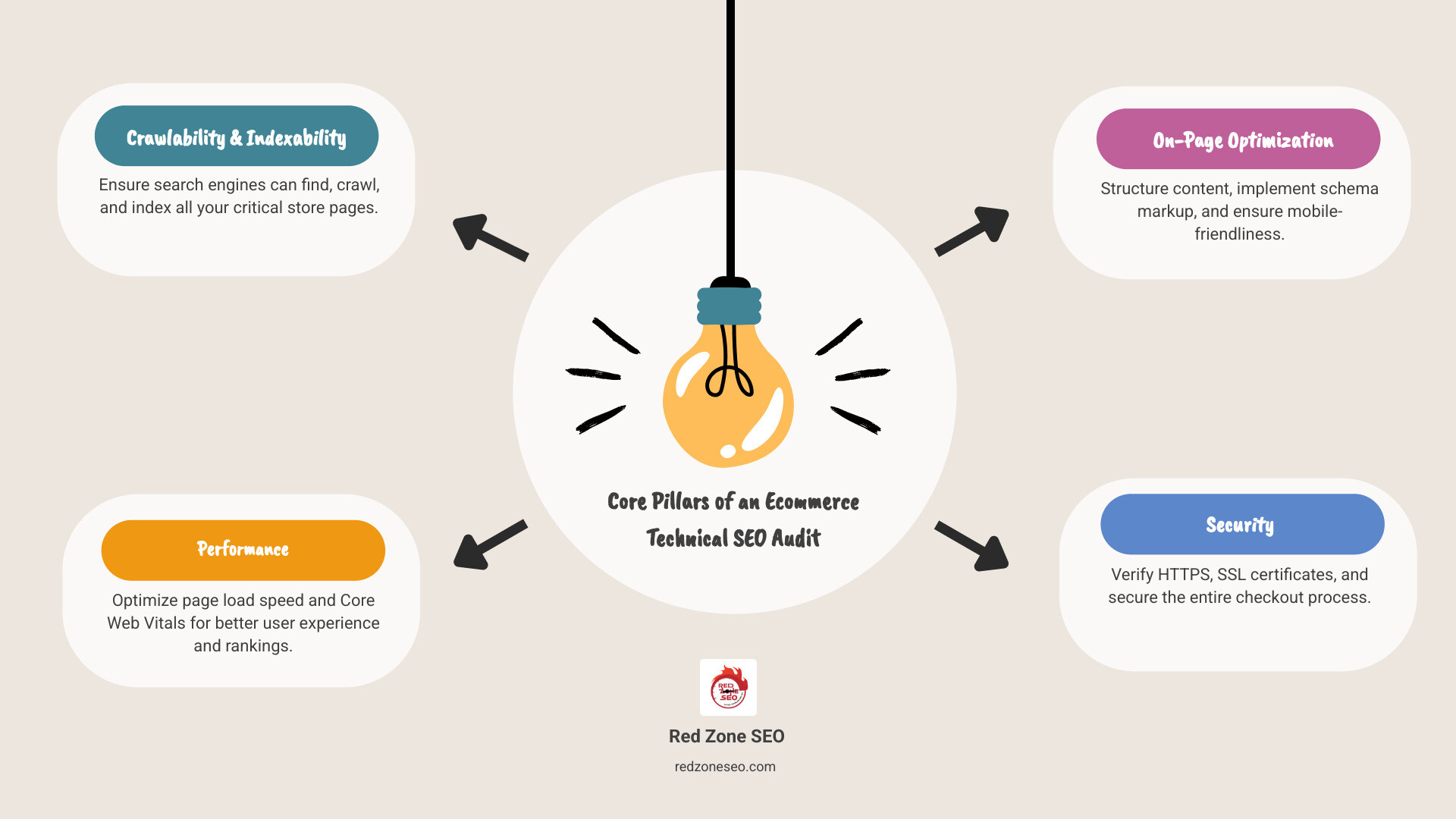
If you've perfected your products and branding but still lag behind competitors in search results, the culprit is likely hiding in your site's technical foundation. An ecommerce technical SEO audit is a diagnostic health check for your website, revealing why it might be invisible to search engines and frustrating for customers.
Your site's technical health directly impacts ranking signals, conversion rates, and ultimately, your return on investment (ROI). Fixing technical issues provides a measurable impact on your bottom line and a significant competitive advantage. Regular audits ensure your site is built for long-term growth, ready to handle more traffic and evolving search engine standards.
An ecommerce technical SEO audit is far more complex than a standard audit. A typical business site may have 50 pages; an ecommerce store can have tens of thousands, creating unique challenges:
Investing in regular audits delivers concrete results that show up in your analytics and revenue.
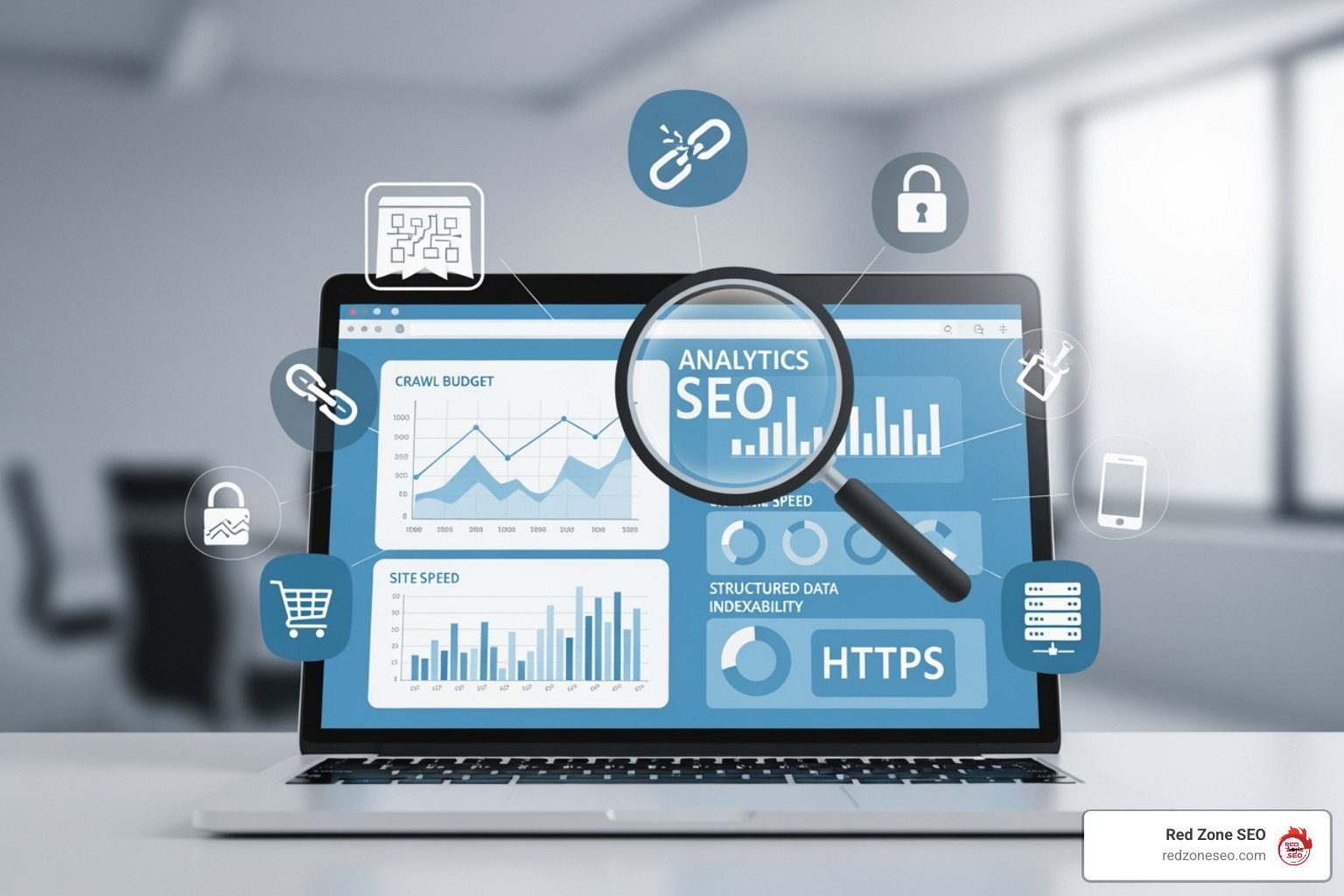
An ecommerce technical SEO audit is a systematic review of the pillars supporting your store's performance. Getting these components right builds a rock-solid foundation for success.
If search engines can't find or access your pages, nothing else matters. This is about ensuring your store is visible and understandable to Google.

Your site's structure should be intuitive for both users and search engines. A logical layout improves user experience and helps search engines understand your content's hierarchy.
/mens-running-shoes instead of /prod?id=123).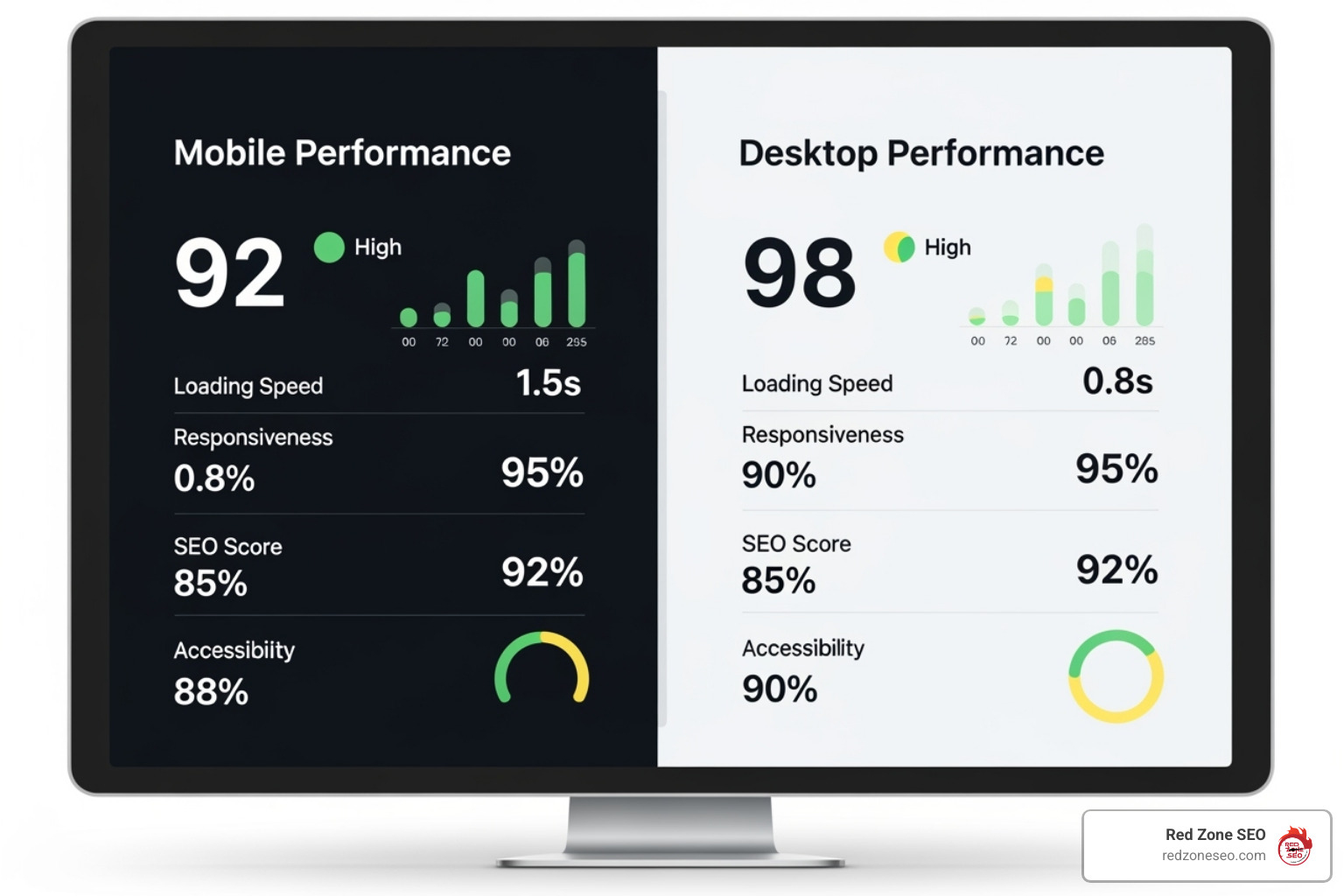
In ecommerce, speed equals revenue. Slow pages lead to abandoned carts and poor rankings. We focus on Google's Core Web Vitals, which measure real-world user experience:
We achieve this through image compression, browser caching, and minifying CSS & JavaScript.

With mobile-first indexing, Google primarily uses your mobile site for ranking. Your store must offer a seamless experience on all devices, with a responsive design, readable text, and easy-to-tap buttons.

Structured data is code that helps search engines understand your content. Proper implementation of Product, Review, and FAQ schema can earn you rich snippets—improved search results with ratings, price, and availability that increase click-through rates.
Security is non-negotiable. HTTPS is a confirmed ranking signal and the foundation of customer trust. We ensure your SSL certificate is correctly installed, and there are no mixed content issues that could trigger browser warnings and scare away customers.
A systematic approach turns the overwhelming task of an ecommerce technical SEO audit into manageable, actionable steps. This framework will guide you through uncovering and fixing issues on your site.
Before you begin, gather the right tools and set clear goals. Your objectives—whether recovering lost traffic or outranking a competitor—will guide your priorities.
Essential Tools:
With your tools ready, it's time to begin the analysis. This process gives you a comprehensive view of your site's technical health.
Certain problems appear frequently on ecommerce sites. Knowing what to look for helps you spot them faster:
An audit is only useful if you act on its findings. Create a roadmap by prioritizing fixes based on their potential impact and the effort required to implement them.
Assign tasks to the appropriate teams—developers for technical fixes and content teams for on-page improvements—to ensure the plan is executed effectively.
An ecommerce technical SEO audit is not a one-time fix; it's the beginning of an ongoing process of maintenance and improvement. After implementing fixes, you must track your progress and maintain your site's health to ensure long-term success.
Tracking the right metrics helps you understand what's working and where to focus your efforts next. Key KPIs include:
The ideal frequency depends on your store's size and how often you make changes. A good schedule ensures you stay ahead of problems and your competition.
It is essential to perform an audit before and after any major site changes, such as a redesign, platform migration, or URL structure update, to prevent any negative SEO impact.
Technical SEO can seem complex, so it's natural to have questions. Here are answers to some of the most common queries we receive from ecommerce store owners.
If we had to choose one, it would be crawlability and indexability. You can have the best products and content in the world, but if Google's bots can't find, crawl, and understand your pages, your store is effectively invisible. This foundation includes your robots.txt file, XML sitemap, and site architecture. Errors in these areas can prevent thousands of your pages from ever appearing in search results.
You can certainly perform a basic audit yourself using free tools like Google Search Console. However, the complexity of ecommerce sites—with faceted navigation, product variants, and JavaScript rendering—often requires professional expertise. Enterprise-level tools are needed to crawl thousands of pages efficiently, and fixing issues like slow server response times or implementing structured data at scale typically requires a developer. A professional brings the experience to spot subtle issues that can have a major impact on revenue.
The timeline for results varies. Quick wins, such as fixing critical crawl blockers or major indexing issues, can show positive effects within days or weeks as search engines re-crawl your site. We've seen indexed page counts jump almost immediately after fixing a misconfigured robots.txt file. Broader improvements from changes like page speed optimization or a new site structure typically take 3-6 months to fully materialize. Google needs time to process these changes and adjust rankings accordingly. Technical SEO is a long-term investment that builds a stronger, more resilient site over time.
An ecommerce technical SEO audit is more than just an error check; it's the cornerstone of a resilient foundation for sustainable growth. By ensuring search engines can efficiently crawl, index, and understand your site, you open the door to better rankings, increased organic traffic, and higher revenue.
Each technical improvement has a compound effect. Fixing a crawl issue can make hundreds of products visible in search. Optimizing Core Web Vitals improves user experience and boosts conversion rates. Implementing structured data helps your products stand out with rich snippets that attract more clicks.
A professional audit uncovers hidden opportunities and protects your most valuable digital asset: your online presence. It can reveal high-value categories that aren't being indexed or a poor mobile experience that's silently driving away customers.
At Red Zone SEO, we provide data-driven, proven SEO solutions custom to the unique challenges of ecommerce businesses. We don't just find problems; we create strategic roadmaps that combine technical expertise with a deep understanding of ecommerce dynamics to deliver measurable results.
Investing in your site's technical health today pays dividends for years. While competitors struggle with hidden issues, your optimized store will be capturing more traffic, converting more visitors, and building the kind of growth that transforms a business.
Ready to see what's possible when your store operates at its full potential? Contact Us today to discuss how a professional SEO audit can transform your online store. Let's build the technical foundation your business deserves.
In the fiercely competitive world of cloud software, mastering seo for saas startups isn't just an option; it's a survival strategy. It’s a specific kind of search engine optimization designed to boost visibility, attract targeted traffic, increase leads, and build brand authority for Software-as-a-Service (SaaS) companies.
The SaaS industry is crowded, with new companies launching daily. While many startups turn to paid ads for quick results, this can be expensive, and the traffic stops when you stop paying. SEO, on the other hand, is a long-term play that builds a steady, sustainable stream of organic traffic.
With 93% of online experiences starting with a search engine, SEO helps potential customers find your solution when they need it most. This "free" traffic from Google significantly lowers your customer acquisition costs over time. As one expert notes, "We won’t sugarcoat this – startup SaaS companies need to try really hard, be patient, and be dedicated to their SEO efforts. Indeed, results won’t appear overnight." This highlights the patience required, but the payoff is a strong foundation for continuous growth.
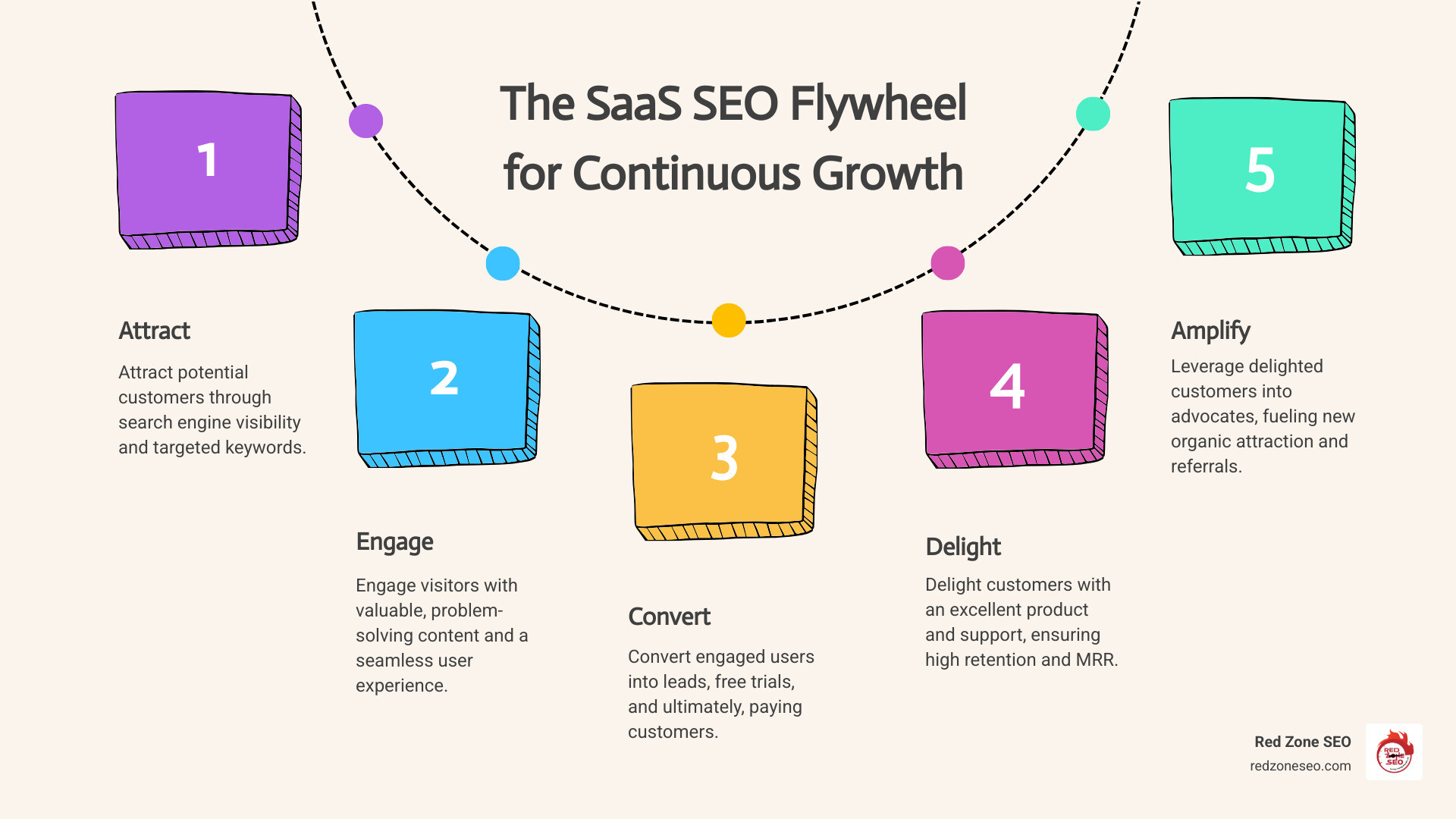
Here at Red Zone SEO, founders often ask, "Is seo for saas startups really different from regular SEO?" The answer is a resounding yes! While core principles remain, their application in the SaaS world is unique. Unlike a one-time sale, SaaS businesses thrive on a subscription model, aiming for long-term customer relationships and steady Monthly Recurring Revenue (MRR). This often involves a longer, more considered sales journey, requiring a more patient content and nurturing strategy.
One of the biggest advantages of seo for saas startups is its power to lower your Customer Acquisition Cost (CAC). Paid ads offer quick visibility but can drain your budget, and traffic often vanishes when the campaign ends. Organic traffic, once established, is essentially "free," allowing you to scale sustainably.
SEO is also crucial for building trust. In a crowded market, ranking high on Google signals authority and aligns with Google's emphasis on E-E-A-T (Experience, Expertise, Authoritativeness, and Trustworthiness). Just look at Copy.ai, which grew its organic traffic to 1 million clicks in five months, generating an estimated $98,500 in monthly traffic value. This incredible growth wasn't a happy accident; it was the direct result of a smart, strategic SEO approach specifically designed for the SaaS landscape. You can explore other impressive SaaS content marketing case studies to see the potential.
At Red Zone SEO, we focus on data-driven SEO solutions that deliver qualified leads and grow your MRR. Learn more about how we tailor our comprehensive SEO Services for businesses like yours.
The special sauce for seo for saas startups comes from a few key ingredients:
Here's a quick comparison:
| Feature | Traditional SEO | SaaS SEO |
|---|---|---|
| Primary Goal | Website traffic, leads, sales | MRR, customer acquisition, retention, product adoption |
| Keyword Focus | Broad informational, transactional | Problem-aware, solution-aware, product-aware, BOFU |
| Content Strategy | Blog posts, service pages, product descriptions | Product-led content, comparison pages, feature pages, free tools, case studies |
| Sales Cycle | Often shorter, direct purchase | Can be longer, nurturing through trials/demos |
| Technical SEO Needs | Standard website optimization | Complex web applications, dynamic content, user accounts |
| Key Metric | Organic traffic, conversions | MRR, CAC, free trial sign-ups, feature adoption |
For seo for saas startups, the impact is fundamental. It drives high-quality leads by attracting users actively searching for your solutions, which directly increases MRR. It builds brand credibility, positioning you as an expert and helping you compete with established giants. Finally, SEO is about long-term asset building; your optimized content continues to generate leads for years, providing compounding returns. For example, Hotjar's SEO efforts boosted Sales Qualified Leads (SQLs) by 150% and helped them secure over 200 backlinks from unlinked brand mentions.
Think of your seo for saas startups strategy as a finely tuned machine built on three interdependent pillars: the Engine (Technical SEO), the Fuel (Content), and the Oil (Off-Page SEO). Ignore or under-invest in any one of them and the whole system sputters.
The "Engine" is your website’s technical backbone—everything that helps search engines crawl, interpret, and index your pages.
robots.txt, logical internal linking, and no stray 404s ensure bots can reach every important page.SoftwareApplication schema is crucial for telling Google about your product, its price, and user ratings.hreflang tags is essential to tell Google which language and regional version of a page to show to users, preventing duplicate content issues and improving user experience.We surface every technical gap in a comprehensive SEO Audit before we ever write a single keyword.
Content is the "Fuel" that powers visibility, nurtures prospects, and—crucially—demonstrates E-E-A-T (Experience, Expertise, Authoritativeness, Trustworthiness).
Need help mapping keywords to each stage of the funnel? This in-depth guide on keyword research and the buyer’s journey from Search Engine Journal dives deeper.
To cement authority we build topic clusters: a broad, comprehensive "pillar" page that acts as a hub for a specific topic (e.g., "Agile Project Management"). This pillar page then links out to multiple in-depth "cluster" posts that cover specific subtopics (e.g., "How to Run a Sprint Retrospective," "Best Agile Tools"). This structure signals to Google that you are a definitive source on the subject and improves internal linking.

We also lean heavily on product-led content—tutorials, templates, and free tools that weave your SaaS interface directly into the narrative. It’s education and soft demo rolled into one tidy asset.
Off-page SEO is the "Oil" that keeps the whole engine humming, primarily through high-quality backlinks—digital votes of confidence.
Industry studies consistently show that sites with more links from unique, high-authority domains dominate the search results. For a deeper dive, check out Search Engine Journal’s comprehensive overview of why backlinks matter.
Our go-to link-building playbook includes:
Built over time, a healthy backlink profile cements you as a market authority. Explore our proven Link Building Services to accelerate the process.
Now, let's put it all into action with a practical blueprint. At Red Zone SEO, we often use a "70/20/10 rule" for initial execution: 70% on-page optimization, 20% internal linking and technical fixes, and 10% backlink building. This phased approach ensures efficient and effective efforts.
This first step is about understanding what customers search for and who you're competing against.
Ready to understand your audience? Let us help you start your Keyword Research journey.
With target keywords identified, we create the content "fuel." We start with a content calendar to map out topics and ensure consistent, strategic production. Every piece of content is optimized using on-page SEO best practices:
yourdomain.com/features/team-collaboration) that are easy for both users and search engines to understand.
Let us help you perfect your Content Optimization and make every word count.
SEO for saas startups is not "set it and forget it." It requires continuous measurement and refinement. We focus on key SaaS KPIs that tie directly to revenue:
We use indispensable tools like Google Analytics and Google Search Console to track these metrics. This constant monitoring allows us to see what's working (e.g., high impressions but low CTR means we should test new titles) and where adjustments are needed. We also prioritize content refreshes and updates. Keeping older articles fresh and accurate is a high-ROI tactic that can significantly boost rankings and traffic.
Ready to track your progress? Get started with Google Analytics and see your data come alive.
In seo for saas startups, there's no one-size-fits-all solution. Your strategy must evolve with your company's growth and funding. At Red Zone SEO, we align our efforts with your business goals at every stage.
With tight resources, the focus is on proving product-market fit and attracting early customers. The strategy is about efficient wins.
With more funding, the goal is to accelerate growth and boost MRR. The SEO strategy scales up accordingly.
At this mature stage, the focus shifts to maintaining market leadership and exploring new growth avenues.
Getting started with seo for saas startups can feel like a big leap. Let's clear up some common questions.
SEO is a marathon, not a sprint. You can generally expect to see tangible results, like increased organic traffic and keyword rankings, within 6 to 12 months of consistent effort. Significant impact on MRR often takes 12 to 24 months.
The timeline depends on several factors:
While early wins are encouraging, the real magic of SEO is its compounding, long-term growth.
While Google uses hundreds of signals, some are more important for seo for saas startups:
You can dig into Google's Search Quality Evaluator Guidelines for more detail on what they look for.
You can still make significant progress with a tight budget by being strategic:
We've covered a lot on our journey through seo for saas startups. You're now armed with a powerful framework for conquering the digital world. By focusing on the three pillars—The Engine (Technical SEO), The Fuel (Content Marketing), and The Oil (Off-Page SEO)—you can build a well-oiled machine for sustainable organic growth.
SEO isn't a quick fix; it's a long-term, high-ROI investment that demands patience, consistency, and a data-driven approach. The payoff is immense: lower customer acquisition costs, a steady increase in MRR, and enduring brand authority that sets you apart in the crowded SaaS market.
At Red Zone SEO, we're passionate about helping businesses like yours thrive. Our data-driven solutions are designed to deliver real, measurable results, changing your startup from a hidden gem into an SEO hero. Whether you're building your dream in Austin, growing in Florida, or making waves in Henderson, Las Vegas, or across Nevada, our team is ready to help.
Ready to start your journey? Let's discuss how our Digital Marketing Agency can build your strategy.
To succeed online, your store must appear in search results. An ecommerce seo audit checklist is a systematic review of your online store's search engine optimization (SEO) performance. It's designed to identify strengths, weaknesses, and opportunities to improve your visibility and organic traffic.
An audit typically includes:
Why is this so important? Because organic search is a goldmine for ecommerce. It drives 43% of all traffic to online stores, but visibility is concentrated at the very top. The first three Google results get a massive 75% of all clicks, and less than 1% of users ever look at the second page. If you're not on page one, you're nearly invisible.
An SEO audit is like a health check-up for your store. It helps you find and fix issues that are keeping you hidden from potential customers. Regular audits ensure your site stays healthy, ranks well, and gives you a significant edge over competitors.
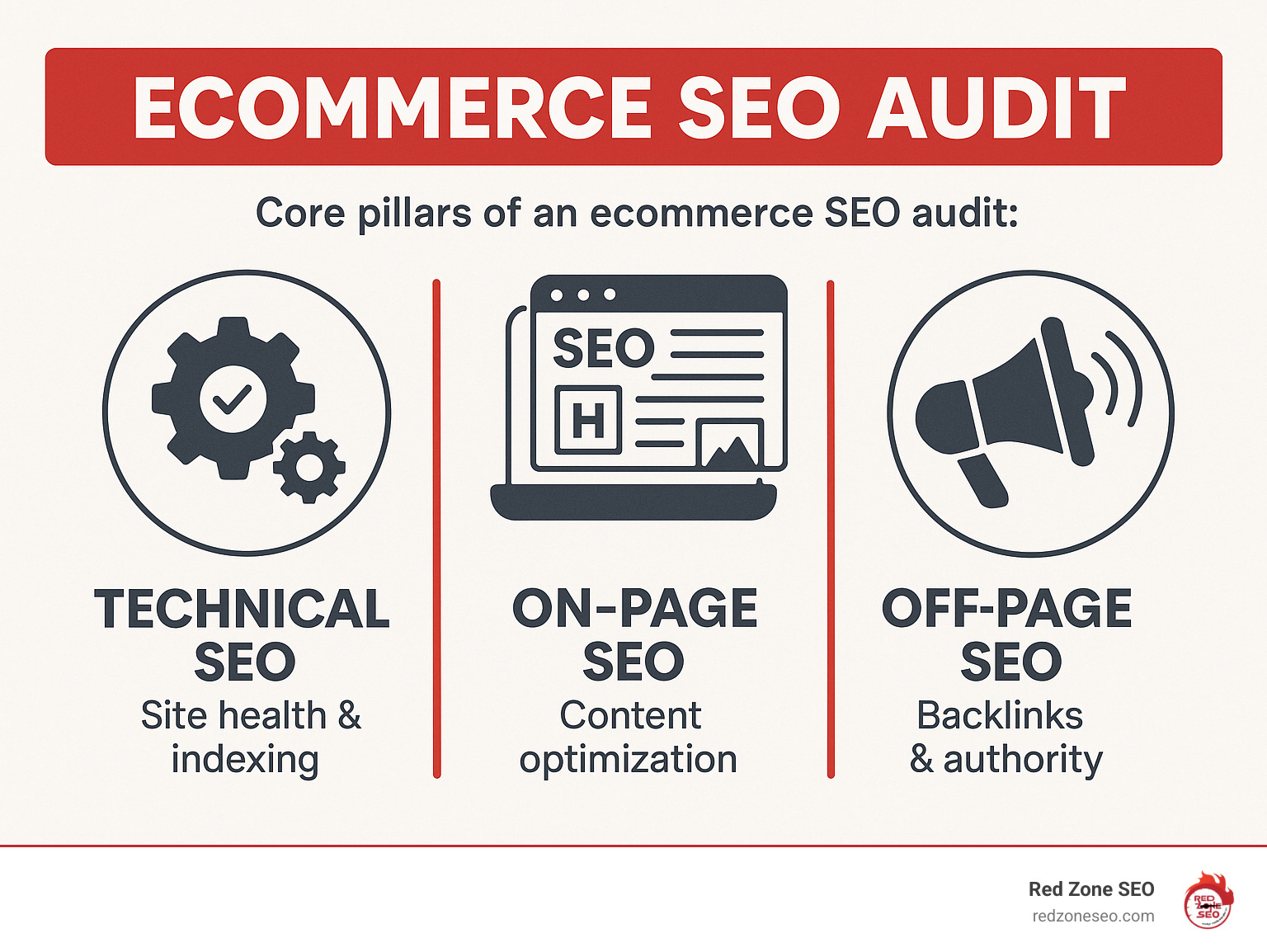
Learn more about ecommerce seo audit checklist:
The competition in online retail is fierce. Simply having a great product isn't enough—you need to be found. For most shoppers, the journey begins with a search engine. This traffic is not just high in volume, but also in quality. People searching for specific products are often ready to buy, and the #1 position in search results has an average Click-Through Rate (CTR) of 27.3%, making it 10 times more likely to get clicked than the #10 position.
Furthermore, mobile commerce is booming. With more than three-quarters of shoppers using a mobile device to look for products and sales projected to hit $710.4 billion by 2025, a mobile-first approach to SEO is critical. If your site isn't optimized for mobile, you're missing a huge segment of your audience.
You can learn more about how we help businesses with their online presence by checking out our page on SEO for Online Business.
The goal of your ecommerce seo audit checklist is to take a holistic approach to improving your store's health and profitability. It's about more than just finding problems.
First, we identify technical glitches, content gaps, and off-page weaknesses. These become clear targets for improvement.
Second, we uncover growth opportunities. This could mean finding new keywords to target, content to create, or internal linking strategies to implement.
Finally, the audit helps create an actionable, prioritized roadmap. We help you understand which fixes will have the biggest impact so you can see results faster. By improving rankings, attracting qualified traffic, and enhancing user experience, the ultimate goal is to increase your revenue.
For a broader understanding of how we approach website audits, visit our SEO Audit page.
Before diving into your ecommerce seo audit checklist, you need the right equipment. Having essential SEO tools is crucial for accuracy, efficiency, and gathering the baseline data needed to measure your success. Without this data, you're just guessing.
While many tools exist, a few are must-haves for any serious SEO audit. Here are the core players:
Google Analytics 4 (GA4): The standard for understanding user behavior. Use it to track where your visitors come from, what pages they view, and how they convert into customers. Get started at Google Analytics 4.
Google Search Console (GSC): This is Google's direct line to your website. It provides vital information on how Google sees your store, including crawl errors, keyword performance, and Core Web Vitals. Access it here: Google Search Console.
Website Crawler: An essential tool for X-raying your entire website. Crawlers like Screaming Frog, Semrush Site Audit, or Ahrefs Site Audit are excellent at finding hidden technical issues like broken links, redirect chains, or duplicate content.
Keyword Research Tool: To connect with customers, you must speak their language. Tools like Semrush, Ahrefs, or Google Keyword Planner help you find the exact phrases your potential buyers are using in search engines.
Page Speed Tool: Speed is non-negotiable. Google loves fast websites, and so do customers. A tool like PageSpeed Insights analyzes your page load times and provides clear steps for improvement.
At Red Zone SEO, we use a suite of advanced tools to get incredible results for our clients, but these categories form the foundation for any comprehensive ecommerce seo audit checklist.
Properly configuring your website crawler is critical, especially for large ecommerce sites. A careful setup ensures you gather the most accurate and complete data for your ecommerce seo audit checklist.
With your tools ready, it's time for the main event: your ecommerce seo audit checklist. We'll systematically review every crucial element of your store's SEO health, broken down into three core parts: Technical SEO, On-Page & Content SEO, and Off-Page SEO.

Technical SEO is the foundation of your site's performance. It ensures search engines can easily find, crawl, and index your content. Without a solid technical base, even the best content and backlinks won't achieve their full potential. We'll examine crawlability, indexability, site structure, mobile-friendliness, speed, and security.
This step ensures Googlebot can efficiently access your site.
?color=red) are handled in GSC to prevent duplicate content. Use Google's URL parameter crawl tool to manage this.Speed is critical for both SEO and user experience. If your site takes longer than 3 seconds to load, 53% of your visitors will click away. Google's Core Web Vitals are a key ranking factor.
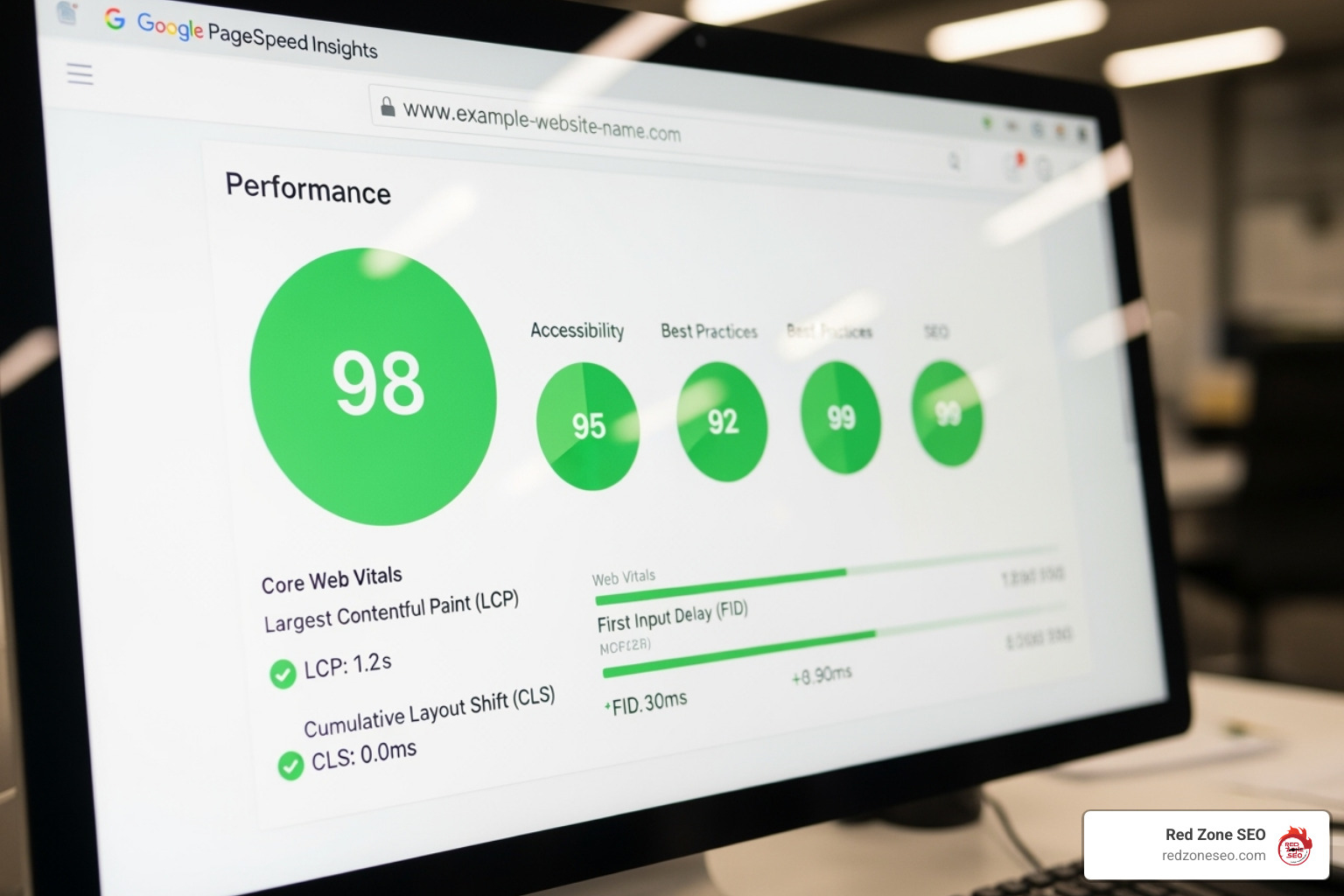
With Google's mobile-first indexing, your mobile site's performance is paramount for rankings.
With a solid technical foundation, we now focus on your on-page content. This involves optimizing for keywords, improving content quality, and ensuring your pages are structured for both users and search engines. Learn more about our approach with our Content Optimization services.
/womens-shoes/red-heels).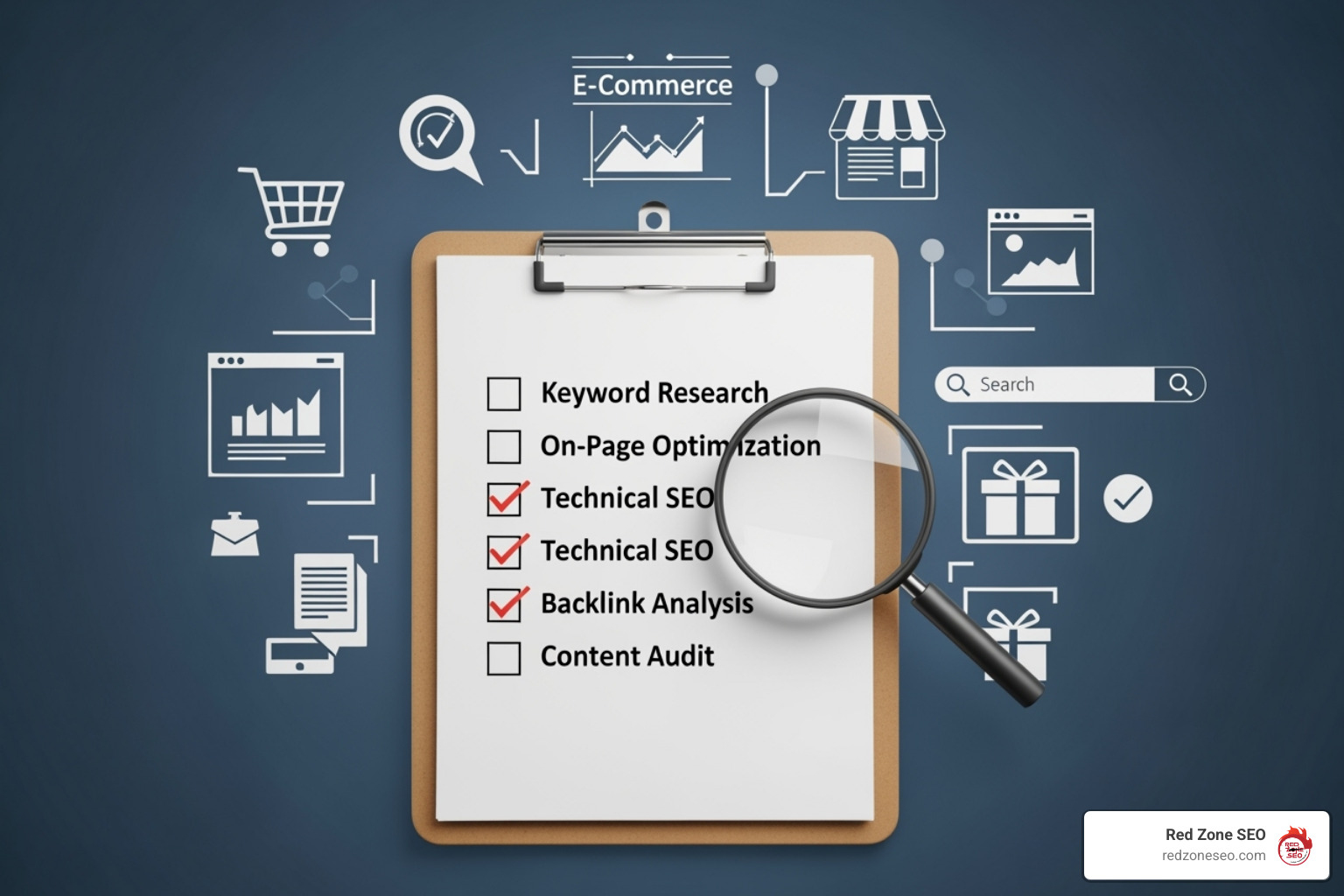
Off-page SEO involves activities outside your website, primarily building a strong backlink profile. High-quality links act as votes of confidence, boosting your site's authority. Learn more at our Link Building Services page.
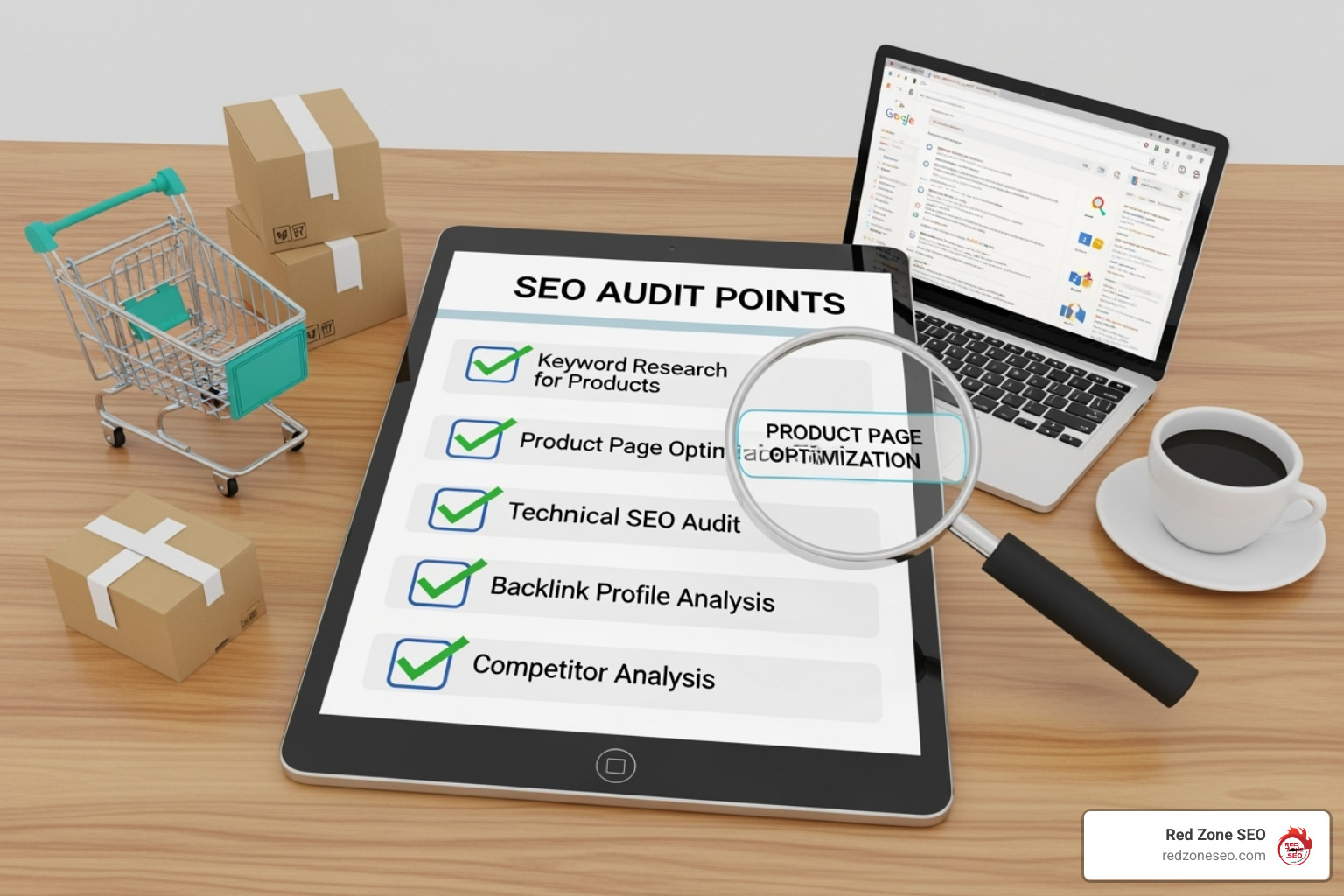
Completing the ecommerce seo audit checklist is just the beginning. Now you must turn those findings into an actionable plan. Without clear priorities and a way to track progress, your hard work won't translate into more traffic and sales.
An audit can uncover many issues. The key is to organize them into a manageable roadmap.
Here’s a simple example of a prioritization matrix:
| Issue | Impact (High/Med/Low) | Effort (High/Med/Low) | Priority (High/Med/Low) |
|---|---|---|---|
| Broken Internal Links | High | Low | High |
| Duplicate Product Descriptions | Medium | Medium | Medium |
| Slow Mobile Page Speed | High | High | High |
| Missing Product Schema | Medium | Low | Medium |
| Toxic Backlinks | High | Low | High |
How do you know if your changes are working? SEO is a continuous process of implementation and measurement. Track these Key Performance Indicators (KPIs) to measure the success of your efforts:
By consistently monitoring these metrics, you can refine your strategy and ensure your ecommerce seo audit checklist continues to drive measurable growth.
It's natural to have questions about the ecommerce seo audit checklist. Here are answers to some of the most common ones we receive.
Think of your website as a dynamic asset. For a full, comprehensive audit, we recommend doing one at least once every six months. This regular check-up helps you spot issues before they become major problems and adapt to changes in the search landscape.
Consider more frequent, focused check-ups if you have a very large site, have recently made significant changes (like a platform migration), or after a major Google algorithm update.
The cost of an ecommerce seo audit checklist varies significantly. The price depends on several factors:
To understand the factors that contribute to the price, see our detailed page on SEO Audit Cost.
Yes, you can! With the right tools and a clear ecommerce seo audit checklist like this one, a DIY audit is possible. It can be a fantastic learning experience that gives you a deeper understanding of your website.
However, be realistic about the time commitment. A thorough audit can take anywhere from a few hours to several days, depending on your site's complexity. It requires a solid grasp of SEO principles and the ability to interpret data. If you have a smaller site and the time to commit, a DIY audit is a great start. For larger, more complex sites, or if you lack the time or expertise, hiring a professional agency can provide a more thorough analysis and a clearer path to success.
We've covered the essentials of an ecommerce seo audit checklist, from the technical foundation to on-page content and off-page authority. The key takeaway is that a regular audit isn't a one-time fix; it's a critical, continuous process that is essential for maintaining and improving your online store's visibility and profitability.
We've seen how organic search is a goldmine for ecommerce and that ranking on the first page of Google is paramount. Every element matters—from a technically sound, fast-loading site to compelling content and a strong backlink profile. An audit doesn't just find problems; it uncovers immense opportunities for growth. By prioritizing fixes and tracking your results, you can turn these insights into a significant increase in revenue.
At Red Zone SEO, we specialize in changing your online presence through data-driven, proven SEO solutions that deliver measurable results. We understand the unique challenges of ecommerce, from managing thousands of product pages to adapting to dynamic content trends. Our team's expertise in keyword research, content creation, and technical SEO ensures your store isn't just visible—it's positioned for success.
You've created valuable products; don't let them stay hidden in the depths of search results. It's time to take control of your online destiny and open up your store's full potential.
Ready to see how a professional SEO audit can boost your sales? We'd love to chat. Visit us at https://redzoneseo.com/seo-services-las-vegas-307753/ to learn more about our custom SEO strategies.
When you're looking into seo for website cost, you'll quickly find there's no single price tag. Much like buying a car, the answer depends entirely on what you need. The investment required is shaped by several key factors:
Many business owners want to grow, attract more customers, and outperform the competition, but investing in something as complex as SEO can feel overwhelming. SEO isn't a magic trick; it's a strategic, ongoing effort to make your website more visible to people searching for what you offer. The goal is to get the best value for your money—avoiding overspending while not cutting corners that lead to poor results.
This guide will break down how SEO agencies charge, what drives costs, and what you should expect at different investment levels. Our goal is to help you make a smart decision so your SEO investment helps your business thrive.
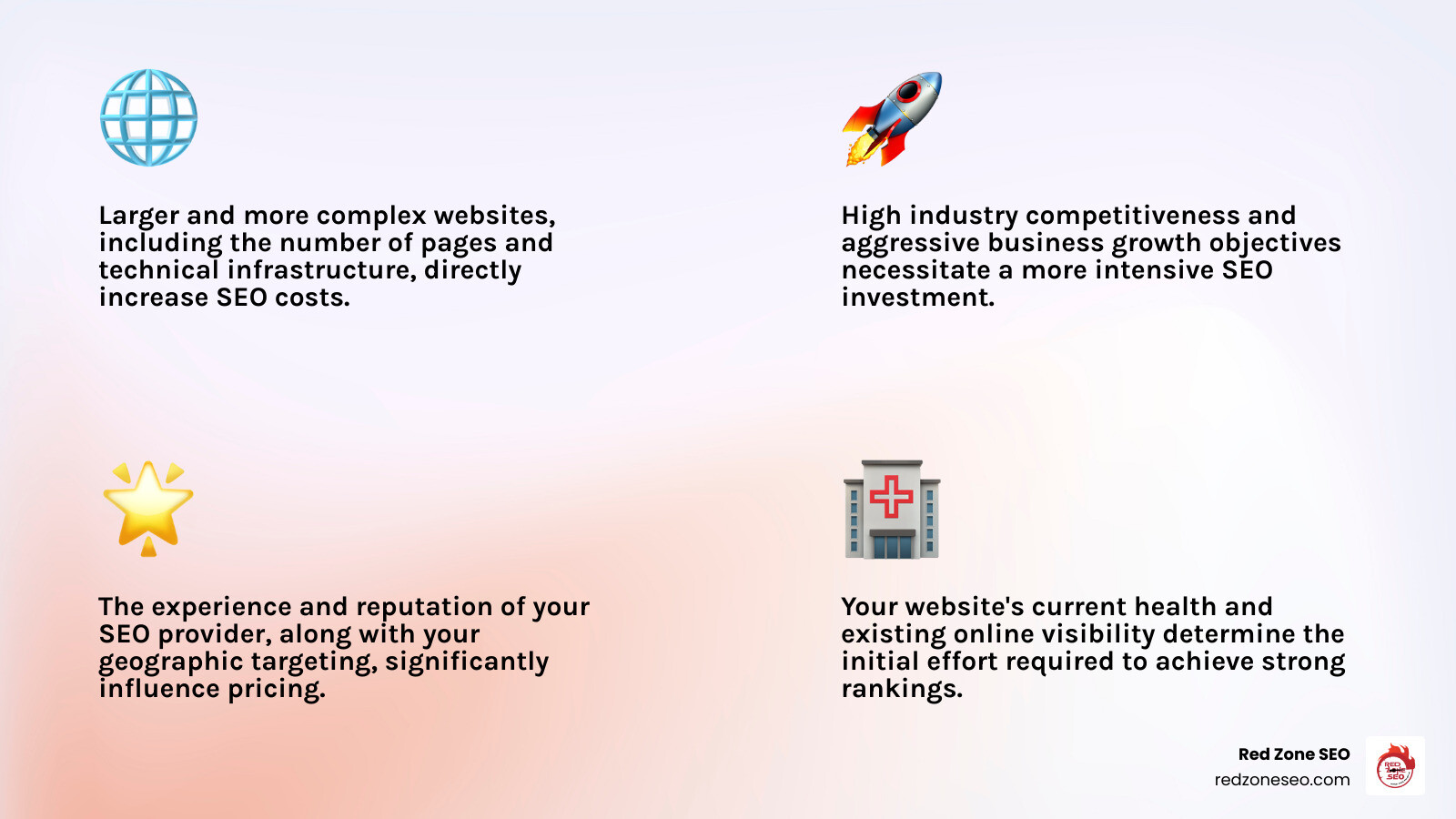
Seo for website cost basics:
When exploring seo for website cost, you'll encounter various pricing models. Each offers unique advantages, and understanding them helps you find the right fit for your business goals and budget.
This is the most common and effective model for ongoing SEO. You pay a consistent monthly fee for a predefined set of services, fostering a long-term strategic partnership. SEO is a marathon, not a sprint, and this approach allows an agency to continuously monitor performance, adapt to algorithm updates, and implement ongoing optimizations. A monthly retainer builds a strong, collaborative relationship, ensuring your SEO partner is always aligned with your evolving goals and driving sustained growth. For example, a lower-tier retainer might focus on foundational technical SEO and local optimization, while a higher-tier retainer would include aggressive content creation, digital PR, and advanced analytics.
Hourly rates are ideal for businesses needing specific, short-term assistance or specialized consultations. You pay for the actual time an SEO professional dedicates to your project, offering flexibility for one-off tasks like an initial audit, technical fixes, team training, or strategic guidance during a website redesign. While great for defined needs, hourly billing can become unpredictable and costly for a comprehensive, long-term strategy, and scope creep is a real risk if not managed carefully. A cheap hourly rate can sometimes lead to low-quality work that does more harm than good; investing in expertise often yields better and safer results.
Project-based pricing involves a one-time fee for a clearly defined scope of work with specific deliverables, such as a comprehensive SEO Audit, a complex Website Migration, Penalty Recovery, a foundational link building campaign, or a content strategy development project. This model offers excellent cost predictability, as you know the total investment upfront. You can find More info about our SEO Audit Cost to understand what a project like this entails. While project-based work provides a fantastic foundation or solves a pressing issue, it doesn't account for the ongoing nature of SEO. It's a crucial tune-up, but you'll still need regular maintenance to maintain rankings and adapt to future changes.
Some agencies offer hybrid models, combining a lower monthly retainer with performance-based bonuses tied to specific KPIs like traffic increases or lead generation. While appealing, these models can be complex to structure and require crystal-clear definitions of success. True performance-only SEO is rare and often comes with significant caveats, as agencies must assume all the upfront risk.
Here's a quick comparison of the primary pricing models:
| Pricing Model | Pros | Cons |
|---|---|---|
| Monthly Retainer | Consistent, long-term strategy; Adaptable to changes; Builds strong client-agency relationship | Can be a significant ongoing investment; Results take time to materialize |
| Hourly | Flexible; Good for specific, short-term tasks; Pay for what you use | Costs can escalate quickly; Requires close monitoring of hours; Not ideal for comprehensive strategy |
| Project-Based | Fixed cost; Clear deliverables; Ideal for one-off improvements or foundational work | Not suitable for ongoing SEO; Doesn't account for algorithm changes; Limited scope |
When comparing costs, you'll also find differences between US-based agencies, overseas providers, freelancers, and full-service agencies. US-based agencies typically have a higher investment due to operating costs and deeper market expertise. While overseas providers may seem budget-friendly, they can sometimes lack the quality, strategic oversight, or cultural understanding needed for top results. Similarly, a freelancer might be a streamlined option for a specific task, but a full-service agency like Red Zone SEO offers a broader range of expertise, a dedicated team, robust systems, and more comprehensive resources for sustainable growth.
Understanding pricing models is the first step; the next is grasping why prices vary. Like building a house, the final cost of SEO depends on many variables. A one-size-fits-all approach to seo for website cost doesn't work because Google uses over 200 ranking factors to determine placement. Here are the key elements that influence your investment.

The size and complexity of your website are major cost drivers. A local plumber with a small, 5-page website has vastly different needs than a national e-commerce store with thousands of product pages.
The online landscape of your industry heavily shapes your seo for website cost.
The expertise and location of your SEO provider are significant cost factors.
Just as business size affects seo for website cost, so does the geographic scope of your audience. Whether you're serving a single neighborhood or a global market, your SEO strategy—and its price tag—will be fundamentally different.

From helping local stores shine in their community to empowering corporations to dominate global search, each focus requires a unique blend of tactics and investment.
Typical Investment: $500 – $2,500 per month
Local SEO is the secret weapon for brick-and-mortar businesses and service providers targeting customers in their immediate area. For a coffee shop in Austin or a dentist in Las Vegas, the goal is to appear in the local map pack and drive foot traffic. This makes local SEO a highly targeted and cost-effective way to grow. The investment is often more modest than for national campaigns, though it varies based on the size of your city and local competition.
Key local SEO activities include:
For community-focused businesses, a strong local SEO strategy is essential. We offer specialized local seo packages and more information on local seo cost to help you stand out.
Typical Investment: $2,500 – $7,500+ per month
If your business serves customers nationwide, your SEO strategy must expand significantly. The goal shifts from local visibility to establishing broad topical authority and competing for high-volume, highly competitive keywords. This requires a much larger investment in content and link building.
Key national SEO activities include:
Typical Investment: $3,000 – $10,000+ per month
E-commerce SEO is one of the most complex and demanding disciplines. With potentially thousands of product and category pages, technical precision is paramount. The higher investment is driven by the sheer scale and technical complexity required to compete.
Key eCommerce SEO activities include:
Typical Investment: $5,000 – $20,000+ per month
Expanding into global markets introduces another layer of complexity. International SEO involves tailoring your website and strategy for different countries and languages. This requires significant technical resources and market-specific knowledge.
Key international SEO activities include:
When considering seo for website cost, it's crucial to know what you're getting for your investment. Understanding the components of an SEO package helps you evaluate its value and set realistic expectations. A truly comprehensive package is a multi-faceted machine where several core services work in concert to improve your online presence.
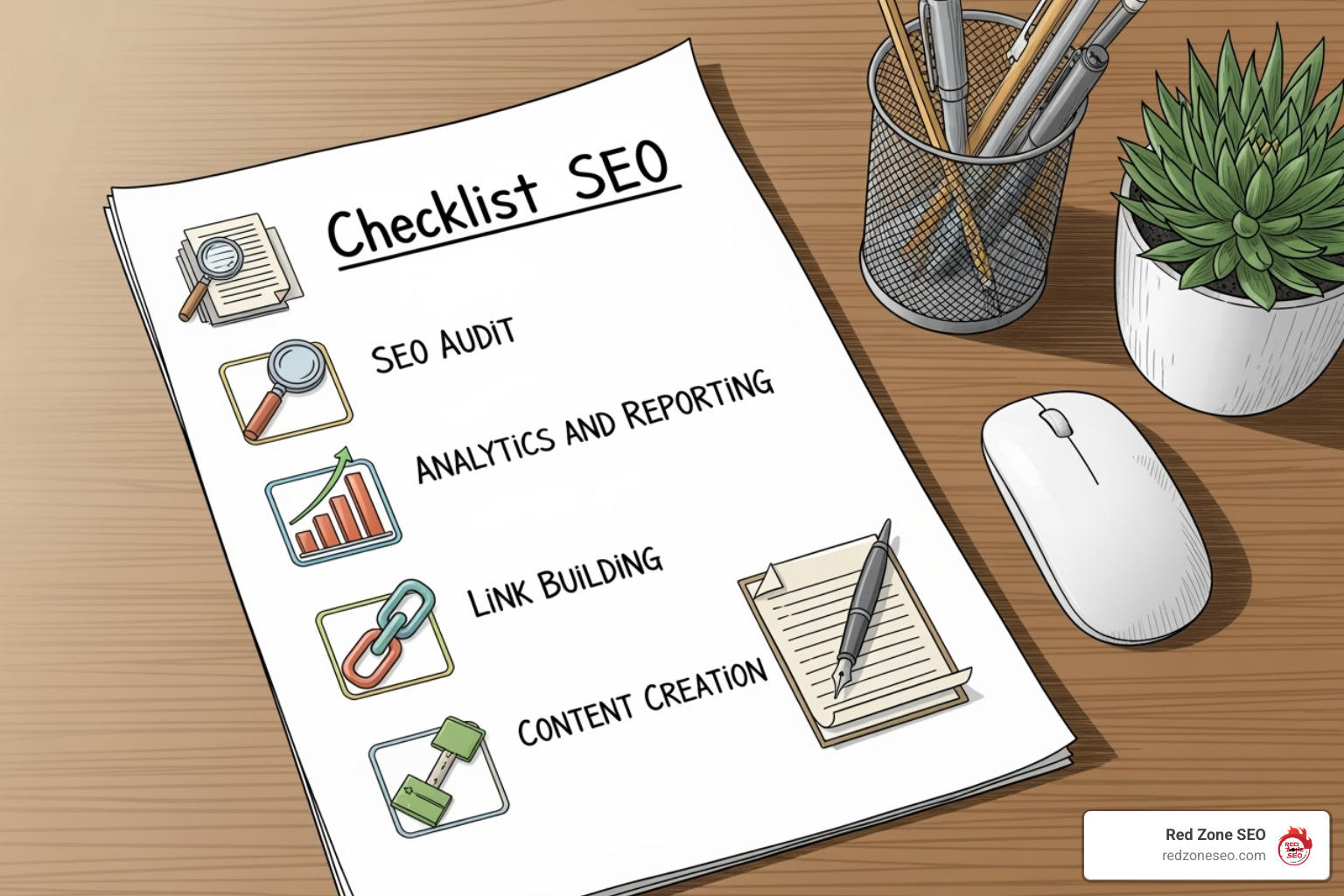
Every successful SEO campaign begins with a clear understanding of your starting point and a data-driven plan. This foundational phase is non-negotiable for long-term success.
Once the strategy is set, the ongoing work begins. This is where consistent effort translates your investment into tangible results like more traffic, leads, and sales.
Viewing SEO as a long-term investment, rather than a monthly expense, is key to success. While it typically takes three to six months to see noticeable results, the momentum builds over time. The real return on investment (ROI) often materializes within 12 to 24 months, as your content and authority grow, delivering sustainable organic traffic long after the initial work is done. This traffic is incredibly valuable, as it comes from users actively searching for your solutions.
Conversely, "cheap" SEO (under $500/month) is incredibly risky. It often leads to harmful "black-hat" tactics, outsourced work with no strategy, or no results at all. With SEO, you truly get what you pay for.
Understanding your return is crucial. The basic formula is (Gain from Investment - Cost of Investment) / Cost of Investment. To measure the "Gain," we track:
Be wary of offers that seem too good to be true. Watch for these red flags:
Your ideal budget depends on your revenue, goals, and industry competition. A common starting point is allocating 7% to 12% of gross revenue to marketing, with about 13% of that dedicated to SEO. If you're unsure, start with a smaller test budget for a few months. As you see positive results, you can confidently scale your investment.
| Monthly SEO Budget | What You Can Typically Expect |
|---|---|
| Under $1,000 | Very basic services, often just an audit or limited consulting. High risk of low-quality or harmful work. |
| $1,000 - $2,500 | Solid foundational SEO for small businesses in low-to-medium competition local markets. |
| $2,500 - $5,000 | Comprehensive local or basic national campaigns. Includes content creation and foundational link building. |
| $5,000 - $10,000+ | Aggressive national or e-commerce campaigns in competitive niches. Includes advanced technical SEO, digital PR, and extensive content strategy. |
Research shows that satisfaction correlates with investment: over 50% of companies spending $2,500 – $5,000 per month would recommend their provider, while 53% spending under $500/month were dissatisfied. While avoiding "cheap" SEO is crucial, you can find excellent value. We offer options like Affordable SEO Las Vegas that balance cost and quality.
Before committing, ask any potential provider these key questions:
As we've seen, there is no single answer to the question of seo for website cost. The right price depends entirely on your unique business needs, goals, and competitive landscape. The most important takeaway is to view SEO as a long-term investment in a sustainable asset, not a short-term expense.
Think of SEO as planting a tree. It takes time to grow, but it eventually provides value that far exceeds the initial effort. SEO is a marathon, not a sprint, and businesses that accept this perspective see the most significant long-term success. A well-executed strategy builds lasting value; unlike paid ads that vanish when you stop paying, optimized content and earned backlinks continue to attract customers for years.
This is why focusing on value and partnership over the lowest price is critical. "Cheap" SEO services often lead to poor results or, worse, penalties that can damage your online presence. At Red Zone SEO, we believe in transparency and measurable outcomes. We don't make empty promises of overnight success. Instead, we provide data-driven strategies customized to your business goals, ensuring your investment is working strategically toward your growth.
We are committed to being your partner in growth, taking the time to understand your business and craft a strategy that makes sense for you. The question isn't whether you can afford to invest in SEO, but whether you can afford not to while your competitors capture the customers who should be finding you.
To get a clear picture of what your investment will look like, we invite you to explore our transparent Pricing page. We believe in straightforward communication so you can make an informed decision about your marketing investments.