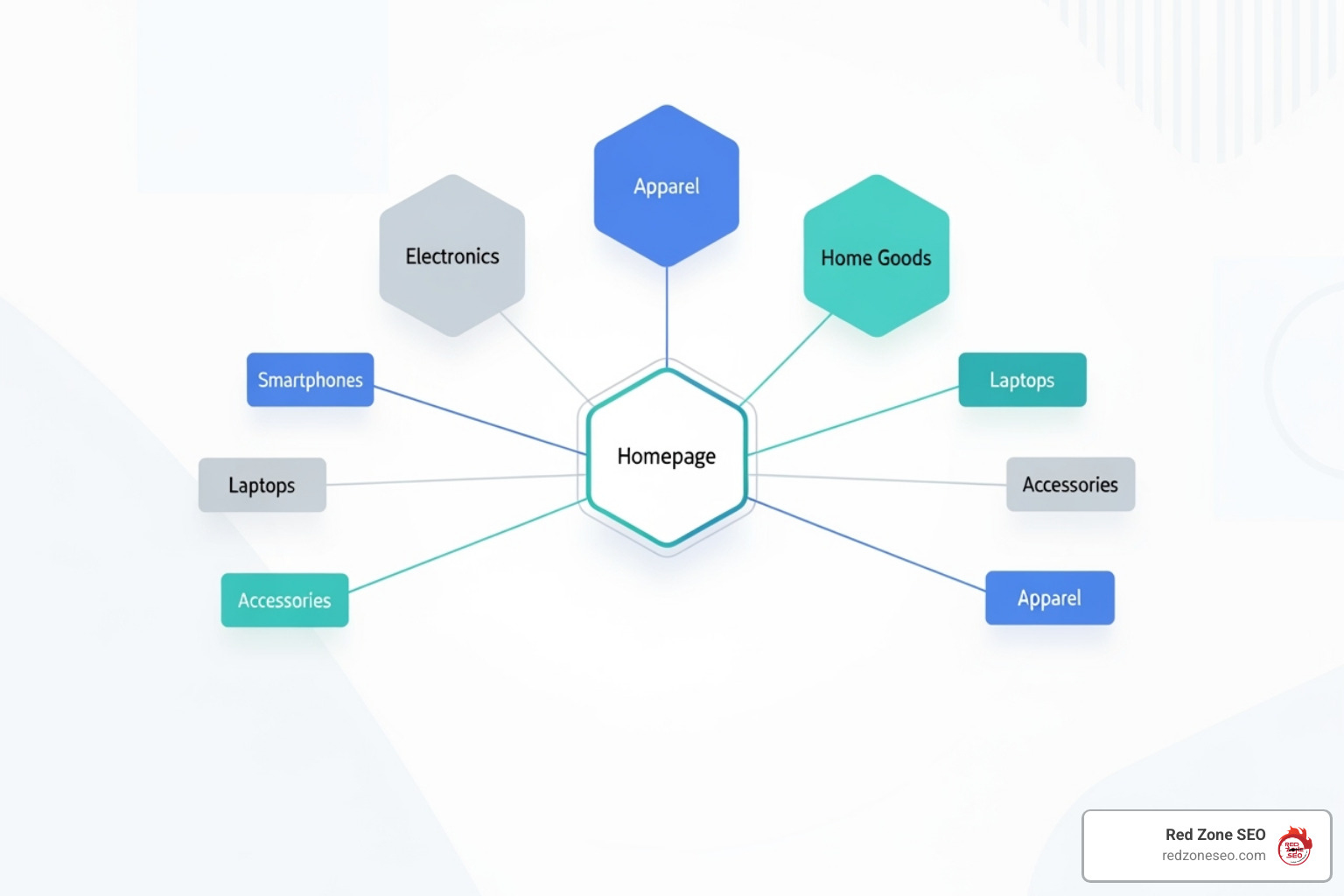
Ecommerce site structure SEO is the strategic organization of your online store's pages and navigation to improve both user experience (UX) and search engine visibility. Think of it as the digital blueprint for your business. This framework, professionally known as Information Architecture (IA), dictates how logically your content is arranged and how easily customers and search engine crawlers can find what they need. A well-planned structure is the bedrock upon which all other SEO and marketing efforts are built.
This framework is absolutely critical because a staggering 88% of online shoppers won't return to a site after a bad experience. In the context of site structure, a "bad experience" means getting lost in confusing menus, being unable to find a specific product, or clicking through endless pages to get to a destination. When customers can't find products quickly, they don't just get frustrated—they leave and buy from a competitor. Simultaneously, when search engines can't crawl your site effectively due to a convoluted structure, your rankings suffer, and you become invisible to potential new customers. A logical, intuitive structure is the solution that serves both audiences, helping search engines index your products and making it effortless for customers to complete a purchase.
Key Elements for a Successful Structure:
domain.com/womens-clothing/summer-dresses/floral-print-maxi-dress).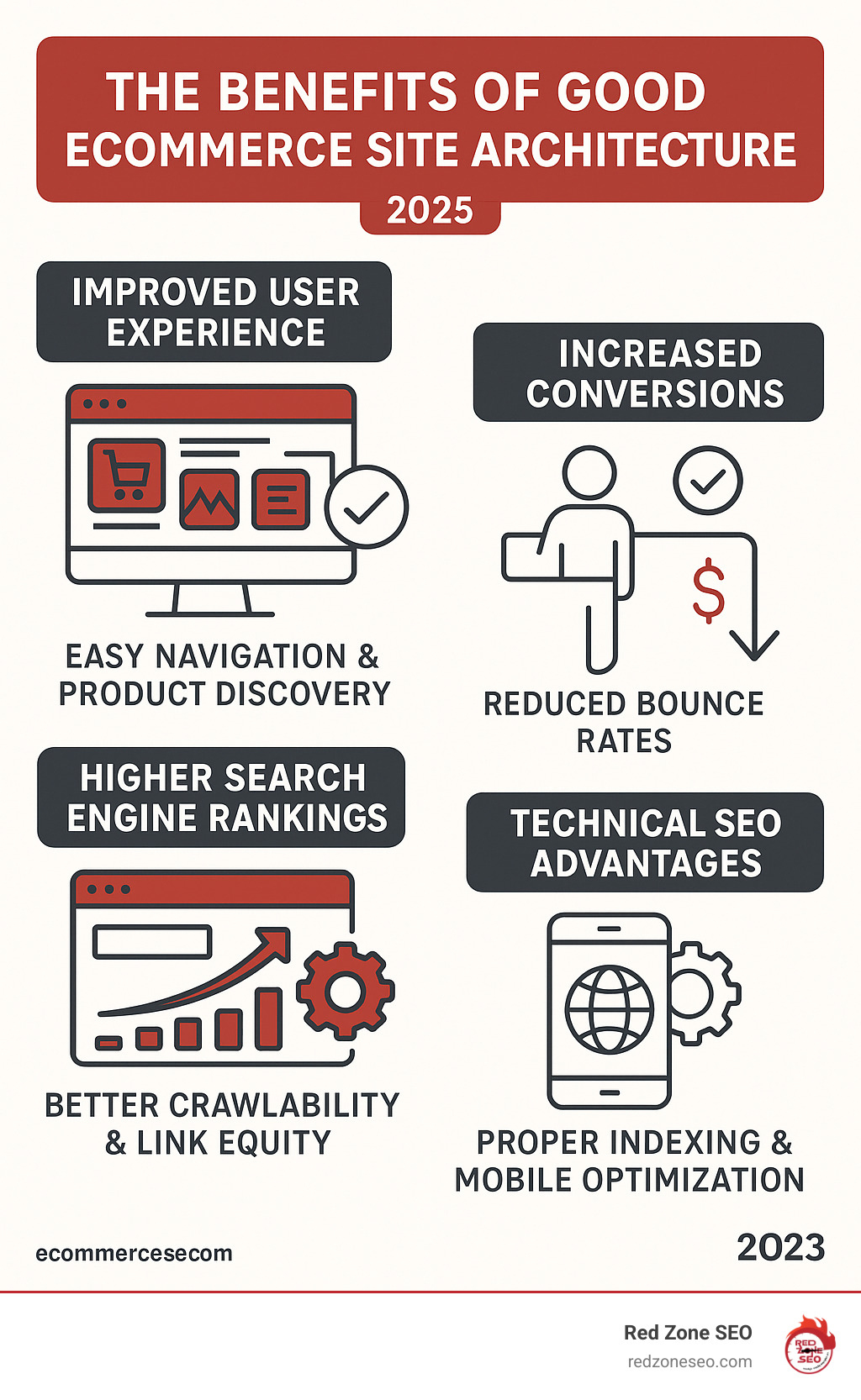
Ecommerce site structure seo helpful reading:
A well-planned ecommerce site structure SEO is essential for sustainable success. It's not just a technical task; it's a core business strategy that impacts everything from how search engines find and rank your products to how smoothly customers can steer their way to a purchase. A solid architecture creates a powerful win-win scenario where both search engine bots and human shoppers can explore your site with maximum ease and efficiency.
A clear, logical structure acts as a detailed and accurate map for search engine crawlers, making their job of understanding and indexing your site significantly easier. This directly and positively impacts your search rankings.
Homepage > Men's Apparel > Outerwear > Waterproof Jackets, they understand the relationship between these pages. This establishes topical authority and helps them match your specific product pages with highly relevant, long-tail search queries.A great site structure is fundamentally about creating an exceptional and frictionless shopping experience that encourages repeat business and builds brand loyalty.
As we've noted, 88% of online shoppers won't return after a bad experience. Your site's structure is a primary driver of that experience. Getting it right creates a virtuous cycle: better organization leads to better UX, which signals quality to search engines, driving more qualified traffic to your well-organized, high-converting store.
Building a high-performing ecommerce site starts with its foundational elements. From the logical grouping of products to the clarity of your URLs and the intuitiveness of your navigation, each component plays a critical role in creating a seamless and effective experience for both search engines and shoppers.
The way you group and classify your products is the single most crucial aspect of your ecommerce site structure seo, as it dictates how your entire inventory is organized and understood. A shallow, hierarchical structure is almost always the best approach.

We recommend a flat architecture that looks like this:
This structure ensures that no product is more than three clicks from the homepage, which is ideal for both user experience and search engine crawlability. To define these categories, conduct in-depth Keyword Research. This isn't just about search volume; it's about understanding user intent and using the same language your customers use. Analyze competitor sites to see how they organize similar products and design a structure that is both intuitive today and scalable for future growth.
Once your categories are defined, you must make them easily accessible through intuitive navigation systems.
Your URLs are a surprisingly important piece of SEO real estate. A well-structured URL should be clean, readable, and descriptive, reinforcing the page's content for both users and search engines. It should mirror your site's hierarchy (e.g., domain.com/category/product-name). Always use hyphens (-) to separate words, as Google treats them as spaces, while it often ignores underscores (_). Keep URLs as short and concise as possible, and if you ever need to change a URL, use a permanent 301 redirect to pass its SEO authority to the new location.

These navigational aids are essential for improving both UX and ecommerce site structure seo.
Breadcrumb Navigation: These are the secondary navigation links, usually at the top of a page, that show a user's location within the site hierarchy (e.g., Home > Men's > Shoes > Running Shoes). They are excellent for UX, as they allow users to easily steer back to higher-level categories. For SEO, they build a strong web of internal links that clearly defines your site's structure for crawlers. Implementing Schema markup for breadcrumbs can also improve your appearance in search results.
Internal Linking Strategy: A deliberate internal linking strategy is vital for distributing authority and guiding users. Link from your homepage to your most important categories. On product pages, cross-link to related items in sections like "Customers Also Bought..." or "Complete the Look." Most importantly, use your blog content to create contextual links that drive traffic to relevant product or category pages. Learn more in our article on Ecommerce Site Structure: SEO Contextual Links.
Beyond the foundational components, advanced technical SEO is required to ensure your site's architecture performs flawlessly at scale. This involves mastering complex navigation systems, strategically guiding search engine crawlers, and relentlessly optimizing for speed and the modern mobile-first landscape.
Faceted navigation—the array of filters for color, size, brand, price, and other attributes—is a fantastic tool for users but can be a catastrophic problem for SEO if not handled correctly. Each time a user clicks a filter or a combination of filters, a new, parameterized URL can be generated (e.g., .../dresses?color=red&size=10). This can lead to thousands, or even millions, of nearly identical pages. This wastes your finite crawl budget on unimportant pages and creates massive duplicate content issues that dilute your ranking signals and can harm your site's authority.
To solve this complex issue, you need a multi-layered approach:
rel="canonical" Tag: This is your primary tool. The filtered, parameterized URL should contain a canonical tag that points back to the main, clean category page. This tells search engines, "This page is just a filtered view; please consolidate all ranking signals to the main category page."noindex Meta Tag: For filter combinations that provide little to no search value (e.g., sorting by price), you can apply a noindex tag to tell search engines not to include them in their index at all.robots.txt: You can use your robots.txt file to block crawlers from accessing URLs with specific parameters (e.g., Disallow: /*?price=). This is a blunt instrument best used to preserve crawl budget, but it will not remove pages that are already indexed.Sitemaps are essential roadmaps you provide to search engines. An HTML sitemap is a user-facing page that acts as a table of contents for your site, improving usability. The XML sitemap, however, is the real workhorse for SEO. It's a specifically formatted file designed for search engines, providing a comprehensive list of all the URLs you want them to find and index. Once created, you must Submit your sitemap to Google Search Console.
A smart indexing strategy is just as important. You want to focus Google's limited crawl budget on pages that drive revenue and rankings—your core product and category pages. You should actively noindex pages that offer no value in search results, such as internal search result pages, checkout and cart pages, and user account pages. Furthermore, you must regularly prune thin content—pages with very little unique information, such as a category page with only one product. These low-value pages can lower Google's overall quality perception of your site. Improve them, redirect them, or noindex them.
Google uses mobile-first indexing, which means it primarily uses the mobile version of your website for ranking and indexing. A clunky, slow, or poorly structured mobile site will severely damage your rankings on all devices. Responsive design is mandatory, ensuring your site's layout, text, and buttons adapt perfectly to any screen size.
Site speed is a confirmed ranking factor and has a direct, measurable impact on your bottom line. Research consistently shows that just a one-second delay in page load time can lead to a 7% drop in conversions. Your site's architecture plays a huge role here. To improve performance, you must optimize for Google's Core Web Vitals (CWV), which measure loading performance (LCP), interactivity (INP), and visual stability (CLS). This involves compressing images, minifying code, and leveraging browser caching. Regularly conducting technical audits is the best way to identify and fix these performance bottlenecks. Our guide on How to Conduct a Technical SEO Audit can walk you through the process.
A perfect structure is only half the battle; it needs to be supported by high-quality, optimized content. To truly succeed, your category and product pages must contain unique, valuable information that satisfies user intent and distinguishes you from the competition.
Even with a flawless ecommerce site structure seo, your pages will fail to rank if they suffer from thin content. This is the biggest content-related mistake in ecommerce—pages with little to no text, or worse, descriptions copied directly from the manufacturer.
For a detailed guide, see our On-Page SEO Checklist.
It's dangerously easy to fall into common traps that can sabotage your rankings and frustrate your customers. Be vigilant in avoiding these mistakes:
.../cat/product vs. .../product-name-id123) across your site confuses users and search engines. Stick to one clean, logical convention.When it comes to implementing ecommerce site structure seo, several key questions arise frequently. Here are clear, actionable answers to the most common queries.
The three-click rule is a widely accepted best practice for user experience, suggesting that users should be able to find any product within three clicks from the homepage. While this is not a strict ranking factor used by Google, it's an excellent guideline because it forces you to create a flat, logical site architecture. The underlying principle is about minimizing psychological distance and user effort. If each click feels logical and brings the user closer to their goal, a four-click path might be perfectly acceptable. The rule's true value is in preventing convoluted, frustrating user journeys that lead to high bounce rates and lost sales. The goal is an efficient path, not just a short one.
For the vast majority of ecommerce sites, subdirectories are the clear and definitive winner. Using subdirectories (e.g., yourstore.com/blog or yourstore.com/mens-shoes) consolidates all your content and SEO authority onto a single, powerful root domain. Search engines often treat a subdomain (e.g., blog.yourstore.com) as a separate website. This means that the valuable backlinks and authority your blog earns may not fully benefit your product pages, and vice-versa, effectively splitting your SEO power. By keeping everything in subdirectories under one domain, you ensure that all your content marketing efforts contribute to the strength of your entire site. Subdomains should only be considered for distinctly separate parts of a business, like a completely different international store with its own language and currency.
Fixing a messy site structure on a live website is a high-stakes process, but it is absolutely fixable and can lead to massive SEO gains. It requires a careful, strategic approach to avoid losing traffic and rankings.
The process involves several critical steps:
A well-planned ecommerce site structure seo is a fundamental business asset, not just another task on an SEO checklist. It is the invisible framework that supports and amplifies all your digital marketing efforts. When you invest the time to create a logical, user-friendly, and technically sound structure, you empower search engines to crawl and understand your offerings efficiently, and you enable customers to find what they need without friction or frustration.
This solid foundation creates a powerful virtuous cycle: a great user experience leads to better engagement signals, which search engines reward with higher rankings. Higher rankings drive more qualified traffic to your site, where the excellent structure makes it easy for visitors to convert into loyal customers. This approach builds sustainable, organic growth that is far more valuable than temporary traffic spikes.
At Red Zone SEO, we specialize in building these data-driven foundations that deliver measurable results you can see in your analytics and, more importantly, in your bottom line. We understand that every ecommerce business is unique, so we take the time to understand your products, customers, and goals before designing an architecture built for long-term success.
Optimizing your site structure is some of the most impactful and highest-ROI work you can do for your online store. It provides a lasting competitive advantage that is difficult for others to replicate and sets the stage for growth for years to come.
Ready to build a powerful and efficient foundation for your online store? Explore our SEO services to learn how a comprehensive site architecture audit can open up your store's true potential.