For small businesses and companies in Henderson seeking to improve their online visibility, selecting the right SEO partner is a critical step toward growth. However, with many options available, finding henderson seo companies affordable and trustworthy can be challenging. This comprehensive guide from RedZone SEO will help you navigate the process by outlining key criteria, essential questions, common pitfalls, and what to expect when hiring affordable SEO services in Henderson.
Affordable SEO services are designed to deliver effective search engine optimization strategies and results without overextending your marketing budget. Being affordable doesn’t mean cutting corners; instead, it means providing value-driven services tailored to your business needs and local market dynamics.
In Henderson and the greater Clark County area, affordable SEO companies often specialize in helping small businesses compete with larger enterprises by focusing on targeted, measurable strategies that improve search rankings, website traffic, and ultimately lead generation.
With the increasing competition in digital spaces, especially in vibrant markets like Henderson, affordable SEO services offer a practical solution to gain visibility without the hefty price tag that larger agencies may demand. These services typically include a blend of on-page optimization, local SEO tactics, content marketing, and technical SEO improvements.
Choosing the right SEO company involves more than just pricing. Here are essential criteria to evaluate prospective affordable SEO providers:
An SEO company familiar with Henderson and Clark County understands the local search landscape, searcher behavior, and competitive environment. This local insight allows them to create customized strategies that resonate with your target audience.
For example, they will know which keywords are popular locally and how to optimize your Google My Business profile to increase visibility in Henderson-specific searches. This local expertise can be a game-changer for small businesses competing for regional customers.
The best affordable SEO companies provide clear pricing structures and detailed service descriptions. Avoid vague packages; instead, look for clearly outlined deliverables, timelines, and reporting methods.
Transparency helps you avoid hidden fees and ensures you understand what you’re paying for. A reputable provider will also offer flexible plans that can scale with your business growth.
Request examples of past work or case studies that demonstrate success with small businesses in Henderson or nearby areas. While no company can promise specific rankings, evidence of steady improvements in traffic, keyword rankings, and conversions is a positive sign.

Look for testimonials, case studies, or references that show how the company helped similar businesses achieve their goals. This will give you confidence in their ability to deliver results.
Generic, one-size-fits-all SEO approaches rarely work well. Look for companies that invest time in understanding your business goals, industry, and competitors before proposing a tailored plan.
A tailored strategy considers your unique selling points, target audience, and local market conditions. It aligns SEO efforts with your overall business objectives.
Ensure the provider adheres to recognized SEO best practices, focusing on white-hat techniques that build long-term value. Avoid companies that rely on shortcuts or questionable tactics.
Ethical SEO builds sustainable rankings and avoids penalties from search engines. Confirm that the company complies with Google’s Webmaster Guidelines and industry standards.
Regular updates and transparent reporting build trust. Confirm how often you’ll receive performance reports, what metrics will be included, and who will be your point of contact.
Effective communication ensures you stay informed about campaign progress and can provide feedback to optimize efforts continuously.
Affordable SEO companies that also offer complementary digital marketing services, such as content marketing or WordPress SEO, can provide more integrated solutions that enhance overall results.
Combining SEO with content creation, social media management, or website optimization often yields better outcomes than isolated efforts.
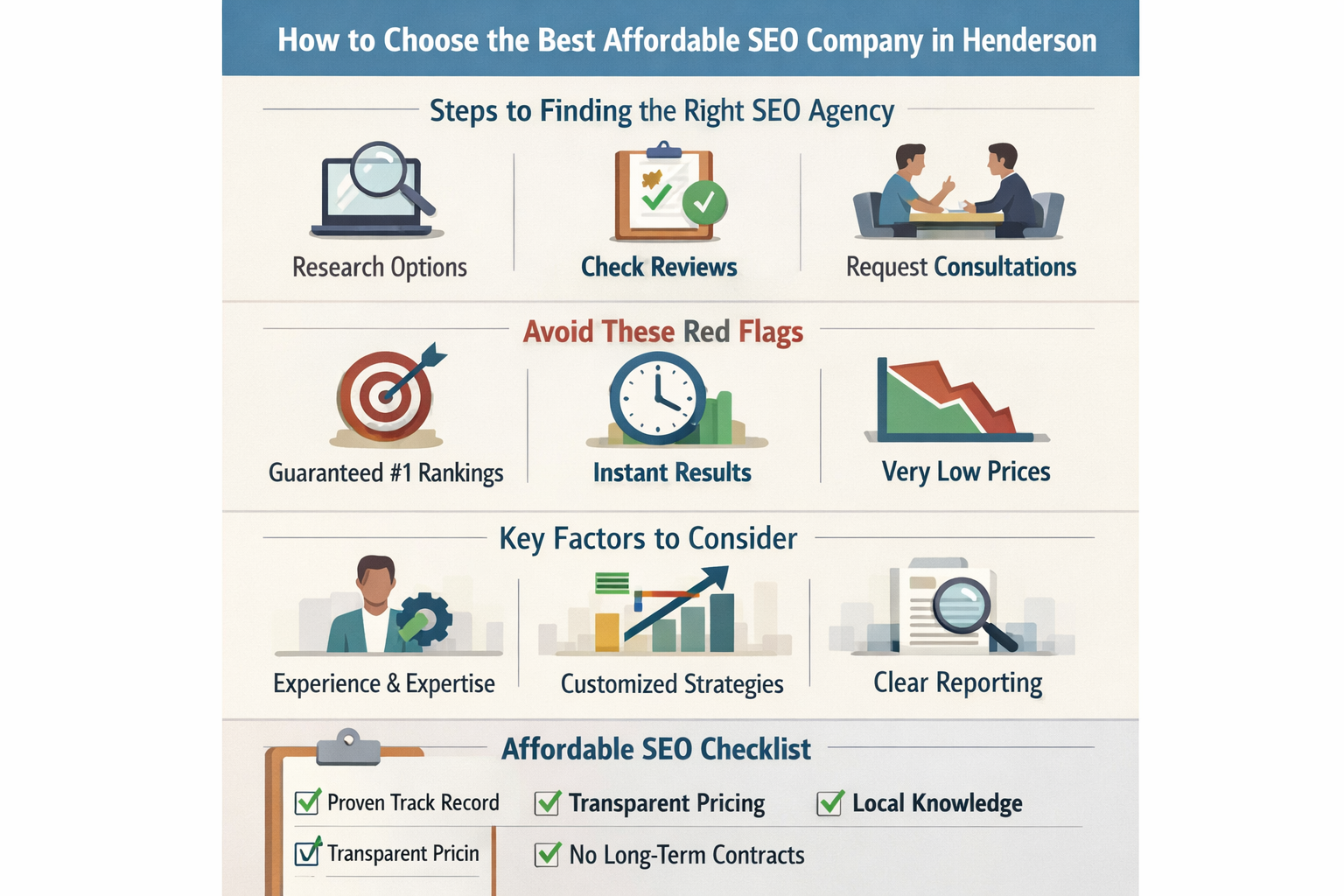
Before committing to an SEO provider, here are important questions to ask to ensure they meet your expectations and needs:
A clear explanation helps you understand what to expect and ensures they follow ethical practices. The provider should outline steps such as keyword research, on-page optimization, technical SEO fixes, content strategy, and link building.
This reveals their local market expertise and ability to customize strategies. They should be able to discuss local keyword targeting, Google My Business optimization, and local citation building.
Ask for references or case studies relevant to your industry or size. Understanding their experience with businesses like yours can guide your decision.
Understand the key performance indicators (KPIs) they track and the frequency of reporting. Common KPIs include organic traffic, keyword rankings, conversion rates, and bounce rates.
Get a detailed list of services, deliverables, and any limitations. Clarify if services like content creation, technical audits, or link building are included or require additional fees.
SEO is dynamic, so your provider should be proactive and adaptable. They should monitor algorithm changes and adjust strategies accordingly to maintain or improve rankings.
SEO is a long-term investment; realistic timelines help manage expectations. Typically, improvements may be noticeable within 3-6 months depending on competition and starting point.
Good collaboration ensures your business goals are aligned throughout the process. Ask about communication channels, meetings, and how you can provide input or request changes.
To make the most of your investment, avoid these common mistakes:

While affordability is important, the cheapest option may lack quality, transparency, or the skills needed to deliver results. Balance cost with value and proven effectiveness.
SEO companies without knowledge of Henderson’s market might apply generic strategies that don’t resonate with your community or customers. Local SEO is vital for small businesses targeting nearby clients.
Understand the contract length, cancellation options, and any hidden fees before signing. Flexible terms allow you to adjust or discontinue services if needed.
Check online reviews, business registrations, and professional affiliations to ensure legitimacy. Avoid companies with consistently negative feedback or unclear credentials.
SEO takes time. Beware of companies promising instant success or unrealistic outcomes. Sustainable SEO growth is gradual and based on ongoing optimization.
Avoid companies that are difficult to reach or provide unclear information about their work. Good communication is essential for a successful partnership.
Understanding the typical SEO process helps you collaborate effectively and evaluate progress:
The company will assess your current website, keyword rankings, competitors, and overall digital presence. This audit identifies strengths, weaknesses, and opportunities.
Based on audit findings, they will develop a customized plan covering on-page SEO, content marketing, link building, and technical improvements. This plan aligns with your business goals and budget.

The provider executes the agreed-upon tactics, which may include optimizing website structure, creating new content, and enhancing local citations. This phase requires collaboration and timely feedback.
Regular tracking of key metrics such as organic traffic, keyword rankings, and conversions is essential. Expect monthly or quarterly reports detailing progress and next steps.
SEO is iterative. The company should adjust strategies based on performance data and search engine updates, continuously working to improve results.
A: Pricing varies depending on the scope of services and your business size. Typically, affordable packages for small businesses range from a few hundred to a couple thousand dollars monthly. Transparency in pricing and deliverables is key.
A: While basic SEO principles can be self-taught, professional companies bring expertise, tools, and experience that often lead to better and faster results, especially in competitive markets like Henderson.
A: SEO is a long-term strategy. Most businesses start seeing noticeable improvements within 3 to 6 months, but it can vary based on competition and current website status.
A: Many affordable SEO providers offer content marketing as part of their packages or as an add-on service. Quality content is vital for SEO success.
A: Ask about their techniques, avoid companies that guarantee instant rankings, and look for those who emphasize white-hat SEO aligned with search engine guidelines.
A: Absolutely. Local SEO strategies focus on optimizing your presence in local search results, including Google My Business, local citations, and reviews, which are crucial for attracting Henderson customers.

A: Most reputable SEO companies provide monthly or quarterly reports detailing key metrics and progress. Confirm the reporting schedule before hiring.
A: Yes, many affordable SEO providers specialize in WordPress SEO services, optimizing site speed, structure, and content to enhance search performance.
A: While SEO principles apply broadly, some industries may face more competition or require specialized strategies. A good provider will tailor their approach accordingly.
Here are some practical approaches affordable SEO companies implement to help local businesses:
Be cautious if you encounter any of the following:
At RedZone SEO, we specialize in delivering affordable, customized SEO and digital marketing solutions that help small businesses in Henderson and Clark County grow their online presence. Our local expertise, transparent pricing, and results-driven approach set us apart.
Discover how we can help you increase website traffic, improve search rankings, and attract more local customers. Learn more about our Henderson SEO services and how we tailor strategies to your unique business needs.
Choosing the best affordable SEO company in Henderson requires careful evaluation of local expertise, transparent pricing, proven results, and ethical practices. By asking the right questions, avoiding common pitfalls, and understanding what to expect, you can partner with a provider who truly supports your business growth.
RedZone SEO is committed to helping Henderson’s small businesses succeed online with affordable, professional SEO and digital marketing services. Contact us today to boost your online presence and grow your business with expert SEO solutions tailored to your local market.
If you’ve seen $500/month “all-in” SEO offers, you’ve also seen the disappointment that follows. SEO isn’t a switch—it’s a craft with real inputs. When the budget isn’t big enough to fund those inputs, the work gets thin, the results stall, and you end up paying again to fix it.
We care about outcomes and brand safety. That’s why we don’t take on underfunded engagements.
A healthy campaign needs research, content, links, on-site improvements, and analysis. Even at a great blended rate, $500 buys only a few hours. After reporting and coordination, there’s almost no time left for the activities that move rankings and revenue (credible content and links).
Result: slow progress, “SEO doesn’t work” narratives, and rework later.
If you want work you can defend in a meeting, the baseline looks like this:
That can’t be delivered responsibly on a $500 monthly retainer.
A focused monthly cadence that actually moves needles typically includes:
Research → writing → editing → publishing → promotion → QA. That’s real time. A $500 budget forces corner-cutting.
Yes—shrink the scope, not the standards. Smart options:
What we won’t do is accept a budget that can’t support quality and then pretend it will work. That’s not fair to you—or your brand.
If you’re not seeing these, you’re buying activity—not outcomes.
This takes expertise and time. It’s built to work, not to check boxes.
Cheap SEO isn’t a shortcut—it’s a detour that leads back to the starting line with less trust and a thinner wallet. If search is supposed to drive revenue, fund it at a level that supports real strategy, real content, and real authority.
When you’re ready, we’ll help you scope a right-sized plan that you can stand behind—and that we can proudly execute.
SEO for small companies is the strategic practice of optimizing your website and online presence to rank higher in search engine results pages (SERPs). It’s about making your business highly visible to the exact people who are actively searching for your products or services. For any small business, from a local bakery to a specialized consulting firm, mastering SEO is the key to being finded in a crowded digital marketplace.
Why is SEO not just important, but absolutely essential?
Every single day, potential customers in your area are typing phrases into Google like "best pizza near me," "emergency plumber in downtown," or "accountant for small businesses." The fundamental question for your business is: will they find you, or will they find your competitors? A well-executed SEO strategy ensures the answer is you. It connects your business with customers who have high purchase intent. Someone searching for an "emergency plumber" isn't just browsing; they have an urgent problem and are ready to hire someone now.
While your competitors might be pouring money into ad campaigns for temporary visibility, your optimized website works tirelessly as your best salesperson—24/7, 365 days a year—attracting, informing, and converting customers without any ongoing advertising costs. It is, without a doubt, the most sustainable and powerful way to grow your business in the modern digital age.
Explore more about seo for small companies:
A successful SEO for small companies strategy is built upon three interconnected and equally important pillars: On-Page SEO, Off-Page SEO, and Technical SEO. Mastering each is essential, as they work in concert to support your online growth and visibility. To make it simple, think of it this way: On-Page SEO is your beautifully organized and helpful storefront, Off-Page SEO is your stellar reputation throughout the town, and Technical SEO is ensuring the doors are open uped, the foundation is solid, and the lights are always on.
Underpinning all three of these pillars is the critical concept of User Experience (UX). Google's algorithms are increasingly sophisticated, designed to reward websites that are fast, intuitive to steer, and genuinely enjoyable for visitors. This is directly linked to Mobile-First Indexing. Google now predominantly uses the mobile version of your content for indexing and ranking. With over half of all web traffic coming from mobile devices, a clunky or slow mobile experience is a surefire way to become invisible in search results.
Understanding these pillars allows you to build a powerful, systematic SEO foundation that delivers lasting results. That's how we approach SEO Strategies for Start Ups—with a step-by-step, data-driven process that addresses every facet of search optimization.

On-Page SEO involves all the measures taken directly within your website to improve its position in the search rankings. It's about creating content that is valuable to users and easy for search engines to understand. Key elements include:
yoursite.com/services/emergency-plumbing is much better for users and SEO than a messy one like yoursite.com/p?id=123.Our On-Page SEO Checklist provides a systematic guide to mastering these crucial elements.
Off-Page SEO refers to all the activities you and others do away from your website to raise its authority and reputation. It’s essentially about building trust and demonstrating your relevance through external signals.
Building your site's page authority through these off-page methods is essential for ranking for competitive keywords. Our Link Building Services focus on ethical, sustainable strategies to build your brand's authority.
Technical SEO is the foundation upon which your entire SEO strategy is built. If search engines can't efficiently crawl, render, and index your site, all your on-page and off-page efforts will be wasted.
robots.txt must allow search engine crawlers to access and understand all your important pages. You need to ensure there are no "crawl traps" or incorrect noindex tags blocking valuable content. Learn how search engines crawl and index websites.Implementing SEO for small companies is a marathon, not a sprint. It requires a clear, strategic roadmap and consistent, dedicated effort. The beauty of SEO is that every improvement you make, no matter how small, compounds over time to drive sustainable, long-term growth. This guide focuses on practical, foundational steps to put your business firmly on the digital map.
Successful small businesses don't need the biggest marketing budgets; they need the smartest and most consistent approach. Let's explore our proven SEO for Small Business methodology, broken down into actionable steps.
Keyword research is the cornerstone of any successful SEO campaign. It's not about guessing what people search for; it's about using data to understand the exact language, questions, and problems your ideal customers have. The key is to grasp search intent—the why behind a search query. Is the user looking to learn something (informational), find a specific website (navigational), compare options (commercial), or make a purchase right now (transactional)?
Tools like Google Keyword Planner (free), Ahrefs, and SEMrush are invaluable for this process. Our comprehensive Keyword Research process transforms these raw data insights into a powerful competitive advantage for your business.
Google and your customers ultimately want the same thing: valuable, helpful, and authoritative information that solves a problem or answers a question. Your content strategy should pivot away from selling and towards helping. When you do this effectively, rankings and conversions will naturally follow.
Our Content Marketing for Small Businesses approach is designed to help you create content that both search engines and, more importantly, your customers will love.
For most small businesses with a physical location or service area, the most valuable customers are the ones right in their neighborhood. Local SEO is the specialized practice of ensuring you appear prominently in front of these local searchers the moment they're ready to buy.
Our Local SEO Packages are specifically designed to connect your business with your local community and drive foot traffic.
A slow, clunky, or broken website will send potential customers running straight to your competitors. In today's world, website performance, especially on mobile, is non-negotiable for both user experience and SEO.
Use free tools like Google PageSpeed Insights to analyze your site's performance. It will provide a detailed report and actionable recommendations for improvement.
Effective SEO for small companies is not a "set it and forget it" activity; it requires continuous monitoring and refinement. You can't improve what you don't measure. Tracking your progress is essential to understand what's working, identify areas for improvement, make data-driven adjustments, and ultimately demonstrate a clear return on your investment (ROI).
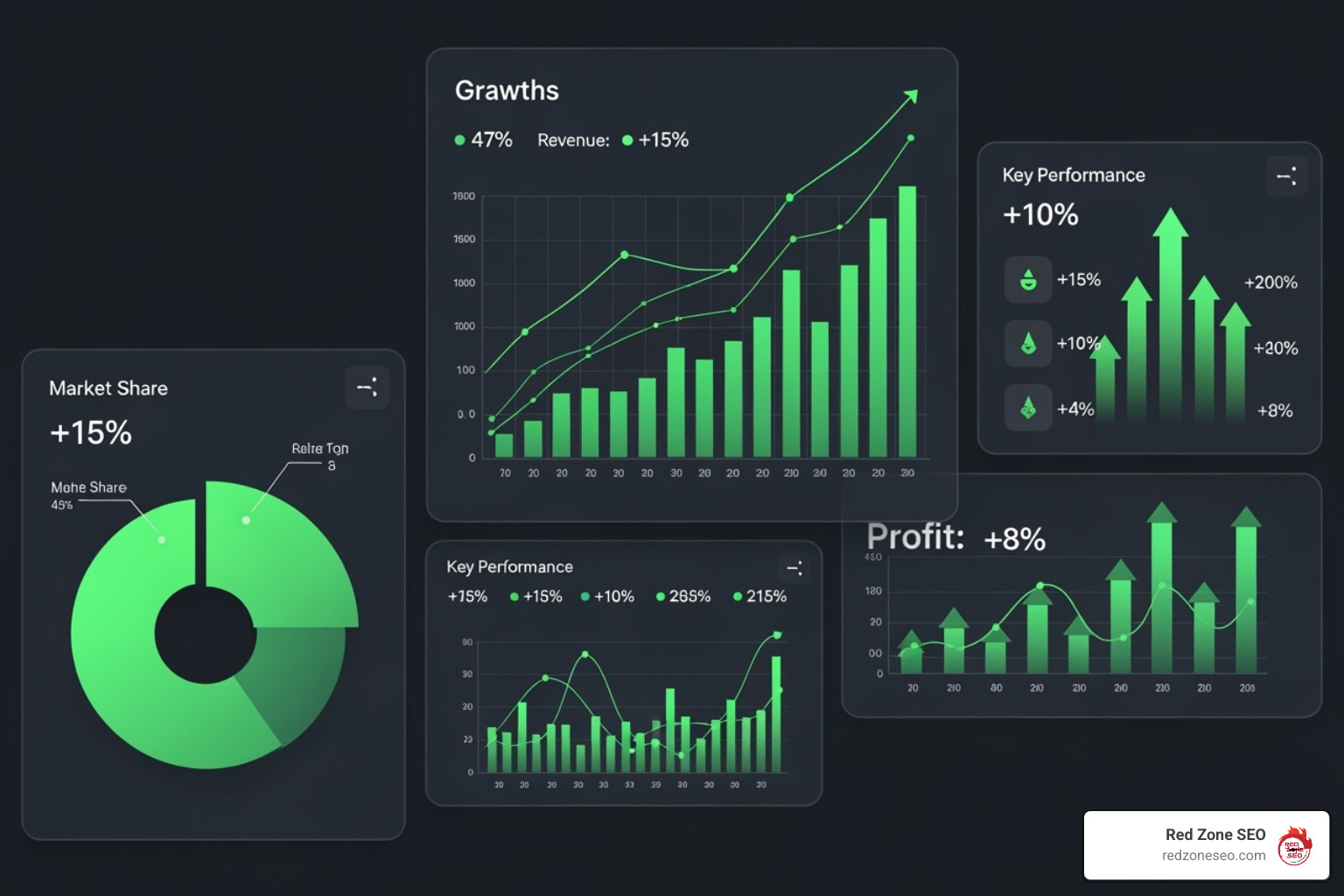
Regular SEO audits and transparent reporting are central to our process. We believe in focusing on the key metrics that actually matter to your business's bottom line and helping you avoid the common pitfalls that can derail your growth.
To measure success, you must focus on Key Performance Indicators (KPIs) that reflect actual business growth, not just vanity metrics like social media likes. The two most important free tools for this are provided by Google itself:
Tracking these KPIs consistently tells the true story of your SEO efforts and their direct impact on your business's growth. A regular analysis, like the one included in our SEO Audit Cost, is essential for identifying new opportunities and staying ahead of the competition.
Many well-intentioned small business owners inadvertently make simple mistakes that sabotage their SEO efforts. Being aware of these common pitfalls is the first step to avoiding them:
Starting on an SEO for small companies strategy can bring up a lot of valid questions. It's a complex field, and it's natural to want clarity before investing your time and resources. Here are straightforward, honest answers to the questions we hear most often from business owners just like you.
This is the most common and important question, and the honest answer is: it's a long-term strategy. SEO is not like flipping a switch. While you might see some early positive signals (like increased impressions in Google Search Console) within the first few weeks, most small businesses begin to see meaningful, consistent, and impactful results within 3 to 6 months.
Results don't happen overnight because SEO has a powerful compounding effect. Each piece of high-quality content you publish, every authoritative backlink you earn, and every technical improvement you make builds on the last. This creates a growing momentum that becomes more powerful over time. After a full year of consistent, strategic effort, the impact on your traffic and leads is often dramatic and transformative.
Several factors influence this timeline, including:
The good news is that small businesses can often be more agile and nimble than large corporations, allowing them to pivot quickly and capture niche and local opportunities much faster.
Yes, DIY SEO is absolutely possible, especially for the basics. Any motivated business owner can and should take foundational steps like claiming and optimizing their Google Business Profile, encouraging customer reviews, and writing helpful blog content about their area of expertise. These actions alone can make a significant difference.
However, the primary challenge for most business owners is the time commitment and the steep learning curve. Effective SEO requires consistent effort in keyword research, content creation, technical optimization, link building, and performance analysis—often requiring 5-10 hours per week, or more, to be truly effective. The real question you must ask is whether that is the best use of your valuable time as a business owner.
Hiring an SEO agency provides you with a team of specialists, access to expensive professional tools, and years of experience. We live and breathe SEO, which means we stay on top of the constant algorithm changes so you don't have to. A task that might take you a full day to research and implement, an experienced team can often handle in a fraction of the time. This allows you to focus on what you do best: running and growing your business, while we focus on what we do best: growing your online presence.
When you're ready to explore professional help, our SEO Packages Pricing offers transparent solutions customized for the unique needs and budgets of small businesses.
Artificial Intelligence is rapidly changing the search landscape, but for authentic small businesses, it's creating more opportunities than threats. It's forcing a shift away from old-school SEO tricks and towards what has always mattered most: genuine value.
AI Overviews (the AI-generated summaries appearing at the top of some search results) are becoming more common. While they may answer simple, factual questions directly, they cannot replicate the personality, trust, real-world experience, and unique expertise that make a customer choose your business over a competitor. This shift makes your unique value proposition and brand story more important than ever.
This leads to a few key strategic adjustments:
In short, AI is pushing SEO away from technical loopholes and towards its rightful place: building genuine trust and providing real, demonstrable value to your audience.
Your small business deserves to be found by the customers who are actively looking for you. Throughout this guide, we've detailed how a strategic approach to SEO for small companies is the most powerful and sustainable way to achieve that critical goal. It's not about chasing fleeting trends or using short-term tricks; it's about building a valuable, long-lasting digital asset for your business.
By committing to a solid SEO strategy built on the three pillars—On-Page, Off-Page, and Technical SEO—you can achieve transformative results:
While your competitors may be burning through their ad budgets for temporary attention, a well-executed SEO strategy is a true investment that compounds over time. Every piece of content you create, every link you earn, and every technical improvement you make builds upon the last, creating a strong, defensible foundation that is incredibly difficult for others to overcome.
At Red Zone SEO, we specialize in helping businesses just like yours steer the complexities of the digital landscape. Our data-driven approach is customized to the unique challenges and opportunities that small businesses face in competitive markets like Austin, Florida, Henderson NV, Nevada, and Las Vegas. We understand that you don't need the biggest budget to win; you need the smartest strategy.
The online world will undoubtedly continue to evolve, but one fundamental truth will never change: customers must be able to find you in order to choose you. Your competitors are already investing in their online visibility. The only question is, when will you? The sooner you start, the faster you can claim your rightful share of the market.
Ready to take the first, most important step? Learn how our process works and find how we can partner with you to put your business on a clear path to sustainable, long-term online growth. Your journey begins now.
If you want your business to stand out online, mastering SEO blog writing is a game-changer. It’s the art and science of creating content that ranks high in search engines like Google, attracting customers who are actively looking for your solutions.
The purpose is simple: drive organic traffic, boost conversions, and build your brand's authority. With billions of daily Google searches, your blog can be the answer people are seeking.
Consider this: the first five search results capture nearly 70% of all clicks. Getting to the top means getting seen. SEO blog writing isn't just about stuffing keywords; it's about creating genuinely helpful content. When you solve a user's problem, you build trust, which helps your site rank higher and convert visitors into loyal customers.
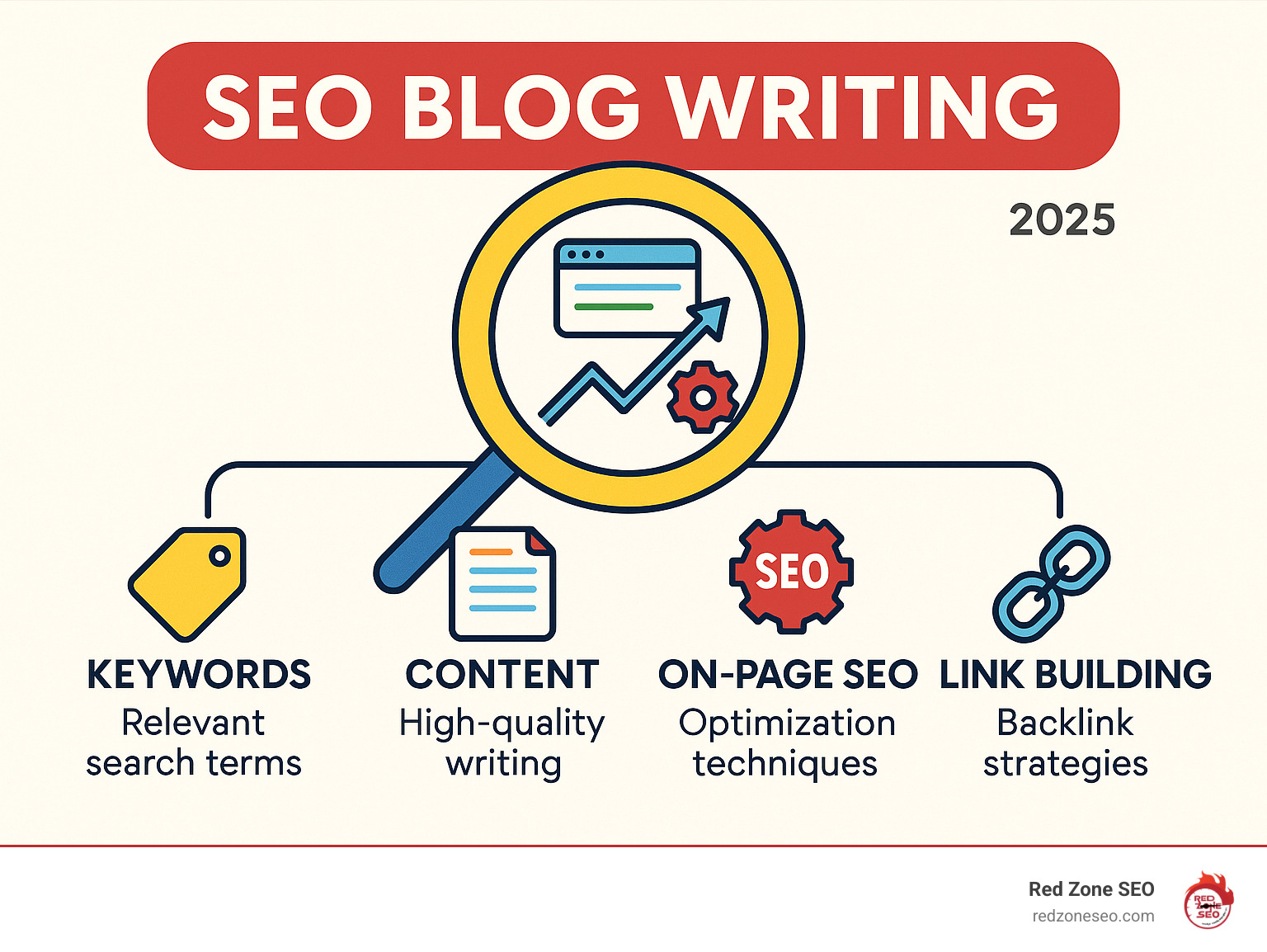
Think of Google as the world's most helpful librarian. To get your blog post recommended, you need to understand how it thinks. Successful SEO blog writing isn't just about creating great content; it's about creating content that Google can find, understand, and trust enough to show its users.
Google's main goal is to provide the best answers. It uses a complex system to crawl the web for new content, index it in a massive digital library, and rank it when someone performs a search.
To rank well, you need to align with Google's key ranking factors:
New websites often experience a "sandbox effect," where content can take 3-6 months to reach its full ranking potential. This is Google's way of testing your commitment to quality. Google's goal is to end the search journey. If your post provides such a complete answer that the user doesn't need to search again, you've hit the SEO jackpot.
Search intent is the "why" behind every search. If your content doesn't match what users want, it won't rank. There are four main types:
To figure out the intent for your keyword, just Google it. Study the first page of results. Are they how-to guides, product lists, or comparison articles? Google is showing you the blueprint for what works. Also, pay attention to SERP features like "People Also Ask" boxes or shopping ads, as they provide more clues about what users are looking for. Match your content format to user expectations, and you'll be on the right track.

Getting these fundamentals right—understanding Google's priorities and matching search intent—is the foundation for all successful SEO blog writing.
Keyword research is your treasure map for SEO blog writing success. It's about understanding what your audience is actually searching for, so you're not just shooting in the dark.
Successful SEO blog writing starts with data, not guesswork. Keyword research tools are your best friend. While Google Keyword Planner is a good free starting point, professional tools like KeySearch offer deeper insights into search volume, competition, and related terms.
Every post needs a primary keyword—the main phrase you're targeting. But don't stop there. You also need related keywords (or LSI keywords) to show Google you have a comprehensive understanding of the topic. For instance, a post about "coffee makers" should naturally include terms like "brewing," "filters," and "espresso." Tools like LSIGraph can help you find these semantic relatives.
At Red Zone SEO, we recommend a content mix of roughly 70% informational content (to build trust and attract a wide audience) and 30% commercial content (to capture leads and drive sales). For a deeper dive, check out our comprehensive keyword research guide.
If your site is new, you can't compete for highly competitive keywords like "best laptops." You need to be strategic and find keywords where you have a fighting chance.
Authority in SEO means being a trusted source. Google needs to believe you know your stuff before it will consistently send users your way.
Topical authority is built by covering a subject comprehensively. Don't just write one article on a topic; create a network of content that covers it from all angles. The content cluster model is the best way to do this. You create a central pillar page on a broad topic (e.g., "The Ultimate Guide to Small Business Marketing") and link it to more specific cluster content (e.g., "Email Marketing for Restaurants," "Local SEO for Plumbers").
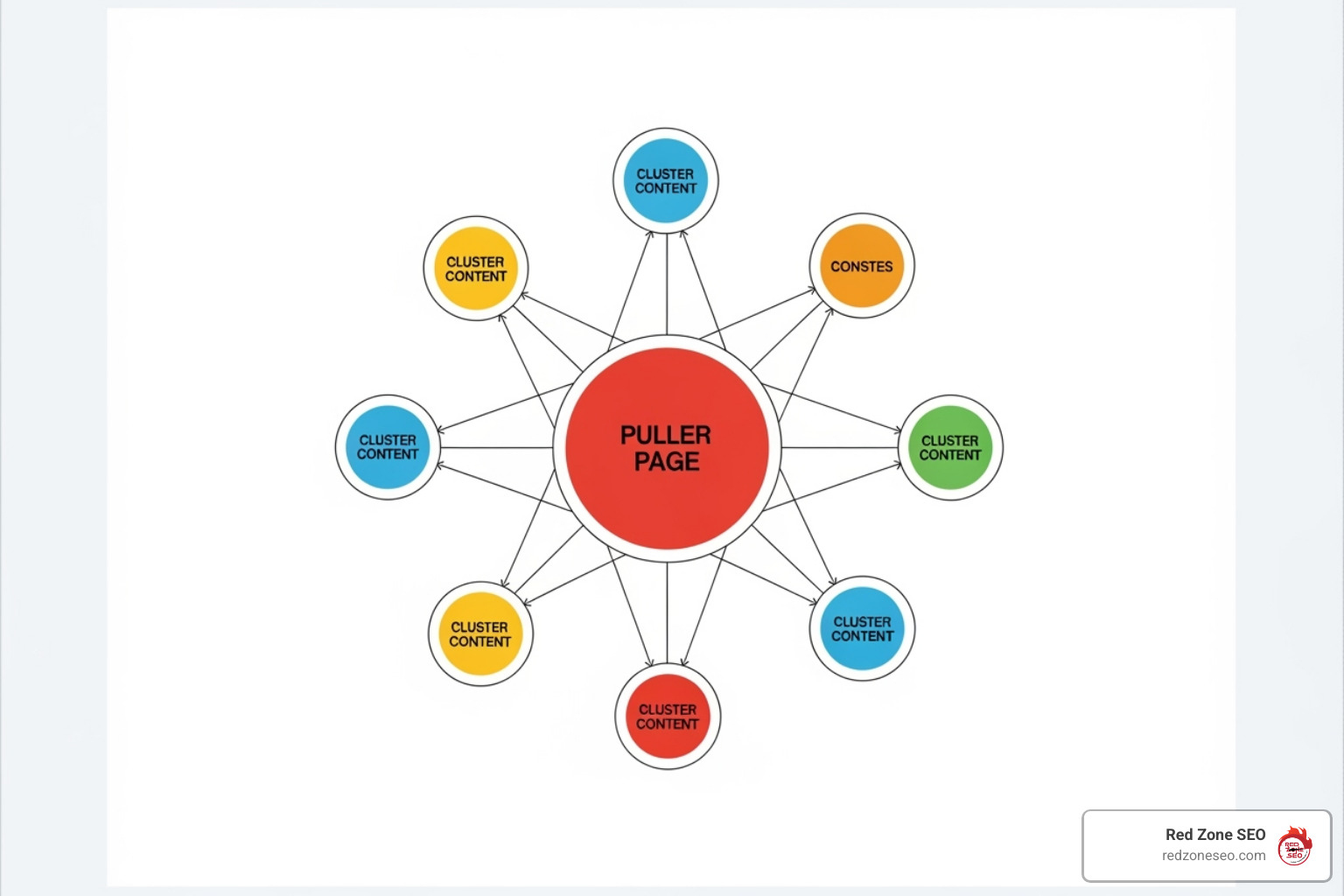
Each cluster post links back to the pillar, creating an interconnected web of content that signals deep expertise to Google. This consistent, high-quality SEO blog writing also builds your Domain Authority (DA), your site's overall reputation score. As our own blog demonstrates, authority is built over time, but every quality post you publish is a step in the right direction.
Now it's time to turn your research and strategy into content that ranks. This is where your SEO blog writing skills come to life. Follow this playbook for content creation success.
Online readers are impatient and scan content. Your structure must cater to this behavior. Start with a solid outline to ensure your post flows logically and covers all key points. Your H1 (main title) must include your primary keyword. Use H2s and H3s for subheadings to break up the text and incorporate related keywords, making the content easy to steer.
Write for scannability. Most people scan before they commit to reading. Make it easy for them:
Content length should be determined by what's needed to be comprehensive. While many top-ranking posts are 2,100-2,400 words, the real goal is to provide a more complete answer than your competitors. Don't fixate on word count; fixate on providing overwhelming value.
Readability is crucial for keeping users on your page. Use clear, simple language and avoid jargon. Vary your sentence structure to keep it engaging. Tools like Hemingway can help you spot overly complex sentences. For a full breakdown, see our On-Page SEO Checklist.
Your title and meta description are your ad in the search results. They are your first and only chance to earn a click.
A high click-through rate (CTR) signals to Google that your result is highly relevant, which can give your rankings a nice boost over time.
Beyond the text, other on-page elements play a key role in SEO blog writing.
seo-blog-writing-tips.jpg instead of IMG_1234.jpg). Always add alt text to describe the image for visually impaired users and to give search engines context. Compress images with tools like TinyPNG to improve page speed, a critical ranking factor.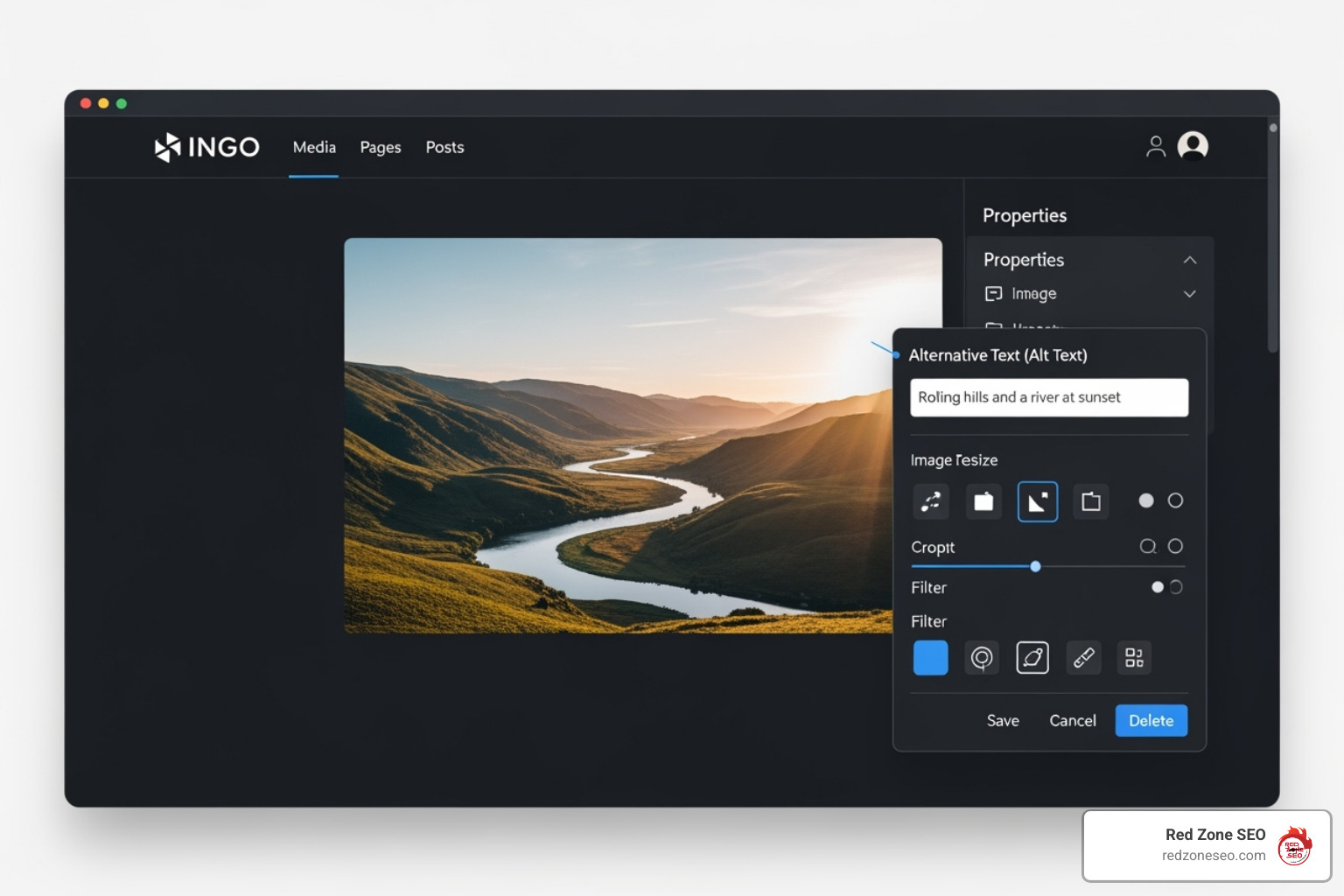
yoursite.com/seo-blog-writing-guide is far better than yoursite.com/p=123. Keep them short, descriptive, and focused on your main keyword.Publishing your SEO blog writing is just the start. To maximize your results, you need to nurture, promote, and maintain your content long after it goes live.
Links are the pathways of the internet, guiding users and search engines while building authority.
Your published posts aren't set in stone. Historical optimization—updating existing content—is one of the most effective and fastest ways to boost your SEO.
Use Google Analytics or Search Console to find posts that are ranking on page two (positions 4-10) or have declining organic traffic. These are prime candidates for an update because a small push can have a big impact.
When refreshing content, update statistics and facts, replace outdated information, and add new sections to make the article more comprehensive than competitors. You can also improve on-page elements like headings, images, and internal links to newer content. This often delivers faster results than creating new content from scratch. For more ideas, explore our Content Optimization Strategies.
While not a direct ranking factor, social media is a powerful amplifier for your content. There's a strong correlation between social shares and higher rankings, likely because social visibility leads to more clicks, engagement, and opportunities for other sites to find and link to your content.
Make it easy for readers to share by including prominent social sharing buttons on your posts. When you share your content, craft compelling updates and use engaging images. Building an engaged community on social media creates a loyal audience that will consistently visit and share your content, signaling to Google that your site is a valuable and active resource.
SEO blog writing can seem complex. Here are concise answers to the questions we hear most often from business owners.
Typically, it takes 3-6 months for a new post to reach its full ranking potential. This is partly due to Google's "sandbox effect," where it takes time to evaluate new content and websites. Google needs to see how users interact with your post before trusting it with a top spot. Consistency is key; a steady stream of high-quality content can speed up this process. Be patient and focus on building a library of valuable content.
While many studies point to an average of 2,100-2,400 words for top-ranking content, there is no magic number. The real answer is: your post should be as long as it needs to be to comprehensively answer the user's query. Analyze the top-ranking pages for your target keyword. Your goal is to provide more value and a more complete solution than they do. Prioritize comprehensiveness over an arbitrary word count.
Yes, but as an assistant, not a replacement. AI is a fantastic tool for brainstorming ideas, creating outlines, and overcoming writer's block. However, for content that builds trust and ranks well, human oversight is non-negotiable. You must ensure the content is accurate, original, and aligns with Google's E-E-A-T (Experience, Expertise, Authoritativeness, Trustworthiness) guidelines. Use AI to improve your creativity, but infuse the final piece with your unique expertise, insights, and voice. That human touch is what makes content stand out.
We've covered the roadmap to transform your online presence through SEO blog writing. The key pillars are mastering search intent, conducting smart keyword research, creating helpful content, and promoting it strategically. This isn't about gaming an algorithm; it's about becoming genuinely useful to people searching for answers.
SEO rewards patience and consistency. It's a long-term strategy that builds a valuable digital asset for your business. Each post you publish strengthens your authority, creating a compound effect where future content ranks more easily. The websites dominating search results today earned their spots through years of providing exceptional value.
At Red Zone SEO, we've seen this change countless times. Businesses that commit to a strategic content plan see more qualified leads, stronger brand recognition, and sustainable growth. It often becomes their most reliable source of new customers.
Your journey to mastering SEO is an investment in your business's future. Ready to turn this knowledge into measurable results? Our team specializes in executing content strategies that drive real growth. Explore our content marketing services for small businesses and let us help you become the go-to authority in your industry.
SEO data visualization is the process of turning raw SEO metrics into clear charts, graphs, and visual reports that reveal patterns, trends, and opportunities at a glance. Instead of drowning in spreadsheets, you get instant insights that drive better decisions and demonstrate real business value.
Quick Answer for Creating SEO Data Visualizations:
The human brain processes visual information 60,000 times faster than text. Yet many SEO reports are still delivered as mind-numbing spreadsheets that hide the real story. As one expert noted, "Poring through pools of numbers can be tedious and mentally exhausting." Visual presentations are essential for getting executive buy-in.
When you show a client a spreadsheet of keyword rankings, their eyes glaze over. But show them a colorful dashboard with their organic traffic climbing month over month? Now you have their attention. Data visualization makes complex SEO data easier to digest and more interesting. It helps you spot trends you'd miss in raw numbers, turns boring reports into compelling stories, and connects your SEO work to real business outcomes.
For any business trying to compete online, this isn't just nice to have—it's essential. You need to prove your SEO investment is working, identify which strategies drive results, and communicate your wins in a way that motivates continued investment.
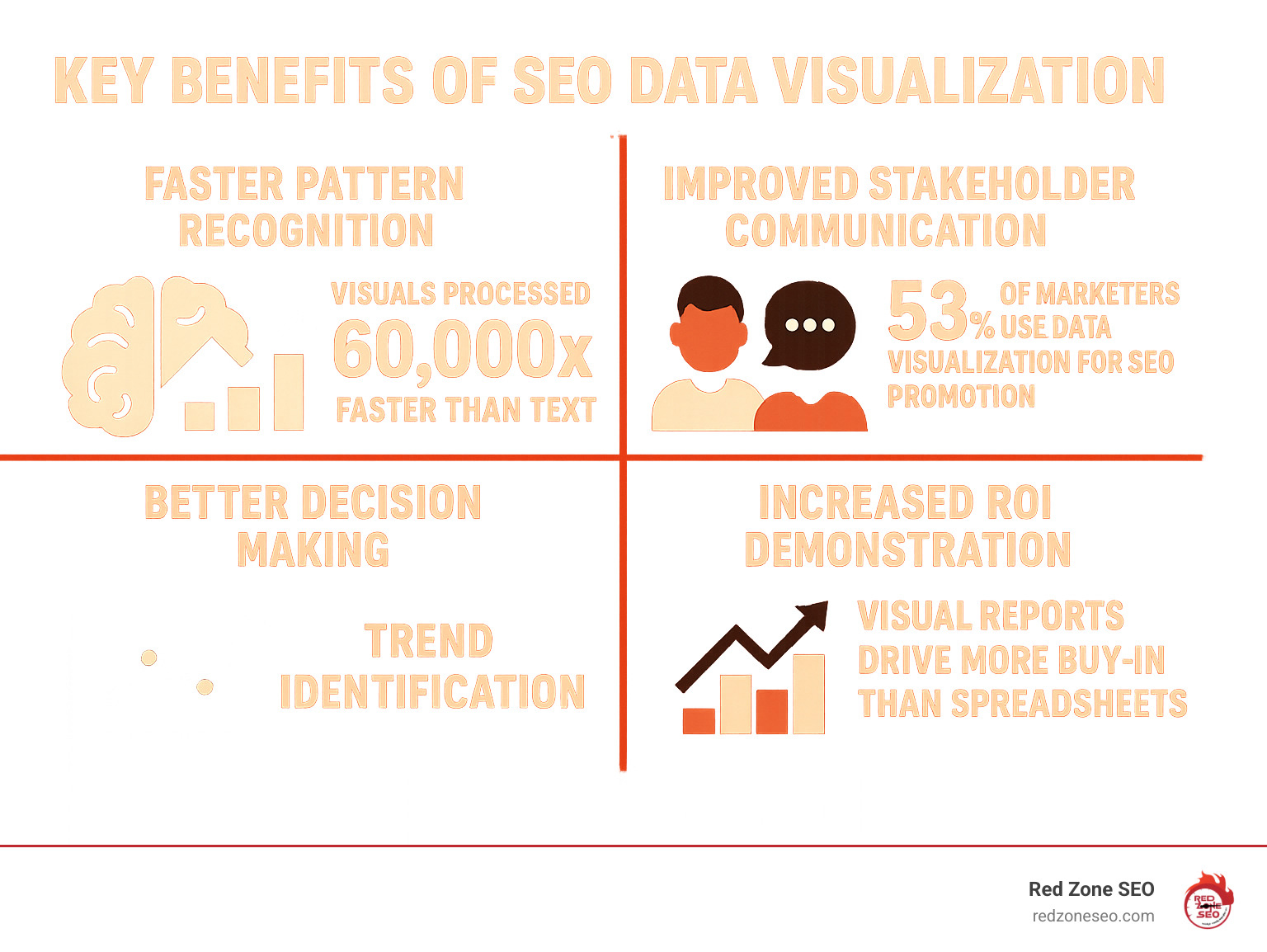
Our brains are visual creatures, processing images 60,000 times faster than text. Yet, many SEO reports are still presented as dense spreadsheets, causing audiences' eyes to glaze over. The data is there, but the story gets lost. This is where SEO data visualization becomes your secret weapon.
When you transform overwhelming datasets into intuitive charts and graphs, something magical happens: suddenly, everyone gets it. Your team sees the wins, clients understand the value, and your boss approves the budget. It's not just about making pretty charts; it's about turning complex performance data into clear, actionable insights that justify your SEO Packages Pricing and demonstrate ROI.
SEO data visualization is the art of translating numbers into stories. It takes unstructured data from tools like Google Analytics and Search Console and converts it into visual charts that provide quick insight. Instead of showing 500 rows of keyword data, you show a colorful chart where green arrows point up for wins. The goal is to make your SEO data accessible and highlight the most relevant information, creating compelling reports that engage stakeholders.
As Search Engine Journal explains, data visualization places your data in a visual context to communicate insights with clarity. For a deeper dive, check out this guide: What Is Data Visualization And How To Use It For SEO.
Staring at endless spreadsheets is inefficient and often counterproductive. Raw data creates several critical problems that visualization solves:
Instead of drowning clients in numbers, imagine pulling up a dashboard that tells the complete story of their SEO success. That's the power of SEO data visualization—turning data into compelling narratives. The secret is choosing the right visual for each story, following a simple rule: clarity beats complexity every time.
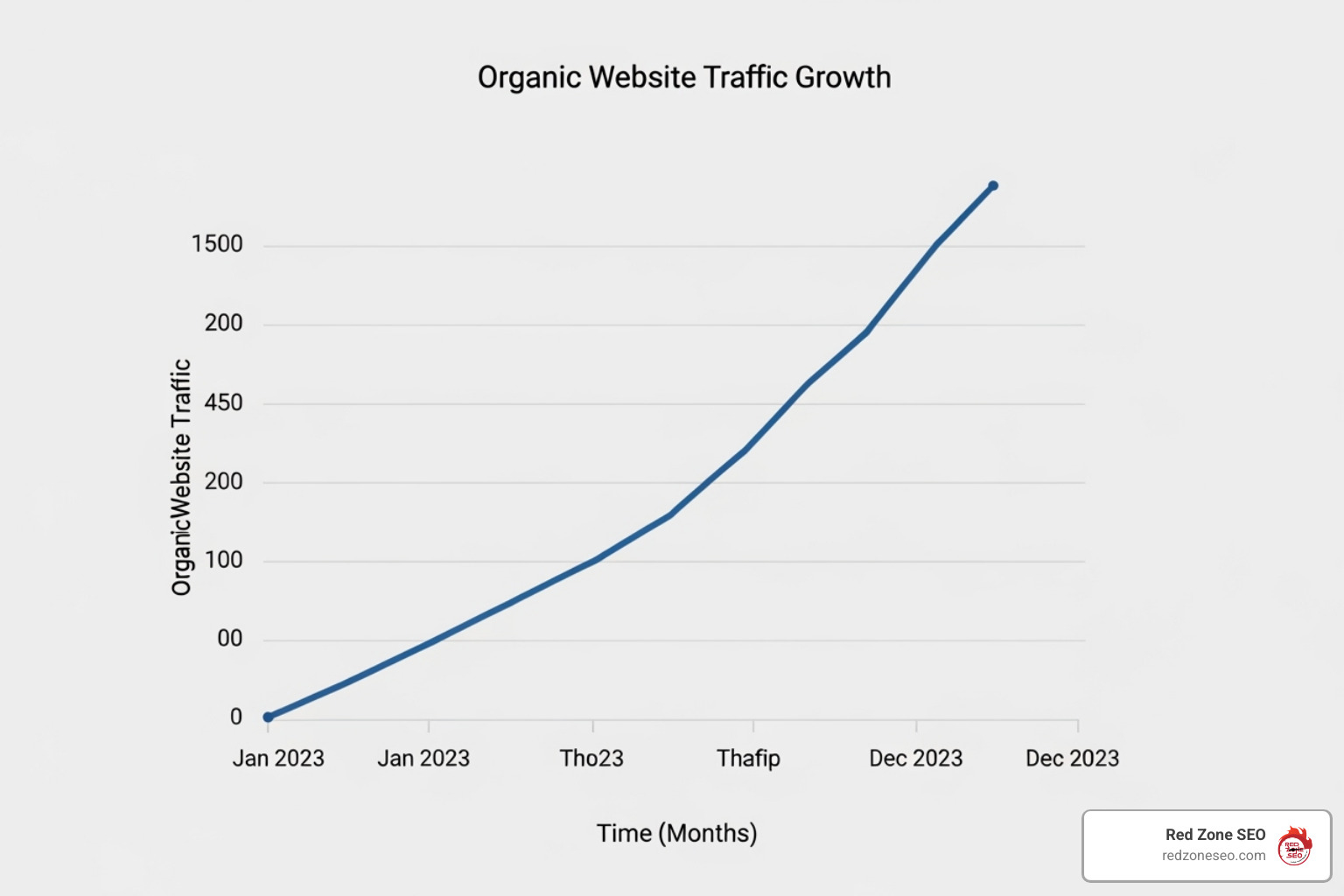
Your website's technical health is its engine. Here’s how to visualize its performance:
Off-page and content metrics show how the web perceives your brand:
Our Link Building Services rely on these visualizations to demonstrate not just the quantity of links, but their quality and strategic impact.
Choosing the right SEO data visualization tool is like an artist picking their medium. The best choice depends on your data sources, audience, team skills, and budget. Let's walk through the options, from free powerhouses to enterprise platforms.
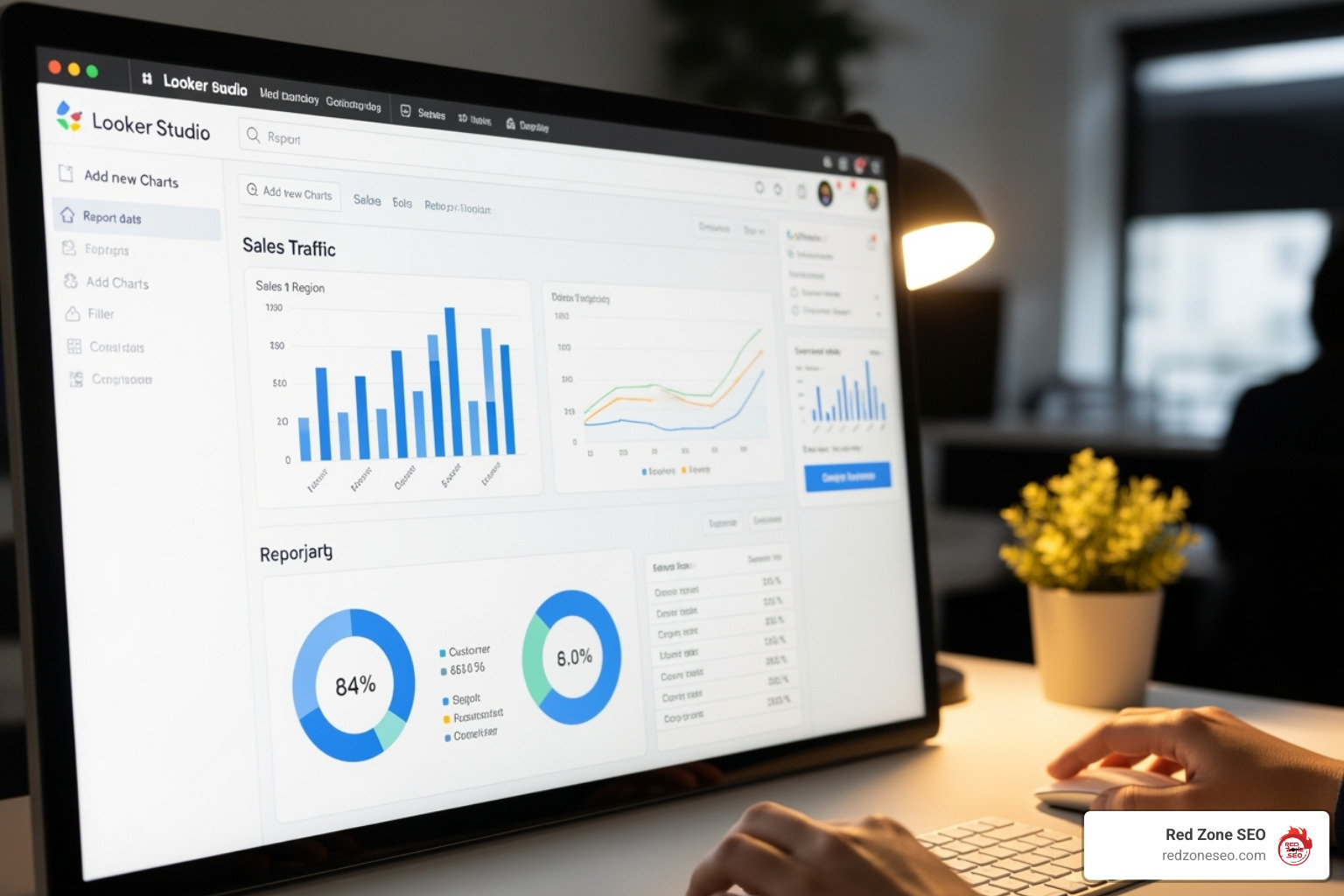
You don't need a big budget to create compelling data stories. Some of the best tools are free:
These tools are perfect for implementing SEO Strategies for Startups without expensive software licenses.
When your data needs become more complex, it may be time to upgrade:
| Feature | Looker Studio | Tableau |
|---|---|---|
| Cost | Free | Paid (with free version) |
| Ease of Use | Beginner-friendly | Steeper learning curve |
| Google Integration | Native & Seamless | Requires connectors |
| Data Sources | Extensive (especially Google) | Very extensive |
| Customization | Good | Excellent |
| Best For | Small to medium businesses, Google-centric data | Large enterprises, complex data analysis |
The best tool is the one your team will actually use consistently. A simple, regularly updated dashboard is far more valuable than a sophisticated one that gathers digital dust.
Knowing your own SEO performance is only half the story. To win the race, you need to understand the competitive landscape. Competitive SEO data visualization is your secret weapon for seeing the bigger picture and spotting gaps your rivals are missing.
Visual competitive analysis provides clarity. A chart comparing your share of voice to three competitors instantly tells a story that no spreadsheet can. This intelligence directly informs your Keyword Research strategy, helping you prioritize terms where you can realistically win.
Turn competitive data into actionable insights with these visualizations:
As Search Engine Land notes, "Visualizing data can help lift SEO strategies like Competitive Analysis and Backlink Analysis." You can learn more here: Visualizing SEO: Why Visualizing SEO Data Matters.
This is where SEO data visualization is most critical. When the budget is questioned, compelling visuals are game-changers.
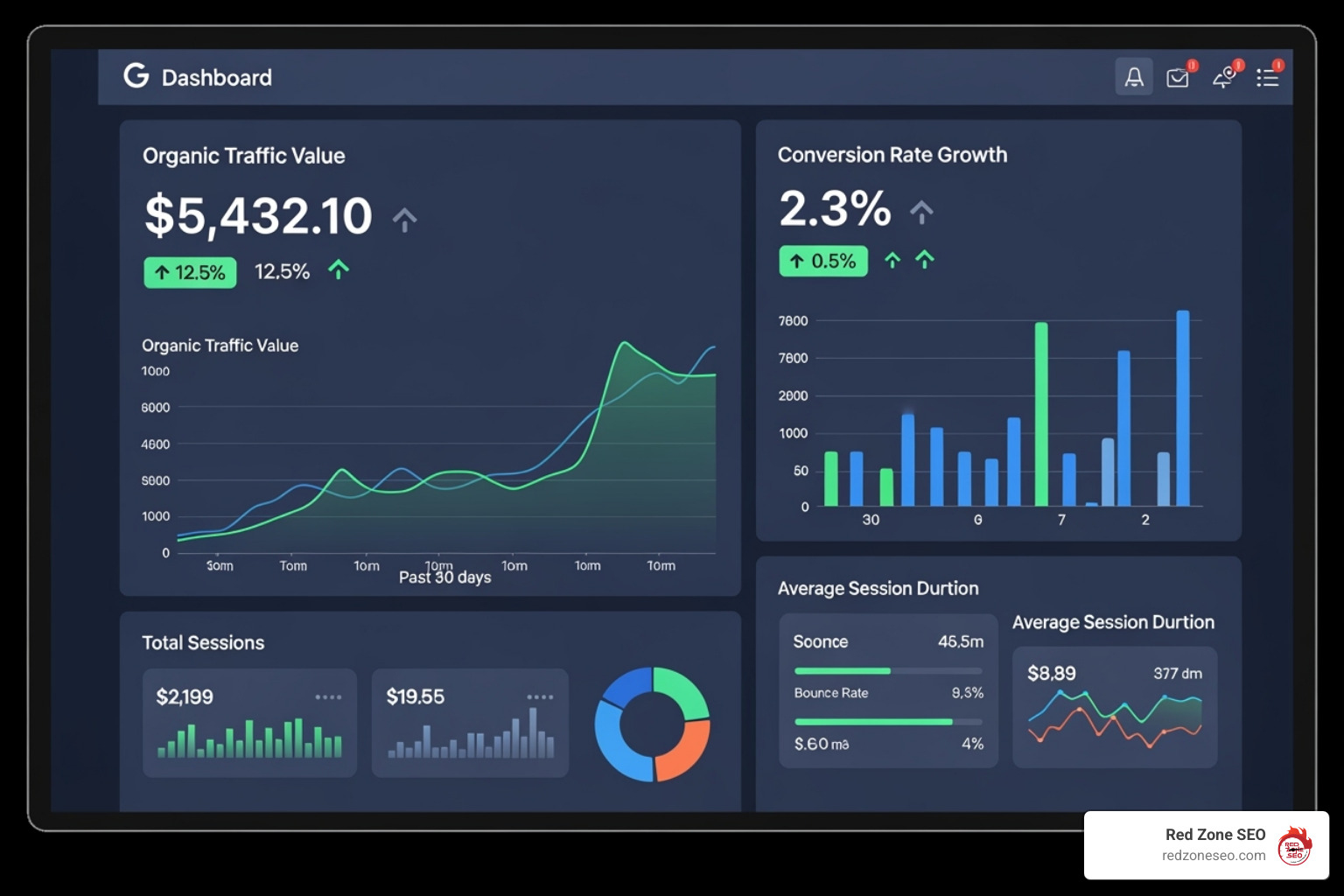
We know organic search drives significant revenue, but you need to show it. We focus on clear, prominent ROI metrics:
These visual stories justify investment in SEO for Small Business by showing measurable returns. When the value is this clear, budget conversations become much easier.
Effective SEO data visualization is about translation. You're crafting a story that transforms complex numbers into clear insights. The secret is showing your audience exactly what they need to know in a way that creates an "aha!" moment.
The best visuals are concise and clear, using clear titles and labels, appropriate colors, and just the right amount of data. We also leverage interactive filters for deeper dives and strategic annotations to highlight key events, like a traffic spike after a content overhaul.
When we talk to business owners about SEO data visualization, a few common questions always come up. Here are the straight answers.
The primary goal is to transform complex SEO data into clear, visual stories that anyone can understand and act on. It allows you to quickly spot trends, identify opportunities, measure performance against goals, and ultimately prove that your SEO investment is paying off.
Absolutely. You don't need to spend a fortune. Powerful, free tools like Looker Studio and Google Sheets are perfect for creating professional dashboards. They connect seamlessly with Google Analytics and Search Console, making them accessible for any business. The key is knowing how to tell a story with your data, not the cost of the tool.
It depends on the audience and purpose. For active campaign management, weekly or even daily updates are useful for making quick decisions. For executive and client reporting, monthly updates are usually best, as they show meaningful long-term trends without getting lost in daily fluctuations. The most important thing is to be consistent and align the reporting schedule with your strategic goals.
We've journeyed from confusing spreadsheets to the clear, actionable world of SEO data visualization. This isn't just about making reports look prettier; it's about fundamentally changing how you understand, communicate, and act on your SEO performance.
The power of data storytelling cannot be overstated. When you show a client their organic traffic climbing, you're not just reporting numbers—you're demonstrating real business growth and building the case for continued success. You're no longer just a data reporter; you're a data analyst who can spot opportunities, solve problems, and prove ROI.
At Red Zone SEO, we've seen this change with clients from Las Vegas to Austin. We turn complex data into measurable growth, creating a clear path from SEO efforts to business results. The future of SEO reporting belongs to those who can transform numbers into actionable insights.
Ready to put these insights into action? If you're looking to improve your online presence with crystal-clear reporting and proven results, explore our Local SEO Packages.
Contact us for expert Las Vegas SEO Services and let's open up the full potential of your SEO data together. Your numbers are waiting to tell their story.
SEO for SaaS companies is the strategic process of optimizing a software website to rank higher in search results, attract qualified leads, and convert them into paying customers. Unlike traditional SEO, it focuses on guiding prospects through longer sales cycles and targeting technical decision-makers who research solutions extensively before buying.
Effective SaaS SEO requires a multi-faceted approach:
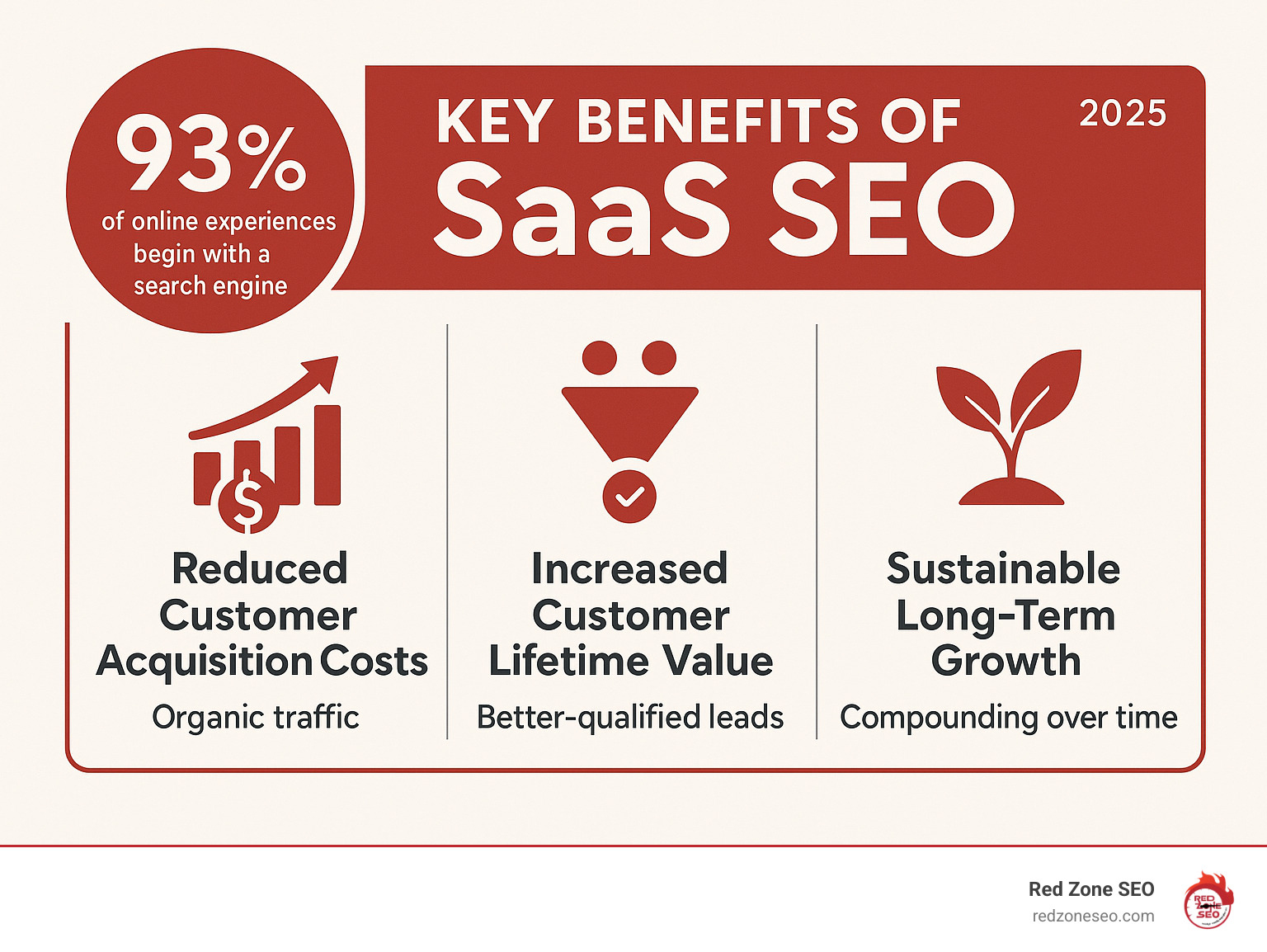
With 93% of online experiences starting with a search engine, SEO is essential for growth. It helps reduce Customer Acquisition Cost (CAC) while increasing Customer Lifetime Value (CLV). However, SaaS SEO is unique, requiring a deep understanding of complex buyer journeys and subscription-based models. Prospects aren't making a one-time purchase; they're choosing a long-term solution.
Many SaaS companies struggle with long sales cycles and high competition. Paid advertising can be costly, especially in B2B. SEO offers a sustainable alternative. While paid traffic stops when you stop paying, organic search creates a growth engine where content continues to attract qualified leads for months and even years.
Seo for saas companies glossary:
SaaS companies face a unique challenge: connecting with people who may not even know a software solution exists for their problem. This is where SEO for SaaS companies becomes a powerful tool, but it operates differently from traditional e-commerce SEO.
Your prospects aren't making a quick purchase; they're entering a relationship. They need to trust your software with their data, workflows, and business processes. This fundamental difference means SaaS SEO focuses on personas and problems. We must understand the distinct needs of each decision-maker involved in the purchase. For example:
Building trust is paramount. In SaaS, you compete on credibility. When your content consistently appears in search results, answering real questions, you become an authority. This aligns perfectly with Google's E-E-A-T (Experience, Expertise, Authority, Trustworthiness) signals, which reward websites demonstrating deep, real-world expertise. For a SaaS company, this means:
SaaS SEO is conversion-focused from day one. Every piece of content aims to drive free trial sign-ups, demo requests, or move prospects closer to a decision. Unlike paid ads, SEO creates sustainable, long-term traffic that improves over time. A blog post published today can attract qualified leads for years, creating a powerful compounding effect on your growth.
Furthermore, SEO complements your other marketing channels. A prospect might see a social media ad but then use Google to research reviews or learn more about the problem you solve. A strong SEO presence ensures you're there to guide them at every touchpoint.
Understanding the customer journey is crucial for SaaS success. We tailor content for each stage of the marketing funnel.
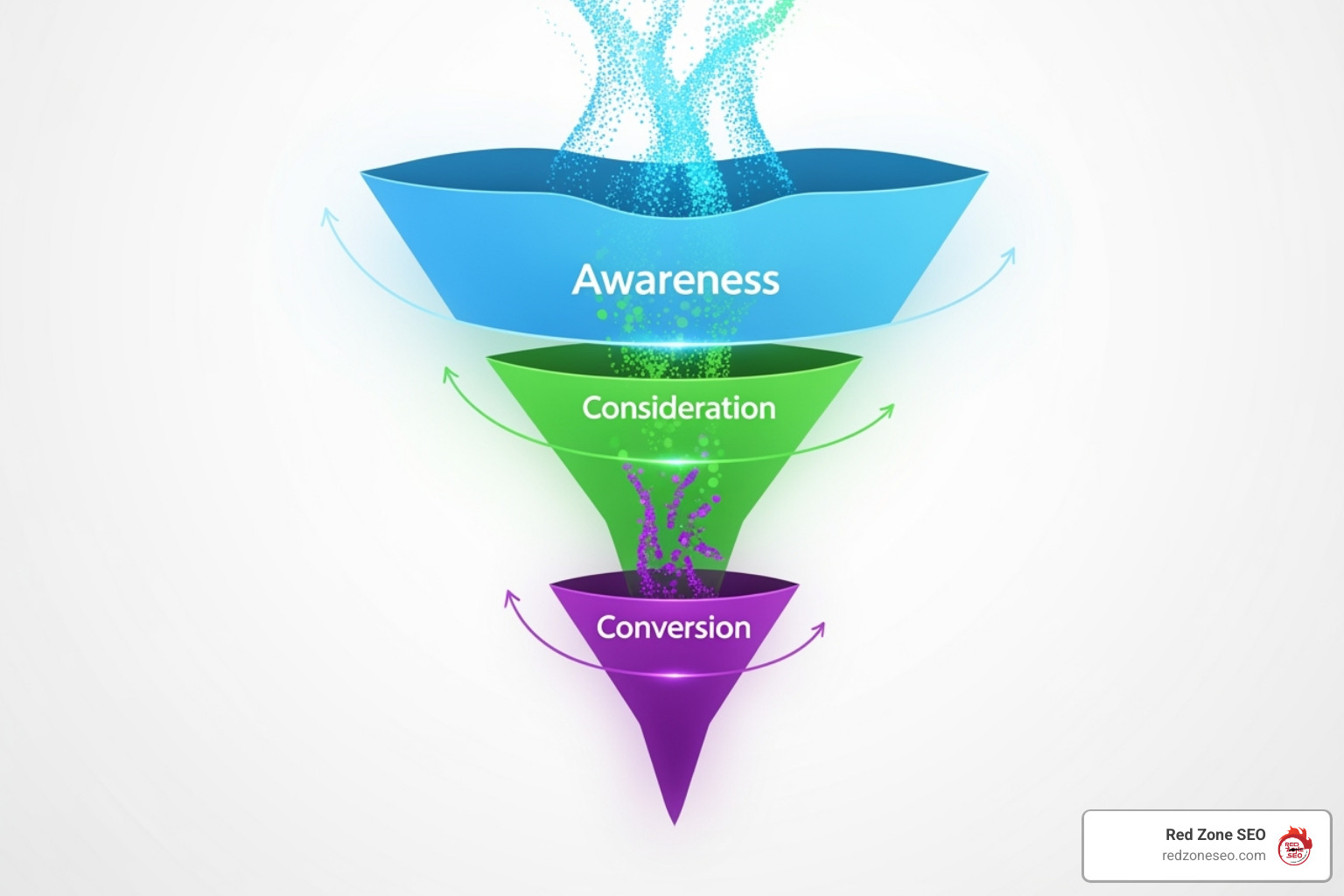
Top-of-the-Funnel (ToFu): Awareness. Prospects are searching for answers to problems, not products. They might search "how to improve remote team communication" or "what is lead scoring." We create comprehensive guides and blog posts that address these pain points to build trust and brand awareness.
Middle-of-the-Funnel (MoFu): Consideration. Prospects know they need a solution and are exploring options. They search for "best project management tools," "HubSpot alternatives," or "CRM software comparison." This is where case studies, testimonials, and detailed feature comparisons demonstrate your value and differentiate you from the competition.
Bottom-of-the-Funnel (BoFu): Decision. Prospects are ready to buy. They search for your brand name, pricing, and reviews (e.g., "Salesforce pricing" or "Asana reviews"). Optimized landing pages, clear pricing tables, and detailed FAQs are essential here to remove friction and drive conversions.
The goal is to connect content across the funnel, guiding prospects naturally from awareness to purchase.
Google's algorithms are increasingly sophisticated, rewarding sites that genuinely help users.
User Intent Alignment: Your content must fully satisfy the reason behind a search query, whether it's to compare options, see pricing, or understand features.
Content Freshness: SaaS products and industries evolve quickly. Regularly updating content to reflect current trends, new features, and pricing changes is critical for maintaining credibility and rankings.
Core Web Vitals: A fast, mobile-friendly, and responsive website is non-negotiable. A poor technical experience suggests a poor software experience.
High-Quality Backlinks: Earning links from reputable industry publications, software roundups, and partners remains a crucial signal of authority and trust.
Semantic Search: Google understands context and relationships between topics. Comprehensive content that covers a subject thoroughly is rewarded over narrowly focused, keyword-stuffed articles.
An effective SEO for SaaS companies strategy requires three components working in harmony. Think of it as a high-performance vehicle: your website's technical foundation is the Engine, your content strategy is the Fuel, and your link building efforts are the Oil that keeps everything running smoothly.
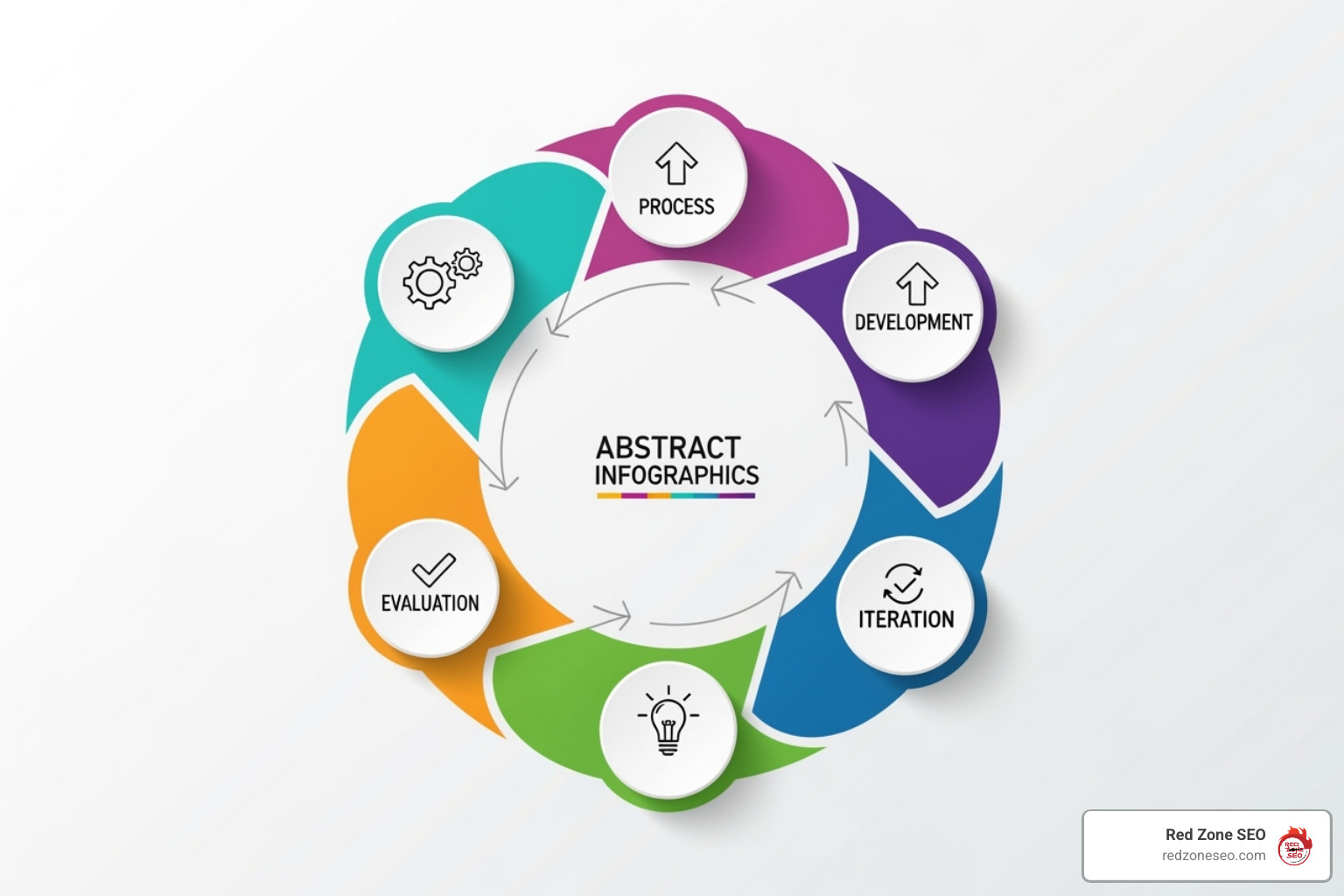
These pillars are integrated into our proven five-step process: Ideate to plan your strategy, Create compelling content, Publish while building connections, Monitor performance with data, and Refine continuously. This cycle creates sustainable growth that compounds over time.
Before any execution, we immerse ourselves in your business. This foundational step maps your path to success.
For new businesses, we focus on building a solid foundation while targeting quick wins. You can learn more in our guide on SEO Strategies for Start Ups.
Here, we create high-value content that drives results.
For more on our process, see our guide on Content Optimization.
Great content needs proper publishing and promotion to reach its potential.
SEO requires continuous analysis and adjustment. It's a dynamic process, not a one-time setup.
Your website is the engine of your marketing. Without a solid technical foundation, even the best content strategy will fail. For SEO for SaaS companies, technical excellence is non-negotiable, as it directly impacts user experience, search engine rankings, and ultimately, a prospect's perception of your product's quality.

Many SaaS companies have beautiful websites that underperform due to hidden technical issues. If Google can't properly crawl, render, and understand your pages, your prospects will never see your content. The stakes are high, as technical decision-makers expect fast, seamless digital experiences. A slow page damages credibility before a prospect even learns about your product.
Core Web Vitals and mobile-first indexing are critical ranking factors. Core Web Vitals measure a user's real-world experience on your site:
Your site must perform flawlessly on mobile devices. Technical SEO isn't just for algorithms; it's about creating the professional, high-performance experience your prospects expect.
Sitemaps: We create comprehensive XML sitemaps to act as a roadmap for Google, then submit them via Google Search Console to ensure efficient crawling and indexing of all your important pages. For specifications, see Google's guide on sitemaps.
Schema Markup: We implement structured data to help search engines understand your content's context. For SaaS, this includes Article schema for blog posts and, crucially, SaaSProduct and SoftwareApplication schema. This can enable rich results in search, such as star ratings, pricing, and key features shown directly on the results page.
Canonical Tags: These tags solve duplicate content issues by telling Google which version of a page is the master copy. This is vital for pages with URL parameters (e.g., from marketing campaigns), consolidating all SEO value to a single, preferred URL.
301 Redirects: When URLs change, we implement permanent 301 redirects to pass link equity and ensure a seamless user experience, preventing visitors and search engines from hitting 404 "Page Not Found" errors.
Robots.txt File: We configure this file to guide search engine crawlers toward your most valuable pages and away from non-essential sections (like admin logins or internal search results), optimizing your crawl budget.
HTTPS Security: A secure site (using HTTPS) is a confirmed ranking factor and is absolutely essential for building trust with prospects who are considering sharing business data with your software.
The platform your website is built on significantly impacts SEO success. We evaluate platforms on three key criteria:
For these reasons, we often recommend platforms like Webflow or well-optimized WordPress installations, which provide the granular control and performance needed for competitive SaaS SEO.
Content is the fuel for your SEO for SaaS companies engine. A strategic content plan transforms your SEO efforts into a growth machine that attracts, educates, and converts your ideal customers. This means creating purposeful content mapped directly to the buyer's journey, where every article, guide, and landing page has a specific job to do.
Our approach focuses on solving real user problems. When a prospect searches for a solution, your content should provide the best answer. This is where product-led content excels. This strategy involves naturally weaving your product into the narrative to demonstrate how it solves the user's problem, without a hard sell. For example, an email marketing SaaS could publish an article, "10 Welcome Email Templates to Boost User Onboarding." The article provides genuine value with the templates, while also using screenshots and GIFs to show exactly how to build and automate those sequences within their software. This doesn't just drive traffic; it drives the right traffic—people who are already looking for what you offer and can see its value in action.
A successful content strategy begins with understanding what your audience is searching for and the search intent behind their queries.
For more details, see our page on Keyword Research.
We organize these keywords into topic clusters. Each cluster focuses on a core "pillar" topic, supported by multiple "cluster" articles on related sub-topics. For a project management SaaS, a pillar page might be an ultimate guide to "Agile Project Management." This would be supported by cluster articles on "Scrum vs. Kanban," "How to run a sprint planning meeting," and "Best agile tools." The cluster articles all link back to the pillar page, and to each other where relevant.
Founders and marketing teams often have similar questions about SEO for SaaS companies. Here are answers to the most common ones.
SEO is a marathon, not a sprint, which is its greatest strength. While every case is different, a general timeline is:
3-6 Months: You can expect to see initial results, such as improvements in keyword rankings for less competitive terms and a gradual increase in organic traffic. This is when technical optimizations and early content pieces start to gain traction.
6-12 Months: This is when you should experience significant impact. Organic traffic growth becomes more substantial, you begin ranking for more competitive, high-value keywords, and qualified leads from search flow more consistently.
The speed of results depends on several factors, including your website's starting authority, the competitiveness of your industry, your budget and resource allocation, and the quality of the strategy's execution.
SEO is a long-term investment. Unlike paid ads, the content created today continues to attract prospects for years, creating compounding returns that lower your customer acquisition costs over time.
We track concrete metrics that tie directly to your bottom line:
This is a common and important question.
DIY SEO is possible if you are a technical founder with ample time and a strong grasp of content marketing. However, SEO is a complex, full-time discipline encompassing keyword research, technical optimization, content strategy, link building, and analytics. Mistakes can be costly, such as earning toxic backlinks that lead to a Google penalty or making a technical error that gets your site de-indexed.
Hiring a specialized agency like Red Zone SEO provides immediate access to expertise, premium tools, and proven processes custom-built for SaaS companies. We've spent years refining our approach, which allows us to accelerate results and help you avoid the costly mistakes that can set your growth back by months or even years.
The real question is about opportunity cost. A comprehensive SEO audit can help clarify your specific needs and determine the best path forward. An agency acts as an extension of your team, allowing you to focus on building a great product while we focus on driving sustainable organic growth.
We've covered the core components of SEO for SaaS companies, from the unique challenges to a comprehensive 5-step strategy. In today's competitive market, having great software isn't enough; the right people must be able to find you when they need a solution.
Our Engine, Fuel, and Oil framework provides a clear path forward. A technically sound website (Engine), powered by a high-value content strategy (Fuel), and supported by authority-building links (Oil) creates a sustainable growth engine. This engine works 24/7, attracting qualified prospects and converting them into loyal customers.
Unlike paid ads, a holistic, data-driven SEO strategy delivers compounding returns. The authority you build becomes a competitive moat, protecting and growing your market share over time.
At Red Zone SEO, we understand that every SaaS business is unique. We don't use one-size-fits-all solutions. Our expertise lies in creating custom strategies that align with your specific business objectives, target audience, and market position. We know your customers are investing in solutions, not just buying software.
Ready to open up your organic growth potential? Your competitors are already investing in SEO. The time to act is now.
Learn how our proven SEO process can drive growth for your SaaS business.
What is the difference between on-page and off-page SEO? Simply put, on-page SEO includes optimizations you control directly on your website, like content and site structure. Off-page SEO involves actions taken elsewhere on the internet to build your site's authority, such as earning backlinks and brand mentions.
Here's the key breakdown:
Think of it like building a house. On-page SEO is the solid foundation and internal structure. Off-page SEO is your curb appeal and neighborhood reputation that makes others want to visit.
As one SEO expert puts it: "What you rank for is largely determined by on-page factors, while how high you rank in the search results is largely determined by off-page factors."
Both work together like yin and yang. You can't achieve lasting SEO success with just one. A well-built house in a bad neighborhood won't attract visitors, and a beautiful house with a cracked foundation won't stand. For any business, this balance is crucial for growth.
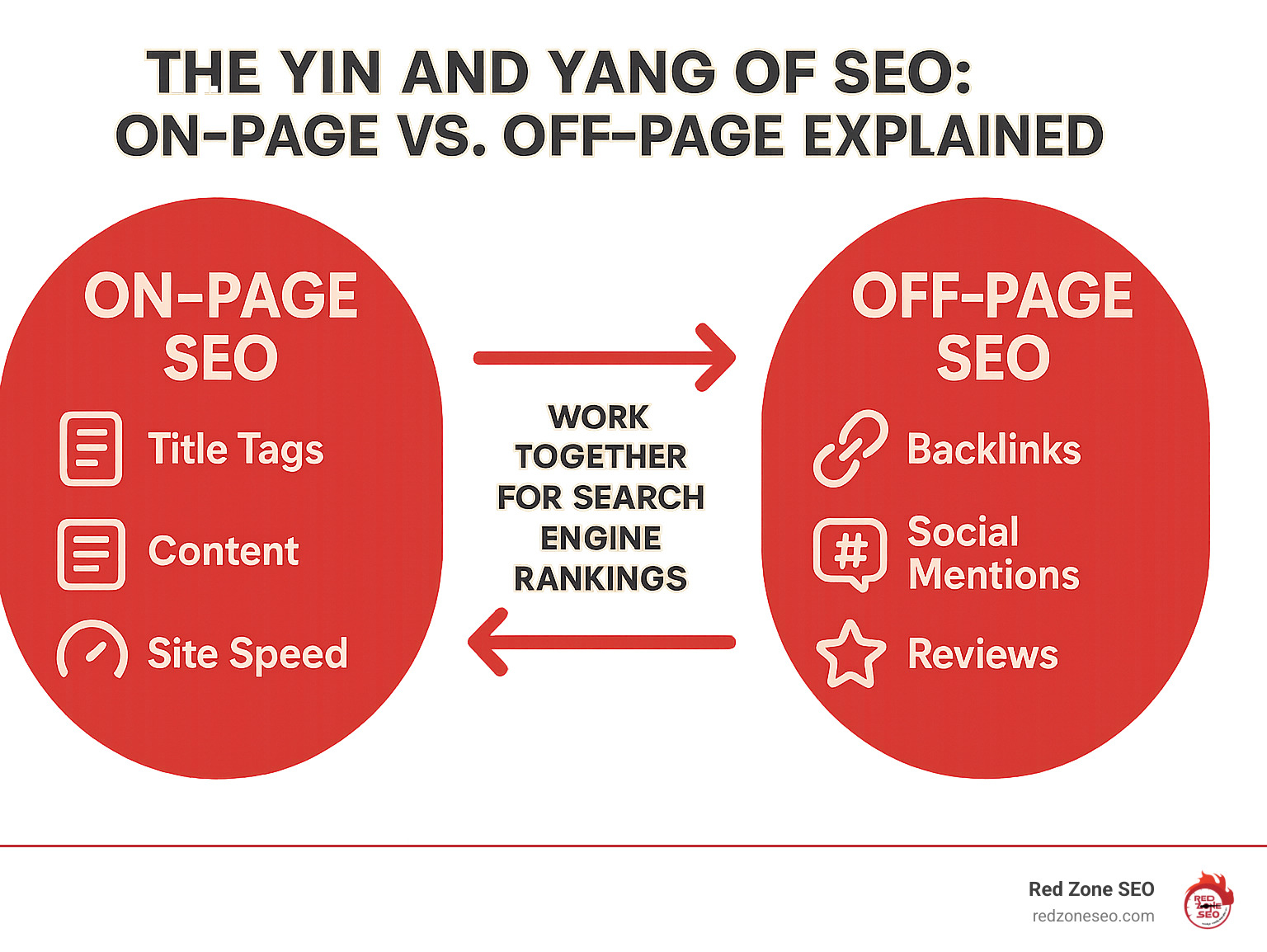
What is the difference between on-page and off-page seo terms to remember:
On-page SEO is where your journey begins. It encompasses every optimization you make directly on your web pages to rank higher, from the words you write to the code behind them. The beauty of on-page SEO is that you have complete control; you can start improving your site today without waiting for external validation.
Why is it so foundational? On-page SEO is how you communicate your content's relevance and purpose to search engines. Without it, Google struggles to understand what your pages are about, and your valuable insights may never reach your target audience. The goal is to make your content clear to search engines while providing an excellent experience for users. A great starting point is a comprehensive audit to identify priorities. For a detailed roadmap, see our An in-depth On-Page SEO Checklist.
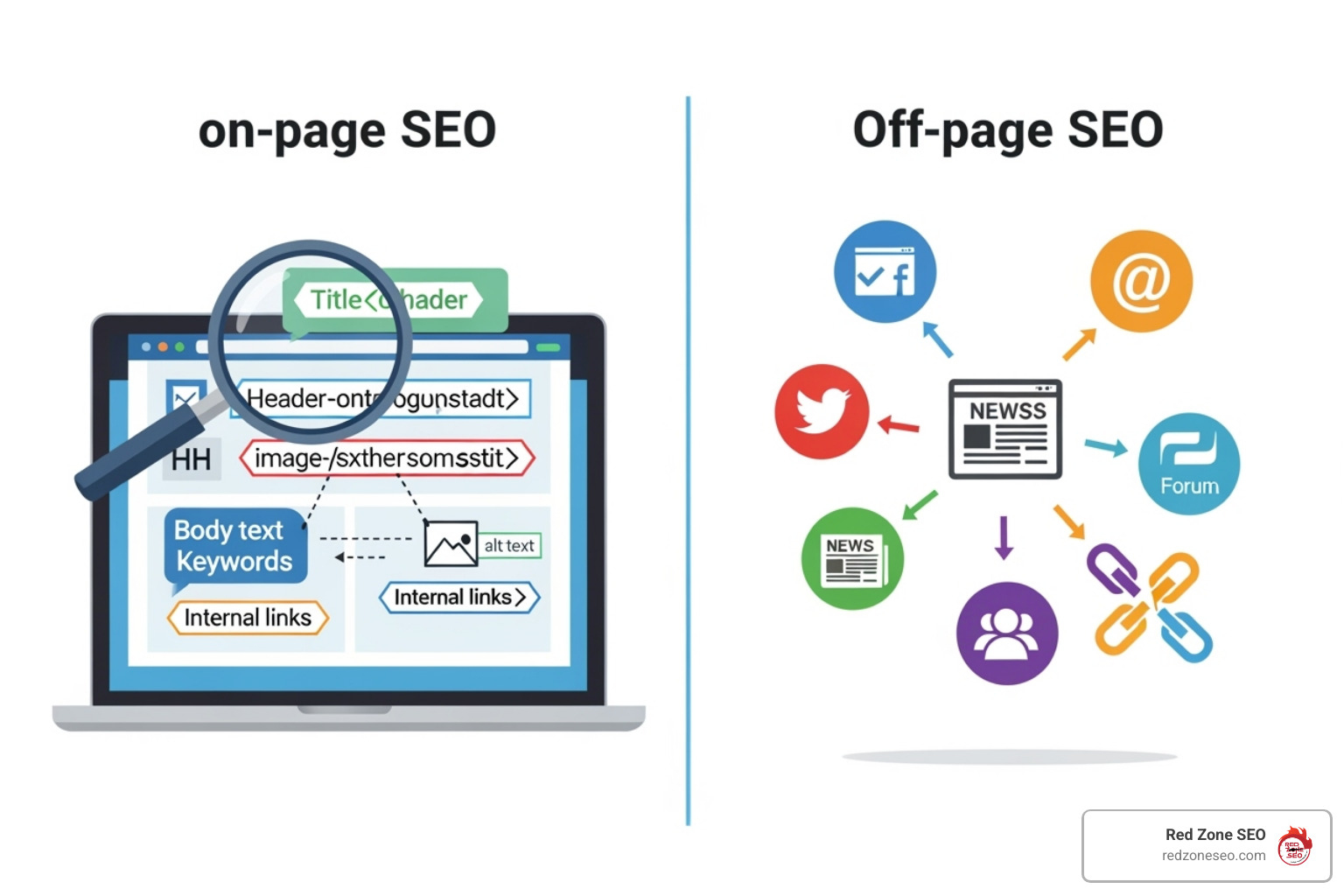
On-page SEO involves several key elements working together to create an experience that users and search engines love.
yoursite.com/on-page-seo-guide) are user-friendly and provide immediate context about the page's content.For more on refining these elements, explore our Content Optimization strategies.
Technical SEO is the behind-the-scenes work that ensures search engines can find, crawl, and understand your site. It's a critical part of your on-page foundation.
robots.txt file are essential.Regular technical audits are key to maintaining a strong foundation. We can help you Run a comprehensive SEO Audit to ensure your site is technically sound.
If on-page SEO is perfecting everything inside your website, off-page SEO is building your reputation out on the wider internet. It encompasses all the efforts that happen away from your site to build authority and demonstrate trustworthiness. While on-page SEO signals relevance, off-page SEO is about building authority.
It's about earning trust from the digital community so that search engines see your site as a credible resource worth recommending. You can't directly control these external factors, but you can influence them by creating valuable content and building relationships. This is a long-term strategy that requires patience and a focus on genuine value.

Building off-page authority involves several key strategies that work together to paint a picture of credibility for search engines.
Sustainable off-page success comes from authentic relationship building and value creation. Our Professional Link Building Services focus on earning high-quality, relevant links that build lasting authority.
Now that we've explored both sides, let's clarify what is the difference between on-page and off-page SEO. The distinction boils down to location and control: where the optimization occurs and how much direct influence you have.
On-page SEO involves everything you do on your site. Off-page SEO is everything that happens off your site to improve its reputation. The table below summarizes the key differences:
| Aspect | On-Page SEO | Off-Page SEO |
|---|---|---|
| Goal | Relevance: Telling Google what your page is about | Authority: Telling Google how important your page is |
| Control | Direct Control: You make changes yourself | Indirect Influence: You earn signals from external sources |
| Focus | Content & Code: Keywords, structure, user experience | Relationships & Reputation: Backlinks, mentions, social signals |
| Key Tactics | Keywords & Structure: Title tags, content quality, site speed | Backlinks & Mentions: Link building, brand awareness, reviews |
The dynamic of control versus influence is central to understanding the two approaches. With on-page SEO, you are in the driver's seat. You can update a title tag, rewrite content, or improve site speed immediately. You control the HTML, the content, and the site structure.
With off-page SEO, you can only influence outcomes. You can't force another site to link to you or compel someone to share your content. Instead, you earn these signals by creating valuable content and building relationships, much like digital public relations. This requires patience, but the third-party validation it generates carries immense weight with search engines.
On-page and off-page SEO answer different questions for search engines.
On-page signals relevance. By optimizing your content, headings, and structure, you're telling Google, "This page is about X." This helps search engines match your content to relevant search queries.
Off-page signals authority. Once Google knows your page is about X, it looks at external signals like backlinks and brand mentions to determine how trustworthy your content is. This tells Google not just what you should rank for, but how high you should rank compared to the competition.
These two work in synergy. Great on-page content naturally earns off-page links, and strong off-page authority boosts the ranking potential of all your well-optimized pages.
On-page and off-page SEO aren't competing priorities; they're dance partners, each making the other more effective. The real magic of SEO happens when they work in harmony. Think of it as a symbiotic relationship that strengthens your entire digital presence.
Your on-page SEO creates a solid, well-structured foundation that users love and search engines can easily understand. Your off-page SEO then acts as an amplifier, broadcasting your content's value to the world. This synergy plays out in a powerful feedback loop: great on-page content naturally earns off-page links and mentions, and that strong off-page authority, in turn, boosts the rankings of all your pages.

Trying to choose between them is like asking if a bicycle needs both wheels. You need both to get where you're going smoothly and effectively.
For businesses starting their SEO journey, there's a logical sequence that delivers the best results.
This foundational approach is especially effective for new businesses. Our guides on SEO Strategies for Start Ups and SEO for Small Business detail this systematic process.
Remember the timeline: on-page changes can yield results in weeks, while off-page SEO is a long-term investment that builds momentum over months. Consistency is key.
Business owners often have questions about the nuances of SEO. Here are our answers to the most common ones we hear regarding what is the difference between on-page and off-page SEO.
This is like asking a parent to choose a favorite child. The truth is, neither is more important; both are essential for long-term success. On-page SEO is foundational—it ensures your site provides a great experience and is understood by search engines. Off-page SEO builds the competitive authority needed to stand out. A balanced strategy that integrates both is the only way to achieve sustainable rankings. All the backlinks in the world won't help a site with a poor user experience, and a perfectly optimized site will struggle to rank without authority.
SEO timelines vary based on competition, your site's current state, and the consistency of your efforts. Generally, on-page changes can show results within a few weeks to a couple of months, as search engines can quickly crawl and process these improvements. Off-page SEO is a long-term strategy, with initial impacts often appearing in 3-6 months. Building significant authority can take 6-12 months or more. SEO is a marathon, not a sprint, and the results from consistent effort compound over time.
Absolutely. Many business owners can handle basic on-page SEO tasks like writing quality content and optimizing title tags. However, off-page SEO, particularly strategic link building, requires significant time and expertise. Building relationships and earning high-quality links is a complex process. While DIY SEO is a great starting point, partnering with an experienced SEO team is often recommended for competitive markets or complex websites to accelerate results and ensure best practices are followed.
As we've seen, the answer to what is the difference between on-page and off-page SEO isn't about choosing a side. It's about understanding their harmony. Like yin and yang, they are two essential halves of a complete, powerful SEO strategy.
Your on-page efforts build a solid, user-friendly foundation. Your off-page efforts build the external reputation and authority that tells the world your foundation is worth visiting. They create a virtuous cycle: great content earns authority, and great authority amplifies your content's reach.
At Red Zone SEO, we've seen this integrated approach deliver lasting growth that withstands algorithm updates and competitive pressure. We don't just optimize websites; we build comprehensive digital reputations that both search engines and customers trust.
Success in SEO is an ongoing journey of improvement. By balancing a well-optimized website with a strong external reputation, you position your business for sustainable growth. The most successful businesses invest in both, becoming the most helpful and trustworthy resource in their field.
To build a powerful, unified SEO strategy that drives measurable results, explore our Las Vegas Search Engine Optimization services. Let us help you achieve the SEO harmony your business deserves.
Learning how to learn technical SEO is the critical first step toward achieving sustainable, high search engine rankings. It serves as the non-negotiable bedrock of any successful digital marketing and SEO strategy. You can invest heavily in creating amazing, insightful content and spend years building authoritative backlinks, but if search engines cannot effectively crawl, index, and render your website, all those efforts will be largely wasted. Your content will remain invisible to the audience you want to reach.
While the term "technical" can sound intimidating and complex, it's crucial to understand that you don't need to be a professional developer to master it. The goal isn't to write production-level code but to understand the mechanics of how a website functions and communicates with search engines. As one expert aptly notes, "What's important is that you understand how Websites are built, and can 'read' HTML/CSS & the fundamentals of JavaScript." This knowledge allows you to diagnose problems and communicate effectively with development teams. The key is to build a strong foundation by focusing on the fundamentals:
This comprehensive guide provides a systematic, step-by-step path to build your skills. We'll take you from the basic mechanics of search engines to conducting your first technical audit and collaborating productively with developers to get your recommendations implemented.
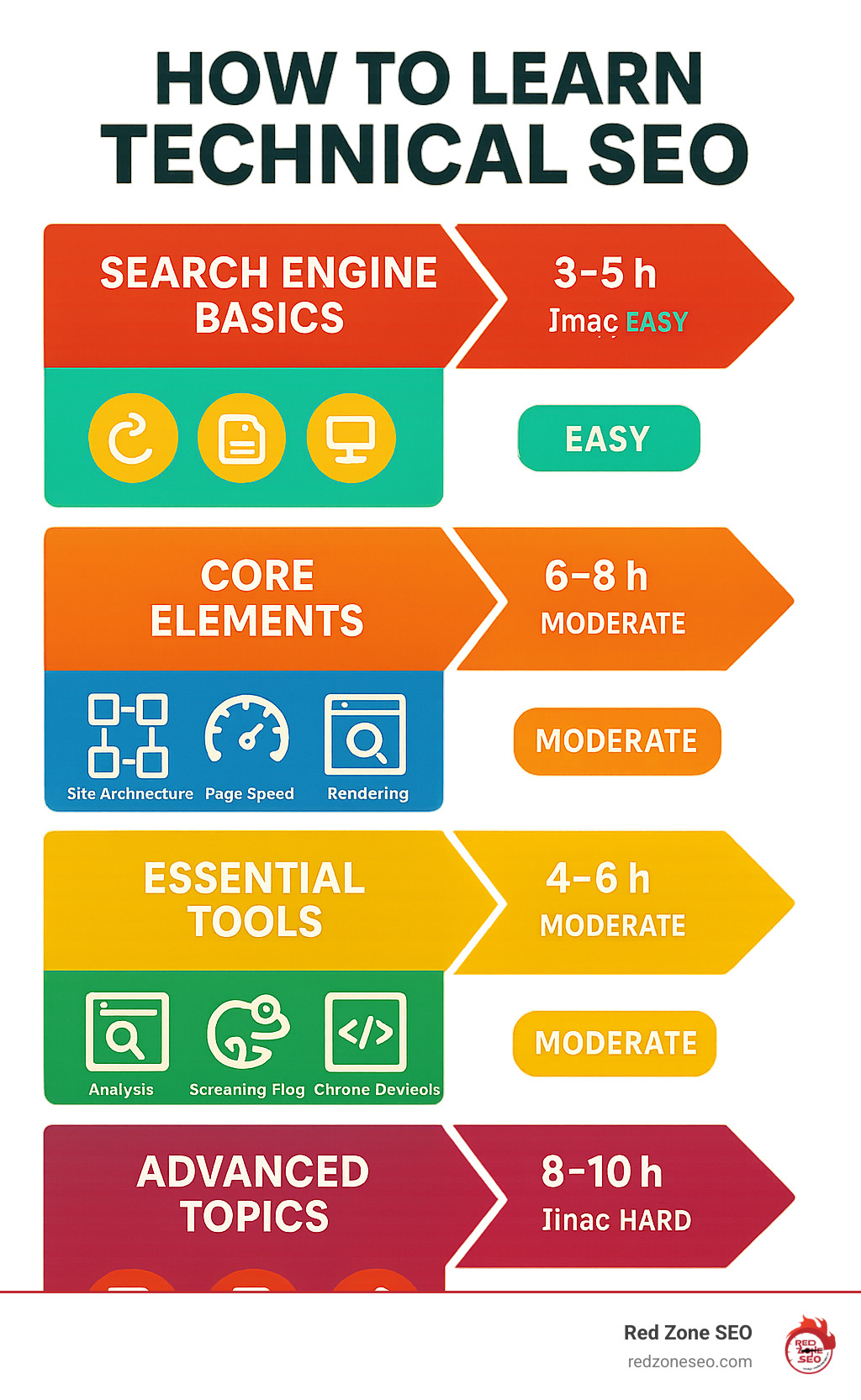
Relevant articles related to how to learn technical seo:
Technical SEO is the practice of optimizing your website's infrastructure and backend to ensure search engines can efficiently find, understand, and rank your content. It isn't directly about keywords or backlinks; it's about building a flawless foundation that allows your other SEO efforts to succeed. Without a technically sound website, even the most brilliant content and authoritative link profile may fail to achieve their ranking potential. As one expert bluntly states, "If your technical SEO is messed up? Then you're not going to rank."
The three core elements of technical SEO that you must master are:
Mastering these elements is non-negotiable for achieving and maintaining online visibility. For businesses that need to ensure this crucial foundation is expertly built, Red Zone SEO provides data-driven SEO services designed to drive measurable growth.
To fully appreciate how to learn technical SEO, it’s essential to understand its place within the broader SEO landscape. Search Engine Optimization is generally divided into three distinct but interconnected pillars:
| Pillar | Focus |
|---|---|
| Technical SEO | The website's foundation and infrastructure. This includes site speed, crawlability, security (HTTPS), indexing, site architecture, structured data, and mobile-friendliness. It's about making your site easy for search engines to process. |
| On-Page SEO | The content and HTML source code of your pages. This covers keyword research and implementation, content quality, title tags, meta descriptions, header tags (H1, H2s), image alt text, and user experience on the page. |
| Off-Page SEO | Your site's authority and reputation across the web. This is primarily built through backlinks from other reputable websites, but also includes brand mentions, social media signals, guest posting, and digital PR. |
Think of it like building a house: Technical SEO is the strong, stable foundation and framework. On-Page SEO is the interior design, room layout, and furnishings that make the house functional and appealing to live in. Off-Page SEO is the house's reputation in the neighborhood—the word-of-mouth recommendations and curb appeal that draw people to it. All three pillars must be strong and work in harmony for a stable, successful, and highly-visible online presence.
Learning how to learn technical SEO is a logical, systematic process. Once you understand the fundamental mechanics of how search engines interact with the billions of pages on the web, you can begin to build your skills layer by layer, from basic controls to advanced optimization strategies.

Before you can optimize a website, you must deeply understand the three-phase process that search engines like Google use to organize the world's information:
<a href=...> tags) on those pages to find new ones. It acts like a digital explorer, constantly navigating the web's pathways. If a page has no links pointing to it or is blocked from being crawled, it will remain invisible.For a comprehensive overview, review Google's official guide to how search works.
Next, you must learn how to use the specific tools and signals that control how search engines crawl and index your website. These are your primary levers for technical SEO.
yourdomain.com/robots.txt). It provides instructions to search engine bots about which parts of your site they should not crawl. It's primarily used to prevent access to non-public sections (like admin logins) and to help manage your crawl budget—the amount of resources a search engine will dedicate to crawling your site.<head> section of a specific page. They give page-level instructions. The most common are noindex, which tells Google not to add the page to its index, and nofollow, which tells Google not to follow any of the links on that page.rel="canonical" tag is an HTML element that solves duplicate content issues. When you have multiple URLs with the same or very similar content, the canonical tag tells search engines which version is the "master" or preferred one that should be indexed and ranked.A logical, well-organized site structure is crucial for both user experience and SEO. It helps search engines understand the relationship between your pages and helps distribute authority (or "link equity") throughout your site.
domain.com/services/service-a, also provides context./blog/how-to-learn-technical-seo is far more user-friendly and informative than a dynamic one like /articles.php?id=789123.With the fundamentals of crawling, indexing, and site structure in place, you can now focus on the specific technical elements that directly impact your search engine rankings and, just as importantly, your users' experience.
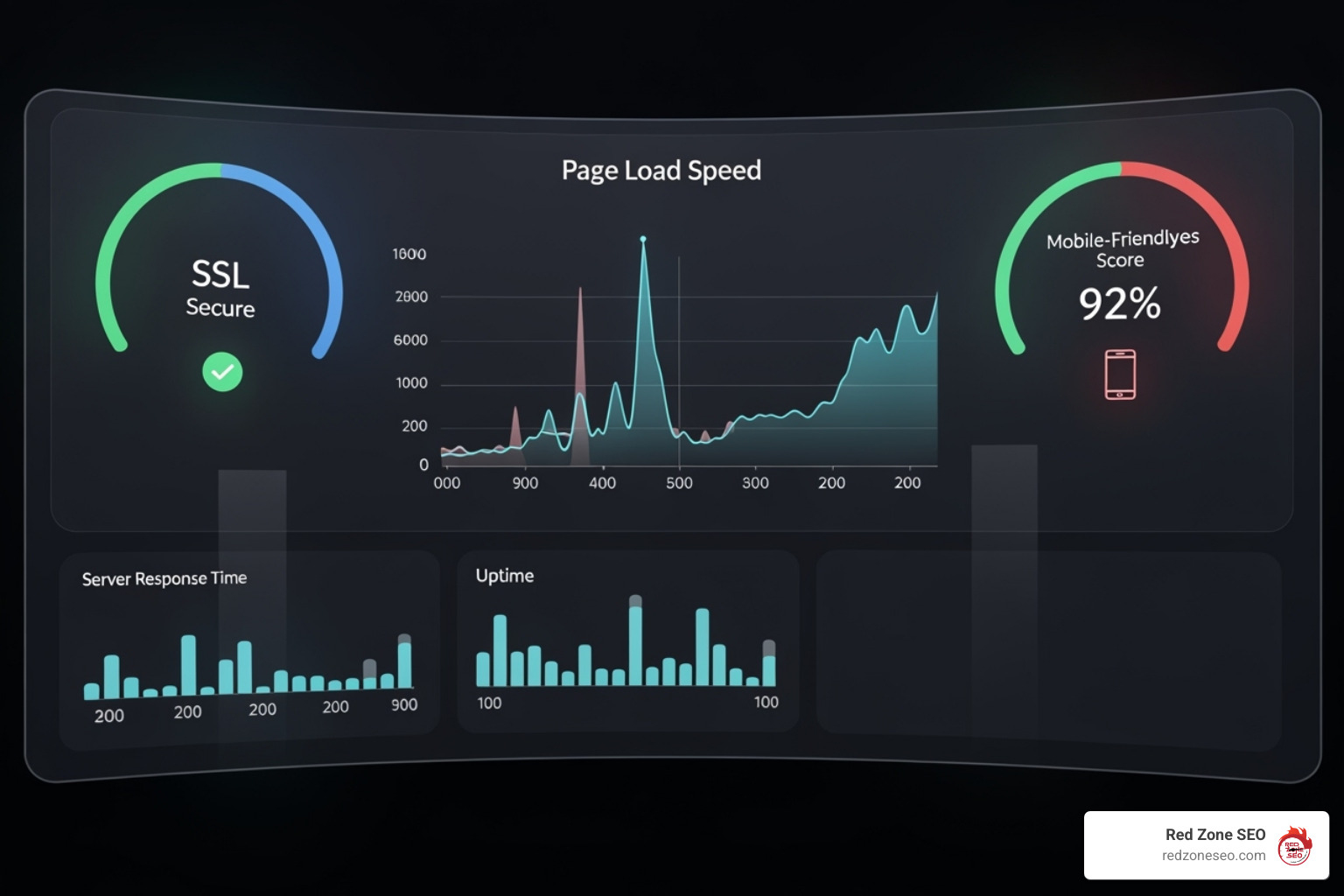
Page speed has been a confirmed Google ranking factor since 2010, and its importance has only grown. Google's Core Web Vitals (CWV) are a set of specific metrics designed to measure the real-world user experience of a page:
Use Google's PageSpeed Insights tool to diagnose issues. Common fixes include compressing images, using a Content Delivery Network (CDN), enabling browser caching, minifying CSS and JavaScript files, and reducing the impact of third-party scripts. A page's total size is often the biggest factor, so focus on reducing it without sacrificing quality.
Duplicate content occurs when the same or substantially similar content exists on multiple URLs. This confuses search engines, forcing them to choose which version to rank and diluting your ranking potential. It can arise from http vs. https versions, www vs. non-www URLs, or parameters used for tracking and filtering. Use the canonical tag (rel="canonical") to point Google to the single, preferred version you want to be indexed. For pages with very little value ("thin content") or pages you don't want in search results (like internal search pages), use the "noindex" tag. Tools like Screaming Frog or Copyscape can help you find instances of duplicate content on your own site and across the web. For more on creating valuable pages that avoid thin content issues, see our guide on content optimization.
Many modern websites rely heavily on JavaScript to create dynamic and interactive experiences. However, this can create challenges for SEO because content is often loaded after the initial HTML file. This can cause delays or, in worst-case scenarios, prevent search engines from seeing critical content and links. It's vital to understand the difference between rendering methods:
Use the URL Inspection Tool in Google Search Console or Chrome DevTools to inspect the rendered HTML and ensure all your important content and links are visible to Google.
Structured data, often implemented using the Schema.org vocabulary, is code you add to your HTML to help search engines understand the context of your content in a more sophisticated way. It's what powers the rich snippets you see in search results—features like star ratings for products, cooking times for recipes, and dropdowns for FAQs. Google prefers the JSON-LD format because it's easier to implement. Use markup that is relevant to your content (e.g., Product, LocalBusiness, Article, FAQPage) and always validate your implementation with Google's Rich Results Test. While structured data is not a direct ranking factor, it can significantly improve your visibility and click-through rates from the search results page.
Theory is important, but the most effective way for how to learn technical SEO is through hands-on practice. Performing a technical SEO audit is the single best way to apply your knowledge, understand how theoretical issues manifest on real websites, and learn how to prioritize fixes. An audit is a comprehensive health check for your website's technical foundation, designed to identify and resolve any issues that could be hindering its performance in search engines.
At Red Zone SEO, our SEO Audit services follow a systematic methodology to uncover critical roadblocks and opportunities for growth. You can use a similar, structured approach to guide your learning.
site:yourdomain.com search operator in Google to get a rough idea of how many pages are indexed. Compare this to the number of valid pages in your sitemap and the Coverage report in Google Search Console. Are there major discrepancies?Finding issues is only half the battle; getting them fixed is what counts. Effective communication with developers is a critical skill for any technical SEO. To build a productive relationship:
For the biggest and quickest impact, especially on a site that hasn't been optimized before, focus on these three areas:
There are different levels of proficiency. You can learn the fundamentals of how to learn technical SEO—what the core concepts are and why they matter—in a few months of dedicated study (e.g., 5-10 hours per week). Reaching proficiency, where you can confidently conduct an audit, diagnose common issues, and recommend solutions, typically takes 6 to 12 months of consistent learning and hands-on practice. Achieving true mastery is a continuous journey that takes years. The field is constantly evolving with Google updates, new technologies, and changing user behavior, so a commitment to ongoing learning is essential. Think of it like driving: you can learn the basics to get your license quickly, but becoming an expert driver who can handle any condition takes years of experience on the road.
No, you do not need to be a professional coder or developer. However, you do need to achieve a certain level of technical literacy. You should be comfortable reading HTML to identify key tags like titles, meta tags, canonicals, and links. You should understand the basics of how CSS styles a page and how JavaScript can add or change content. The goal is not to write the code yourself but to understand how it works so you can identify problems (e.g., "This important paragraph is loaded via JavaScript and may not be visible to Google") and communicate the required fix clearly to a developer.
Some of the best and most authoritative learning materials are completely free:
Learning how to learn technical SEO is a rewarding journey that empowers you to build and maintain the invisible, yet absolutely critical, foundation for online success. By moving from understanding the core mechanics of search engines to mastering key elements like site speed and architecture, and finally to auditing a site and collaborating effectively with developers, you gain a skill set that is essential for any modern marketing professional.
Mastery in this field is not a destination but a continuous process. It requires a commitment to ongoing learning and curiosity, as the digital landscape and search engine algorithms are in a constant state of flux. The most effective approach will always be a practical one: start auditing, get your hands dirty with the tools, find real issues, and learn by fixing them. Don't be afraid to experiment and make mistakes on a test site—it's a rite of passage for every skilled technical SEO.
While learning these skills yourself is incredibly valuable, executing a comprehensive technical SEO strategy at scale can be a significant challenge, requiring time, expertise, and resources that many businesses don't have in-house. For businesses ready to implement advanced strategies and achieve measurable, long-term growth, the expert team at Red Zone SEO can build the powerful technical foundation your website needs to thrive in competitive search results.
Our data-driven approach ensures that technical improvements are not just about checking boxes on a list, but about translating those fixes into more organic traffic, a better user experience, and ultimately, more customers for your business.
Get in touch with our Las Vegas SEO experts today!
In a digital world saturated with content, getting your message heard is tougher than ever. Every day, millions of blog posts, videos, and social media updates compete for a finite amount of audience attention. This overwhelming flood of information is the "digital noise" that drowns out most marketing messages. Authority building content is your solution—a strategic approach designed to lift your brand above the chaos. It is specialized, high-value content that positions you not just as a participant in your industry, but as a trusted expert and leader. It achieves this by demonstrating deep knowledge, providing unique, actionable insights, and backing every claim with solid, verifiable evidence. Unlike standard blog posts that chase fleeting traffic spikes, authority content is an investment in building long-term credibility that methodically turns curious browsers into confident buyers.
This type of content is carefully crafted around several key components:
Standard content competes for attention; authority content earns it. This distinction is critical for any business serious about growth. When you establish authority, you change the dynamic of the buyer's journey. Instead of you chasing them, they seek you out. The data supports this: research consistently shows that a majority of B2B decision-makers, with some studies citing as high as 54% of companies, made a purchase after engaging with thought leadership content. When you establish authority, people don't just read your content—they trust it, they share it, and they act on it.
This strategic shift also has a profound impact on your visibility in search engines. Google's core mission is to provide users with the most helpful and reliable answers to their queries. By creating in-depth, valuable content that demonstrates expertise and trustworthiness, you directly align your marketing with Google's objectives. This signals to both algorithms and customers that you are the go-to source in your field. In an era defined by short attention spans and widespread skepticism, authority content builds the foundational trust needed to create meaningful connections, foster loyalty, and drive sustainable business growth.
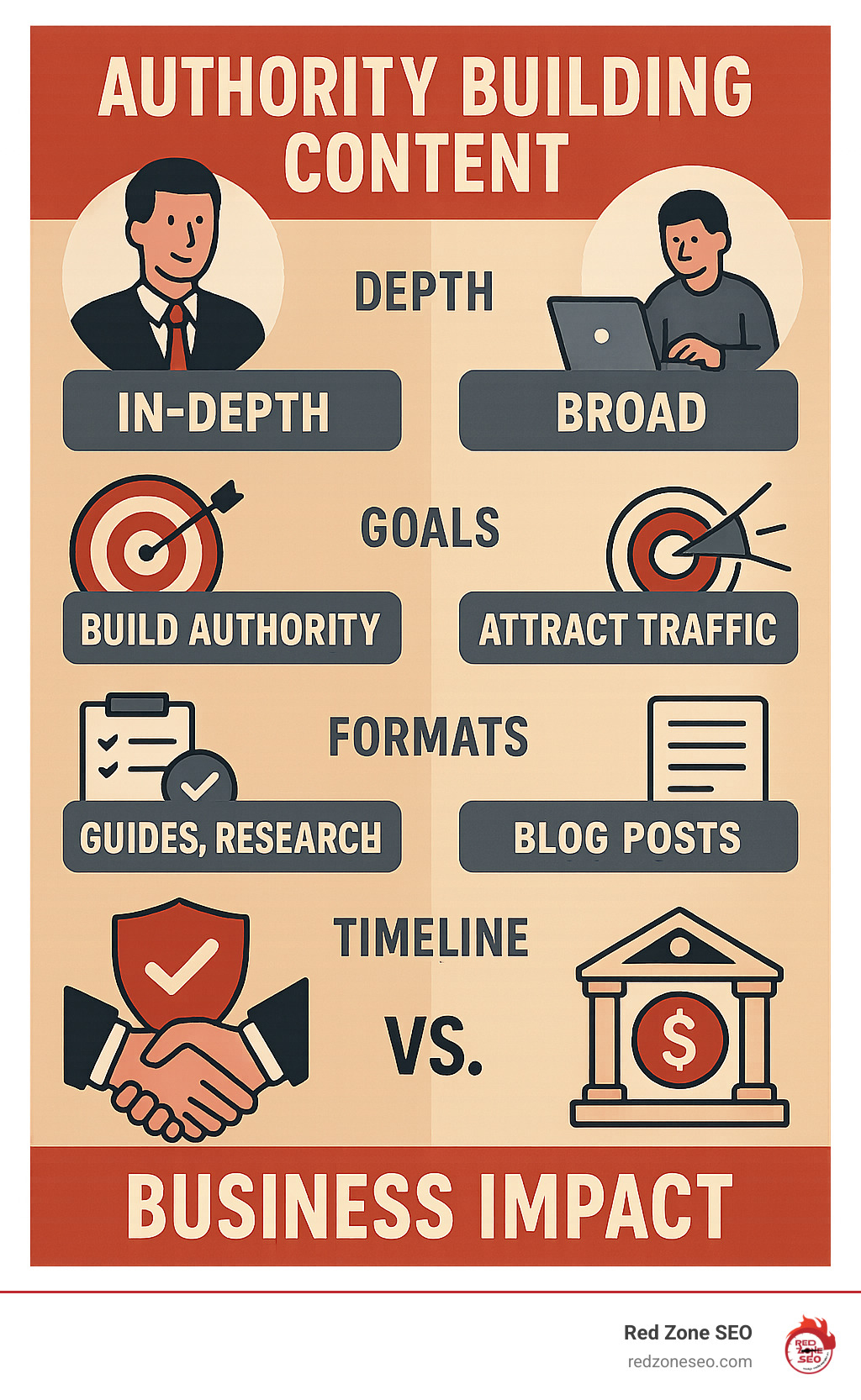
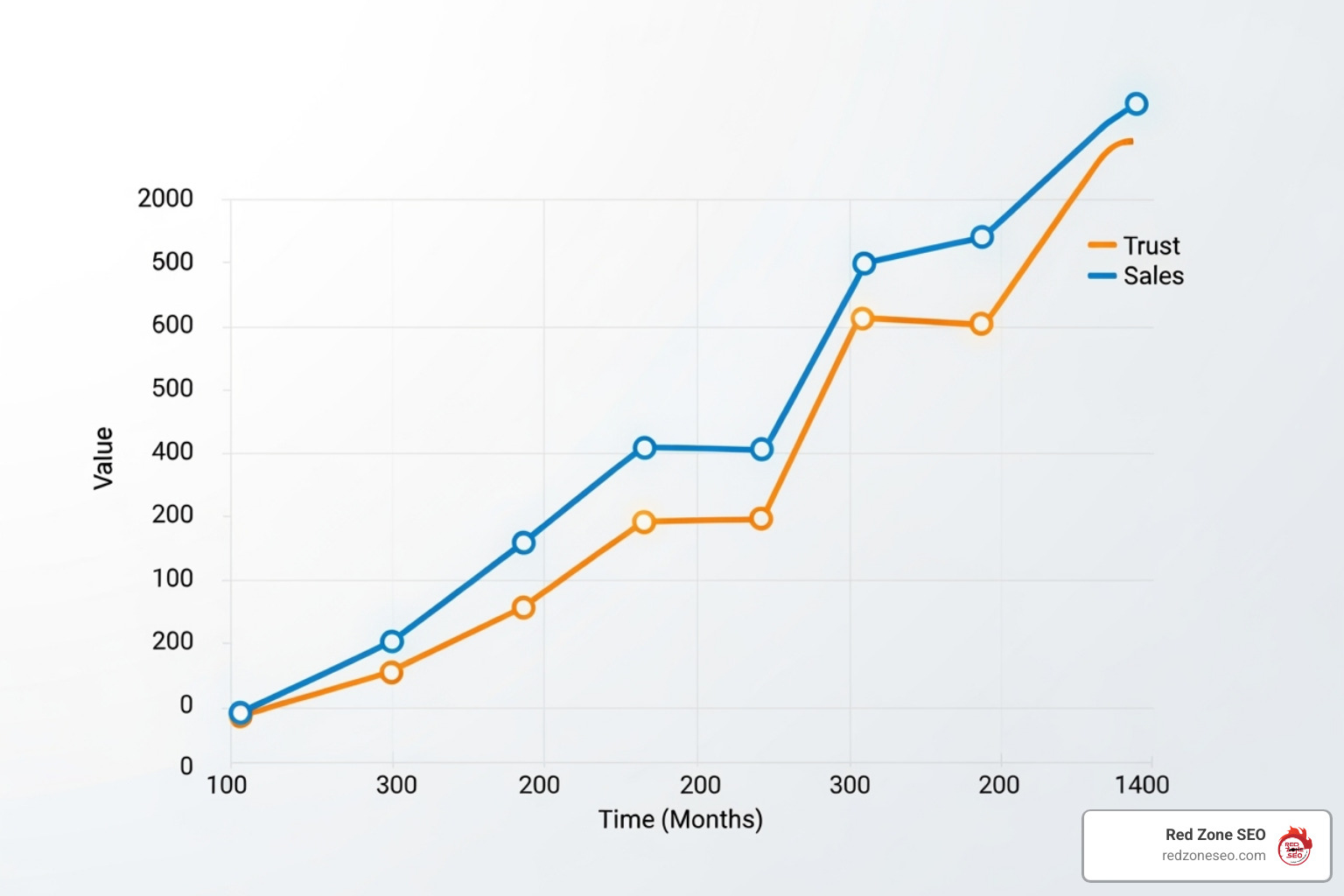
Think of authority building content as your business's lighthouse in a stormy digital sea. It's the carefully researched, consistently accurate, and genuinely helpful content that serves as a guide, guiding your ideal customers through the fog of online information directly to your expertise. When you commit to consistently delivering valuable insights, you earn a level of trust that translates directly into tangible business results. This trust is a powerful asset that improves brand credibility, fosters unwavering customer loyalty, dramatically improves search engine rankings, and generates a steady stream of high-quality, pre-qualified leads. Prospects who have already learned from you and benefited from your expertise arrive with built-in confidence in your capabilities. This fundamentally changes the sales conversation, leading to shorter sales cycles, higher conversion rates, and a clear, defensible differentiation from competitors who are still focused on shouting about features and prices. The research confirms this unequivocally: a landmark study by Edelman and LinkedIn found that 54% of B2B buyers make purchasing decisions based on the authority demonstrated through content.
Many businesses fall into the trap of approaching content marketing as a numbers game, publishing a high volume of quick blog posts on trending topics in the hope of generating immediate traffic. While this strategy might produce occasional short-term gains, it rarely builds lasting value or a defensible brand asset. Authority building content takes a fundamentally different approach, prioritizing the cultivation of long-term trust and unshakeable credibility over the pursuit of fleeting traffic spikes.
Standard content often skims the surface, providing a quick overview or a list of tips without much context. Authority content, in contrast, dives deep. It explores the "why" and the "how" in exhaustive detail, providing comprehensive answers that leave the reader feeling truly informed and empowered. A standard post might list "5 Tips for Better SEO," while an authority piece would be titled "The Definitive Guide to On-Page SEO in 2024," complete with detailed explanations, examples, and data. While standard posts on trending topics can become outdated within weeks, evergreen authority content is designed for longevity, remaining a valuable asset that attracts, educates, and converts readers for years to come.
| Metric | Authority Building Content | Regular Blog Posts |
|---|---|---|
| Depth | Comprehensive, in-depth, covers all facets of a topic | Often surface-level, covers many topics briefly |
| Goal | Establish expertise, build trust, long-term influence | Drive traffic, immediate engagement, general awareness |
| Typical Format | Long-form articles, white papers, case studies, pillar pages | Shorter articles, news updates, listicles |
| Focus | Empowering audience, unique insights, problem-solving | Information dissemination, trending topics |
| Longevity | Evergreen, consistently valuable | Often timely, can quickly become outdated |
| Impact | Builds brand authority, deep relationships, high-quality leads | Increases visibility, drives short-term traffic |
Authority building content is arguably the most powerful SEO asset a business can develop. While Google's algorithm undergoes hundreds of changes a year, its core preference for content that demonstrates real expertise, authoritativeness, and trustworthiness remains constant. When your website consistently publishes comprehensive, high-quality content on a specific set of topics, you build topical authority. This signals to search engines that you are not just a casual commentator but a definitive, reliable source for that subject matter.
This strategy directly aligns with Google's rigorous E-E-A-T guidelines, which stand for Experience, Expertise, Authoritativeness, and Trustworthiness. Authority content inherently showcases these qualities. Furthermore, truly high-quality authority content naturally attracts backlinks from other reputable sites—journalists, industry bloggers, and academic institutions—that want to reference your work as a source. Each of these backlinks acts as a vote of confidence, further bolstering your site's authority in the eyes of Google. Positive user engagement signals—such as longer time on page, lower bounce rates, and higher click-through rates—also send a powerful message to Google that your content is satisfying searcher intent. This creates a virtuous cycle, a powerful SEO flywheel: great content earns backlinks and high engagement, which boosts your authority and rankings, which in turn drives even more traffic to your expert content. For any business serious about achieving and maintaining long-term SEO success, this strategic approach is not just beneficial; it's essential. To learn more about developing effective SEO content strategies that incorporate these principles, check out our detailed guide on SEO Content Strategies.

To build true authority, your content must be constructed upon three unshakeable pillars: Expertise, Evidence, and Experience. These foundational elements are what separate genuinely authoritative content from the vast sea of generic, forgettable information flooding the internet. When you consciously and consistently master the integration of these pillars into every piece of content you create, you transform your website from a simple digital brochure into a trusted resource that turns casual readers into loyal, lifelong customers.
Anyone can claim to be an expert; true authorities prove it through their work. The key principle here is to show, don't tell. Instead of littering your content with self-congratulatory statements about your expertise, you must demonstrate it with in-depth analysis that goes far beyond surface-level facts. This means breaking down complex topics into their constituent parts, clearly explaining the "why" behind your recommendations, and sharing unique insights gleaned from your specific vantage point. A powerful strategy for demonstrating expertise is niche specialization. It is far better to be the undisputed, go-to expert on a narrow topic like "SEO for local plumbers" than to be just another generalist talking about "digital marketing." This focus allows you to achieve a depth of knowledge that is impossible for broader competitors. By confidently and comprehensively answering the difficult, nuanced questions that others in your space avoid, you prove your knowledge beyond a doubt and become the definitive resource your audience actively seeks. To uncover these critical questions your audience is asking, you need a robust strategy for Keyword Research.
Expertise without proof is merely opinion, and in an online world rife with misinformation, opinions are cheap. Hard evidence is the currency of trust. It's what transforms your assertions from vague statements into powerful, undeniable facts. You can achieve this by weaving statistics and data from credible sources throughout your content. Citing reputable third-party sources, such as industry reports, academic studies, or government data, allows you to borrow their established authority to strengthen your own. Case studies are particularly potent, as they offer concrete, narrative proof of your ability to deliver real-world results. For instance, showing exactly how you helped a client increase their organic traffic by 150% with a detailed breakdown of the process is infinitely more compelling than simply claiming you can improve SEO. Other forms of evidence include original research (like conducting your own industry survey), data visualization through charts and infographics to make complex data digestible, glowing customer testimonials, and quotes from other recognized experts in your field. When you build a strong case supported by a variety of evidence, you make skepticism nearly impossible and build a foundation of trust with your audience. Our Content Optimization services can help ensure your evidence is presented for maximum clarity and impact.
While expertise and evidence provide the logical foundation for your authority, it is your unique experience and perspective that create the emotional connection necessary to build a loyal, engaged following. This is where you move beyond the data and transform dry information into engaging, memorable storytelling. Use personal anecdotes and brand stories to illustrate your points, making your content more relatable and human. Don't be afraid to share lessons learned from past failures; this vulnerability and authenticity can build tremendous trust and rapport with your audience. A crucial element here is developing a distinct brand voice and a unique "content tilt"—the specific, consistent lens through which you view your industry's challenges and opportunities. Is your voice witty and irreverent, or academic and serious? Is your tilt focused on sustainability, small business empowerment, or cutting-edge technology? This unique perspective is what makes your content instantly recognizable and uniquely valuable in a crowded marketplace. The goal is to empower your audience. When you shift your focus from selling your services to genuinely helping them succeed, you transcend the role of a mere vendor and become a true, indispensable partner in their journey.
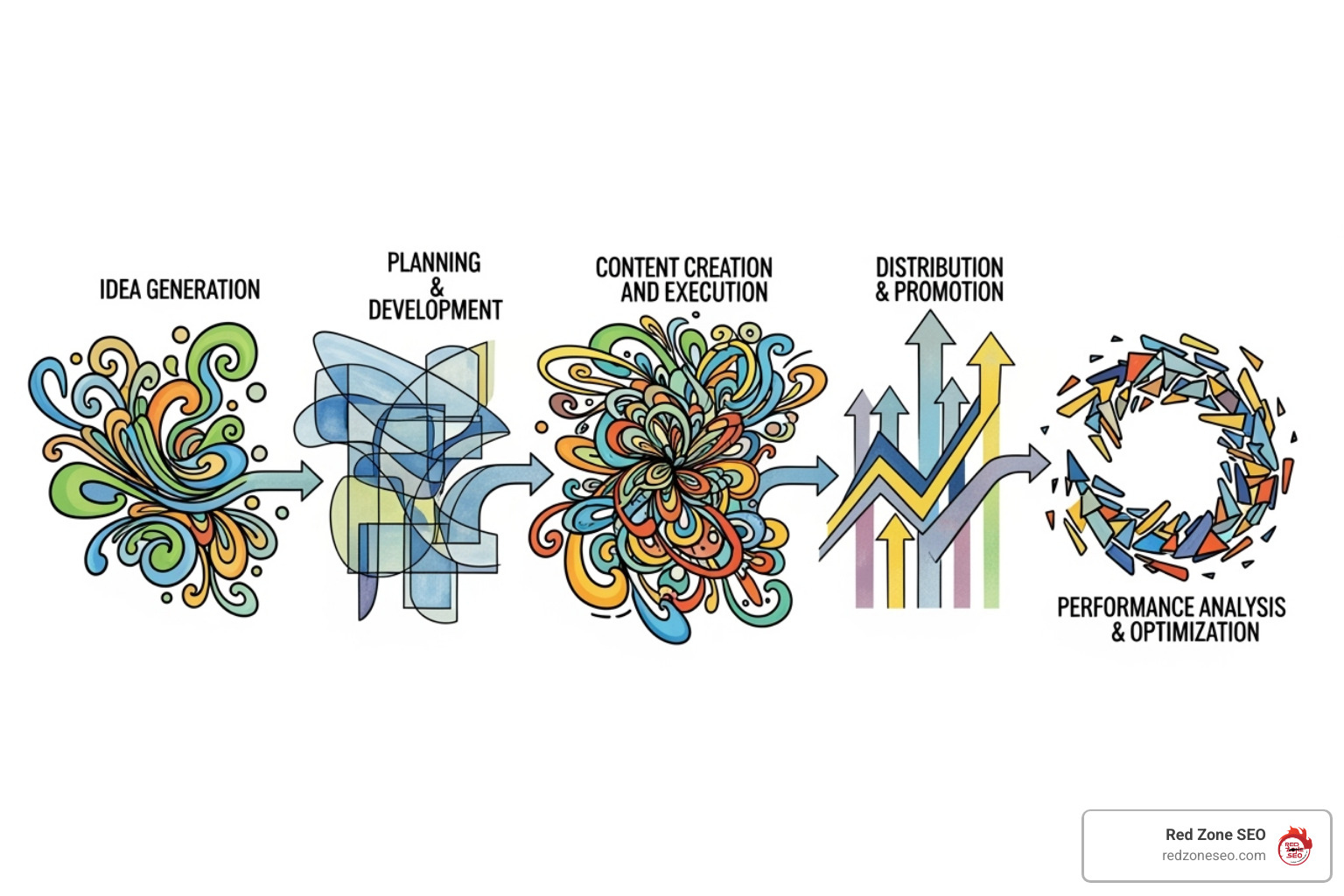
Building authority isn't an accident; it requires a deliberate, strategic approach, not scattered, random acts of content. This blueprint will guide you through a systematic process, from initial idea to measurable impact, ensuring that every piece of authority building content you produce serves a clear and strategic purpose. A well-executed plan transforms your content from a simple marketing expense into a powerful, lead-generating asset—a magnet for your ideal customers that builds the deep trust necessary to convert casual browsers into committed buyers.
Before you write a single word, you must achieve absolute clarity on who you're talking to and what specific problem you are uniquely positioned to solve for them. Avoid the temptation to cast a wide net. Instead of a broad topic like "digital marketing," laser-focus on a specific niche where you can realistically become the leading expert, such as "content marketing strategies for B2B SaaS startups" or "SEO for family-owned restaurants." This specificity makes every subsequent content decision simpler and more effective. Next, go beyond basic demographics to develop a profound understanding of your audience's world. Create detailed buyer personas that feel like real people, documenting not just their job titles but their deepest pain points, aspirations, daily frustrations, and primary goals. What keeps them up at night? What does success look like for them? Use tools like AnswerThePublic, Quora, and Reddit forums to find the exact questions they're typing into search engines. Finally, conduct a thorough competitive content analysis. Identify the top-ranking content for your target topics and look for gaps. What questions have they failed to answer? Where is their advice superficial? Your opportunity lies in filling those gaps with superior, more comprehensive value. This targeted, empathetic approach is the non-negotiable foundation for creating content that truly resonates. For businesses looking to master this crucial first step, our insights on SEO for Small Business can provide a targeted framework.
To demonstrate comprehensive authority to both users and search engines, you must structure your content strategically. The pillar and cluster model is the gold standard for this. Pillar pages are massive, comprehensive, long-form guides (often 3,000+ words) that act as the ultimate, one-stop resource on a broad topic within your niche. For example, an HVAC company might create a pillar page titled "The Complete Guide to Commercial HVAC Maintenance." This page would cover every major aspect of the topic at a high level.
Topic clusters are a series of more specific, shorter articles that dive deep into individual subtopics mentioned in the pillar page. For our HVAC example, cluster topics might include "5 Warning Signs Your Commercial HVAC System Needs Attention," "How to Choose the Right HVAC Filter," and "Calculating HVAC Tonnage for Your Commercial Space." Crucially, each of these cluster articles links back up to the main pillar page. This creates a dense web of internal links centered around your core topic, which signals immense topical authority to search engines and improves the user experience by making it easy for readers to find related information. If you prefer a distribution-first framework for atomizing long-form content into platform-specific assets, you might also consider the GaryVee Content Model, which focuses on repurposing a single pillar piece into dozens of smaller assets. Long-form pillar content also naturally attracts more traffic, social shares, and high-quality backlinks, making your pillar pages your most powerful SEO assets. Strategic internal and external linking is crucial, and our Link Building Services can help build the authoritative profile needed to support your content strategy.
Brilliant content is utterly useless if it never reaches your intended audience. A multi-format production and distribution plan maximizes your reach and caters to different learning preferences. Long-form articles, white papers, and ebooks should form the backbone of your strategy, as they are perfect for demonstrating deep expertise and serving as valuable lead magnets to capture contact information. However, don't stop at text. Video marketing, whether through short-form tutorials or in-depth explainers, builds trust and human connection far faster than text alone. Podcasts and webinars offer a platform for deeper engagement, expert interviews, and live Q&A sessions, positioning you as a central figure in your industry. And case studies are absolutely essential for providing concrete proof of your results, masterfully combining data-driven evidence with compelling storytelling.
Your distribution strategy is just as important as your production plan. Don't just publish and pray. Use email marketing to nurture your existing audience directly, delivering your best content straight to their inbox. Leverage social media to amplify your reach and engage in conversations around your topics. Consider guest blogging on reputable industry sites to tap into new audiences and build valuable backlinks. The key to all of this is consistency. Authorities show up regularly and reliably with valuable content, reinforcing their position as a trustworthy source. Create a content calendar and stick to it.
Ongoing measurement and optimization are what separate good content strategies from great ones. You must track key performance indicators (KPIs) to understand what's working, what isn't, and where to focus your efforts for improvement. Monitor website traffic, paying special attention to organic traffic growth for your pillar pages and topic clusters. Track search rankings for your primary and secondary keywords to see if your authority is tangibly growing in the eyes of Google. A critical indicator of true authority is backlink growth; use tools to monitor how many new, high-quality sites are linking to your content. Analyze on-page user engagement signals like time on page, scroll depth, and social shares to gauge whether your content is truly resonating with your audience. Finally, and most importantly, measure lead quality and conversion rates originating from your content. These are often significantly higher than from other marketing channels. Use tools like Google Analytics and Google Search Console to gather this data, but don't just collect it. Use the insights to continuously learn, adapt, and improve your strategy over time. A regular, comprehensive SEO Audit can provide a holistic analysis of your performance and help refine your strategy for maximum long-term impact.
One of the fastest ways to master any skill is to study those who have already achieved excellence. By analyzing brands that have successfully mastered authority building content—and, just as importantly, those who have stumbled along the way—you can gain invaluable insights and fast-track your own path to success. Learning from their victories and their mistakes can help you build a more resilient and effective strategy from day one.
Some companies have so effectively executed this strategy that they have become synonymous with expertise in their respective fields, building massive businesses on the back of their content.
These brands all succeeded because they prioritized authentic helpfulness over aggressive selling and chose to go deep in their niche rather than wide, becoming the definitive, indispensable resource.
Even well-intentioned businesses can inadvertently derail their authority-building efforts with a few common missteps. Be vigilant and avoid these traps to ensure your content effectively builds trust and credibility.
The journey through the principles and practices of authority building content reveals a powerful and enduring truth: this is not just another marketing tactic to be added to your checklist. It is the very foundation for building lasting, trust-based business relationships and achieving sustainable, long-term growth. It represents a strategic choice to be the clear, trusted voice your audience seeks for real solutions, rather than contributing another shout to the deafening roar of the digital crowd.
By carefully constructing your content on the three pillars of Expertise, Evidence, and Experience, you create something that is not only informative but also memorable, relatable, and genuinely valuable. This reader-centric approach does more than just generate traffic; it transforms skeptical browsers into confident buyers and satisfied customers into passionate brand advocates. Authority is not a short-term campaign; it is a long-term asset that compounds over time, working tirelessly to attract high-quality leads, improve your reputation, and build your brand 24/7, long after the content is published.
The strategic blueprint we've outlined provides a clear roadmap, but true success requires unwavering commitment. The brands that win with authority content, as we've seen, do so through patience, consistency, and an unwavering focus on making their audience more successful. When trust is the ultimate currency, authentic, generously shared expertise is the most valuable commodity you can offer.
At Red Zone SEO, we have witnessed how this strategic shift can transform businesses, elevating them from obscurity to industry leadership. We specialize in helping companies cut through the noise by identifying and packaging their unique expertise in ways that search engines love and audiences trust. Your hard-won expertise has immense value, and your audience is actively searching for a guide they can depend on. The only remaining question is whether you're ready to share it strategically and reap the rewards.
The digital landscape will undoubtedly continue to evolve, but the fundamental human need for trustworthy guidance is constant and unchanging. By committing to authority building content, you are not just future-proofing your marketing; you are building a timeless, invaluable asset for your brand.
Ready to transform your content strategy and become the trusted voice in your industry? Learn more about our Content Marketing for Small Businesses services and find how we can help you build the authority your business deserves.
SEO data analysis is the process of collecting, interpreting, and acting on your website's search engine performance data to improve rankings, traffic, and conversions. Instead of guessing what works, you use real data to make smart decisions about your SEO strategy.
Quick Answer: SEO Data Analysis Essentials
Search engines constantly update their algorithms, and your competitors are always optimizing. Without analyzing your SEO data, you're flying blind in a fast-changing landscape. Think of it as your website's health checkup—it shows you what's working, what's broken, and where your biggest opportunities are hidden.
As Neil Patel says, "Without analytics, you are flying blind." Your website generates tons of valuable data every day. The question is: are you using it to grow your business?
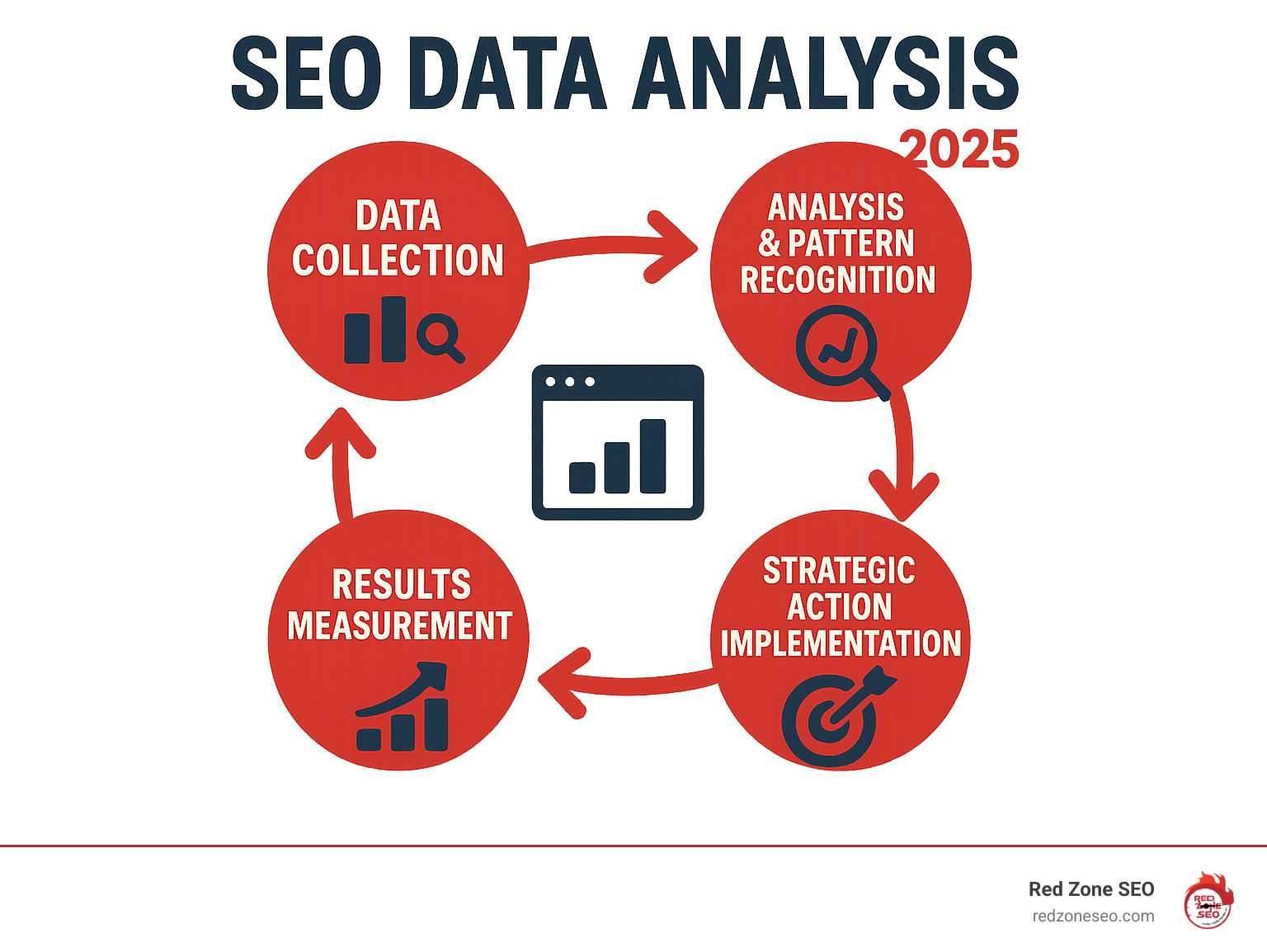
Think of SEO data analysis as a conversation with your website. Every click and search query tells you what your visitors want and how well you're delivering it. SEO analytics is the digital detective work of collecting clues from search engines, piecing together user behavior patterns, and using those insights to make your website more visible and valuable.
Why is this essential for your business growth?
Companies that succeed online treat data as a competitive advantage. More info about our data-driven SEO strategies shows how we turn insights into growth for our clients.
Effective SEO data analysis isn't about collecting more data—it's about collecting the right data. Your business goals should determine which metrics you track.
Your website's technical foundation is critical. If search engines can't find, crawl, or understand your site, your content strategy won't matter. Monitoring site health ensures your SEO efforts have the best chance to succeed.
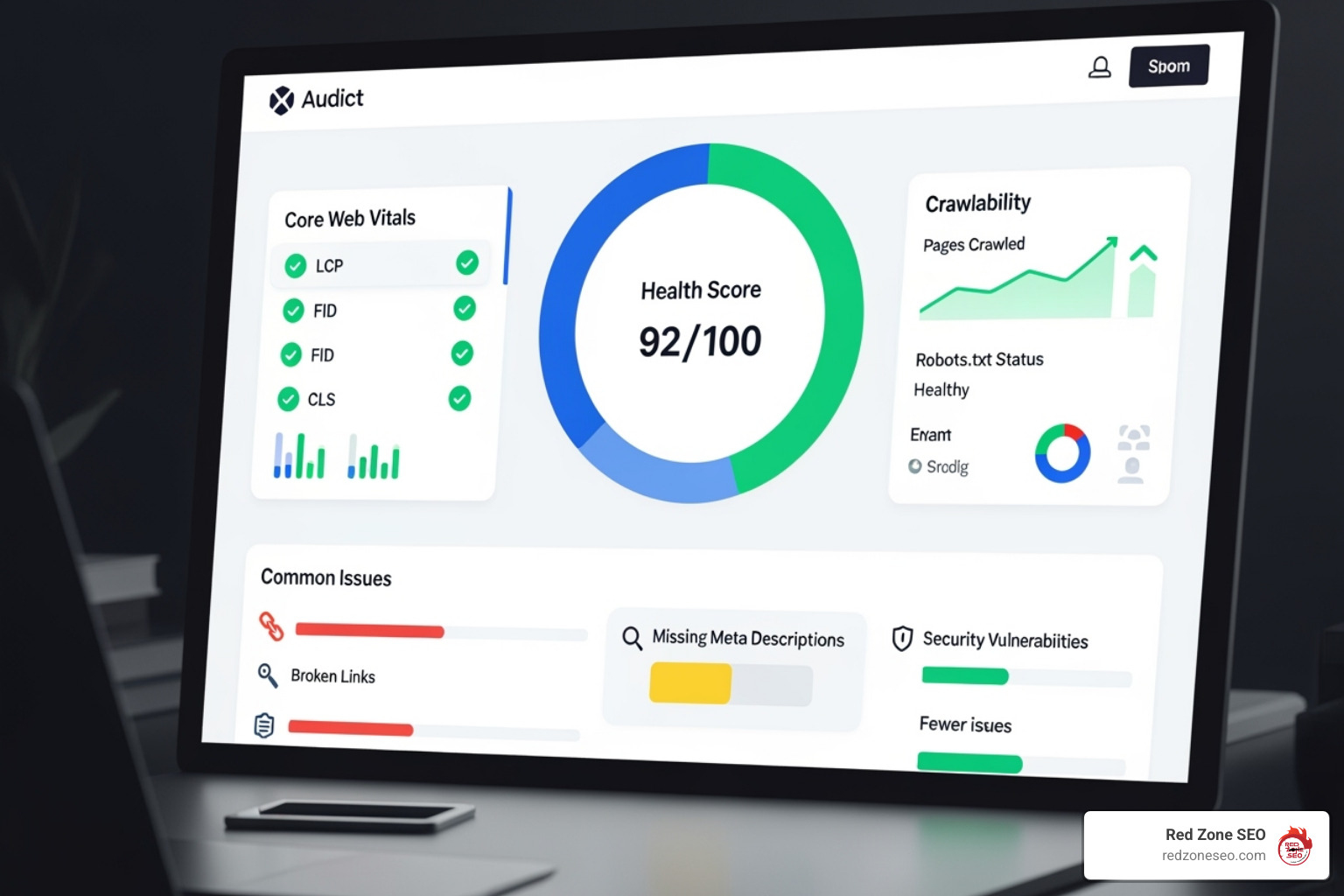
Key areas we monitor:
Regular site health monitoring prevents minor technical issues from becoming major ranking problems. More info about technical SEO audits shows our comprehensive approach.
To master SEO data analysis, you need the right tools. They allow us to track, troubleshoot, and significantly improve your site's search performance. The real power comes from integrating data from multiple sources into a unified view, which helps us spot trends and opportunities.
Automating data collection is key. It frees up valuable time from manual reporting, allowing us to focus on what truly matters: analyzing insights and implementing strategies that drive growth. How Red Zone SEO integrates data for clients.
Google's free tools are the foundation of any solid SEO data analysis strategy.
Google Search Console (GSC) for pre-click data
GSC is our window into how Google sees your site. It provides crucial pre-click data, including impressions, clicks, click-through rate (CTR), and average ranking position. We use it to understand your visibility in search results and identify technical issues like indexing errors.
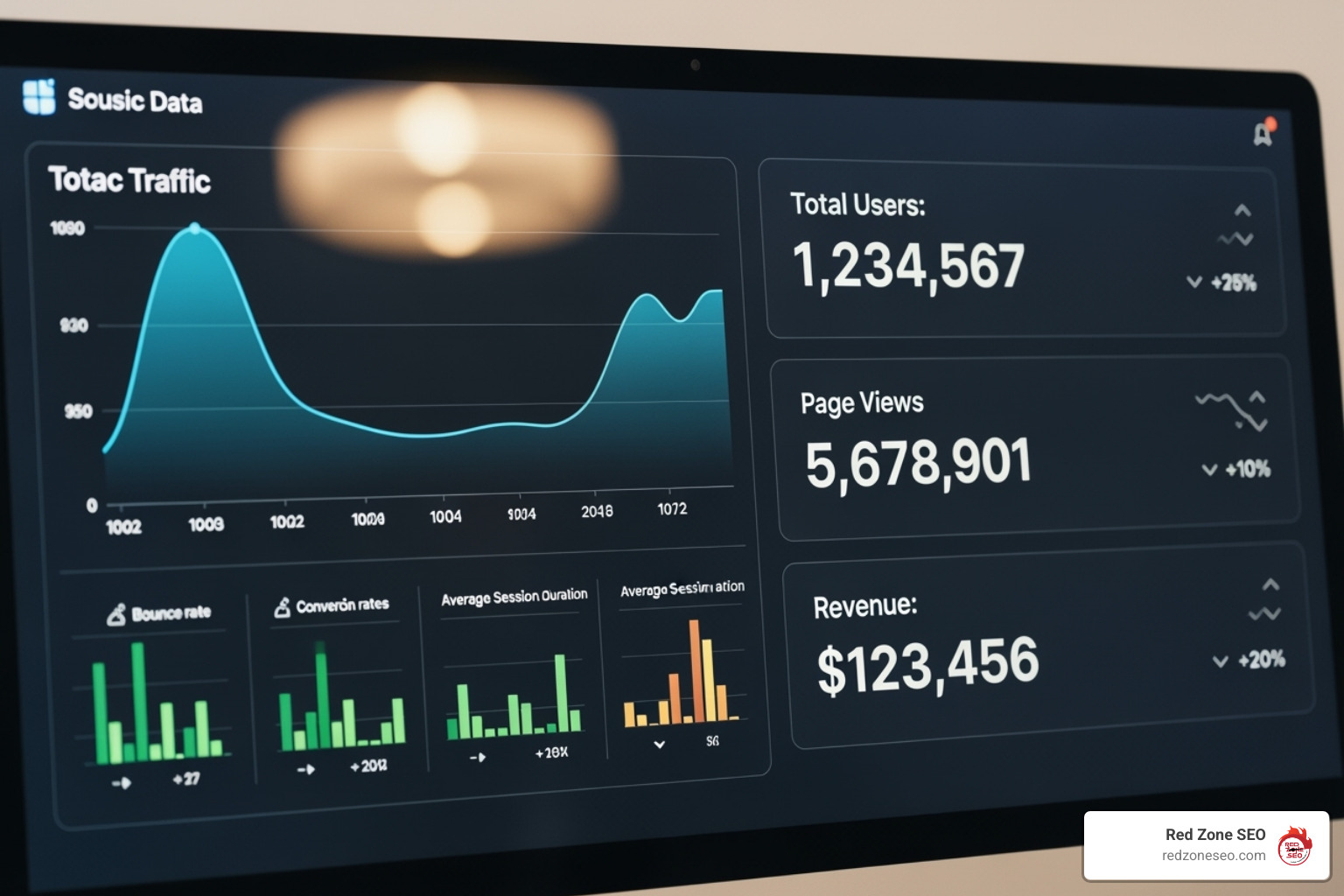
One of our favorite GSC tactics is finding keywords with high impressions but low CTR. Improving the page titles and meta descriptions for these terms can deliver a quick and significant traffic boost.
Google Analytics 4 (GA4) for post-click data
While GSC shows how users find you, GA4 reveals what they do after they arrive. This powerful tool provides deep insights into user behavior, engagement, and conversions. We use it to track metrics like average engagement time and, most importantly, to measure how organic traffic contributes to your business goals, such as form submissions or sales. More info about Google Analytics.
While Google's tools are essential, paid SEO platforms are necessary to outmaneuver the competition. They offer a level of depth, automation, and competitive intelligence that free tools can't match.
Advanced tools like Ahrefs and Semrush provide:
Here's a comparison of free versus paid tools:
| Feature/Tool Category | Free Tools (GSC, GA4, Bing Webmaster Tools, SEOQuake) | Paid Tools (Ahrefs, Semrush, Moz, Screaming Frog, SpyFu, etc.) -|
| Keyword Research | Basic keyword performance data (your site only). | Advanced keyword research, difficulty scores, and competitor keyword analysis. -|
| Backlink Analysis | Limited view of incoming links. | Comprehensive backlink profiles, authority metrics (DA/DR), and competitor link analysis. -|
| Competitor Analysis | Almost none. | In-depth analysis of competitor strategies, keyword gaps, and backlink sources. -|
| Technical SEO Audit | Basic error reporting (e.g., crawl errors in GSC). | Comprehensive site audits that identify hundreds of potential technical issues, from broken links to hreflang errors. -|
| Content Optimization | Manual analysis of content performance in GA4. | AI-powered content editors that provide real-time suggestions for improving on-page SEO and readability. -|
Collecting data is just the first step. The real value of SEO data analysis comes from turning those insights into concrete actions that improve performance. This is where we move from observation to optimization.
Turning Insights into Action
Data eliminates the guesswork. Instead of wondering what to do next, we follow a systematic process: measure what matters, analyze the patterns, report the findings, and take decisive action. This approach allows us to prioritize SEO tasks based on their potential impact. We focus on fixing the critical "red flags" first—like site-wide technical errors—that deliver the biggest return on effort.
A/B Testing and Continuous Improvement
SEO isn't about making a change and hoping for the best. We use A/B testing to validate our strategies, experimenting with different page titles, content variations, or calls-to-action to see what truly works. By measuring the results in tools like Google Search Console, we create a continuous feedback loop: implement, measure, analyze, and refine. This iterative process keeps your website ahead of algorithm updates and competitive pressures.
A sudden drop in rankings can be alarming, but a data-driven approach allows us to diagnose the cause methodically. Common culprits include:
We use GSC's URL Inspection Tool to get a direct look at how Google sees a specific page, identifying any crawling or indexing errors that might be holding it back. More info about the URL Inspection Tool.
Data is only useful if it's understood. We translate complex analytics into clear, compelling stories that stakeholders can act on.
Our goal is to make SEO data accessible and actionable, empowering you to make confident decisions about your digital marketing. More info about our Las Vegas digital marketing agency services.
Here are answers to some of the most common questions we receive about SEO data analysis.
The ideal frequency depends on your goals, but a consistent schedule is key.
Think of it as the difference between your home's interior design and its neighborhood reputation.
On-Page Data refers to everything on your website that you control directly. This includes content quality, keyword performance, technical health (like site speed), and user engagement metrics (like time on page). It's about how well your site is built and optimized for users and search engines.
Off-Page Data reflects your website's authority and reputation across the web. This is primarily about your backlink profile—who links to you and the quality of those links. It also includes brand mentions and social signals, which act as external votes of confidence.
A successful SEO strategy requires optimizing both. Great on-page SEO makes your site worthy of earning high-quality backlinks, and a strong off-page profile boosts the visibility of your well-optimized content.
This is where SEO data analysis directly impacts your bottom line. It's not just about traffic; it's about turning visitors into customers.
Flying blind isn't an option. SEO data analysis is the process of changing raw website data into a powerful growth engine, providing the clear insights needed to make strategic, impactful decisions.
The core principle is a continuous improvement cycle: Collect data, analyze patterns, take action, and measure results. Every click, ranking change, and user interaction tells a story. The businesses that thrive are those that listen to what their data is saying and use it to their advantage.
At Red Zone SEO, we've seen how data-driven decision-making can transform a business's online presence. Whether it's uncovering keyword gaps in Austin, fixing site speed issues in Henderson, or outmaneuvering competitors in Las Vegas, data provides the roadmap for success.
Your website is constantly generating valuable information. By embracing SEO data analysis, you can move beyond guesswork and make confident, purposeful decisions that lead to sustainable growth and measurable results.
Contact our Las Vegas SEO experts to open up your website's potential.